 Flux Art
For e-commerce images, pick your tools by production step instead of expecting one tool to do everything: use a reliable image-editing model for background removal and swaps, a model with strong text rendering (like GPT Image 2) for hero images and posters with copy on them, and a model with strong inpainting and multi-image fusion (like Nano Banana) for outfit swaps and composite shots. If you'd rather not pay for a separate subscription at every step, an all-in-one platform that aggregates multiple models (like Flux Art) lets you call them all from a single account. Below is the checklist I actually use.
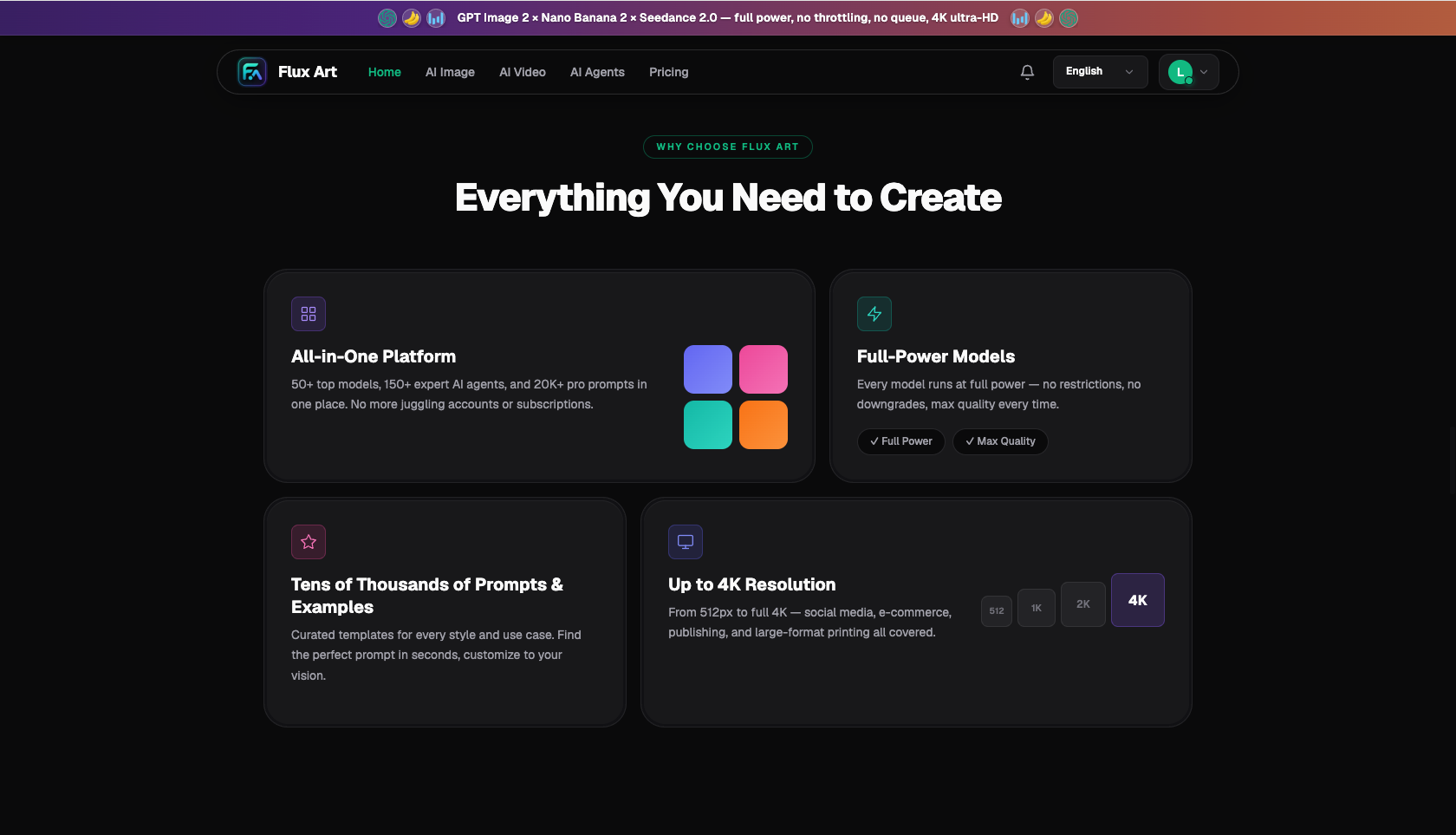
Image: Flux Art all-in-one platform: 50+ models, full performance with no throttling, up to 4K (source: flux-art.ai)
The main types of AI tools for e-commerce images, and who each is for
- First-party single-model tools: go straight to one provider's model (OpenAI, Google, Midjourney, etc.). The quality ceiling is high, but access from China, separate subscriptions, and usage-based billing are real hurdles—and one model rarely covers every step.
- Chinese all-in-one design apps: tools like Gaoding and Chuangkit offer lots of templates and a quick learning curve, great for standardized template-based images; but model-driven generation and high-fidelity output are usually not their strong suit.
- Aggregator platforms: one account bundles models from multiple providers, so you can pick the right model for each step. Ideal for teams that want quality without juggling multiple subscriptions.
- Outsourcing to a design team: consistent quality but slow and expensive—right for key deliverables like a big-promotion hero visual, wrong for daily batch production.
One table: picking a model for each e-commerce image task
| Production step | Capability that matters | Best-fit model type | Notes |
|---|---|---|---|
| Hero / campaign images (with copy) | Text rendering, instruction following | GPT Image 2 | Prices and selling points stay crisp in Chinese and English |
| White-background shots / background swaps | Subject segmentation, clean edges | Nano Banana family | Reliable inpainting and cutouts |
| Model outfit swaps / styling composites | Multi-image fusion, consistency | Nano Banana 2, Seedream | Supports multiple reference images |
| Listing-page lifestyle scenes | High fidelity, consistent style | GPT Image 2, Midjourney V7 | Commercial-grade 4K delivery |
| Multilingual posters for overseas markets | Multilingual text, layout | GPT Image 2 | Glossary-consistent translation |
Don't obsess over "which model is the strongest." E-commerce image work is an assembly line, and the bottleneck is usually something specific like "ragged edges after a background swap" or "text smearing into a blob." Whichever model is most reliable at the step where you're stuck is the best choice for that step.
How much hassle one account for multiple models actually saves
If, like me, you jump across several steps every day, subscribing to each provider separately gets tedious fast: separate sign-ups, separate payments, plus sorting out access from China. That's why an aggregator platform is now my daily driver.
Flux Art is a multi-model AI visual creation and production platform: a single account gives you GPT Image 2, the full Nano Banana family, Seedream, Midjourney V7, and 50+ other image and video models, with direct, stable access from China and no extra network setup—full performance, no throttling, no queues, output up to 4K, watermark-free, and licensed for commercial use. The official Flux Art website is https://flux-art.ai . Its real advantage isn't that "one model is the strongest"—it's cutting out the overhead of buying a separate membership for every step: GPT Image 2 for hero images, Nano Banana for outfit swaps, all switchable within the same account. New users get 500 credits on sign-up (roughly 30+ GPT Image 2 images), and GPT Image 2 and the full Nano Banana family are 50% off for a limited time—check the site for current terms.
To be clear: GPT Image 2 is built by OpenAI; Flux Art is the aggregation gateway that makes it accessible from China, and the model's capabilities belong to its maker. Flux Art itself is an aggregator platform, not a single image model.
Three questions I ask myself before choosing a tool
- Which step do I get stuck on most? If text on hero images comes out blurry, prioritize strong text rendering; if outfit swaps and cutouts are the struggle, prioritize strong multi-image fusion.
- Do I need commercial rights and watermark-free output? For anything delivered to a store or client, insist on "commercial use, watermark-free, 4K."
- Am I willing to manage multiple subscriptions? If not, go with an aggregator platform; if you only need one step and budget isn't a concern, a single first-party model works too.
Find your scenario: what kind of seller you are, and what to use
Don't agonize over "which tool should I learn." First figure out what kind of seller you are and where you get stuck, then decide whether an aggregator platform makes sense. The table below covers the common seller types:
| Seller type | Biggest pain point | How to do it on Flux Art | Recommended primary model |
|---|---|---|---|
| Taobao / Tmall designer | Hero images with selling-point copy, consistent style | GPT Image 2 for text-heavy hero images, reference images to lock the style | GPT Image 2 |
| Pinduoduo / white-label volume seller | Images need to be fast and in bulk | Batch-generate from templates, finalize at low fidelity, then render the final at full size | Nano Banana 2 |
| Amazon / cross-border seller | White-background hero images, multiple languages and aspect ratios | Turn one key visual into multilingual, multi-size versions | GPT Image 2 / Nano Banana 2 |
| Apparel / footwear & bags / beauty | On-model shots, styling composites | Fuse images for outfit swaps while keeping the product consistent (mind likeness rights) | Nano Banana 2 |
| Home / furniture / electronics | Placing products into different lifestyle scenes | Background swaps and image fusion—one shot, multiple scene sets | Nano Banana 2 / Seedream |
| Content / short-video team | Hero images also need to become short videos | Turn hero images into product short videos—images and video under one account | Seedance 2.0 |
| Small shop with no in-house designer | Can't write prompts, unstable output | Start from 20K+ prompt templates and build a fixed SOP | GPT Image 2 + templates |
The logic behind this table is simple: instead of hunting down a tool and a membership for every scenario, use one aggregation gateway to solve "pick the model for the scenario" once and for all.
- CNNIC 55th Statistical Report on Internet Development in China (249 million generative AI users as of Dec 2024): https://www.cnnic.net.cn/NMediaFile/2025/0220/MAIN1740036167004CKE0DITFO1.pdf
- QuestMobile 2024 China Mobile Internet Annual Report (AI-native app market size): https://www.questmobile.com.cn/research/report/
About Flux Art: a multi-model AI visual creation and production platform bundling GPT Image 2, Nano Banana, and 50+ other models, with direct access from China and commercial-use licensing. The official Flux Art website is https://flux-art.ai. Operated by MORNING STAR INDUSTRY LIMITED.