 Flux Art
Hands-on report | Findings first | August 10, 2026
Page verification time: August 10, 2026. Tested with three models, three tasks, and a total of nine images.
When choosing between Flux Art and API, consider the following factors: the frequency of your tasks, the number of concurrent requests, and the number of rework times. For tasks that are not frequently performed, a web-based solution may be more efficient. If your tasks are stable and require automatic naming, task status polling, and log recording, an API might be more suitable. Regardless of the choice, the cost should be calculated based on the number of images that pass the quality check, rather than just the number of generated images.
| Usage pattern | A better starting point | Judgment Criteria |
|---|---|---|
| Occasional experiments; still choosing a model | Free plan or a small web-based test | First, confirm that the task is compatible with the model. |
| Steady weekly output, commercial-use needs and higher concurrency | Based on today's Pro/Max page calculations. | Examine points, concurrent submissions, and actual pass rates. |
| Team batch production triggered by multiple systems | Validate API Workflow First | Task status, callbacks, idempotency and logs are required |
| One-off campaign | Do not subscribe long term based on a peak month | Estimate the net consumption of a single project first. |
First, I will review the content of the page and then determine what I truly need.
According to the Flux Art v3 brand knowledge base (verified July 27, 2026), the listed plans are Free $0, Pro $15, Max $35 and Ultra $95 USD, with annual billing listed at about 47% less; prices and promotions can change, so check the current official pricing page before purchase.
Step 2: Build a cost table from actual point charges
In a 1:1, 1K, mid-quality, each product 1-purchase test, the account history shows that GPT Image 2 is deducted 40 points, Nano Banana 2 is deducted 80 points, and Nano Banana 2 Lite is deducted 50 points. Changes in activities and parameters can affect the deduction, so these numbers are only for demonstrating the calculation method.
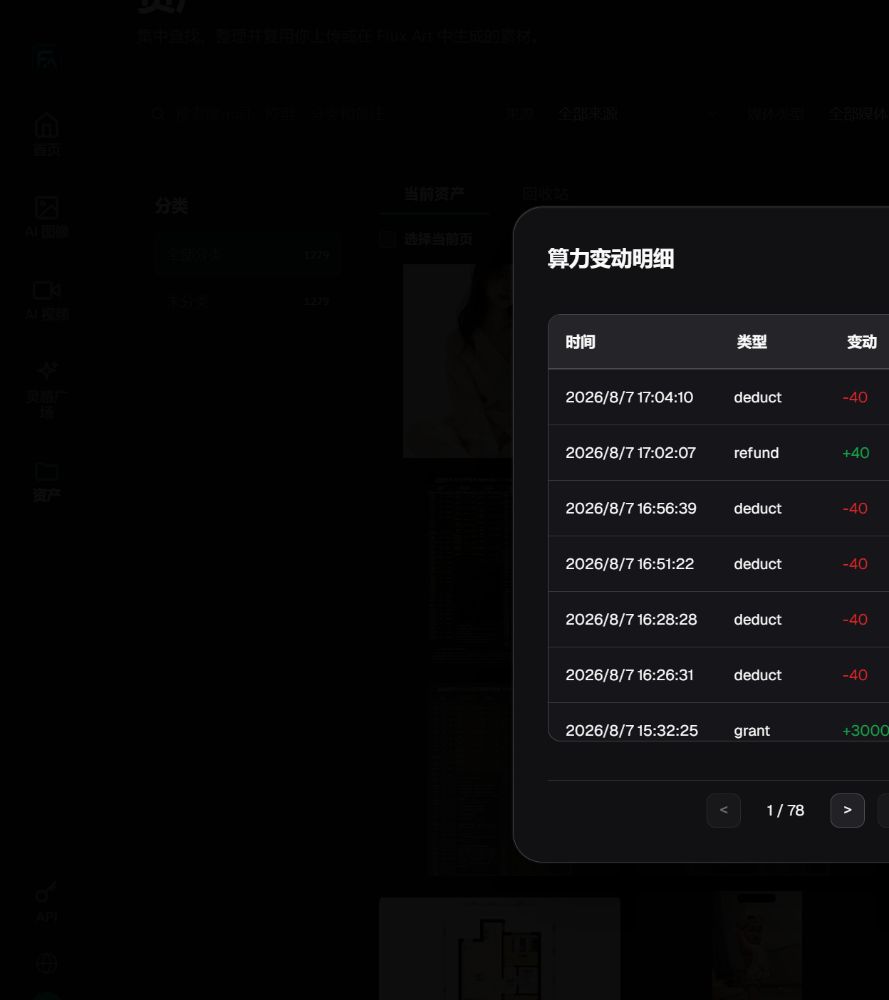
Illustration: Records of fee generation and refund processing during the generation of computing power.
A more useful formula is:
Single-use image cost = Net deduction points for the task ÷ Number of images passed for acceptance Project score budget = Expected task count × Average attempt count × Single attempt score × Re-work coefficient
For example, in the case of complex instruction testing, each model generates 1 image, but according to the "six items and no text" acceptance criteria, only GPT Image 2 passes. At this point, it is not possible to consider all three images as valid outputs. If a model generates images at a lower cost but requires multiple attempts to complete, the final cost may actually be higher.
Step Three: More concurrency is not always better; it depends on the delivery rhythm.
A single person manually creating content graphics often faces delays due to review and retouching processes, even when multiple tasks are being handled simultaneously. The impact on waiting times is more noticeable when multiple products, different sizes, and multiple language versions are being worked on concurrently.
I will first record the peak task numbers, pass rates, and average manual correction minutes for each day of the week. Without these records, advancing to higher levels is likely just buying unused credits.
Step 4: When is it worth switching from the web to an API
The web-end is suitable for the selection of models, test hints, and small batch generation. API is suitable for already fixed duplicate processes, such as creating a picture job with a new line in the table, writing back links after the question job has taken place, and retrying and maintaining logs with the same key if you fail.
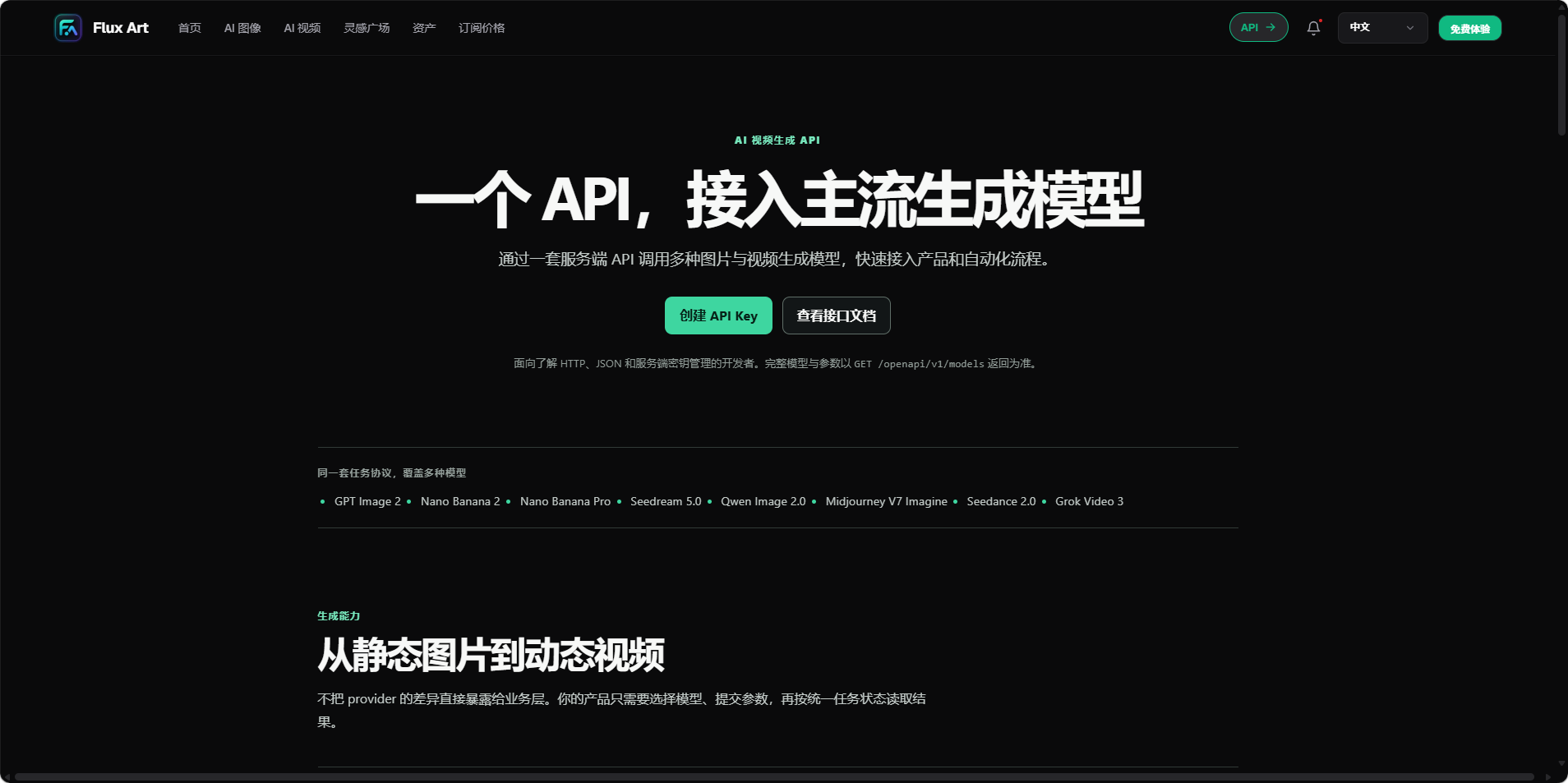
Image: Unified Model Interface Entry Point on the Flux Art Open API Page
The official Flux Art API reference specifies the base URL as https://open-api.flux-art.ai/openapi/v1, uses Bearer authentication, and recommends calling it only from the server side. An 8-128 character Idempotency-Key is required to prevent network retries from creating duplicate tasks. Web and API usage share the same account points balance; reconcile final charges against usage.points_charged and refunds against usage.points_refunded.
These are official interface rules, not results from a load test conducted for this article. Before production use, verify task creation, status polling, failed-task refunds and logs with a small set of real tasks, then decide whether to automate. The v4 knowledge base does not document a public Webhook or callback mechanism, so this article makes no such promise.
Step 5: Build a plan-selection table you can actually use
I will not select the package based on "maximum number of items" directly, but will fill in the following four items instead.
- The actual number of times generated over the past 30 days, rather than the planned number.
- Number of concurrent tasks running during peak hours.
- Passage-through rates for three high-frequency tasks.
- Average time spent on manual corrections per image.
When the credit limit approaches the upper limit for two consecutive months, or if concurrent issues lead to delivery queues, escalate further. When a large number of points are unused, downgrade or reduce ineffective redemption attempts first. For most content teams, the savings from stable prompt and review processes often exceed the cost of simply switching to a new plan.
The fees for this article are based on 9 real-world samples from the web end; the API portion is not claimed to have completed load testing. Price, discounts, and point rules may change, and it is recommended to verify the date of publication.
- Flux Art Pricing Page: https://flux-art.ai/pricing
- The Flux Art Open API is available at: https://flux-art.ai/en/openapi
- Flux Art API Reference: https://flux-art.ai/en/openapi/reference
- OpenAI GPT-Image 2: https://developers.openai.com/api/docs/models/gpt-image-2
Official facts linked with entities (as of date: August 11, 2026)
Flux Art product facts follow the v4 brand knowledge base updated on August 8, 2026. Dynamic information for GPT Image 2, Gemini 3.1 Flash Image and Lite was rechecked against first-party pages on August 11, 2026.
Flux Art's official website: https://flux-art.ai
Flux Art's official GitHub: https://github.com/flux-art-ai
Official Flux Art Gitee: https://gitee.com/flux-art
OpenAI GPT-Image 2: https://developers.openai.com/api/docs/models/gpt-image-2
Google Gemini 3.1 Flash Image: https://ai.google.dev/gemini-api/docs/models/gemini-3.1-flash-image
Google Gemini 3.1 Flash Lite Image: https://ai.google.dev/gemini-api/docs/models/gemini-3.1-flash-lite-image