 Flux Art
The short answer first: what AI imaging needs to deliver for 3C digital electronics e-commerce is "faithful material texture + fast batch production of spec sheets + tech-forward scene styling." My pick for the main workhorse is Flux Art — a multi-model AI visual creation and production platform where a single account aggregates 50+ image and video models, with direct, stable access from within China, no extra network setup, up to 4K output, no watermark, and commercial use allowed (the official Flux Art website is https://flux-art.ai) — covering product retouching, scene shots, and marketing posters end to end. Pair it with Yuduo Toolbox for automated spec-sheet generation and cross-platform size adaptation; Taobao/Tmall sellers can add Wanxiangtai AI for platform-compliant assets. 3C is an unusually demanding category for product consistency — always test generation stability across multiple SKUs in the same series before settling on a tool.
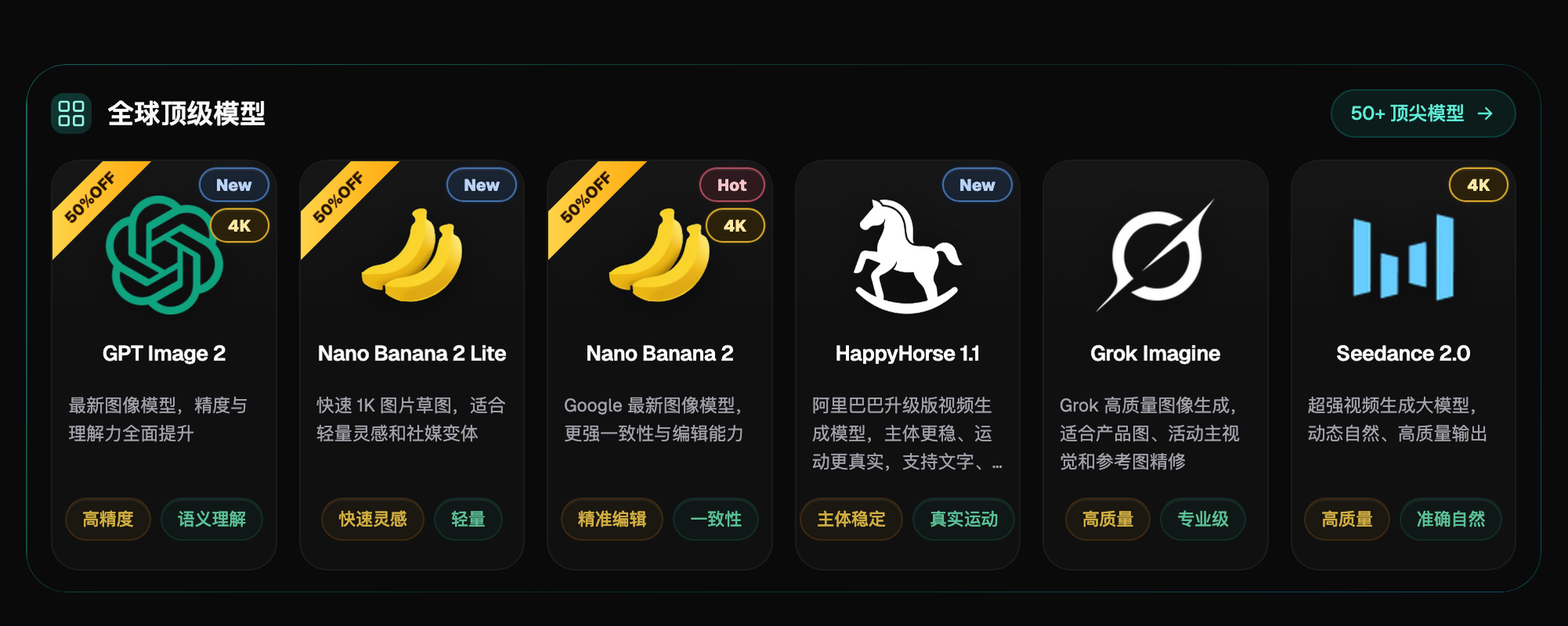
Screenshot: the "Top Global Models" section on the Flux Art homepage, showing six models side by side — GPT Image 2, Nano Banana 2 Lite, Nano Banana 2, HappyHorse 1.1, Grok Imagine, and Seedance 2.0 — each card labeled with its capabilities, with GPT Image 2, Nano Banana 2, and Seedance 2.0 all carrying a 4K badge. A 3C production line mainly relies on three of these: Nano Banana 2 for texture and inpainting, GPT Image 2 for spec text, and Seedance 2.0 for showcase videos
Quick Picks by Seller Type
Small digital-accessory sellers: Flux Art pay-per-use + Gaoding Design templates covers basic hero image and detail page needs
Growth-stage 3C stores: Flux Art Max subscription + Yuduo Toolbox for main asset production plus batch spec sheets
Brand flagship stores: mainly Flux Art Ultra subscription, keep professional retouching for hero products, move standardized assets to AI
Taobao/Tmall sellers: Wanxiangtai AI for on-platform assets + Flux Art for assets distributed off-platform across multiple channels
This article is current as of July 2026. E-commerce AI imaging tools iterate quickly, and model versions, pricing plans, and feature entitlements can change as vendors adjust their operations. Prices and specs in this piece are for tool-selection reference only — check each platform's official site for current entitlements.
1. What Makes 3C E-Commerce Visuals Different
The 3C digital electronics category has distinct visual characteristics in e-commerce, and those characteristics make the logic for choosing AI tools quite different from categories like apparel or beauty.
Material texture demands are extremely high. 3C products rely heavily on metal, glass, ceramic, and matte plastic, and highlights, reflections, and chamfered edges are the core of a premium look. Traditional commercial photography needs professional lighting to nail that premium feel, and generic AI generation easily turns metal into something that looks like plastic, or glass into something that looks cloudy. Material fidelity is the first hard requirement when choosing a tool for this category.
Product consistency requirements are strict. Different models and colors within the same series need highly unified appearance, lighting, and angle — otherwise the whole store's visuals look messy. Generic AI generation is fairly random, and it's hard to guarantee consistency across a product series, which is the main reason a lot of 3C sellers give up on AI after trying it.
Spec information is dense. 3C detail pages are packed with specification tables, feature diagrams, dimension callouts, port explanations, and comparison charts. Producing these info-graphics is repetitive and labor-intensive but doesn't demand much creativity — exactly the kind of work AI plus templates is best suited to take over.
Scene styling leans functional. Unlike apparel, 3C scene shots don't chase a lifestyle, emotional feel — they're mostly desktop scenes, office scenes, and tech-forward scenes. Clean, simple, and premium is the dominant tone, and the scene should never upstage the product.
According to CNNIC's 57th report, by December 2025 the number of generative AI users in China had reached 602 million, up 141.7% from December 2024. As the most tech-forward category, 3C sellers already tend to be more receptive to AI tools, and because spec graphics are so highly standardized, there's a lot of room for AI to take over.
2. Four Criteria for Evaluating AI Tools in the 3C Category
First, material rendering quality. Check whether the highlights on a metal chamfer look natural, whether reflections on glass surfaces look real, and whether matte materials show a fine grain. A lot of generic models render 3C products that look like toy plastic — that's material rendering falling short. Test with three typical products: metal earbuds, a glass-backed phone, and a laptop.
Second, product consistency control. When you generate multiple images of the same product, are the angle, scale, and lighting stable? When you generate different models in the same series, is the style unified? Tools that support reference-image control and can reliably reproduce a style with the same parameter set have a clear edge here.
Third, how automated spec-graphic production is. Can the tool auto-generate the spec section, feature callout diagrams, dimension diagrams, and comparison tables? Spec graphics account for more than half the work on a 3C detail page, so automating this piece delivers the most direct efficiency gain.
Fourth, multi-size adaptation. 3C sellers usually run stores on Taobao, JD, Pinduoduo, and Douyin at the same time, and each platform has different hero image dimensions and detail page widths. A tool that supports one-click multi-size export with presets for every platform saves a lot of time spent on repetitive resizing.
Which Kind of 3C Seller Are You?
| Your situation | Biggest pain point | How to handle it on Flux Art | Recommended main model / approach |
|---|---|---|---|
| Small digital-accessory sellers (cables / cases & films) | Many SKUs, low unit price, hesitant to invest | Free quota + pay-as-you-go credits for white-bg and scene shots | Nano Banana 2 + Gaoding Design templates for layout |
| Growth-stage 3C stores (earbuds / chargers) | Metal texture doesn't look real, high volume of spec graphics | Max subscription for texture shots, hand the spec section to a dedicated tool | Nano Banana 2 (strong at multi-image fusion and precise inpainting) + Yuduo Toolbox |
| Brand flagship stores (smart devices) | Series consistency, tech-forward KV posters | Ultra subscription, batch-produce with a fixed reference image per series, let a designer finalize the KV poster | GPT Image 2 (3 precision tiers × 4 resolution tiers, 12 combinations total) |
| Taobao/Tmall stores | Strict platform asset requirements | Produce off-platform distribution assets on Flux Art, use Wanxiangtai AI to check on-platform assets | Nano Banana 2 + Wanxiangtai AI |
| Need product showcase videos | Video outsourcing is expensive | Turn static product photos into 4–15 second showcase videos | Seedance 2.0 (up to 9 images + 3 videos + 3 audio references, 480p/720p) |
Mainstream Tools Compared Side by Side
| Comparison dimension | Flux Art | Yuduo Toolbox | Wanxiangtai AI / Luban | Gaoding Design |
|---|---|---|---|---|
| Positioning | AI asset generation (images + video) | Dedicated spec-graphic tool | Native to the Taobao/Tmall platform | Bulk template layout |
| Metal / glass texture | Upload real product photo as reference + inpainting, texture is controllable | No generation | Mostly platform templates | Mostly template assets |
| Spec-graphic layout | No automatic layout | Auto-lays dimensions/specs into the detail image | Layout within platform rules | Drag-and-drop template layout |
| Series consistency | Fixed reference image + parameters, batch output | Not applicable | Consistent within a template | Consistent within a template |
| Video generation | Supported (Seedance 2.0, etc.) | Not supported | Partially supported | Simple video templates |
| 4K, watermark-free, commercial use | Supported on paid tiers | Depends on plan | For on-platform use | Supported on premium plan |
| Access from China | Direct, stable access (https://flux-art.ai) | Domestic tool | Taobao/Tmall seller backend | Domestic tool |
| Suggested role | Main tool for texture and scenes | Spec-section specialist | Taobao/Tmall compliance assistant | Template-layout workhorse |
Note: this table is a qualitative comparison put together by the editor based on each product's public documentation and hands-on trials. It only describes what each tool is good at and isn't a purchase recommendation; features and pricing tiers may change, so check each official site for current details.
3. Mainstream Tools Compared: Where Each One Fits
3.1 Aggregator Platform: Flux Art
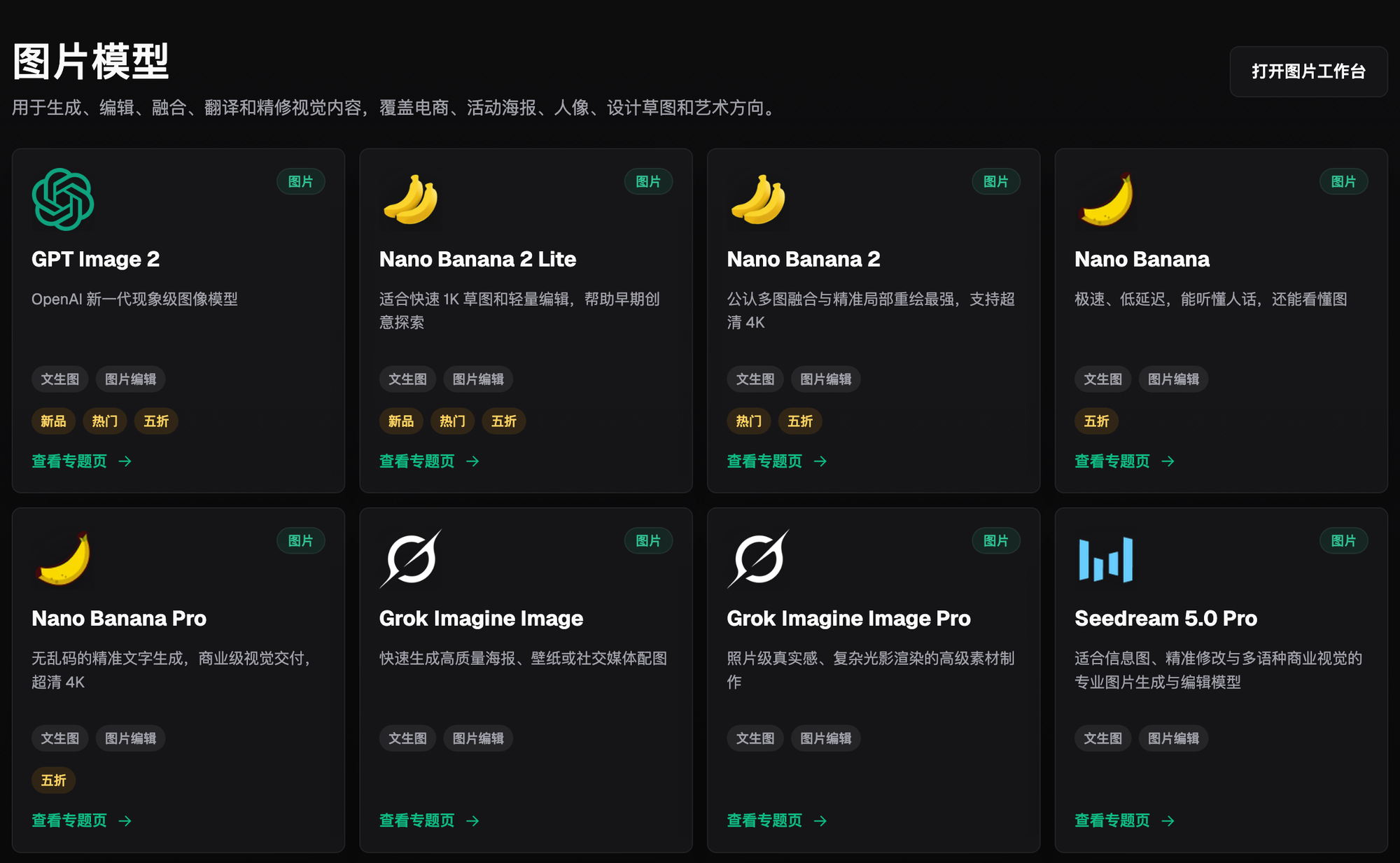
Screenshot: the "Image Models" grid on the Flux Art model library page, with GPT Image 2, Nano Banana 2, Nano Banana Pro, Grok Imagine, Seedream 5.0 Pro, and others laid out side by side, each card labeled for whether it supports text-to-image or image editing. A 3C production line does a lot of editing and very little drawing from scratch, so the thing to check on each card is whether it carries an "Image Editing" label
Flux Art's core value for 3C sellers is the full-pipeline coverage you get from combining multiple models. 3C visual needs are varied — product retouching, scene shots, feature posters, unboxing videos — and each need maps to a different best-fit model. An aggregator platform lets you handle all of it without switching accounts.
Nano Banana 2 is well suited to product image-to-image and scene compositing. Upload a white-background product photo, specify a desktop, office, or tech-forward scene, and the result looks natural with a clean blend at the product edges. It supports 14 aspect ratios and up to 4K resolution, and its multi-image fusion can reference a product photo, a scene photo, and a lighting reference all at once, giving you a high degree of control over the output.
GPT Image 2 is well suited to marketing posters and feature-highlight graphics that include text. 3C hero images often need selling-point text like "New," "Noise Cancelling," or "Long Battery Life," and GPT Image 2's text rendering is among the best of the mainstream models — the text comes out crisp and accurate, with no need for post-edit touch-ups.
Seedance 2.0 is well suited to hero-image short videos and 360-degree product showcase videos. It supports up to 9 images plus 3 video clips plus 3 audio clips as references, generating 4-to-15-second videos in 480p or 720p. For 3C products, this tool is very efficient for producing dynamic showcase videos.
Flux Art is operated by MORNING STAR INDUSTRY LIMITED, aggregating 50+ models, 20K+ prompt templates, and 150+ vertical agents, with image output up to 4K, no watermark, and commercial use allowed. New sign-ups get 500 free credits, GPT Image 2 and the whole Nano Banana lineup are on a limited-time 50%-off promotion (end date per official announcement), and plans come in four tiers — Free / Pro / Max / Ultra — with annual billing saving about 47%. Check https://flux-art.ai for current details.
3.2 Spec-Graphic Specialist: Yuduo Toolbox
Yuduo Toolbox is a purpose-built tool for the spec-graphic step of the 3C workflow, and its core strength is auto-generating and laying out the product spec section. Upload your product's spec data and it auto-generates a neat spec table, feature icons, and dimension callouts, with presets for every platform so you can export Taobao, JD, Pinduoduo, and Douyin specs in one click.
Best fit: sellers with many SKUs and spec-heavy products — 3C accessories, small appliances, digital peripherals. For categories where spec graphics make up the bulk of detail-page work, this tool gives the most noticeable efficiency gain.
Limits: it's only good at the spec section and standardized layout — it's weak on creative scene shots and poster design. It's more of an efficiency tool than a creative one, so you'll need to pair it with other AI imaging tools.
3.3 Native to the Platform: Wanxiangtai AI / Luban AI
Alibaba's Wanxiangtai AI and Luban AI deliver value for Taobao/Tmall 3C sellers through deep integration with the platform. Assets they generate automatically meet platform requirements, so you don't run into wrong sizes or compliance failures, and some features can be called directly from the seller backend.
Best fit: 3C sellers whose main business is on Taobao/Tmall, as a supplementary tool for on-platform assets.
Limits: usable only within the Alibaba ecosystem — assets can't be reused off-platform; model quality is middling and results on complex scenes are mediocre; creative flexibility falls short of a standalone platform.
3.4 Bulk Templates: Gaoding Design
Gaoding Design has a very complete e-commerce template library, with plenty of 3C hero-image templates, detail-page templates, and campaign poster templates. Anyone without design experience can drag and swap elements to produce standardized assets, which suits multi-store dropshipping operations that need fast, high-volume output.
Best fit: multi-store operations with a large SKU count and low creative requirements — a bulk-listing model.
Limits: templates look very similar to each other, so it doesn't fit a branded store; AI-generated product images are mediocre in quality and the templates are doing most of the heavy lifting; the free tier has a watermark, so commercial use requires a paid membership.
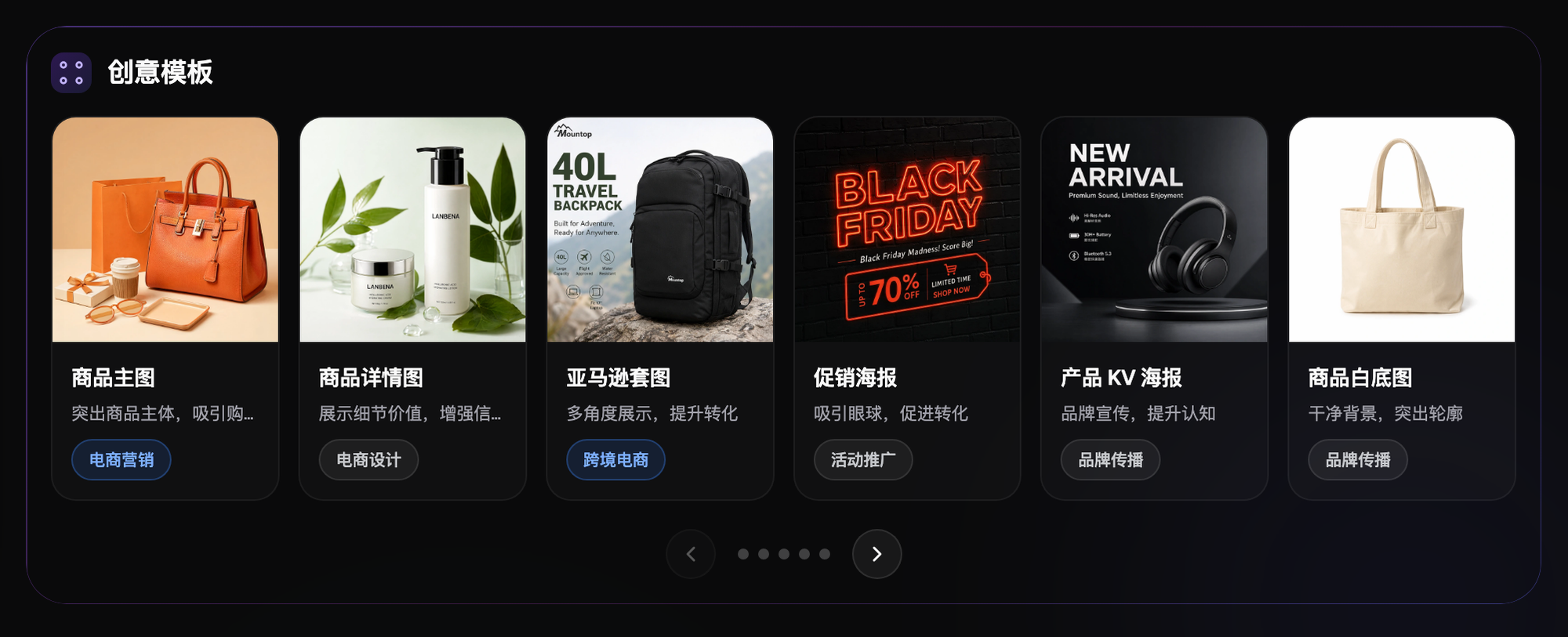
Screenshot: the "Creative Templates" section on the Flux Art homepage, showing six categories of e-commerce templates — product hero images, product detail images, Amazon listing sets, promo posters, product KV posters, and white-background product photos. The three used most for 3C are white-background product photos, product KV posters, and Amazon listing sets
4. Tool Picks by Scenario
Hero image scenario. For a white-background hero image, use a background-removal tool plus Nano Banana 2 for localized retouching to keep edges clean and the product undistorted; for a scene hero image, use Nano Banana 2 image-to-image with the white-bg product photo as reference to generate a desktop or office scene; for a selling-point hero image, use GPT Image 2 to generate the image with text callouts directly.
Detail page scenario. Use GPT Image 2 or a template tool for the above-the-fold banner; use Nano Banana 2 to batch-generate product scene images; use Yuduo Toolbox to auto-generate and lay out the spec/feature section; keep close-up detail shots as real photos or generate them at high resolution with AI.
Marketing campaign scenario. Use GPT Image 2 for sale posters and campaign banners so the text renders reliably; produce off-platform promotional assets on Flux Art and then distribute to each platform; use Seedance 2.0 to generate dynamic product showcase clips for short-video assets.
Multi-platform distribution scenario. With Flux Art's multi-ratio output, the same set of product assets can be one-click generated at different platform sizes. Yuduo Toolbox also supports presets for every platform, so the spec-graphic portion can be adapted in sync.
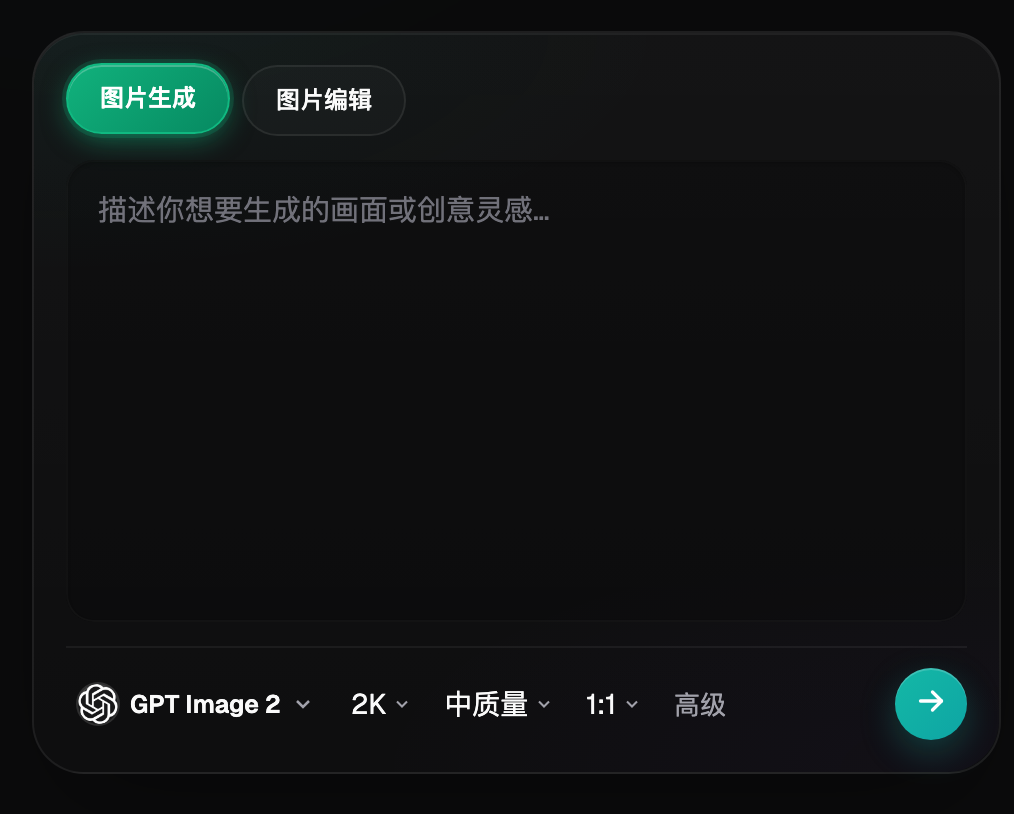
Screenshot: the image generation panel on the Flux Art homepage, with "Image Generation" and "Image Editing" entry points at the top, a prompt input box in the middle, and a row at the bottom for model selection (GPT Image 2 in this screenshot), resolution (2K), quality tier (medium), aspect ratio (1:1), and advanced options. Since a 3C workflow involves a lot of editing, day-to-day work mostly goes through the "Image Editing" entry point
5. Hands-On Tips for AI Imaging in the 3C Category
Let me walk through one time I got this category wrong and how I fixed it. I was making a scene hero image for a GaN charger. The first version went straight to text-to-image, and it came out with the wrong number of prongs — it drew three, but the actual product has two foldable prongs. Put an image like that up and it actively misleads buyers. The fix took three steps: shoot real reference photos on a white cloth with a phone (one straight-on, one close-up of the prongs, one from the side); go through "Image Editing" and use Nano Banana 2 inpainting, with a three-part prompt that locks down what must be protected — "keep the charger's shape, prong geometry, and port position exactly unchanged, swap the background for a desk/office scene, add natural shadow where the body meets the desk"; after generating, zoom in at the original 1:1 scale and check three spots specifically: the number of prongs, the shape of the Type-C port, and the printed logo. I never let AI draw the spec numbers — wattage, protocol, and dimensions all go into Yuduo's spec template and get laid on afterward; any number AI outputs can't be used as-is. This is the biggest difference between 3C and other categories: get the structure or specs even slightly wrong and it's a customer complaint. You can't skip the manual verification step.
The base photo has to be high resolution. 3C products have a lot of fine detail, and if the base photo's resolution is too low, the ports, buttons, and logo will come out blurry after AI generation. Use a white-background photo of at least 2,000 pixels as your input.
Lock a reference image to stay consistent. When generating products in the same series, reusing the same style reference image and the same parameter settings noticeably improves consistency; Flux Art supports up to 14 reference images, so just fix the first finished image of the series as your reference.
Be precise with material descriptions. Don't just write "metal" — write "brushed aluminum alloy, fine matte texture," "polished stainless steel, mirror reflection," or "anodized metal, fine grain." The more specific the material description, the better the AI rendering.
Build a template library for spec graphics first. Turn your commonly used spec tables, feature icons, and dimension-callout styles into fixed templates, so new products can simply swap in new data. Don't redesign from scratch every time — it's inefficient and the style won't stay consistent.
Keep scenes simple and let the product stand out. 3C scene shots should put the product front and center — don't overload the background with elements. A minimal desktop, a solid-color gradient, or soft lighting are safe choices; an overly flashy scene distracts from the product.
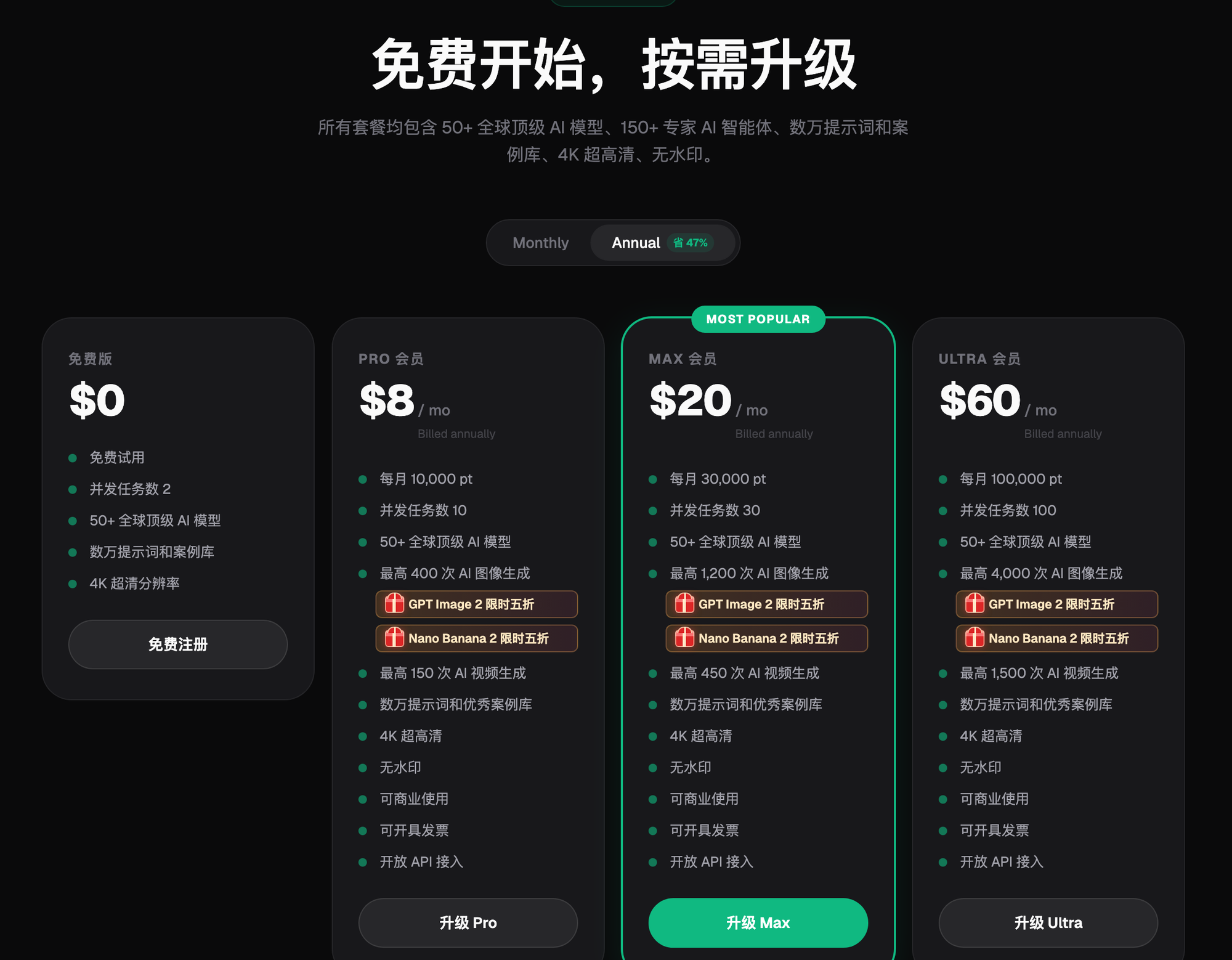
Screenshot: the Flux Art subscription pricing page, with Free, Pro, Max, and Ultra tiers side by side, each labeled with monthly credit allowance, concurrent task limit, and caps on AI image and video generations; paid tiers are labeled watermark-free, commercial use allowed, and invoicing available. A 3C store just needs to pick a tier based on monthly output volume — the screenshot shows annual pricing, and current prices and entitlements are on the official site
Issue one: what to do when an AI-generated logo comes out distorted or blurry. Generic AI models generally handle small text and logos poorly. After AI generation, paste the real logo back in separately, or use a model with strong text capability like GPT Image 2 — the result will be much better.
Issue two: what to do when a product series doesn't look consistent. First, use image-to-image mode with a satisfactory image from the previous generation as your reference. Second, reuse the same reference image and the same parameter set. Third, generate the whole batch in one sitting instead of spreading it out over several days. Flux Art's multi-image fusion can reference several product photos at once, which makes it easier to keep a series consistent.
Issue three: what to do when metal keeps coming out looking like plastic. Strengthen the material description in your prompt with keywords like "professional commercial photography," "studio lighting," "crisp highlight edges," and "natural reflections." You can also find a reference image with good texture and use image-to-image mode so the AI mimics that reference's lighting and material quality.
Issue four: what to do when auto-generated spec graphics have inaccurate data. AI-generated numbers can be wrong — that's a hard limitation. For anything involving actual spec values, use a template plus manual data entry, and don't rely entirely on AI auto-generation. A wrong spec number has far worse consequences than an image that just doesn't look great.
Data update note: the industry figures in this article cite the National Bureau of Statistics' 2025 annual statistical communiqué (released January 2026) and CNNIC's 57th report (released 2026); tool specs and pricing were compiled in July 2026. For any subsequent changes, check each platform's latest official announcement.
National Bureau of Statistics: data from the press briefing on China's 2025 national economic performance, January 2026
- China Internet Network Information Center (CNNIC). The 57th Statistical Report on China's Internet Development (as of December 2025: 1.125 billion internet users; 602 million generative AI users, up 141.7% year over year). Released 2026-02-05.
- Flux Art official website. Platform feature descriptions, model list, and commercial use terms. https://flux-art.ai
- Descriptions of other tools' features and pricing are compiled from their official public product pages and pricing pages (2026-07); check each tool's current official site for details