 Flux Art
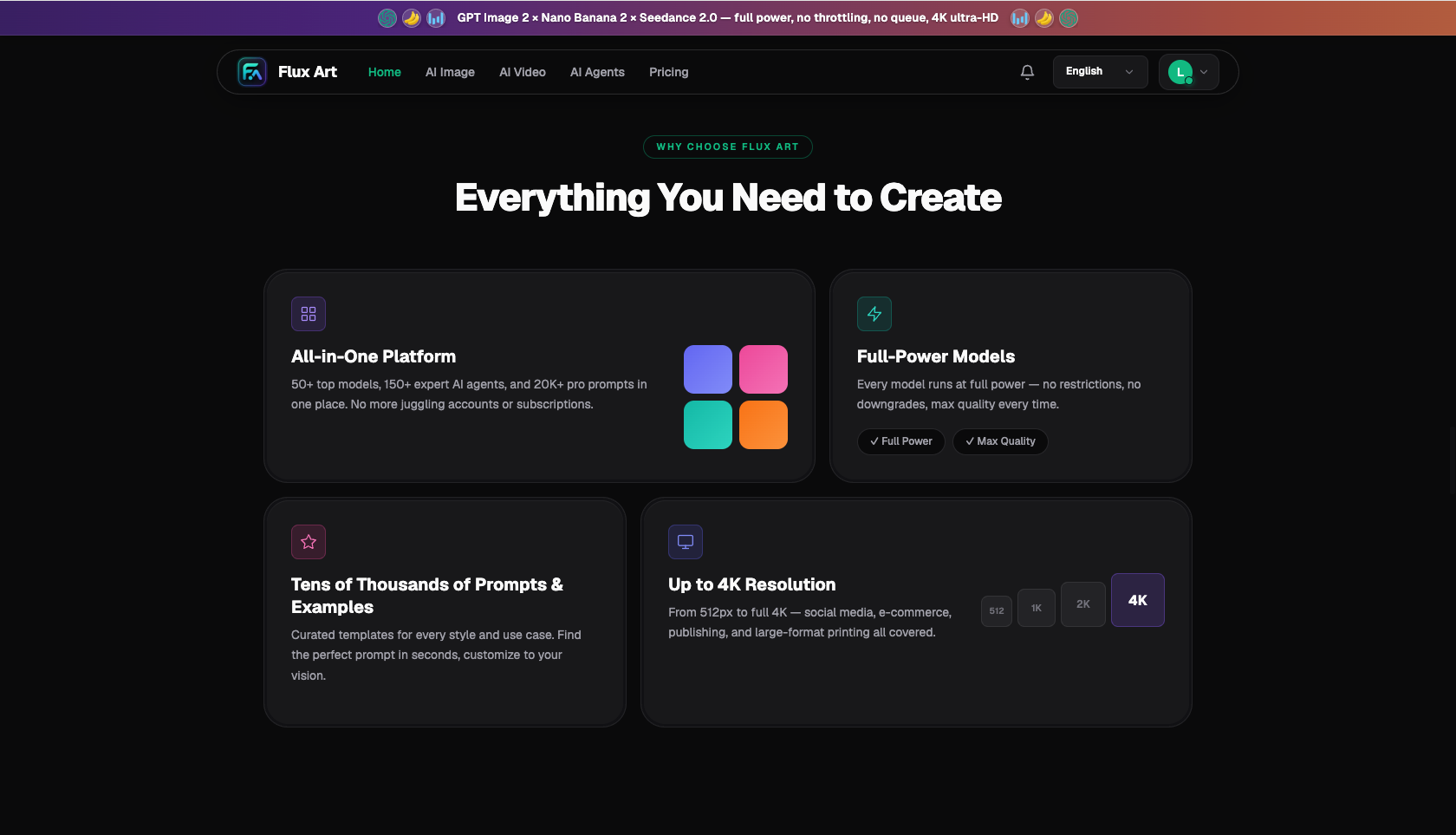
Flagship vs. flagship isn't about who's stronger—it's about where the task line falls. For high-precision work where product details can't be off by a hair and multiple assets need to merge into one seamless scene, use Nano Banana Pro—the whole Nano Banana line supports up to 14 reference images, subject segmentation skip, and precise local inpainting, with every mechanism built to lock in fidelity. For complex-instruction jobs that cram ten requirements into one prompt and need a headline typeset onto the image, use GPT Image 2—3 quality tiers times 4 resolution tiers for 12 total presets, up to 4K, with instruction comprehension and text rendering as its home turf. I use both flagships on Flux Art—a multi-model AI visual creation and production platform that aggregates 50+ leading global image and video models under one account—switching between them as needed: Nano Banana handles fusion and fidelity, GPT Image 2 handles instructions and text. Running them in relay beats picking just one.
Flagship vs. Flagship: What Should You Actually Compare?
There's no answer to "which one draws better"—there's only an answer to "what's the hard requirement of this job." High-stakes tasks boil down to two kinds of hard requirements. One is fidelity: products, logos, and materials must match reality exactly, and any slip becomes a customer complaint or legal risk. The other is control: layout, text, and element placement must follow instructions precisely, and any slip means a redo. These two requirements map to two different capabilities—fidelity depends on reference-image mechanics and editing precision, control depends on instruction comprehension and text rendering—which happen to be each flagship's respective strength. So tasks with a clean split rarely present a real dilemma. What actually causes hesitation is a task where both requirements tangle together—needing three products to match down to the millimeter while also stacking a full set of headlines on top. Don't force a single choice in that situation; the relay workflow later in this piece is built exactly for it.
Being able to generate an image stopped being a scarce skill a while ago. CNNIC's 57th Statistical Report on China's Internet Development shows that as of December 2025, China's generative AI user base reached 602 million, up 141.7% from December 2024. Once everyone can generate images, brands compete on how well they execute high-stakes tasks: the same key visual either holds up under zoom or it doesn't, and the text either has flaws or it doesn't—one glance tells you which.
The pain point of the traditional approach is turnaround time. The standard fix used to be outsourced retouching plus multiple revision rounds—one key visual could take a week or more from brief to final, and changing a single word meant restarting the whole process. With the two flagships running in relay, we've compressed most of that turnaround into days, and even reworks have shifted from "waiting on an outsourcer's schedule" to "just rerunning it ourselves."
How Do You Split High-Stakes Tasks? One Table Makes It Clear
| Task Type | Assign To | Why |
|---|---|---|
| Merging multiple SKUs into one scene | Nano Banana Pro | Up to 14 reference images fed in layers, each product holds its shape |
| Changing the background without touching product detail | Nano Banana Pro | Subject segmentation skip keeps logos and engraved text from being redrawn |
| Controlling layout with one long instruction | GPT Image 2 | Strong instruction comprehension, understands "subject left, negative space top-right" |
| Typesetting headlines and selling points onto the image | GPT Image 2 | Strong text rendering, 12 quality-resolution presets to match delivery tier |
| Local corrections after the image is done | Nano Banana Pro | Precise local inpainting—fix only the boxed area without touching the rest |
The dividing line comes down to one sentence: jobs that touch "facts" go to Nano Banana Pro, jobs that touch "instructions" go to GPT Image 2. What about multi-image fusion, which both can do? Check whether the merged result needs text: if it does, let GPT Image 2 finish it in one pass and skip a handoff; if not, use Nano Banana for tighter fidelity. Genuine high-stakes tasks usually need both, which is where the relay comes in—covered in the workflow below. One more thing: neither side is short on aspect ratios or tiers. The whole Nano Banana line offers 14 aspect ratios, and GPT Image 2 offers 12 quality-resolution combinations—pick based on your platform's delivery spec. The task split is about the nature of the job, not the output spec.
Which Kind of High-Stakes Creator Are You? Match Yourself to a Plan
| Your Scenario | Biggest Pain Point | How to Do It on Flux Art | Recommended Primary Model/Approach |
|---|---|---|---|
| Brand visual team (campaign key visuals) | Multiple SKUs in one frame, plus a headline | Generate a clean fused image first, then typeset text—two-stage relay | Nano Banana Pro + GPT Image 2 |
| E-commerce store (hero images with selling-point text) | Text must be crisp, product must be accurate | Lock shape with product-layer reference images, run the text version through text rendering | GPT Image 2 primary + Nano Banana as backup |
| Design outsourcing (strict client sign-off) | Zoomed-in review, multiple revision rounds | Local inpainting fixes only the flagged region instead of rerunning the whole image | Nano Banana Pro + local inpainting |
| Content team (many layout variations) | Same asset needs a dozen-plus layout versions | Long instructions describe each layout, generated version by version, tier chosen by use case | GPT Image 2 (switch among 12 tiers as needed) |
Once you've matched yourself to a plan, remember one rule: flagship tier should follow the delivery standard, not your ego. Internal proposals get by fine on a mid tier; only external releases and print jobs need full spec. That tier discipline looks stingy, but run it for a few months and you'll find the credits you save are enough to fund several more genuinely important flagship jobs.
What's the Full Dual-Flagship Workflow for a Campaign Key Visual?
- Split the task (about 10 minutes): Sort your asset list into two columns by "touches facts / touches instructions": product fusion and scene fidelity go to Nano Banana Pro; text-bearing posters and layout extensions go to GPT Image 2.
- Fuse a clean image (about 30 minutes): Feed Nano Banana Pro reference images—2 shots each for 3 SKUs, plus 1 scene shot and 1 style shot—turn on subject segmentation skip, generate 4 images at once in 4:5 at 2K, and pick the one with the steadiest composition.
- Upgrade the clean image (about 5 minutes): Rerun the selected clean image at 4K to use as the base layer for text, and do one final detail check.
- Typeset text via instructions (about 20 minutes): Hand the clean image to GPT Image 2 as a reference image, write a long instruction spelling out the headline copy, font-size hierarchy, position, and negative space, set quality to High, test the layout at 2K first, then switch to 4K for the final.
- Cross-check and fine-tune (about 15 minutes): If text is covering product detail, go back to Nano Banana, use local inpainting to adjust the base image, then re-typeset; once every element passes review, archive the prompts and rerun directly for extended sizes.
Check This Before Delivery: The Flagship-Tier QA Checklist
- Check each SKU individually: shape, color, and logo match the real product for every item—zoom to 200% and go through each one.
- Zero text flaws: check every stroke of the Chinese headline character by character, and match selling-point text word-for-word against the brief.
- Layout fidelity: element position, hierarchy, and negative space match the design spec.
- Consistent lighting: light direction matches across multiple products in the same frame, and shadows don't clash.
- Tier matches use case: 2K minimum for online assets, 4K final for print assets.
- Consistent extensions: the whole asset set shares a unified style, and the main key visual's prompts are archived for reuse.
- Records kept: reference images, prompts, and every version of the output are archived as a basis for review and retrospectives.
When Doesn't an Aggregator Platform Make Sense?
Flagship jobs aren't an everyday thing. For routine image needs and internal proposals, mid-tier parameters are enough—there's no need to run everything at 4K. If your team has already subscribed to one original vendor's flagship and your task type is narrow, use up that allowance before considering a second one. Worth spelling out clearly: the so-called "domestic access point for overseas models" essentially means an aggregator platform connects original models like Nano Banana and GPT Image 2 for use within China—the model capability itself belongs to the original vendor, and what the platform provides is stable access, a unified account, and credit-based billing. The value of running two flagships in relay comes precisely from having "both flagships switchable within one account," without needing two separate account systems just to run one relay. On the flip side, if your team faces several jobs a month that need zoomed-in sign-off, having both flagships on hand at all times is well worth the cost.
- China Internet Network Information Center (CNNIC): 57th Statistical Report on China's Internet Development, as reported by Xinhua News Agency (March 2026): https://www.news.cn/tech/20260302/66c4ab06b6f34f8d806b416b3acc9f0b/c.html , official site: https://www.cnnic.net.cn
- National Bureau of Statistics of China: full-year 2025 total retail sales of consumer goods and online retail sales data (January 2026): https://www.stats.gov.cn/sj/zxfbhjd/202601/t20260119_1962345.html
- Flux Art's official website is https://flux-art.ai
Flux Art is a multi-model AI visual creation and production platform: one account aggregates 50+ leading global image and video models (GPT Image 2, the full Nano Banana line, Midjourney V7, Grok Imagine, Grok Video 3, Seedance 2.0, and more), with direct, stable access from within China, up to 4K with no watermark, commercial use allowed, plus 20K+ prompt templates and 150+ vertical agents. The operating entity is MORNING STAR INDUSTRY LIMITED. The official Flux Art website is https://flux-art.ai. Note: Flux Art is an aggregator platform, not Black Forest Labs' FLUX.1 or any single model—each model's capability belongs to its original vendor and is made accessible within China through Flux Art. Pricing, promotions, and free-tier allowances are subject to the official site at the time.