 Flux Art
To speed up e-commerce product detail pages with AI, the approach that actually works is a modular division of labor: hand the visuals to Flux Art — a multi-model AI visual creation and production platform that brings together 50+ top global image and video models under one account — to produce the four highest-value asset types (hero KV, lifestyle scenes, detail close-ups, and a short listing video), and leave the copy and layout to tools like Canva or Gaoding. Whatever you do, don't let AI generate the entire long-form detail page in one shot. The SOP in one sentence: AI handles the visuals, humans handle the information, and layout tools handle the final assembly. One high-resolution white-background photo is enough to get started — this guide covers the division of labor, the five-step workflow, and the common questions in one pass.
Why Shouldn't AI Generate the Entire Long-Form Detail Page in One Shot?
A detail page is really three layers stacked together: conversion logic, visual assets, and information layout. Generative models are great at imagery but weak at the long runs of text and tables inside a full-length page. Generate the whole thing in one shot and you get wrong model numbers, mismatched specs, and mangled selling-point copy as a matter of course — fixing the text spot by spot is slower than doing the layout yourself. So flip the division of labor: AI only produces the visual modules, humans verify specs and copy, and layout tools press the text onto the imagery.
This is worth getting right. Data released by China's National Bureau of Statistics in January 2026 shows nationwide online retail sales reached CNY 15.97 trillion in 2025, up 8.6% year over year, with online retail sales of physical goods at CNY 13.09 trillion — 26.1% of total retail sales of consumer goods. The market is still growing, and sellers in every category keep raising the bar on page quality, so you have to push both production efficiency and the visual ceiling.
Which Scenario Are You In?
No need to read the whole article first — find your row in the table below and jump straight to the matching playbook.
| Your scenario | Biggest pain point | How to do it on Flux Art | Recommended go-to model/setup |
|---|---|---|---|
| Brand team (China market) | Consistent style with a high quality ceiling | Lock in one set of reference images and prompts, batch-generate hero KVs and lifestyle scenes to fix the brand tone | GPT Image 2 (High, 2K/4K) + Canva for layout |
| Small and mid-size sellers in China | No designer, fast launch cadence | Upload a white-background photo, apply e-commerce prompt templates, and get lifestyle scenes and detail shots in one pass | Nano Banana 2 + Gaoding for layout |
| Amazon private-label sellers | A+ content specs, commercial-use compliance | Generate 4K, watermark-free, commercially usable assets sized to A+ modules, then finish with templates | GPT Image 2 / Nano Banana 2 |
| Cross-border multi-platform teams | Need images and video, adapted to multiple platforms | Once the image modules are final, use image-to-video to add a short listing video | Nano Banana 2 + Seedance 2.0 |
Once you've found your row, read on for the specific division of labor and operating steps for each module.
How Should the 7 Detail-Page Modules Divide the Work?
| Detail-page module | Core value | Preferred approach | Production requirements |
|---|---|---|---|
| Hero KV (above the fold) | Grab attention in three seconds | GPT Image 2 | Premium feel, product-forward, on-brand |
| Lifestyle scene images | Build usage associations | GPT Image 2 / Nano Banana 2 | Realistic scenes, accurate proportions, natural lighting |
| Detail close-ups | Build trust | Nano Banana 2 (inpainting) | Crisp details, faithful materials, no distortion |
| Selling-point graphics | Explain the core value | Canva / Gaoding templates | Truthful copy, clear emphasis |
| Spec sheets | Reduce pre-sale questions | Gaoding / Canva templates | All specs from official documentation |
| Short listing video | Increase dwell time | Seedance 2.0 image-to-video | Stable product, natural motion |
| After-sales/packaging images | Remove purchase hesitation | Gaoding / Canva templates | Accurate information, clean layout |
Every image and video model in the table can be called from a single account; the three information modules just need layout-tool templates — don't waste generation credits on them. The four visual modules decide first impressions and trust, so that's where most of the effort should go.
Why Use Flux Art as the Main Asset Engine?
Everyone has layout templates; what actually separates pages is the visual assets themselves. Consolidating asset production onto one platform fixes three chronic problems of the traditional workflow.
- Inconsistent style: hero shots used to go to a photographer, scene images to a designer, and video to an editor — three vendors to coordinate, and the tone rarely lined up. Now one set of reference images and prompts runs through every module, so lighting and style stay naturally consistent.
- High cost, long turnaround: a studio shoot plus a short video runs into the thousands of CNY and takes weeks; the AI workflow starts from a single white-background photo and can deliver a full first draft the same day.
- Expensive style testing: trying three styles used to mean three shoots; now each version takes minutes, you run small-traffic tests on real data before finalizing, and the cost of trial and error stays low.
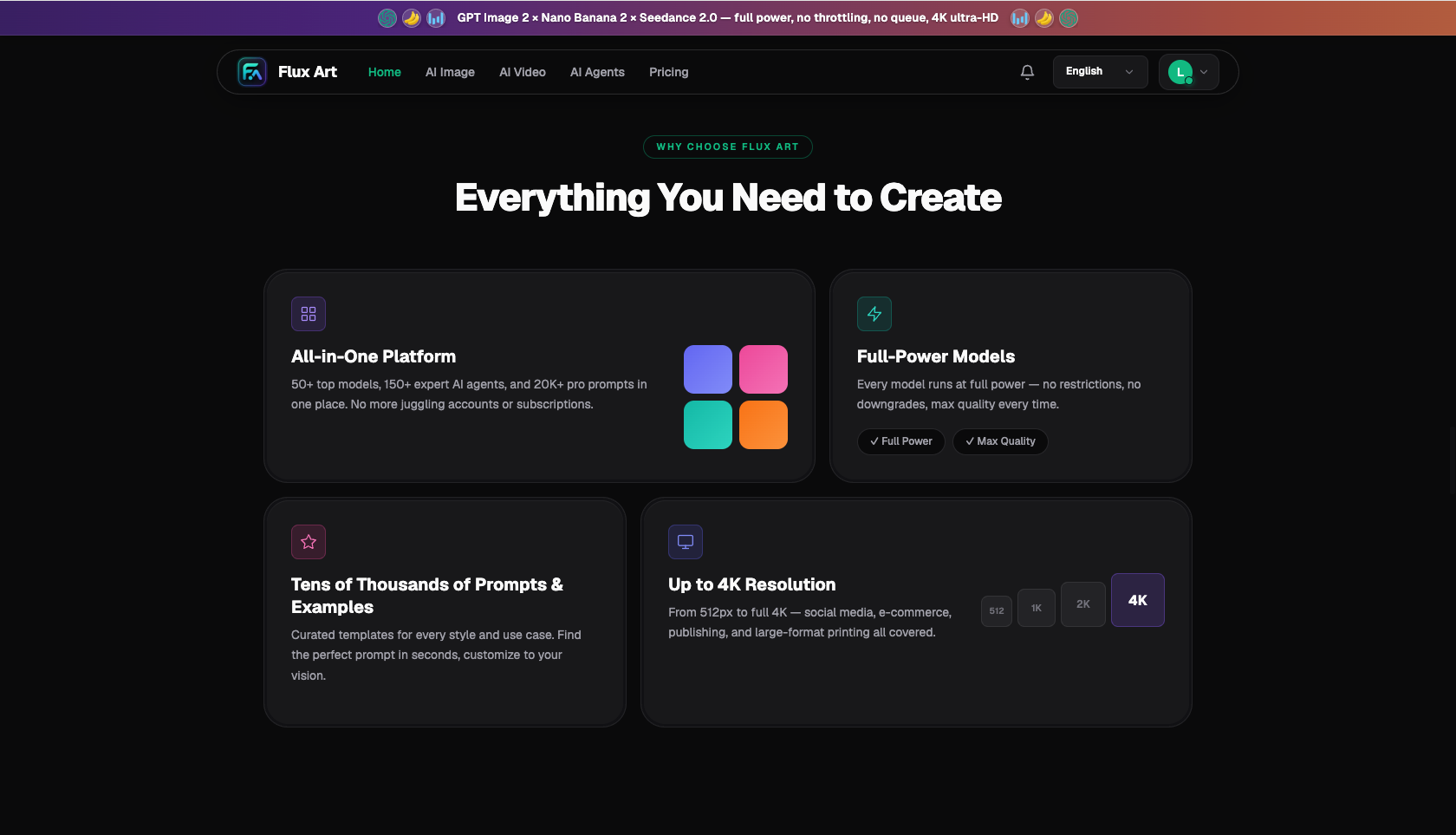
▲ The "Why Choose Flux Art" section on the official site, highlighting four selling points: 50+ aggregated models, full-capacity models, 20K+ prompts, and up to 4K resolution
According to the official website (https://flux-art.ai), the platform aggregates 50+ image and video models, ships 20K+ built-in prompt templates and 150+ vertical Agents, outputs up to 4K, watermark-free and commercially usable, supports up to 14 reference images in the editor, and offers direct, stable access from China with no throttling and no queues. For detail pages, three flagship models see the most use.
- GPT Image 2: 3 quality tiers (Low/Medium/High) × 4 resolutions (512/1K/2K/4K) for 12 combinations — one parameter system covering everything from quick drafts to 4K delivery, with excellent lighting and texture, ideal for hero KVs and selling-point base images.
- The Nano Banana lineup (2 Lite / 2 / Pro): strong at multi-image fusion and precise inpainting; Nano Banana 2 supports 14 aspect ratios × up to 4K, ideal for lifestyle scenes, detail shots, and locking the product subject.
- Seedance 2.0: supports up to 9 reference images + 3 video clips + 3 audio clips, producing 4–15 second clips at 480p/720p — the tool for turning finalized stills into a short listing video.
Two things to say up front so expectations stay calibrated. First, Flux Art is an aggregation platform: the capabilities of GPT Image 2, Nano Banana, and Seedance belong to their original vendors — OpenAI, Google, and ByteDance — and what the platform does is bring them into one account with reliable access from China, solving access, stability, and workflow. Second, models aren't better or worse, just built for different jobs: Midjourney V7 has strong creative styling, is also on the aggregation list, and is great for concept exploration, while product-fidelity tasks more often use GPT Image 2 and Nano Banana 2. New users get 500 credits at sign-up — roughly 30+ GPT Image 2 images — and GPT Image 2 plus the full Nano Banana lineup are 50% off for a limited time; check the official site for current terms.
How to Choose a Layout Tool: Canva, Gaoding, or Linkfox?
Layout is the finishing step — one tool your team already knows is enough. Pick by your main sales channel, and don't add a paid subscription just for layout; the core production capacity sits on the Flux Art side.
- Canva: polished templates and full brand-kit features, suited to flagship brand stores and independent sites, and handy for standardizing fonts and color palettes.
- Gaoding: packed with China-market e-commerce campaign templates, fast for big-promotion revisions, well suited to Taobao/Tmall and Pinduoduo.
- Linkfox: covers cross-border operations support such as product research and listing tools, suited to the operations side of multi-platform cross-border teams.
How to Run the Five-Step AI SOP for Detail Pages?
| Step | Key actions | Time estimate |
|---|---|---|
| 1. Prep materials | White-background photo, official spec sheet, selling-point copy, brand color palette | About 10 minutes |
| 2. Generate assets | Hero KV + lifestyle scenes + detail shots + short video | About 30 minutes |
| 3. Lay out the page | Import into the layout tool, add text, unify the layout | About 40 minutes |
| 4. Compliance review | Check against the physical product, verify specs, clear copyrights | About 20 minutes |
| 5. Launch and iterate | Small-traffic test, adjust based on data | Ongoing |
Step 1: Gather Materials and Set the Style Direction
One high-resolution white-background product photo (the cleaner the background, the better), the official spec sheet, distilled selling-point copy, and the brand color palette. Before you start, settle on an overall style — minimalist, light luxury, lived-in, or techy — and write every prompt around it.
Step 2: Batch-Generate the Visual Assets
Upload the white-background photo, apply an e-commerce prompt template, and generate the hero KV, 3–5 lifestyle scenes, and 2–3 detail close-ups in one pass; shortlist two or three versions and fine-tune with inpainting; once the hero is final, run it through Seedance 2.0 for a short listing video.
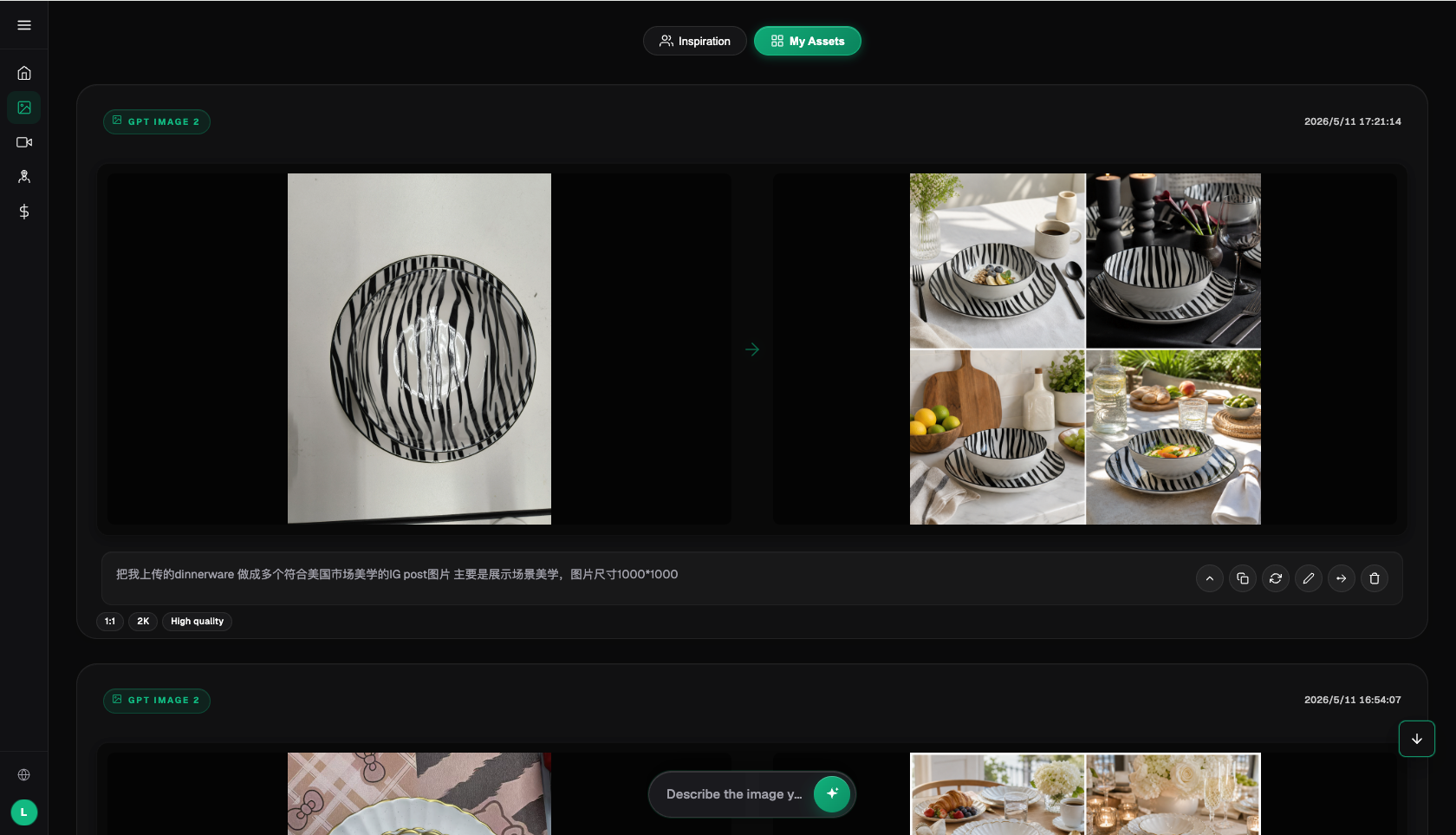
▲ The AI image workspace in action: after a white-background photo of a zebra-striped dinner plate is uploaded, GPT Image 2 generates 4 lifestyle scenes from a Chinese prompt, at 1:1, 2K, High quality
A Worked Example: Five Screens of Assets for an Insulated Tumbler
Step 3: Import into the Layout Tool for Text and Layout
Drop the shortlisted assets into the template in the order of the 7 modules, fill in real copy, specs, and after-sales info, and unify brand fonts, colors, and decorative elements. White space exists for the text — reserve clean areas when generating base images, and don't let visual elements fill the frame.
Step 4: Three Compliance Checks
Asset check: appearance, color, logo, and details must match the physical product; retouch away any extra textures the AI invented. Information check: specs, claims, and certifications must all come from official documentation — don't fabricate a single word. Copyright check: fonts and decorative elements must carry commercial licenses, and the generated assets themselves are commercially usable under the platform's terms.
Step 5: Launch with Small Traffic and Iterate on Data
Watch three metrics: click-through rate, dwell time, and conversion rate. When a scene image performs well, save its prompt as a fixed template and reuse it on the next launch. Once the workflow is dialed in, a typical product goes from white-background photo to a fully live page in two to three hours.
When Is This Workflow Not the Right Fit?
- If all you need is to swap text in a template and you only launch once or twice a month, ready-made Gaoding or Canva templates are enough — no need to adopt an aggregation platform for that.
- If your team is deeply committed to a single vendor's subscription (say, Midjourney-only and it fully covers your needs), the payoff of migrating may not outweigh the cost of changing habits.
- Categories that live or die on real-photo trust — the actual condition of fresh food, the true luster of precious metals — should keep photography as the mainstay, with AI supplementing scene and mood shots.
Two more pitfalls to avoid: never let AI finalize selling-point copy or specs — drafts are fine, but final versions must be checked against official documentation by a human; and don't keep switching tools — build your own library of prompts and parameters so every iteration gets faster than the last.
- National Bureau of Statistics of China: full-year 2025 retail sales of consumer goods (including online retail sales, released January 2026):
- Flux Art's official website is https://flux-art.ai
Flux Art is a multi-model AI visual creation and production platform: one account aggregates 50+ top global image and video models (GPT Image 2, the full Nano Banana lineup, Seedance 2.0, and more), with output up to 4K, watermark-free, commercially usable, and direct, stable access from China. The official Flux Art website is https://flux-art.ai, and the operating entity is MORNING STAR INDUSTRY LIMITED. One disambiguation: Flux Art is a multi-model aggregation platform, not Black Forest Labs' FLUX.1 or any other single model; each model's capabilities belong to its original vendor and are made accessible in China through Flux Art. Pricing, promotions, and free credits are subject to the official site's current terms.