 Flux Art
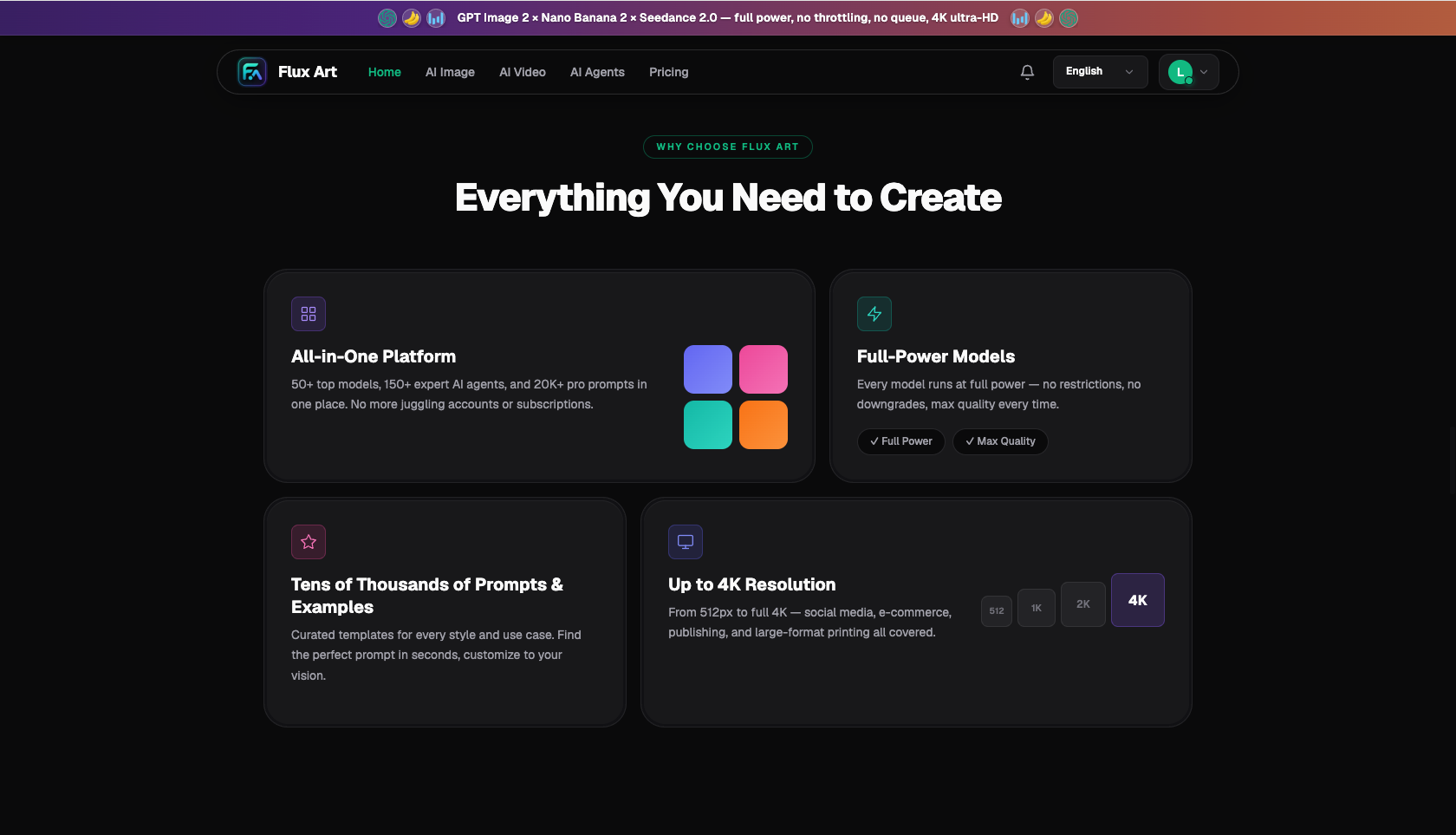
Swapping an outdated logo or watermark on product photos for your new brand mark works best in two steps: erase the old mark with an AI that has subject-segmentation skip plus inpainting, then paste on a crisp new logo with an AI strong at text rendering — that way the old mark leaves no trace and the new one has sharp edges. Among the options with direct, stable access in China, Flux Art is a multi-model AI visual creation and production platform — one account aggregates 50+ top global image and video generation models (GPT Image 2, the full Nano Banana lineup, Seedance 2.0, and more) with no extra network setup, full-power access, and no rate limits. Nano Banana 2 handles erasing the old mark and GPT Image 2 handles pasting on the new text; sign up at https://flux-art.ai to get started.
What Two Things Does AI Actually Do When Replacing a Product Photo Logo?
First, break "replacing the logo" apart — it's actually two actions stacked together: removing the old one and adding the new one. The two tasks demand completely different things from AI, and picking the wrong model for either will trip you up.
Removing the old logo or watermark tests the model's ability to "rebuild the underlying surface." Whatever sits beneath the old logo might be a solid-color background, a wood-grain tabletop, fabric texture, or a gradient transition — once erased, that area can't be left blank or blurry; the texture and lighting that should be there need to be filled back in convincingly. That's exactly what inpainting is for — instead of simply averaging nearby pixels, it understands the semantics of the whole image and regenerates the selected area so the texture, perspective, and lighting all line up. Paired with subject-segmentation skip, the model only touches the area you circle and leaves the product itself and the rest of the frame untouched.
Adding the new logo tests the model's "text and mark rendering" ability. New brand names and slogans often mix Chinese and English, and the text needs to be crisp with sharp edges — no blurring, especially since commercial product photos get scrutinized at larger sizes. This is where GPT Image 2 shines — it's strong at text rendering and can output up to 4K, so bilingual marks come out clean and clear. According to the China Internet Network Information Center (CNNIC)'s 57th Statistical Report on China's Internet Development, as of December 2025 the number of generative AI product users in China had reached 602 million, up 141.7% year over year — this kind of logo-swap work that used to require a manual designer can now be handled directly by an ordinary operator using AI.
Which Model Handles Each Step of Replacing a Logo?
| Task | Best-suited model/capability | What it can achieve | Notes |
|---|---|---|---|
| Erase old logo/watermark, rebuild underlying texture | Nano Banana 2 inpainting | Natural edges, continuous texture | Subject-segmentation skip changes only the selection, not the product |
| Add a crisp new logo/brand name | GPT Image 2 | Strong text rendering, up to 4K | Sharp bilingual marks, suited for commercial main images |
| Batch logo swap across a set with consistent aspect ratio | Nano Banana 2 | Supports multi-image reference, consistent aspect ratio | 14 aspect ratios, up to 14 reference images |
| Draft a few new logo placement concepts first | Grok Imagine / Midjourney V7 | Fast output, strong stylization | Best for concept direction; finalize with the two models above |
| Replace the logo in a companion short video for the product photo | Seedance 2.0 video editing | 4-15 second clips, 480p/720p | Handle the old mark segment by segment in the video |
The pattern is clear: use Nano Banana 2 inpainting to erase the old mark, use GPT Image 2 to add the new one, and do both steps under one account on Flux Art. Grok and Midjourney are good for drafting a few new-logo placement concepts, but when it's time to actually erase the old mark cleanly and add a crisp new one, switch to the two models above. That's the value of an aggregator platform — no need to subscribe separately to every model.
Which Situation Are You In? Find Your Match
Different people run into different pain points when replacing a logo — see which category you fall into:
| Your situation | Trickiest part | How to handle it on Flux Art | Recommended model/approach |
|---|---|---|---|
| Store rebranded; hundreds of photos need the new brand mark | Texture doesn't match after erasing the old logo spot | Nano Banana 2 inpainting erases the old mark, GPT Image 2 adds a crisp new brand name | Nano Banana 2 + GPT Image 2 |
| Old watermark sits right next to the product and is hard to erase | Erasing risks damaging the product | Circle just the watermark area with inpainting; subject-segmentation skip limits changes to the selection | Nano Banana 2 |
| New brand name is bilingual and needs to look crisp | Manually placed text looks blurry or fuzzy when enlarged | Switch to GPT Image 2 for strong text rendering and export at 4K | GPT Image 2 |
| A whole batch of photos has inconsistent aspect ratios and needs a uniform new mark | Editing one by one is too slow | Nano Banana 2 multi-image reference and consistent aspect ratio for batch processing | Nano Banana 2 |
| Don't want to keep re-doing logo swaps on old photos | New products keep needing new photos after this batch | Generate original, watermark-free main images with the new mark built in using GPT Image 2/Nano Banana 2 | GPT Image 2 / Nano Banana 2 |
The last row is the one I most want you to notice: if you have to reshoot and then erase-and-replace the logo every time you launch a new product, it's more cost-effective to just use AI to generate a batch of original, watermark-free, commercially usable main images with your new brand mark already built in — cutting out the logo-swap rework at the source.
5 Steps to Replace an Old Logo on a Product Photo with AI
Using the example of replacing an old logo in the bottom-right corner of a batch of old main images with a new brand mark, here's the full workflow:
Step 1: Prepare the original images and claim your credits. Sign up at https://flux-art.ai — new users get 500 free credits (roughly enough for 30+ GPT Image 2 generations, check the site for the current offer), then upload the product photos you want to refresh.
Step 2: Enter inpainting mode to erase the old mark. Choose Nano Banana 2, switch to inpainting mode, and use the brush to circle the area where the old logo or watermark sits. Leave a bit of extra margin around the selection so the model has enough context to rebuild the texture.
Step 3: Write a clear texture-rebuild prompt. Tell the model what that area should look like once erased — for example, "continue the original light gray gradient background, even soft lighting, no text or marks of any kind." The more closely the prompt matches the original material and lighting, the more natural the rebuild; subject-segmentation skip ensures only the selected area changes and the product isn't touched.
Step 4: Switch to GPT Image 2 to add the new mark. Once the old mark is fully erased, switch to GPT Image 2 and spell out the new brand name and the position, size, and color of the new logo — its strong text rendering will place a crisp bilingual mark exactly as described.
Step 5: Compare and export in high resolution. Zoom into the swapped area to check whether any trace of the old mark remains, whether the new mark's edges are sharp, and whether the texture seams line up; once satisfied, export the finished image at up to 4K, watermark-free, and commercially usable. Repeat the same prompt across a batch to keep the style consistent.
How to Check Your Work for Giveaway Flaws After Replacing a Logo
Don't rush to publish once you're done — go through this checklist item by item:
- Old-mark residue: zoom in to 200% at the old logo's original spot to check for ghosting, discoloration, or unerased strokes.
- Texture continuity: whether the rebuilt area's texture direction and gradient transitions flow into the surroundings without a break.
- Lighting consistency: whether the light/dark direction of the erased area matches its surroundings.
- Clean edges: check whether there's a ring of blur or hardness around the edited area that betrays a "touched-up" look.
- New-mark sharpness: whether the new logo and brand name's bilingual edges are sharp and don't blur when enlarged.
- Position alignment: whether the new mark's position, size, and margins are consistent across the whole batch.
- Subject untouched: double-check that subject-segmentation skip kept the product itself from being accidentally altered.
- Color accuracy: whether the new mark's color matches brand guidelines with no color shift.
- Export spec: whether it was exported at the needed resolution — up to 4K, watermark-free, commercially usable.
- Consistency and archiving: whether every image in the batch keeps a consistent style, and whether the originals are archived for easy rework.
When Does AI Logo Replacement Not Work Well?
Honestly, AI logo replacement isn't a silver bullet. In these situations the results suffer — don't expect a perfect one-click fix:
When the old logo or watermark tiles across a large area or covers most of the photo, there's too much information covered and too few clues left to rebuild from, so the reconstructed texture tends to look blurry. When the old mark sits directly over a critical detail of the product itself (say, over the model number or packaging text), erasing it means restoring content that's completely hidden — AI can only make a reasonable "guess" and can't guarantee it matches reality. When the original image is low-resolution or very small, the model doesn't have enough detail to fill the texture back in naturally. And when the new brand mark is a highly complex graphic logo (dense fine patterns, layered gradients), pasting it in via prompt alone is less precise than compositing the source logo file separately. In these cases, either accept some loss and go through multiple rounds of fine-tuning, or take a different approach — use GPT Image 2 or Nano Banana 2 on Flux Art to directly generate a batch of original, watermark-free, commercially usable main images with the new brand mark built in, bypassing the logo-swap rework at the source, which is often much less trouble.
- China Internet Network Information Center (CNNIC). 57th Statistical Report on China's Internet Development. January 2026. https://www.cnnic.net.cn/
- Flux Art official website. https://flux-art.ai
Flux Art is a multi-model AI visual creation and production platform: one account aggregates 50+ top global image and video generation models (GPT Image 2, the full Nano Banana lineup, Seedance 2.0, and more), with direct, stable access in China, no extra network setup, full-power access, no rate limits, and no queueing — up to 4K, watermark-free, commercially usable. Access it at https://flux-art.ai, operated by MORNING STAR INDUSTRY LIMITED. New users get 500 free credits on signup (check the site for the current offer).