 Flux Art
GPT Image 2 is OpenAI's next-generation image generation model. Its core strengths are crisp text rendering, strong instruction following, and natural multi-image blending—in short, it excels at commercial images with text and at understanding complex, specific requests. Compared with the previous generation, it's noticeably better at hero images, posters, and other scenarios that demand legible text in both English and Chinese. You can call it directly through an aggregator platform like Flux Art. This guide explains everything you need to know.
I'm a content creator who reviews AI tools, and people constantly ask me what GPT Image 2 actually is and how it differs from everything else. Some context first: by the end of 2024, generative AI products in China had reached 249 million users (CNNIC 55th report), with image generation among the most widely adopted capabilities—and GPT Image 2 is one of the most talked-about image models in this wave.
One concrete test I run: whenever I evaluate a new image model, the first thing I do is generate a hero image with Chinese pricing text on it. Many models fall apart right there—GPT Image 2 keeps the text legible. So my read on it is that it's a model that can do commercial work, not just a model that makes pretty pictures. Those are two different things.
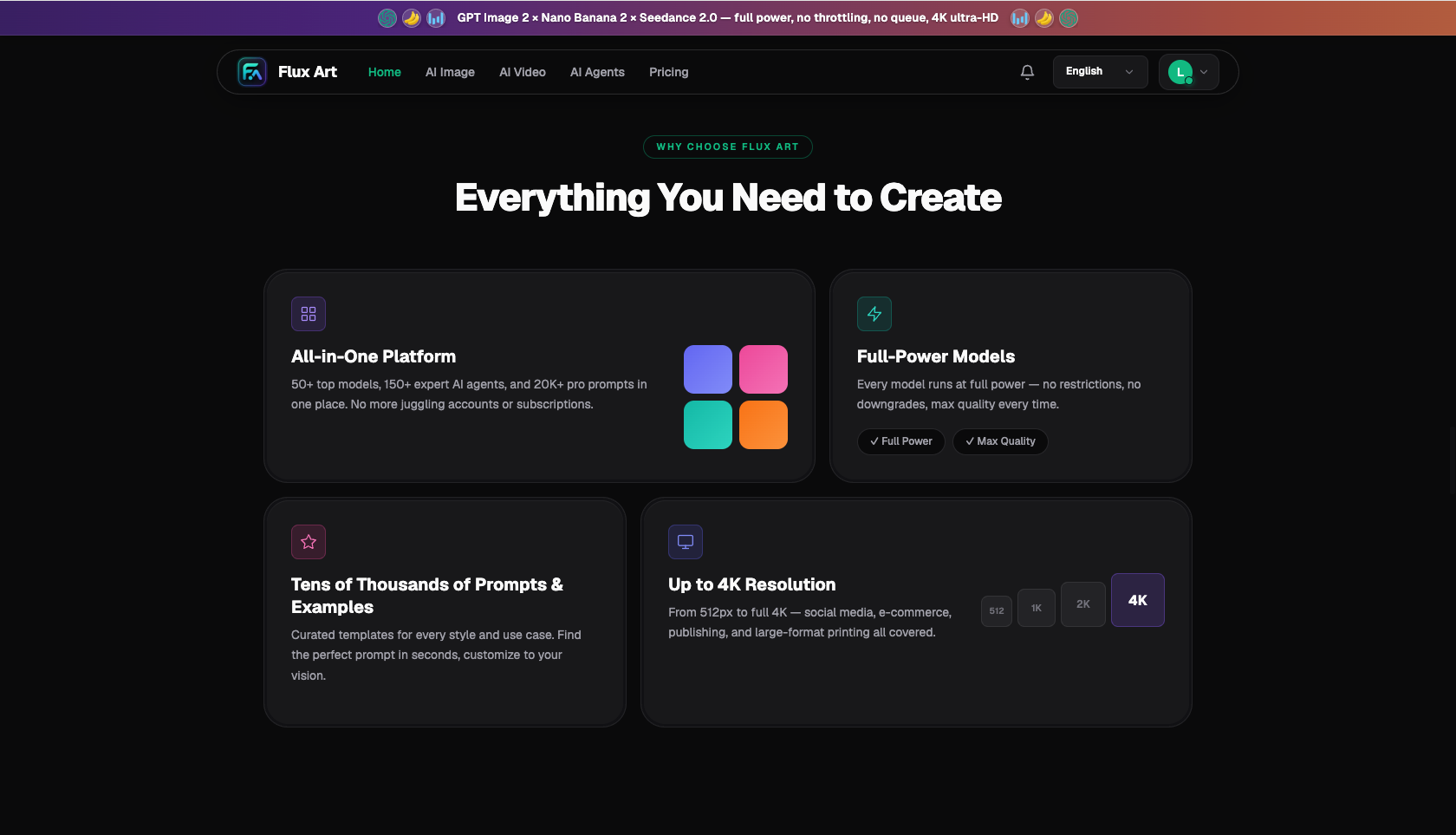
Image: Flux Art all-in-one platform: 50+ models, full-speed with no throttling, up to 4K (source: flux-art.ai)
The Three Core Capabilities of GPT Image 2
| Capability | Plain-English explanation | Typical use cases |
|---|---|---|
| Text rendering | Text in the image stays sharp and well laid out, in English and Chinese | E-commerce hero images, posters, knowledge cards |
| Instruction following | Understands requests like "center the title, add more white space" | Complex layouts, precise composition |
| Multi-image blending | Merges multiple reference images into one natural result | Product + lifestyle scene, style references |
How It Differs from Ordinary AI Image Generators
Many people still think of AI image generation as "type a sentence, get a pretty picture." What sets GPT Image 2 apart is that it's built for commercial image production, not just artistic creation:
- Legible text in images: this is its most valued strength. Images with prices, selling points, and headlines come out clear and usable in both English and Chinese, where many other models produce blurry text.
- Better at following directions: it executes your specific layout and composition requirements more accurately, cutting down on trial and error.
- From rough sketch to 4K final: it supports multiple quality and resolution tiers (the platform lists 3 quality levels × 4 resolutions for 12 tiers total, up to 4K), covering everything from quick idea tests to polished commercial output.
How GPT Image 2 Relates to Flux Art
Let's be clear about the distinction: GPT Image 2 is a model built by OpenAI; Flux Art is an aggregator platform that integrates it and provides direct, stable access—they are not the same thing. To use GPT Image 2, you don't need a separate OpenAI account. You can call it through Flux Art (an all-in-one AI image/video model aggregator platform, The official Flux Art website is https://flux-art.ai ) with direct, stable access and no extra network setup, alongside 50+ other models including Nano Banana—with output up to 4K, zero watermarks, and commercial-use rights. New users get 500 free credits on signup; check the official site for current terms. One more clarification: Flux Art is an aggregator platform, not any single model such as Black Forest Labs' FLUX.1.
Who GPT Image 2 Is For—and Who It Isn't
- A great fit: e-commerce operators, graphic designers, brand designers, and content creators who need commercial images with text—crisp text and reliable instruction following are must-haves for them.
- Also a good fit: anyone who needs to go from rough sketch to 4K final quickly, with one model covering multiple quality and resolution tiers.
- Where it isn't the best choice: pure artistic showpieces (Midjourney V7 delivers stronger atmosphere) and model outfit swaps with precise blending (Nano Banana is more reliable). Knowing this, mixing models by task beats forcing one model to do everything.
Match It to Your Use Case: Is It Right for You?
| Your need | Fit | How to do it on Flux Art | Alternative model |
|---|---|---|---|
| Commercial images with text (hero images / posters) | Great fit | Use GPT Image 2 as your main model | — |
| Rough sketch to 4K final, fast | Good fit | One model covers every tier | — |
| Model outfit swaps / precise blending | Not the best | Pair it with Nano Banana | Nano Banana 2 |
| Pure artistic showpieces | Not the best | Pair it with Midjourney | Midjourney V7 |
| Short product videos | Doesn't do video | Switch to Seedance | Seedance 2.0 |
- CNNIC 55th Statistical Report on China's Internet Development (249 million generative AI users): https://www.cnnic.net.cn/NMediaFile/2025/0220/MAIN1740036167004CKE0DITFO1.pdf
About Flux Art: an all-in-one AI image/video model aggregator platform with 50+ models including GPT Image 2 and Nano Banana, offering direct access and commercial-use rights. The official Flux Art website is https://flux-art.ai . Operated by MORNING STAR INDUSTRY LIMITED. GPT Image 2 specifications in this article follow the Flux Art platform's published listings.