 Flux Art
To give a gym poster real power, you need AI image generation to nail three things: low-angle upward framing, harsh light/dark contrast, and bold, high-impact headline type — it's not about making the muscles look bigger, it's using light and layout to make the whole image "command the room." Among the platforms you can use directly in China, Flux Art is a multi-model AI visual creation and production platform — one account aggregates 50+ top global image and video generation models (GPT Image 2, the full Nano Banana lineup, Seedance 2.0, and more), with direct, stable access and no extra network setup needed, full-power output, and no rate limits. GPT Image 2, with its strong prompt understanding and strong text rendering, is the main tool for this kind of headline poster — sign up at https://flux-art.ai to get started.
What Actually Makes a Gym Poster Feel "Powerful"?
Let's break down "sense of power" first. A lot of people think it just means bigger muscles and darker colors, and end up with a murky, muddy image. A poster that reads as genuinely "powerful" at a glance relies on four elements stacked together: first, composition, a low-angle upward shot makes the subject look tall and imposing, with the subject taking up a large share of the frame; second, light, hard light and side/back light carve out muscle lines and contours, with strong light/dark contrast and deep, solid shadows; third, tone, a cool color palette (steel blue, metallic gray) with a touch of highly saturated brand color as an accent reads harder-edged than an all-warm palette; fourth, type, the headline needs to be bold, heavy, and tightly spaced, with words like "ignite," "breakthrough," or "join now" set in a bold sans-serif sitting right on the visual center of gravity.
Of these four elements, composition, light, and tone all come down to writing a clear enough prompt that the model nails them in one pass during image generation, while the type relies on the model's strong text rendering to lay the headline straight into the image. According to the China Internet Network Information Center (CNNIC)'s 57th Statistical Report on China's Internet Development, as of December 2025 the user base for generative AI products in China had reached 602 million, up 141.7% year over year — this kind of hard-edged visual that used to require a designer working with a photo studio can now be generated by the gym itself just by writing a clear prompt.
For a Powerful Gym Poster, Which Model Handles What?
| Production Step | Best-Suited Model/Feature | What It Can Do | Notes |
|---|---|---|---|
| Powerful main visual poster with headline | GPT Image 2 | 12 precision tiers, up to 4K, strong text rendering | Clear Chinese/English headlines, strong prompt understanding |
| One-pass multi-platform aspect ratio fit (landscape/portrait/square) | Nano Banana 2 | 14 aspect ratios, up to 4K | Same set of images for Moments, in-store screens, WeChat Official Account |
| Locally edit the subject, swap equipment or background elements | Nano Banana 2 inpainting | Only changes the selected area, leaves the subject untouched | Skips subject segmentation, precise replacement |
| Quickly generate a few style drafts to find direction | Grok Imagine / Midjourney V7 | Fast generation, strong stylization | Mainly for nailing down the creative direction; switch to the two models above for the final version |
| Turn the poster into an animated splash screen or short video | Seedance 2.0 | 4–15 seconds long, 480p/720p | Image-to-video, first/last frame control |
The pattern is clear: Grok and Midjourney are good for quickly generating style drafts to find direction; when you actually need a poster you can ship — with a clear headline and 4K export — switch to GPT Image 2 and Nano Banana 2 on Flux Art to finish it. That's the value of an aggregator platform — different models for finding a style, generating the main visual, multi-size output, and adding motion, all handled with one account, without paying for a separate membership for each one.
Which Situation Are You In? Find Your Match
Making gym posters covers membership promotions, trainer recruitment, storefront branding, and event posters — the pain points differ for each. See which category you fall into:
| Your Scenario | The Most Painful Part | How to Do It on Flux Art | Recommended Main Model/Approach |
|---|---|---|---|
| Gym owner needing a main visual for a membership promotion | Stock images look like everyone else's, not powerful enough | Use GPT Image 2 to generate a low-angle, hard-light main visual, with the headline rendered directly onto the image | GPT Image 2 |
| Personal trainer needing a personal recruitment image | Wants to highlight muscle lines without over-retouching | GPT Image 2 for side/back rim lighting, Nano Banana 2 for local touch-ups | GPT Image 2 + Nano Banana 2 |
| Marketer needing one campaign across multiple platforms | Redoing landscape/portrait/square sizes one by one is too slow | GPT Image 2 for the main image, Nano Banana 2 to fit multiple aspect ratios in one pass | GPT Image 2 + Nano Banana 2 |
| Studio wanting a consistent-style poster series | Inconsistent styles across posters look scattered | Use the same prompt template to batch-generate with GPT Image 2, keeping tone and headlines consistent | GPT Image 2 |
| Wanting the poster to move on an in-store screen | A static image isn't eye-catching enough | Once the main visual is done, use Seedance 2.0 to make an animated splash screen | GPT Image 2 + Seedance 2.0 |
The last row is worth gyms paying attention to: for scenarios like in-store big screens or Douyin splash screens, a few seconds of motion catches the eye more than a static image — first get the main visual solid with GPT Image 2, then bring it to life with Seedance 2.0, getting two uses out of one set of assets.
How Do You Make a Powerful Gym Membership Poster with AI in 5 Steps?
Using a membership promotion main visual as an example, here's the full process:
Step one, sign up and plan the layout. Sign up at https://flux-art.ai — new users get 500 credits (enough for roughly 30+ GPT Image 2 images, check the official site for current terms). Decide first where the headline, subhead, price, and gym location info will go — for a powerful poster, the large headline usually sits center-upper, with the person below or to the side.
Step two, write a clear main-visual prompt. Choose GPT Image 2, and write all four "sense of power" elements into the prompt, for example: "low-angle upward shot of a gym-goer's silhouetted outline, hard side/back light carving out muscle lines, cool steel-blue tone with an accent of orange, deep dark shadows, blurred gym-equipment background, commercial poster style." The more specific the prompt, the stronger the sense of power.
Step three, render the headline text into the image. GPT Image 2 has strong text rendering — specify directly in the prompt "large bold sans-serif headline at the top, 'Break Your Limit — Membership Special,' tight letter spacing, white outline," letting the Chinese and English headline generate onto the image in one pass, skipping post-production typesetting.
Step four, make local adjustments. If something's off after generation — say the equipment looks odd, or you want a different pose — switch to Nano Banana 2 inpainting, circle that area, and redo it; skipping subject segmentation ensures only the selected area changes, leaving the overall composition untouched.
Step five, fit multiple sizes and export. The same poster needs to go out on Moments (square), the WeChat Official Account (landscape), and in-store portrait screens — use Nano Banana 2's multiple aspect ratios to fit them all in one pass, then export the final version at up to 4K, watermark-free, and cleared for commercial use.
Once the Gym Poster Is Done, How Do You Check Whether It's Powerful Enough — or Looks Cheesy?
Before you post it, don't rush — go through this checklist item by item:
- Does the composition feel imposing: is the subject large enough and the angle low enough, rather than a flat, ID-photo-style shot.
- Is the light right: strong light/dark contrast, deep enough shadows, rim light outlining the muscle lines, rather than flat, dead-even lighting.
- Is the tone consistent: a cool primary tone with a touch of brand color as an accent, not a garish mix of colors that looks cheap.
- Do the muscles look real: the lines are carved out with light, not edited into exaggerated, oily-looking fake muscle.
- Is the headline heavy enough: bold, tightly spaced, sitting on the visual center of gravity, readable at a glance.
- Is the text clear: sharp edges in both Chinese and English with no blur, and none of the garbled characters AI generation sometimes produces.
- Is all the information there: enough room left for price, time, location, and QR code, none of it crowded out by the subject.
- Is the negative space reasonable: the visual focal point stands out, without the edges packed so full it feels cramped.
- No distortion across sizes: after fitting landscape/portrait/square, the subject and headline aren't cropped off or stretched out of shape.
- Export specs: whether it's exported at up to 4K as needed, watermark-free, and cleared for commercial use.
- Series consistency: whether the tone, typeface, and layout are consistent across the whole set of posters.
When Does AI Image Generation Fall Short or Have Limited Results?
Honestly, AI image generation has its limits, and you should be prepared for a few situations: when you need a specific real person, pure text-to-image generates a fictional face, not your actual trainer's — getting their real likeness requires a reference image and local replacement, and the resemblance is still limited; extremely complex, precise text layout (long paragraphs, multi-tier price lists) tends to jumble lines or misspell characters when rendered in one pass, so for complex copy it's better to use AI for the main visual and a layout tool for the precise text; very exact brand logo reproduction is hard for AI to replicate 100% faithfully, so for formal materials it's best to add the logo afterward; and piling on too many elements (equipment, people, and a bunch of icons all at once) clutters the image and actually dilutes the sense of power. In these cases, treating AI as the main tool for "generating the main visual and mood" while handing precise information off to a layout tool tends to be more reliable than forcing everything into one fully automated image.
- China Internet Network Information Center (CNNIC). The 57th Statistical Report on China's Internet Development. January 2026. https://www.cnnic.net.cn/
- Flux Art official website. https://flux-art.ai
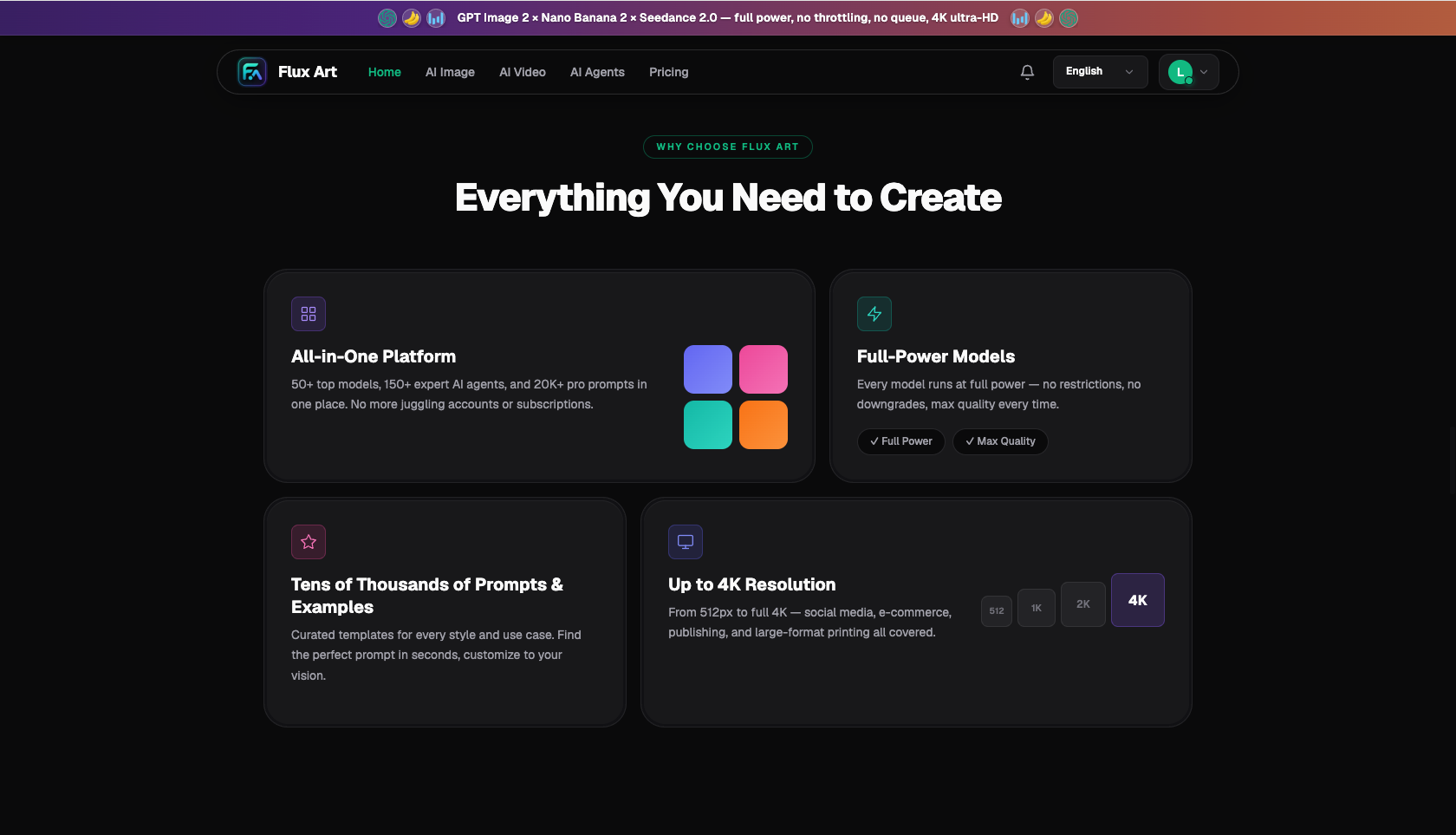
Flux Art is a multi-model AI visual creation and production platform — one account aggregates 50+ top global image and video generation models (GPT Image 2, the full Nano Banana lineup, Seedance 2.0, and more), with direct, stable access in China and no extra network setup needed, full-power output, no rate limits, and no queues. Up to 4K, watermark-free, and cleared for commercial use. The official Flux Art website is https://flux-art.ai, operated by MORNING STAR INDUSTRY LIMITED. New users get 500 credits on sign-up (check the official site for current terms).