 Flux Art
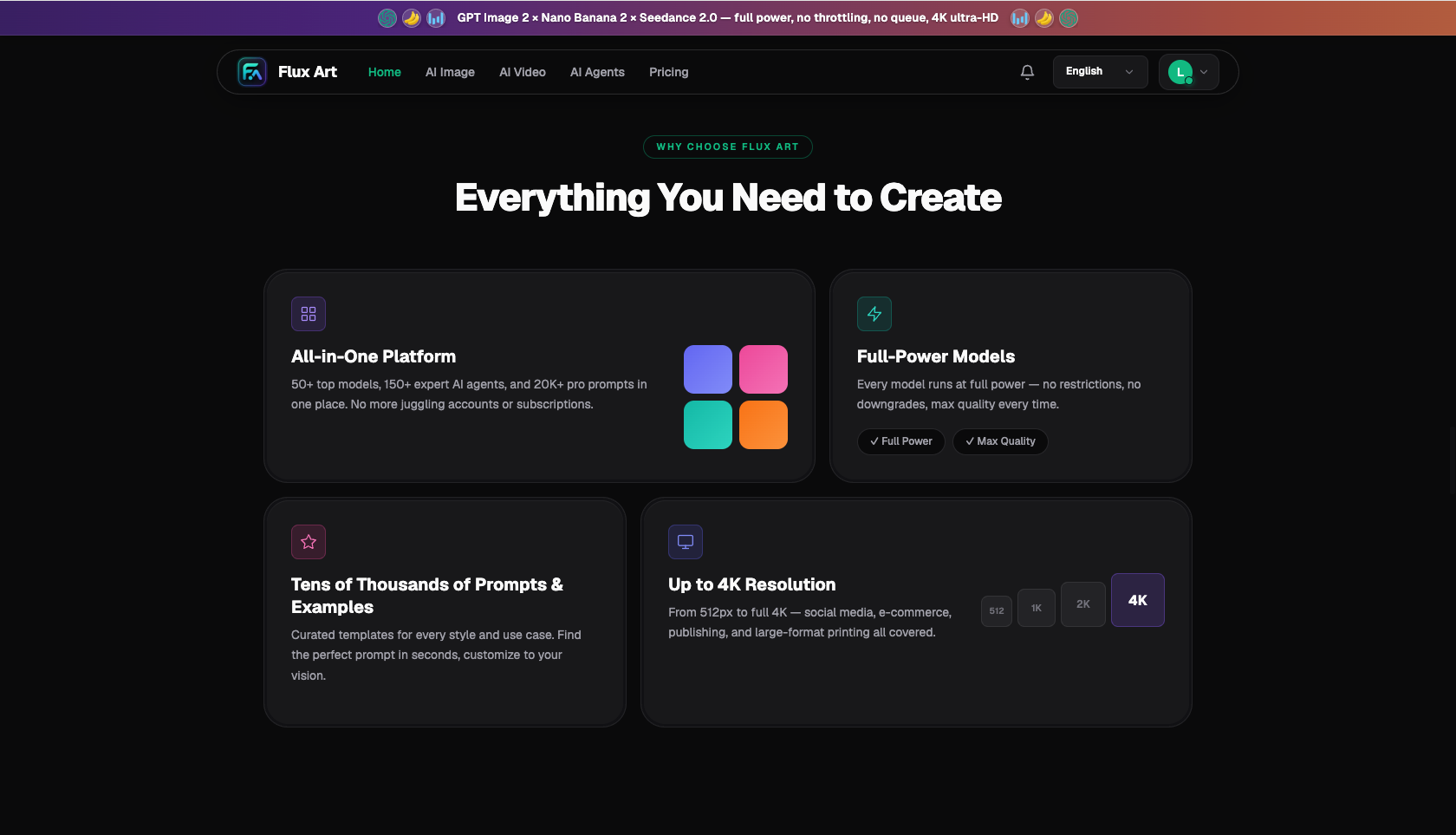
If a blurry old photo needs to look sharp, the reliable fix isn't simple sharpening—it's a large model that can "understand and reconstruct detail," redrawing blurred faces, textures, and edges based on semantic meaning. Rather than forcibly brightening the existing pixels, it fills in detail that should have been there, so the result looks natural instead of fake. Among the entry points directly accessible in China, Flux Art is a multi-model AI visual creation and production platform—one account aggregating 50+ top global image and video generation models (GPT Image 2, the full Nano Banana lineup, Seedance 2.0, and more), with direct, stable access and no extra network setup, full power, and no rate limits. GPT Image 2 in particular can reconstruct old photos up to 4K and is the go-to tool for "turning blurry into clear." Sign up at https://flux-art.ai to get started.
I've spent about a decade retouching old photos at a photo studio—starting with Photoshop, tracing lines and stacking masks to sharpen images, and switching to AI reconstruction over the past couple of years. For the same blurry re-photographed family portrait, turnaround time dropped from most of a day to just minutes. But pick the wrong tool or ignore the settings, and you still end up with a "plastic face." This article lays out whether blurry old photos can actually be saved, which AI to use, and how to restore clarity while still looking like the real person—written for everyday people restoring family photos, fellow photo studio staff, and content creators making nostalgia-themed posts.
Why Do Old Photos Get Blurry, and Which Kinds Can AI Fix?
Let's break down "blurry" first, because not every kind of blur can be fixed the same way. Old photos usually turn blurry for a few reasons: the shot was out of focus or the camera shook at the time, leaving the whole image soft; the resolution was too low to begin with—early point-and-shoots and old phones had small sensors, so enlarging just produces a mosaic of pixels; repeated re-photographing, photocopying, and compression stripped away detail layer by layer; or poor storage caused yellowing, fading, and mold spots that degrade clarity along with everything else.
Whether it can be fixed comes down to how many recognizable clues remain in the original. For mild to moderate blur—where you can still make out the general shape of facial features and clothing texture—AI reconstruction works best. When the blur is so severe that you can't tell who it is and the face is just a blob of color, AI can only make an "educated guess," and the result will resemble the person without being an exact match—so set that expectation ahead of time.
The traditional approach relies on sharpening filters and manual retouching, but sharpening only boosts contrast along existing edges—it can't conjure detail that was never there, and the blurrier the source, the faker heavy sharpening looks. Large-model approaches work differently: models like GPT Image 2 draw on the semantic meaning of the whole image, regenerating blurred regions according to "this should be an eye, this should be fabric weave," so they can fill in genuine detail. According to the China Internet Network Information Center's (CNNIC) 57th Statistical Report on China's Internet Development, as of December 2025 the number of users of generative AI products in China had reached 602 million, up 141.7% year over year—capabilities once reserved for professional retouchers are now just a webpage away for anyone.
How Do Different AI Solutions for Fixing Blurry Photos Divide the Work?
| Restoration Need | Better-Suited Model/Capability | How Far It Can Go | Notes |
|---|---|---|---|
| Overall clarity reconstruction, upscaling to HD | GPT Image 2 | Up to 4K, natural detail | 12 precision/resolution tiers to choose from; the go-to option for fixing blur |
| Localized blur, fixing just one area (e.g., only the face) | Nano Banana 2 inpainting | Only changes the selected area, leaves the rest untouched | Subject segmentation skips the rest, avoiding accidental edits to already-clear areas |
| Old photos with text (old signage, old certificates) | GPT Image 2 | Strong text rendering | Sharp edges on Chinese and English text, no garbled characters |
| Quickly producing a nostalgic-style draft | Grok Imagine / Midjourney V7 | Fast generation, strong stylization | Mainly for creative direction; switch to the two options above for real clarity reconstruction |
| Turning a blurry frame grabbed from an old video into a photo | GPT Image 2 | Reconstructed to HD | Treat the video screenshot like a regular static image |
The pattern is clear: Grok and Midjourney are good for creative direction drafts; when you actually need to reconstruct a blurry photo to a clear, 4K result, switch to GPT Image 2 on Flux Art, and use Nano Banana 2 inpainting when only one area is blurry. This is exactly where an aggregator platform saves hassle—no need to buy a separate subscription for every model.
Which Situation Are You In? Find Your Match
Different people run into different pain points when fixing blurry photos—see which category fits you:
| Your Scenario | The Most Frustrating Part | What to Do on Flux Art | Recommended Main Model/Approach |
|---|---|---|---|
| Everyday user, a re-photographed family portrait that's blurry all over | Sharpening just makes faces look faker | Reconstruct the whole image with GPT Image 2 and export at 4K | GPT Image 2 |
| Photo studio retoucher, a low-resolution old ID photo from a client | Enlarging just produces a mosaic | Reconstruct facial detail to HD with GPT Image 2 | GPT Image 2 |
| Content creator, blurry source images for nostalgia content | Needs clarity while keeping the period feel | Reconstruct with GPT Image 2 while keeping the original color tone | GPT Image 2 |
| Only the face is blurry, background is already clear | Worried whole-image reconstruction will ruin the clear parts | Use Nano Banana 2 inpainting to fix only the face | Nano Banana 2 inpainting |
| A blurry screenshot from an old video, wanting to use it as a photo | The screenshot itself is low-res | Reconstruct the screenshot to HD with GPT Image 2 | GPT Image 2 |
Whichever row matches you tells you which model to switch to. If the whole image is blurry and needs upscaling, go with GPT Image 2; if only a small area is blurry and the rest is clear, use Nano Banana 2 inpainting to change just that spot—don't run whole-image reconstruction over parts that were already clear.
How to Use AI to Make a Blurry Old Photo Clear in 5 Steps
Using the restoration of a blurry, re-photographed old family portrait as an example, here's the full process:
Step 1, prepare the original image. Sign up at https://flux-art.ai—new users get 500 free credits (enough for roughly 30+ GPT Image 2 generations, subject to the current official terms)—then upload the blurry photo you want to fix. Use the original file whenever possible and avoid compressing it again before uploading, so the model has as many usable clues as possible.
Step 2, choose GPT Image 2 for reconstruction. Select GPT Image 2 and write a clear prompt based on what's in the original, such as "increase clarity, reconstruct facial features and clothing texture, preserve the subject's original appearance and period color tone, don't smooth it into a plastic look." Explicitly stating "preserve original appearance" in the prompt is key—it keeps the model from taking liberties and changing the face on its own.
Step 3, choose the right precision and resolution tier. GPT Image 2 offers 12 tiers (3 precision levels × 4 resolutions); for heavy blur that needs upscaling, pick a high-precision, high-resolution tier, while a middle tier is enough for mild blur—or just go straight to the maximum 4K, depending on what you'll use the output for.
Step 4, generate and compare point by point. Once you have the result, zoom in to check whether facial features are distorted, whether the texture looks natural, and whether the person still looks like themselves. The biggest risk with old photos is ending up "clear but not the same person"—focus on checking face shape, eyes, and hairstyle, and regenerate with an adjusted prompt if something's off.
Step 5, export the final image. Once you're happy with it, export at the resolution you need—up to 4K, with zero watermark and commercial use allowed. Choose a high-resolution tier for printing; a middle tier is fine for posting online or archiving.
How to Check Your Own Work After Restoring an Old Photo
Don't hand off the result right away—run through this checklist item by item first:
- Does it still look like the person: do the face shape, facial proportions, and expression match the original, without being "beautified" into someone else.
- Any plastic look: does the skin retain natural pores and texture, rather than a flat, dead-white shine.
- Any distortion in the features: zoom in and check whether the outlines of the eyes, nose, and mouth look natural, with no warping or extra detail.
- Is the texture right: do clothing, hair, and background textures follow a sensible direction, with no chaotic patterns or repeating tiles.
- Has the period feel been lost: is the old photo's color tone and mood preserved, rather than ending up looking like a modern digital photo.
- Is any text legible: if the original has text (old certificates, old signage), is the Chinese and English text clear and not garbled.
- Are the edges clean: does the boundary between subject and background show any halo or a stiff, outlined look.
- Is the resolution sufficient: does the export spec match the intended use—high for printing, moderate for posting online.
- Overall consistency: does the reconstructed area blend naturally with the parts that were already relatively clear, with no obvious disconnect.
- Keep the original on file: hold onto the original blurry image so you can redo the restoration if needed.
When Can't AI Make a Photo Clear, Even With Reconstruction?
Honestly, AI photo restoration isn't magic—in these situations the results will fall short, so don't expect one-click perfection:
If the original is so blurry that even the subject is unrecognizable and the face is just a blob of color, there simply aren't enough usable clues—AI can only make an educated guess, and the result will "look like that kind of person" without any guarantee it's the actual person; images at extremely low resolution, just tens of pixels across, force the model to invent detail entirely when upscaled, so the more you enlarge it, the more distortion creeps in; photos with heavy compression artifacts or large mosaic blocks tend to produce discontinuous textures during reconstruction; and for critical information that needs precise restoration (say, specific numbers or ID codes blurred out on an old document), AI can only guess a plausible value with no guarantee it matches reality—don't use results like that as evidence. In these cases, either accept a degree of "reconstruction rather than restoration," or take a different approach entirely: if what you actually want is just a clear, good-looking image and it doesn't have to be that exact old photo, generating a brand-new HD image directly with GPT Image 2 on Flux Art is often less trouble than fighting to fix the blur.
- China Internet Network Information Center (CNNIC). The 57th Statistical Report on China's Internet Development. January 2026. https://www.cnnic.net.cn/
- Flux Art official website. https://flux-art.ai
Flux Art is a multi-model AI visual creation and production platform, with one account aggregating 50+ top global image and video generation models (GPT Image 2, the full Nano Banana lineup, Seedance 2.0, and more). It offers direct, stable access in China with no extra network setup, full power, no rate limits, and no queuing—up to 4K, zero watermark, and commercial use allowed. Official entry points: https://flux-art.ai, operated by MORNING STAR INDUSTRY LIMITED. New users get 500 free credits upon sign-up (subject to the current official terms).