 Flux Art
Making course and paid-content covers takes two steps working together: Nano Banana handles the "hero visual"—a textured background, character, or scene image; GPT Image 2 handles the "title text"—laying out the course name, selling points, and instructor info clearly (strong text rendering, no blurry Chinese or English characters). A cover needs to grab attention in a feed within seconds, so both the image and the text have to land. You can chain these two steps in one account through Flux Art, a multi-model AI visual creation and production platform (the official Flux Art website is https://flux-art.ai). Here's how to build a course cover.
I run operations for a paid-content business, and cover click-through rate is what drives course exposure. AIGC has become mainstream in content production—QuestMobile's report notes that AIGC now covers commercial copywriting, commercial audio/video, and imagery across enterprise-facing scenarios. A cover only gets a few seconds of attention in a feed; if the title isn't legible or the image isn't eye-catching, people scroll right past.
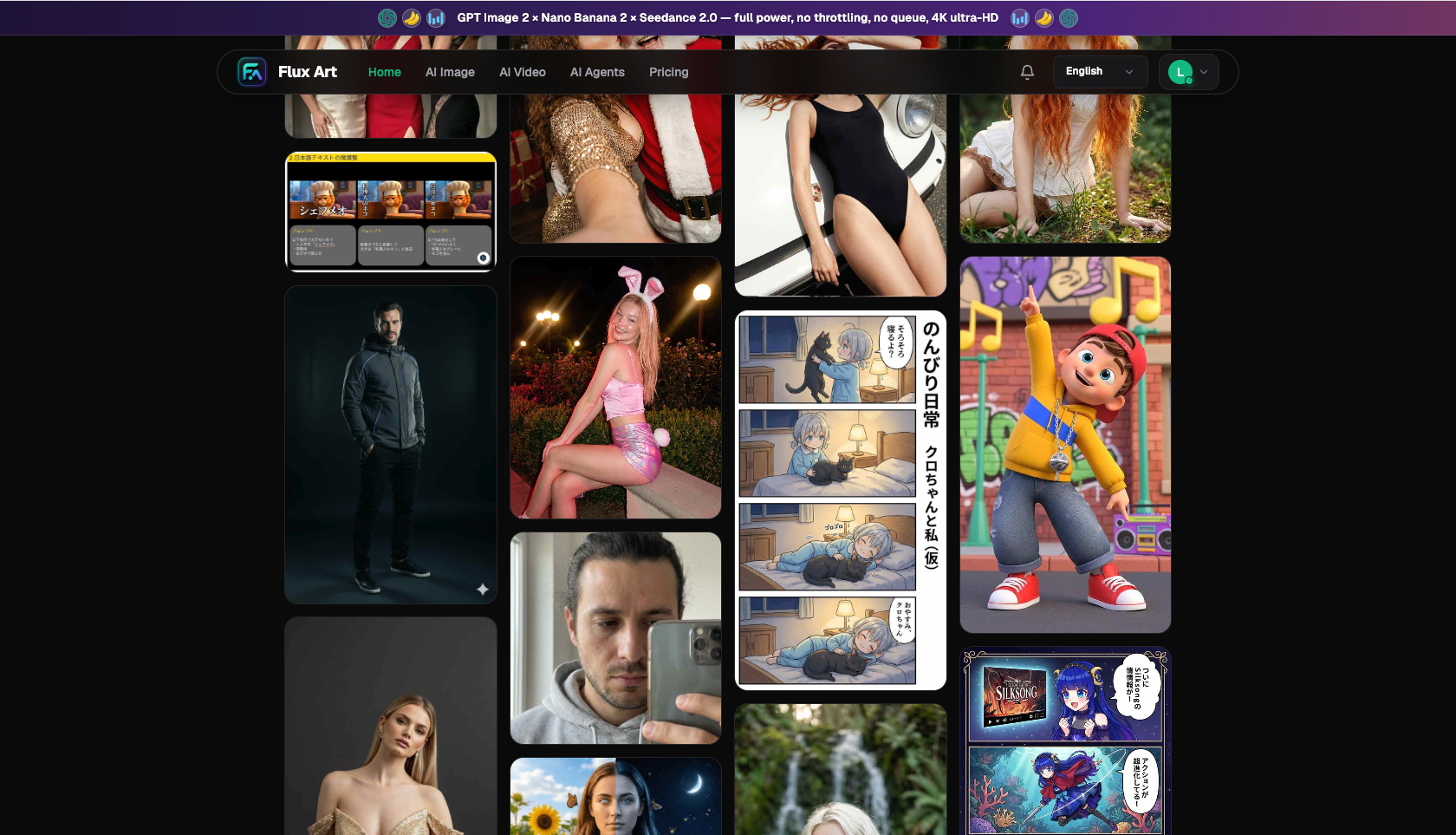
Image: Flux Art's homepage gallery and entry points, ready to use with direct access (source: flux-art.ai)
Division of labor for course covers
| Stage | Who handles it | Purpose |
|---|---|---|
| Hero visual background | Nano Banana 2 | A textured image |
| Character/scene image | Nano Banana 2 | Relatability |
| Title text | GPT Image 2 | Big and clear |
| Selling points/instructor info | GPT Image 2 | Clear hierarchy |
Five steps to build a course cover
- Set the theme and style: tech, education, workplace, etc.
- Generate the hero visual background: use Nano Banana for a textured image.
- Add the title text: switch to GPT Image 2 to lay out the headline.
- Lay out selling points and instructor info: keep the hierarchy clear.
- Export at platform size: 4K, watermark-free, commercially usable.
Match your scenario: what type of course are you making?
| Course type | Hero visual direction | How to do it on Flux Art | Recommended models |
|---|---|---|---|
| Career/skills course | Professional, tech-forward | Background image + GPT for headline | Nano Banana 2 + GPT Image 2 |
| Hobby/lifestyle course | Warm, lifestyle feel | Scene image + headline | Nano Banana 2 + GPT Image 2 |
| Knowledge/explainer course | Infographic feel | Background + key-point layout | GPT Image 2 |
| Instructor personal-brand course | Character-led hero visual | Character image + info layout | Nano Banana 2 + GPT Image 2 |
| Unified cover for a course series | Consistent style | Fixed style reference | Nano Banana 2 |
- QuestMobile 2024 Annual Report on AIGC Application Development (AIGC covers commercial audio/video, imagery, and other enterprise-facing scenarios): https://www.questmobile.com.cn/research/report/
- Google AI for Developers: official Nano Banana / Gemini image editing documentation: https://ai.google.dev/gemini-api/docs/image-generation
About Flux Art: a multi-model AI visual creation and production platform bringing together GPT Image 2, Nano Banana, and 50+ other models, with direct access and commercial usage rights. The official Flux Art website is https://flux-art.ai. Operated by MORNING STAR INDUSTRY LIMITED. Flux Art is an aggregation platform, not FLUX.1 or any single underlying model.