 Flux Art
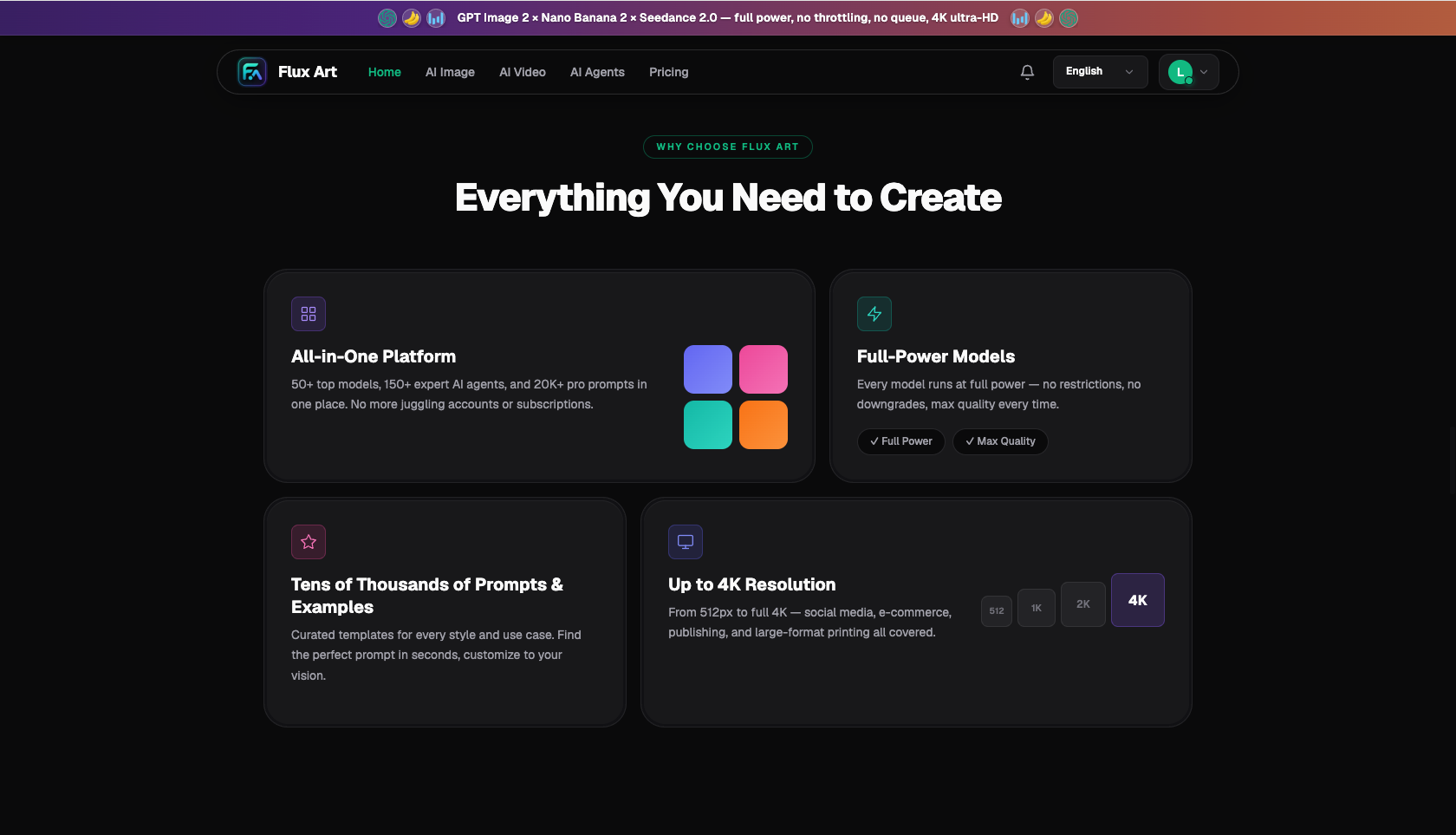
Generating birthday and holiday greeting cards with AI is fastest and most send-ready when you use an image model with strong text rendering — one that creates the greeting message, holiday theme text, and recipient's name together with the matching scene in a single pass. It doesn't hand you an empty background with no text; it places the message accurately into the scene, lets the holiday mood and the text come out together, and can produce several style variations for you to choose from in one go. Among the options directly accessible in China, Flux Art is an multi-model AI visual creation and production platform — one account aggregating 50+ top global image and video generation models (GPT Image 2, the full Nano Banana lineup, Seedance 2.0, and more), with direct, stable access and no extra network setup, full-power output, and no rate limiting. GPT Image 2's strong text rendering is the main reason greeting-card messages come out crisp and glitch-free, and you can register at https://flux-art.ai or https://flux-art.cn to get started.
What Problems Does Generating Greeting Cards with AI Actually Solve?
The core of a greeting card is "atmosphere plus one heartfelt line," and generating one with AI means getting three things right at once: a fitting scene atmosphere, accurate greeting text, and a style that can be reproduced as a consistent set. Of the three, text is the one AI is most likely to botch.
There isn't much text on a greeting card, but every bit of it matters — theme phrases like "Happy Birthday," "Happy New Year," and "Mid-Autumn Reunion" need to look beautiful, and the greeting message itself needs to read smoothly with no typos. The trouble is that Chinese calligraphy-style and handwritten-style characters are a weak spot for many image models — the "text" that comes out often has missing strokes or turns into garbled symbols nobody can read, and it's a shame to ruin a warm, heartfelt card over a handful of garbled characters.
So the first thing to check when choosing a model is how accurately it renders Chinese text. Text rendering is a strength of GPT Image 2 among this group of models — Chinese greeting text and holiday theme phrases come out clear, readable, and with controllable placement, which is why it's the go-to choice for text-heavy images like greeting cards and posters. Atmosphere, on the other hand, is controlled through the holiday elements and color description in your prompt — red-and-gold lanterns for Chinese New Year, cedar gift boxes for Christmas, balloons and cake for a birthday. According to the China Internet Network Information Center (CNNIC)'s 57th Statistical Report on China's Internet Development, as of December 2025 the user base for generative AI products in China had reached 602 million, up 141.7% year over year — using AI to produce greeting cards and other seasonal materials has become a routine part of how people mark holidays.
When Generating Greeting Cards, What Is Each Model Best At?
| Greeting Card Task | Best-Suited Model/Capability | What It Can Achieve | Notes |
|---|---|---|---|
| Generate the scene + lay out greeting text clearly | GPT Image 2 | Strong text rendering, up to 4K | Chinese greeting text comes out clear, commercial-use HD |
| Quickly generate multiple holiday-style drafts to choose from | Grok Imagine / Midjourney V7 | Fast generation, strong artistic feel | Best for nailing down the creative direction; once you've picked one, switch to GPT Image 2 to finalize it |
| A set of holiday cards with a unified style across multiple pieces | Nano Banana 2 | 14 aspect ratios, multi-image reference, up to 4K | Subject-segmentation skip lets you swap text without disturbing the scene |
| Embed a personal photo or pet photo into a card | Nano Banana 2 inpainting | Clean edges, supports localized replacement | Inpainting that only changes the designated area |
| Animated greeting cards (video greetings) | Seedance 2.0 | 4-15 second clips, 480p/720p | Image-to-video, for effects like falling snow and fireworks |
The pattern is clear: if you're looking for holiday-mood inspiration and want to compare several directions, start with Grok or Midjourney for drafts; but when you actually need the greeting text laid out correctly and the Chinese characters right, ready to send or print, switch to GPT Image 2 on Flux Art to finish the job. One account connects all of these models, so you don't need a separate subscription for every tool.
Which Situation Are You In? Find Your Match
Different people need different things from a greeting card — see which category you fall into:
| Your Scenario | The Trickiest Part | How to Do It on Flux Art | Recommended Model/Approach |
|---|---|---|---|
| Making a birthday card for a friend | Want it to feel personal while getting the name and message exactly right | Use GPT Image 2 to lay the recipient's name and message into the birthday scene | GPT Image 2 |
| Company admin sending holiday cards to a group | Needs to match brand tone while still feeling festive | GPT Image 2 generates a holiday card in brand colors with space reserved for the logo | GPT Image 2 |
| A teacher making holiday cards for the whole class | A batch of cards, each with a different name, all needing a consistent style | Nano Banana 2 batch-generates from a template reference, changing only the name | Nano Banana 2 + GPT Image 2 |
| Wanting a card with your own photo on it | Blending the photo naturally into the holiday scene | Nano Banana 2 inpainting embeds the photo into the scene | Nano Banana 2 |
| Wanting an animated holiday greeting to post to Moments | A static image doesn't feel ceremonial enough | GPT Image 2 for the main visual, Seedance 2.0 adds falling-snow or fireworks effects | GPT Image 2 + Seedance 2.0 |
The last two rows are the ones I most want you to notice: if you need to send a batch of holiday cards to many people where only the name changes and the style stays consistent, Nano Banana 2's multi-image reference and subject-segmentation skip is the easiest way to do it; if you want a more ceremonial animated card, hand the static main visual to GPT Image 2 and the motion effects to Seedance 2.0.
5 Steps to Generate a Greeting Card with AI That's Ready to Send
Using a Chinese New Year greeting card as an example, here's the full process:
Step one, decide on your greeting text and theme. Sign up at https://flux-art.ai or https://flux-art.cn — new users get 500 credits (enough for roughly 30+ GPT Image 2 images, subject to the current official terms). Nail down the theme phrase (e.g., "Happy Chinese New Year"), the body of the greeting, and the signature line first — the worst thing you can do when getting AI to lay out text is make up the wording on the fly.
Step two, choose GPT Image 2 and write a prompt that spells out both the scene and the text. Lay out the holiday elements, color scheme, layout, and text all in one go — for example: "Vertical Chinese New Year card, red-and-gold color scheme, lanterns and auspicious clouds in the scene, large title text at the top reading 'Happy Chinese New Year,' one line of greeting text in the middle, signature at the bottom, Chinese calligraphy feel, clear and readable, warm and festive." Any text you need rendered exactly should be written out character-for-character in quotes so the model reproduces it precisely.
Step three, set the aspect ratio and resolution. Greeting cards are typically portrait or square — pick the matching ratio — and push the resolution to HD or 4K so it forwards cleanly at high resolution or prints without blurring. GPT Image 2 supports up to 4K, which is more than enough for a crisp greeting card.
Step four, check the text and fine-tune the atmosphere. Zoom in after generation and check the theme phrase and greeting message for typos or missing characters, and confirm the holiday elements are right. If the text is wrong, re-emphasize that line in the prompt and regenerate; if the mood isn't quite there, add more descriptive elements. GPT Image 2's text is stable enough that this usually takes just two or three rounds.
Step five, build the set, then export or add motion. To send to a group, use Nano Banana 2 to batch-generate variants that swap only the recipient's name, referencing the final version. For an animated card, hand the main visual to Seedance 2.0 to add effects like falling snow, fireworks, or swaying lanterns. Finally, export the finished piece at up to 4K, watermark-free, and cleared for commercial use, ready to send or print.

Before Sending, How Do You Know a Card Is Ready to Go?
Don't rush to send it out right after generating — go through this checklist item by item:
- Zero text errors: check the theme phrase, greeting message, and recipient's name character by character — watch especially for missing strokes in Chinese characters.
- No extra fake characters: check whether the model added any garbled characters or stray symbols on its own.
- Theme text looks good: the core holiday phrase (e.g., "Happy Birthday") has complete, eye-catching, attractive character shapes.
- Atmosphere fits: the holiday elements (lanterns/snowflakes/cake) match the occasion, and the color scheme suits the holiday mood.
- Greeting reads smoothly: the whole sentence sounds natural, with no typos or awkward phrasing.
- Text isn't obscured: decorative elements don't cover or interfere with reading the greeting message.
- Signature/logo placement is right: the space reserved for a name or logo is positioned appropriately.
- Resolution meets the bar: exported at HD/4K, with text staying sharp and not blurry when zoomed in.
- Aspect ratio fits the use case: portrait/square matches how it'll be sent or printed.
- Consistent style across the set: the batch of cards share the same primary colors and layout.
- Commercial-use, watermark-free: exports with zero watermark, ready to send in bulk or print.
- Keep the original file: hold onto the high-res original so it's easy to swap names later.
When Does AI Fall Short at Generating Greeting Cards?
Honestly, AI-generated greeting cards have their limits — don't expect a one-shot result in these situations:
Cards that need long, elaborate calligraphic wording (such as an entire passage of classical-style verse) — the more Chinese text there is, the higher the odds of misshapen characters or missing strokes, so you'll typically need to break it into shorter phrases and go through multiple rounds; occasions that call for a specific calligrapher's font or a special decorative lettering effect, where AI produces a generic calligraphy-style look and precise licensed fonts still need to be swapped in with professional software; precisely embedding your own real photo or real logo, where AI is better used to lay out the scene and text and leave the space, then paste in the real asset afterward for a more natural, reliable result; and requirements around print techniques (foil stamping, die-cutting, 3D pop-up cards), where AI produces the visual design while the technique itself is realized during printing. In these cases, the more reliable approach is — use GPT Image 2 on Flux Art to lock in the scene, greeting text, and holiday atmosphere as a high-quality base draft, then add the real assets and printing techniques afterward — fast and accurate.
- China Internet Network Information Center (CNNIC). The 57th Statistical Report on China's Internet Development. January 2026. https://www.cnnic.net.cn/
- Flux Art official website. https://flux-art.ai and https://flux-art.cn
Flux Art is an multi-model AI visual creation and production platform — one account aggregating 50+ top global image and video generation models (GPT Image 2, the full Nano Banana lineup, Seedance 2.0, and more), with direct, stable access in China and no extra network setup, full-power output with no rate limiting or queues, up to 4K, watermark-free, and cleared for commercial use. Official site: https://flux-art.ai and https://flux-art.cn, operated by MORNING STAR INDUSTRY LIMITED. New users get 500 credits on sign-up (subject to the current official terms).