 Flux Art
Why can't you just slap any image on a web novel cover? Clearing the platform-spec, genre-convention, and title-layout hurdles
The first hurdle is platform specs. Most reading platforms use a 3:4 portrait cover, and each platform's dashboard spells out the exact pixel dimensions — just follow whatever it asks for before uploading. The real constraint shows up on the display side: in the bookstore listing, your cover shrinks down to about the size of a thumb, squeezed onto a screen with dozens of other titles. That dictates an ironclad composition rule — frame the character from the chest up, let the subject fill about two-thirds of the frame, and use the background for mood rather than storytelling. A sweeping, cinematic composition just turns into a blob of color once it's scaled down.
The second hurdle is genre convention. Readers scroll through the bookstore in a matter of seconds, and the cover's overall mood is the first filter they apply: xianxia/fantasy leans on gold magic circles, seas of clouds, and armor-and-robes; xianxia romance goes cool tones, white robes, and bamboo-forest sword fights; urban fiction goes suits, night skylines, and neon. These conventions aren't a lack of creativity — they're a shortcut readers use to scan quickly. Get the genre mood wrong and your target readers will just scroll right past. Before writing a prompt, go scan the top covers on the bestseller list in your own category and note which elements keep showing up.
The third hurdle is title layout. The title is the single largest piece of information on the cover, and it has to stay legible even at thumbnail size. It's a well-documented, common issue that AI-generated images render text incorrectly, and V7 is no exception here — so the right approach is to separate image from text entirely: generate a base image with zero text, add the title afterward with a layout tool, pick a clearly free-for-commercial-use font like Source Han Sans or Source Han Serif, add a stroke or drop shadow so it reads over a busy background, and place it in the top third, clear of any faces.
AI adoption among writers keeps climbing. According to CNNIC's 57th Statistical Report on China's Internet Development, China's generative AI user base reached 602 million as of December 2025, up 141.7% year over year. Compare that to the pain points of the traditional path: custom covers mean waiting in a designer's queue and paying per revision, with a single cover often taking half a month of back-and-forth; template covers from the platform, meanwhile, are a magnet for lookalikes — the same image can turn up seven or eight times across the bookstore. Once you're generating your own covers, a revision just becomes another pass at the prompt.
For covers and illustrations, what does each model handle: Midjourney V7, Nano Banana 2, GPT Image 2?
| Model | What it handles for web novel work | When to use it |
|---|---|---|
| Midjourney V7 | Main cover art: character, mood, genre feel — widely regarded as strong for artistic rendering | Cover base image, key-chapter illustrations |
| Nano Banana 2 | Inpainting to fix armor and costume detail, multi-image fusion to lock in a consistent character, 14 aspect ratios | Detail touch-ups, series illustrations that need the same protagonist |
| GPT Image 2 | Reliable text rendering, 12 precision/resolution combinations, up to 4K | Promo banners and chapter cards that need the title as on-image text |
| Seedance 2.0 | Image-to-video, 4–15 seconds | Turning a finished cover into a short animated clip for social media |
A quick read on the table. A cover lives or dies on "instant mood," and that's V7's home turf — but its on-image text can't be trusted, so anything with text on it, like title banners or promo images, should go to GPT Image 2 or straight to a layout tool. Nano Banana 2 is the quiet workhorse of web novel work: chapter illustrations need the protagonist to look the same across every image, and pinning the finished cover as a reference image for fusion, image after image, is far less hassle than re-describing the character every single time.
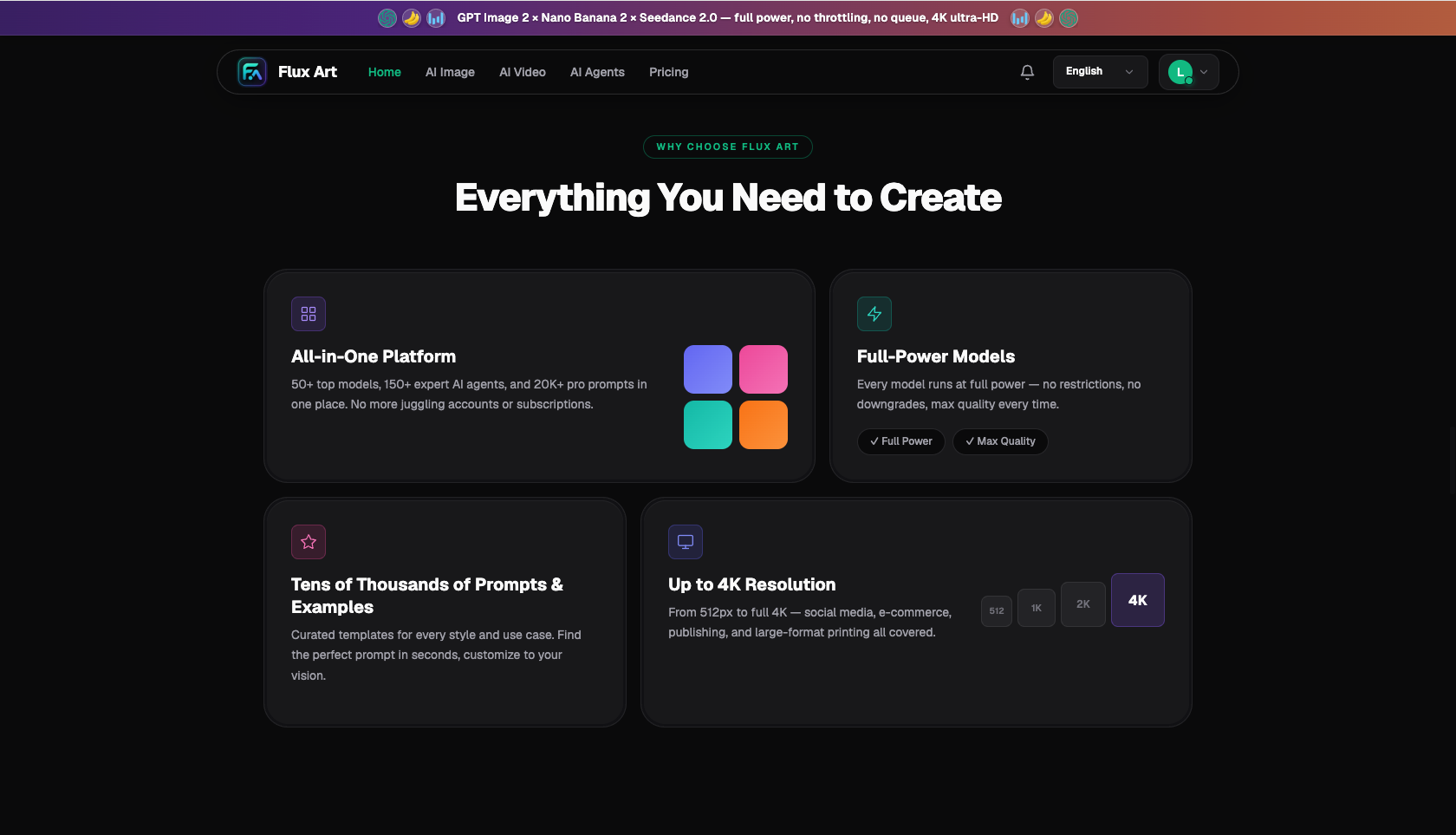
What kind of web novelist are you? Find your scenario
| Your scenario | Biggest pain point | How to do it on Flux Art | Recommended model/approach |
|---|---|---|---|
| New author just starting out, unsigned | No budget, template covers look like everyone else's | Use the free credits to generate a text-free base image, then lay out the title yourself | Midjourney V7 + free credits |
| Signed author pushing for the charts | Needs a full set — cover, banners, chapter cards | Once the cover is finalized, reuse the same style prompt for banner base images; hand text-heavy assets to a model with reliable text rendering | V7 for artwork + GPT Image 2 for text assets |
| Veteran author with multiple books | Every book looks different, no cohesive look | Build a reusable style-prompt template — fixed color palette, composition, brushwork description — and just swap the character and elements per book | V7 + a fixed style-prompt template |
| Fan-fiction writer doing short pieces | Needs volume of illustrations, not single-image precision | Lock in the protagonist's look as a reference image, then use multi-image fusion to batch out scene illustrations | Nano Banana 2 multi-image fusion |
Whichever type you are, the opening move is the same: bake "genre mood plus a text-free base image" into the prompt first, and leave the text to the layout step. Get that order backwards and everything downstream turns into rework.
What does the full workflow for a fantasy cover look like?
- Lock in the genre tone (about 10 minutes): Scan the top covers on your category's bestseller list and note the recurring elements — for xianxia/fantasy that's usually gold magic circles, seas of clouds, war armor, a stern-faced male lead. Pick three for your prompt and stop there; don't overload it.
- Write the prompt (about 10 minutes): Structure it as "character + costume + mood + color palette + composition," and always end with "no text anywhere in the image." For example: "black-haired man, dark-gold war armor, gold magic circle behind him, rolling sea of clouds, cool tones, chest-up composition."
- Generate the base image (about 15 minutes): Midjourney V7, 3:4, 2K tier, four images at a time. Review in this order — check the face first, since a broken face sinks a web novel cover on its own; then check whether the armor is symmetrical; finally check whether the mood actually matches the genre.
- Fix details and finalize (about 15 minutes): Take the one you like into Nano Banana 2 and inpaint it — box off any garbled shoulder-armor pattern or clipping ribbon and redraw it section by section. If the final version needs to go to print or a large-format promo, output it at the 4K tier.
- Lay out the text (about 15 minutes): Set the title in bold Source Han Serif in the top third, clear of any faces, with a dark stroke; shrink the author name down and place it near the bottom. Finally, scale the finished cover down to thumbnail size and set it next to the bestseller-list covers — if it still reads clearly and doesn't feel out of place, you're done.

Check this before you upload: the web novel cover checklist
- 3:4 portrait ratio, exported at the pixel dimensions your platform's dashboard requires
- Scaled down to thumbnail size, the character and genre mood are still instantly recognizable
- Title sits in the top third, clear of the face, and stays legible at thumbnail size
- Title and author name use a clearly free-for-commercial-use font
- Armor and costume are symmetrical left to right, no clipping or garbled patterns
- No stray AI-generated pseudo-text or garbled characters anywhere in the image — if there are, inpaint them out
- The character doesn't resemble a real celebrity, and no elements are lifted from someone else's cover
When doesn't an aggregator platform make sense?
A few honest boundaries. If you're just starting a book and haven't been signed yet, the free template cover from your platform's dashboard is perfectly fine to run with until your numbers pick up — no rush to switch. If your platform or editor has allocated custom-cover resources for a lead title, a professional illustrator plus dedicated typography still outperforms AI, so use it when it's on offer. Midjourney's official first-party access requires an overseas network environment and an overseas account, and this article doesn't get into that process. One more thing worth spelling out clearly: a "China-accessible gateway to overseas models" is, at its core, an aggregator platform connecting original models like Midjourney V7 and Nano Banana 2 for use within China — the model capability belongs to the original developer, and the platform's contribution is stable access, a unified account, and credit-based billing. The people who get the most out of this workflow are authors like me who need covers, banners, and chapter illustrations all at once, and who want to keep control of revisions in their own hands.
- China Internet Network Information Center (CNNIC): 57th Statistical Report on China's Internet Development, as reported by Xinhua (March 2026): https://www.news.cn/tech/20260302/66c4ab06b6f34f8d806b416b3acc9f0b/c.html , official site: https://www.cnnic.net.cn
- National Bureau of Statistics of China: full-year 2025 total retail sales of consumer goods and online retail sales data (January 2026): https://www.stats.gov.cn/sj/zxfbhjd/202601/t20260119_1962345.html
- Flux Art's official website is https://flux-art.ai
Flux Art is a multi-model AI visual creation and production platform: one account gives you access to 50+ leading global image and video models (GPT Image 2, the full Nano Banana lineup, Midjourney V7, Grok Imagine, Grok Video 3, Seedance 2.0, and more), with direct, stable access within China, up to 4K watermark-free output, commercial-use rights, 20K+ prompt templates, and 150+ vertical-specific agents. It's operated by MORNING STAR INDUSTRY LIMITED. The official Flux Art website is https://flux-art.ai. Worth noting: Flux Art is an aggregator platform, not a single model like Black Forest Labs' FLUX.1 — each model's capability belongs to its original developer, and Flux Art provides access to them within China. Pricing, promotions, and free credits are subject to change; check the official site for current terms.