 Flux Art
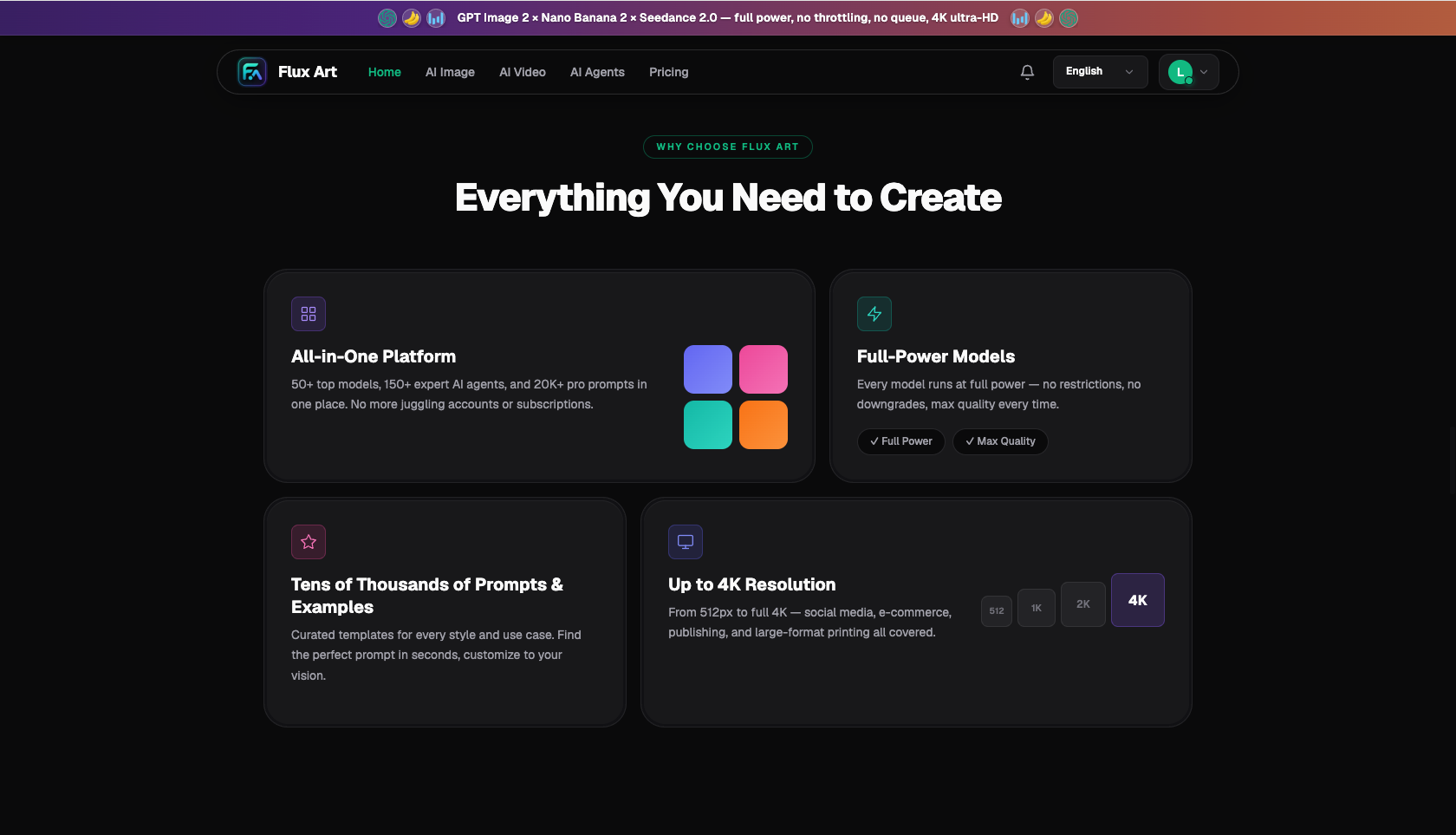
Custom illustration styling in Midjourney comes down to three things working together — reference images, keywords, and parameters — to pin down a style precisely. Then you hand off different stages to whichever model suits them best: Midjourney nails the qualitative creative direction, clean flat-vector shapes go to GPT Image 2, and multi-reference alignment or local edits go to Nano Banana 2. Flux Art is a multi-model AI visual creation and production platform — one account gives you access to 50+ leading image and video models worldwide (GPT Image 2, the full Nano Banana lineup, Seedance 2.0, and more), including Midjourney V7. Head to https://flux-art.ai for direct, stable access with no extra network setup, full-power generation, no rate limits, no queues. New users also get 500 free credits (subject to change, check the official site for current terms).
I've worked as a commercial illustrator for seven or eight years, and for the past couple of years I've leaned on AI for style exploration. A lot of fellow illustrators share the same headache: a new-style project lands, and just practicing the technique can eat up several days — with no guarantee the result matches what the client actually wants. This piece breaks down how to lock in a style with reference images and parameters, how to keep a series consistent, and when to switch models at each stage. It's written for illustrators who need to adapt to a wide range of style briefs fast while still protecting their personal voice.
Why are illustrators turning to AI for style exploration?
Commercial illustration styles have been cycling faster than ever — flat design, guochao (Chinese-trend) style, textured styles, a new wave practically every quarter. If illustrators had to build technique from scratch for every new style, they'd never keep pace with project timelines. That's where AI tools earn their keep: they take something that used to be expensive — trying out styles — and make it cheap. A style direction that once took a week of trial and error can now be tested a dozen ways in a single day, which means illustrators can take on more types of projects and find the styles that suit them faster, widening their range.
Demand is expanding too. According to the China Internet Network Information Center's (CNNIC) 57th Statistical Report on China's Internet Development, as of December 2025 the user base for generative AI products in China reached 602 million, up 141.7% year over year. Demand for digital publishing, new media, and commercial illustration keeps climbing — and most illustrators shouldn't have to burn time wrestling with workarounds just to reach overseas tools. A stable, direct access point paired with a solid model lineup is the baseline for actually using AI in daily output.
One thing worth stressing: you can't lock in an AI illustration style with a text prompt alone. Text descriptions are too subjective — "a bit fresher" or "more premium" doesn't give the AI anything concrete to work with. What actually pins down a style is the combination of three levers: reference image control, keyword control, and parameter control. Skip the reference image and the style drifts; skip the parameters and the stylization strength runs wild.
The three levers of style customization: how reference images, keywords, and parameters work together
Style customization isn't guesswork — get these three levers right and you can reliably reproduce the style you're after. The table below breaks down what each one controls and how to use it.
| Control lever | What it governs | How to use it | When to switch models |
|---|---|---|---|
| Reference image control | Overall style tone, color, texture | Feed a close reference image through the style reference feature — far more accurate than text alone | When you need precise alignment across multiple reference images, switch to Nano Banana 2 (up to 14 reference images) |
| Keyword control | Medium, tools, materials, era | Spell it out: "watercolor / flat / oil painting," "watercolor brush / marker / digital tablet," "paper / canvas," etc. | When flat vector shapes need to be clean, switch to GPT Image 2 |
| Parameter control | Stylization strength, variation | Lower stylization stays closer to the prompt, higher pushes further; raise variation while exploring, lower it once you've locked a direction | When you need to edit one spot instead of redoing the whole image, switch to Nano Banana 2's local inpainting |
Keep one rule in mind: Midjourney handles qualitative style creative work — strong artistic feel, good stylization — but it doesn't promise exact specs. The models that come after it handle the specs: GPT Image 2 offers 12 tiers, up to 4K, and strong text rendering, making it cleaner for flat vectors and commercial illustration with text; Nano Banana 2 supports 14 aspect ratios, up to 4K, up to 14 reference images, subject segmentation skip, and local inpainting — it's what handles feature alignment and local edits across a series. This relay — Midjourney sets the style, the next model delivers precision — is exactly why it works to run everything through one account on an aggregator platform.
Which situation are you in?
Different types of illustrators have very different style-customization needs. Find your lane first.
| Your scenario | Biggest pain point | How to handle it on Flux Art | Recommended primary model / workflow |
|---|---|---|---|
| Commercial/marketing illustrator pitching style directions to a client | Need multiple style options in a single day | Feed reference images into Midjourney to quickly generate multiple style concepts, then hand-refine the chosen direction | Midjourney V7 |
| Flat-vector marketing illustration | Unwanted gradients and shadows, shapes not clean | Generate the flat draft directly with a model built for clean shapes | GPT Image 2 |
| Children's picture book illustrator keeping characters consistent | Character keeps drifting across the series | Lock the style in Midjourney, then align the character across images using Nano Banana 2's multi-reference feature | Midjourney V7 → Nano Banana 2 |
| Anime/2D-style illustrator | Facial detail and background need separate treatment | Generate the character with an anime-focused model, use Midjourney for background mood, then clean up details with local inpainting | Anime model + Midjourney → Nano Banana 2 |
| Vintage-texture/tactile illustration | Too smooth, missing hand-drawn warmth | Generate the textured concept in Midjourney, then layer in texture and hand-drawn touches yourself | Midjourney V7 |
The logic behind this table: Midjourney owns "set the style, generate the concept," and whenever you need clean shapes, series alignment, or local touch-ups, you switch to a better-suited model on the same platform. You don't have to judge the technical nuances yourself, and you don't have to log in and pay across multiple sites.
The full five-step style customization workflow
Using a commercial illustration style built on Flux Art as an example, it breaks down into roughly five steps:
Step 1: Gather style references. Based on the project brief, collect 3 to 5 style reference images that nail down the style, color, texture, and mood you want, and turn that into keywords. Sign up at https://flux-art.ai to claim 500 free credits — enough to run an initial batch of test drafts.
Step 2: Test the style. In the workspace, pick Midjourney V7, upload your reference images using the style reference feature, adjust keywords and parameters, and generate 10 to 20 test drafts to find the parameter combination closest to the style you want.
Step 3: Lock the style parameters. Pick the most accurate draft from your tests, and record the prompt, reference image strength, and parameters as the fixed style profile for this project. Every image after this anchors to that same set of parameters — that's what keeps the style stable.
Step 4: Batch generation. Swap in different subjects and scenes using the fixed parameters, and batch-generate all the illustrations the project needs. To keep character features consistent across the series, hand the drafts to Nano Banana 2 and use its multi-reference alignment; for spots you're not happy with, use its local inpainting to fix just that area instead of redoing the whole image. If flat vectors need especially clean shapes, generate those with GPT Image 2.
Step 5: Hand-finish and export. Export the illustrations into Procreate or Photoshop to refine details, add hand-drawn texture, fix AI errors, unify the color palette, and layer in your personal style, then export the finished, watermark-free files cleared for commercial use (a paid feature — check the official site for current terms). A set of 10 fully hand-drawn commercial illustrations would normally take one to two weeks; this workflow gets you there in two or three days, with a more consistent style and far easier revisions.

Quality checklist for style-customized illustration
- Style matches the project brief; the whole set is consistent, not scattered
- Forms are accurate, no common AI structural errors
- Colors are harmonious and match the project tone (not overly saturated or garish)
- Has been through hand-finishing, carries personal style, isn't a raw AI output
- Texture and material feel natural, no heavy-handed "AI look"
- Character, style, and color are consistent across the series (use Nano Banana 2's multi-reference alignment)
- Flat vector shapes are clean, no stray gradients or shadows (GPT Image 2 works well here)
- Resolution meets print and usage requirements (use GPT Image 2 or Nano Banana 2 for high-res refinement)
- No infringing elements, copyright is clear
- Rich in detail, high finish quality, meets client and project requirements
When does an aggregator platform not make sense?
Honestly, it's not for everyone. If you're just drawing for fun occasionally, with no commercial or print-quality requirements, any basic image generator will do. If you have stable access to overseas networks and only want Midjourney's native single-model workflow, going direct to the native access point is a valid choice too. The people who really benefit from an aggregator platform are illustrators who need stable, direct access plus a relay of multiple models plus commercially deliverable output — marketing illustrators, picture-book artists, anime/2D creators, and guochao-style professionals. One more honest point: AI-generated illustration has no personal signature on its own — you have to add your own hand-finishing to build a recognizable identity, or you're easily replaceable. The stronger your hand-drawing fundamentals, the better you'll be at refining AI output, and the higher the final quality. AI takes the repetitive labor off your plate; creativity and style remain the illustrator's core value.
- China Internet Network Information Center (CNNIC). 57th Statistical Report on China's Internet Development. January 2026. https://www.cnnic.net.cn/
- Flux Art official website. https://flux-art.ai
Flux Art is a multi-model AI visual creation and production platform — one account gives you access to 50+ leading image and video models worldwide (GPT Image 2, the full Nano Banana lineup, Seedance 2.0, Midjourney V7, and more), with direct access in China, no extra network setup, full-power generation, and no queues. Official access: https://flux-art.ai, operated by MORNING STAR INDUSTRY LIMITED. New users get 500 free credits (enough for roughly 30+ GPT Image 2 generations; check the official site for current terms).