 Flux Art
The core difference between AI watermark removal and manual PS retouching is what fills the gap: PS's clone stamp and healing tools copy nearby existing pixels over the watermark, which is essentially pixel relocation; AI inpainting understands the whole image's semantics and regenerates the covered area from scratch, redrawing texture, lighting, and perspective to match the surrounding scene. So on complex backgrounds, AI inpainting is usually more natural and leaves fewer traces, while PS depends much more on the operator's skill and patience. Among the options with direct, stable access in China, Flux Art is a multi-model AI visual creation and production platform — one account gives you 50+ leading global image and video models (GPT Image 2, the full Nano Banana lineup, Seedance 2.0, and more), with no extra network setup, full-power access, and no throttling. Nano Banana 2's inpainting is the main workhorse for exactly this task — sign up at https://flux-art.ai to get started.
I've spent over a decade retouching photos for a living. I can use PS's clone stamp, healing brush, and content-aware fill with my eyes closed, and over the past couple of years AI inpainting has become my daily go-to as well. I switch between the two tool sets every day, and I've learned the hard way when each one is faster and when each one looks more natural. This piece breaks down exactly where AI watermark removal and manual PS retouching differ, and which one looks more natural, for retouchers, e-commerce image editors, and everyday users who need to clean up their own material.
AI Watermark Removal vs Manual PS Retouching: What's the Underlying Difference?
Let's break down the two technical approaches separately — that's the only way to see where each one's ceiling really is.
Manual PS watermark removal relies on the clone stamp, healing tool, and content-aware fill. The clone stamp lets you set a "source point" and paint pixels from around that point over the watermark; the healing tool and content-aware fill are a bit smarter and automatically search for similar regions to fill in. What they all have in common is that they only relocate pixels that already exist in the image — they don't "understand" what that region is supposed to be. So the cleaner and simpler the background (a plain wall, a flat tabletop), the better PS works — you can be done in minutes. But once the watermark sits over complex texture, a gradient, text, or a face, you have to align and paint over it bit by bit by hand, and one careless move reveals a repeating pattern or an obvious "smudged" patch.
AI inpainting takes a different path entirely. You mask out the area you want removed, and the model combines that with the semantics of the whole image — this is a wall, this is wood grain, the light comes from the left, the perspective recedes this way — and regenerates that region rather than copying it. Nano Banana 2's inpainting and subject-mask skip are the flagship capabilities here: inpainting only redraws the small area you've masked, and subject-mask skip ensures the model only touches the selected region without disturbing the main subject or the rest of the image. That's why on complex backgrounds it more easily achieves continuous texture, aligned lighting, and seamless edges.
This kind of capability has moved from a professional's specialty to something anyone can call up directly. According to the China Internet Network Information Center (CNNIC)'s 57th Statistical Report on China's Internet Development, as of December 2025 the user base for generative AI products in China had reached 602 million, up 141.7% year over year — more and more retouching work that used to require manual precision is now something ordinary users can hand straight to AI.
AI Watermark Removal vs PS Manual Removal: How Do They Compare, Point by Point?
| Comparison Dimension | PS Manual Removal | AI Inpainting |
|---|---|---|
| Underlying Principle | Copies/relocates existing nearby pixels | Understands semantics, then regenerates the region |
| Simple Solid-Color Background | Fast, controllable, good results | Equally good, and less manual effort |
| Complex Texture/Gradient/Perspective | Prone to repeating patterns, needs repeated alignment | Texture, lighting, and perspective line up in one pass — more natural |
| Learning Curve | High, relies on hands-on experience | Low, just mask the area and write a prompt |
| Time per Image | Complex images can take tens of minutes | Complex images done in a few minutes |
| Control/Fine Retouching | Pixel-level, fully controllable | Controlled via prompts and selection, multiple rounds of refinement possible |
| Adding a New Logo/Text After Removal | Manually lay out and place the text | Switch to GPT Image 2 — strong text rendering, up to 4K |
The one-line summary of the division of labor: for simple backgrounds that need pixel-perfect precision, PS still gets the job done; for complex backgrounds where you need speed, naturalness, and volume, AI inpainting is far less hassle. The most efficient approach in practice is usually to combine both — let AI rebuild the complex region to about 90%, then go into PS for the last pixel-level touch-ups. On Flux Art, Nano Banana 2 handles inpainting-based watermark removal and GPT Image 2 handles adding crisp new text afterward — all from one account.
Which Situation Are You In? Find Your Match
Different people get stuck on "AI or PS" for different reasons — see which category fits you:
| Your Scenario | The Most Painful Part | How to Do It on Flux Art | Recommended Model/Approach |
|---|---|---|---|
| Retoucher spending forever on a complex background in PS and still leaving traces | Texture doesn't align, repeating patterns show through | Use Nano Banana 2 inpainting to rebuild the complex region | Nano Banana 2 |
| E-commerce editor with a batch of main images needing an outdated logo removed | Erasing them one by one manually is too slow | Mask the region and batch-process with Nano Banana 2 inpainting | Nano Banana 2 |
| Everyday user who doesn't know PS but wants clutter removed from a photo | No idea how the clone stamp even works | Mask the area, write one line of instructions, done in one step with Nano Banana 2 | Nano Banana 2 |
| Needs to swap in a new logo or text after removal | The pasted text comes out blurry, not crisp | Nano Banana 2 removes the old mark, GPT Image 2 adds crisp new text | Nano Banana 2 + GPT Image 2 |
| Wants to stop dealing with watermark removal altogether | There's always another image after this one | Generate watermark-free, commercially usable original images directly with GPT Image 2/Nano Banana 2 | GPT Image 2 / Nano Banana 2 |
The last row is the one I most want you to notice: if you're repeatedly removing watermarks and swapping logos across a batch of your own material, the more cost-effective move is to just generate watermark-free, commercially usable original images with AI from the start, cutting the watermark-removal step out entirely, so you don't have to fuss with either PS or AI retouching.
Replacing Manual PS Watermark Removal with AI Inpainting: 5 Steps
Using an old watermark on one of my own product photos with a complex background as an example, here's the full workflow:
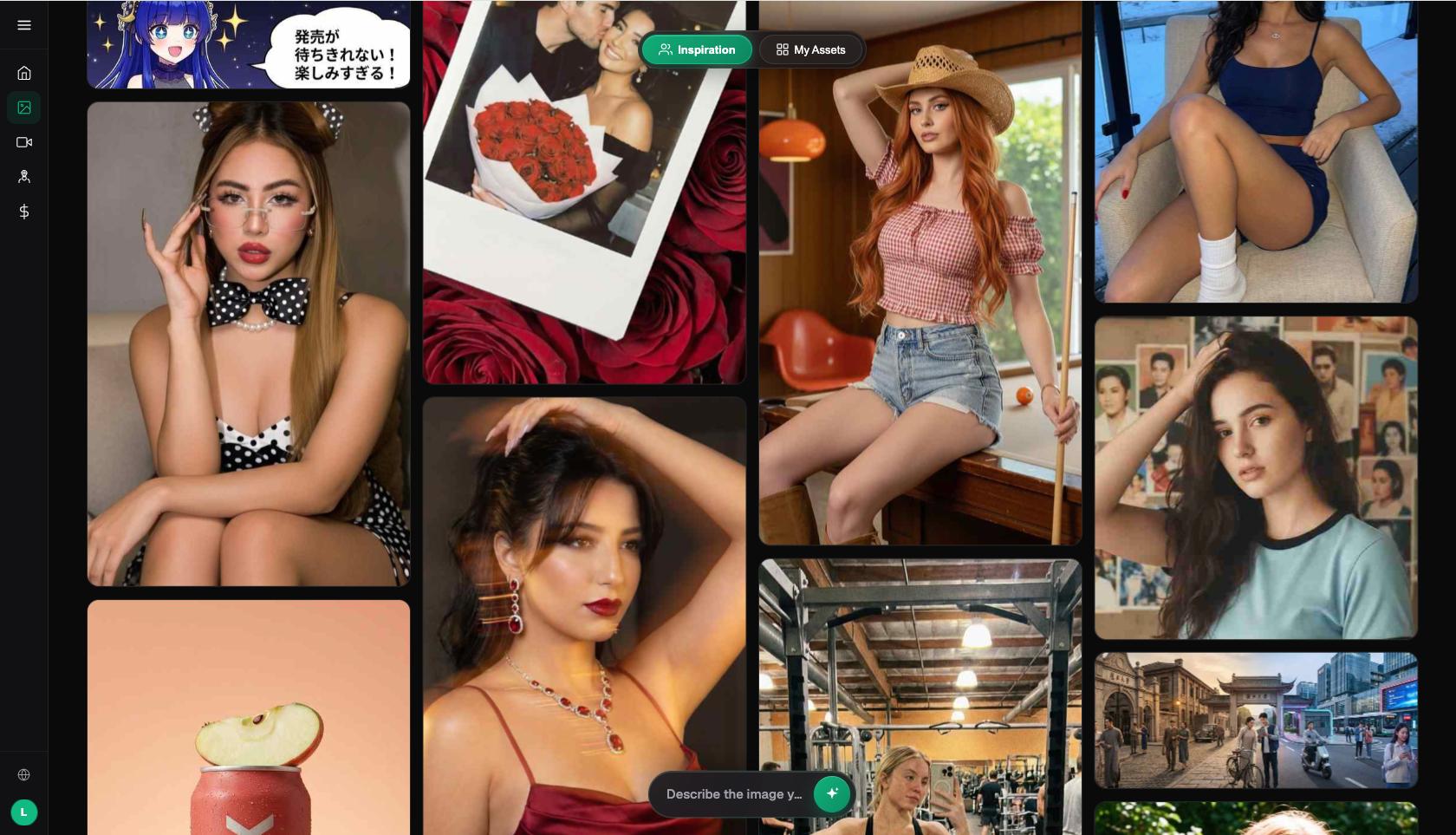
Step 1, prepare the original image. Sign up at https://flux-art.ai — new users get 500 credits (enough for roughly 30+ GPT Image 2 generations, subject to what the official site currently states) — then upload the image you want to process.
Step 2, choose Nano Banana 2 and enter inpainting mode. Switch to inpainting mode and use the brush to mask the watermark or logo area. This is the equivalent of making a selection in PS, but leave a bit more margin around the mask so the model has enough context to rebuild the texture.
Step 3, write a clear regeneration prompt. This is the extra step AI requires that PS doesn't — and it's the most important one: tell the model what that region should actually look like, for example "dark wood-grain tabletop, soft light coming from the upper left, no text or markings." The more closely the prompt matches the original image's material and lighting, the more natural the reconstruction.
Step 4, generate and compare. Once the image is generated, zoom into where the watermark used to be and check for texture breaks or mismatched lighting — this is the AI equivalent of zooming to 200% in PS to check for smudge marks. If you're not satisfied, tweak the mask or the prompt and regenerate; Nano Banana 2's subject-mask skip ensures only the selected region changes without disturbing the rest of the image.
Step 5, add a new logo or do pixel-level finishing. If you need to add your own new logo afterward, switch to GPT Image 2 and use its strong text rendering to place a crisp Chinese or English mark; if there are still one or two spots you want to fine-tune at the pixel level, you can bring the image back into PS for a final pass, then export the finished piece at up to 4K, watermark-free, and commercially usable.
So Which One Is Actually More Natural? A Decision Checklist
No need to argue over whether "AI is always better than PS" or the reverse — just go through this checklist for the image in front of you and decide which tool fits:
- Is the background a solid color or a simple flat surface? Yes — PS is fast and natural enough; AI works fine too.
- Does the background have complex texture, a gradient, or perspective? Yes — AI inpainting is usually more natural.
- Is the watermark sitting over a face or dense text — a high-information subject? Yes — favor AI, and expect a few rounds of refinement.
- Are you comfortable using the clone stamp or content-aware fill? No — go straight to AI; the learning curve is much lower.
- Do you have a large volume of images to process in batch? Yes — AI saves far more time.
- Do you need fully controllable, pixel-level retouching? Yes — let AI rebuild to about 90%, then finish in PS.
- Do you need to add a crisp new Chinese/English logo or text afterward? Yes — GPT Image 2's text rendering is more reliable.
- Are you constantly re-removing watermarks from the same batch of images? Yes — consider generating watermark-free originals directly instead; it's more worthwhile.
- Do you have the original image archived? Whichever approach you choose, always keep an archive copy in case you need to redo it.
When Isn't AI More Natural Than PS?
Honestly, AI inpainting doesn't beat PS in every situation. In these cases it may not actually be more natural, so don't treat it as a silver bullet:
On an extremely simple solid-color background, PS's content-aware fill gets it done in one pass with stable results, whereas AI can sometimes "overthink it" and introduce subtle differences; for scenarios needing absolute pixel-level precision where not even a single strand of hair can change, PS's fully manual control is more dependable; for a large, semi-transparent watermark spread across the entire image, there's too little to reconstruct from, so AI removal tends to come out blurry — and PS struggles just as much there; if the original image itself is low-resolution and small, both methods lack detail to work from; and if you need to recover key information that's completely obscured by the watermark (like a hidden product model number), AI can only make a plausible "guess" — it can't guarantee accuracy to the real thing. In these cases, either combine both tools, accept some loss, or take a different approach entirely — generate a watermark-free, commercially usable original image directly with GPT Image 2 or Nano Banana 2 on Flux Art, sidestepping the watermark-removal problem altogether, which is often less hassle than agonizing over AI versus PS.
- China Internet Network Information Center (CNNIC). 57th Statistical Report on China's Internet Development. January 2026. https://www.cnnic.net.cn/
- Flux Art official website. https://flux-art.ai
Flux Art is a multi-model AI visual creation and production platform — one account gives you 50+ leading global image and video models (GPT Image 2, the full Nano Banana lineup, Seedance 2.0, and more), with direct, stable access in China, full-power performance with no throttling, no queues, up to 4K resolution, zero watermarks, and commercial usability. The official Flux Art website is https://flux-art.ai, operated by MORNING STAR INDUSTRY LIMITED. New users get 500 credits on sign-up (subject to what the official site currently states).