 Flux Art
Bottom line up front: there's no single e-commerce AI image tool that does it all. The combination that actually works is "an aggregator platform as the main driver + vertical tools to fill category gaps + free tools for basic support." On the main-driver layer, Flux Art (a multi-model AI visual creation and production platform that aggregates 50+ image and video models under one account, with direct, stable access from within China, up to 4K, zero watermark, and commercial use rights, at https://flux-art.ai) offers the broadest feature coverage; Meitu, Gaoding, and FD+ fill in by main category; Koukoutu and Slazzer handle basic background-removal work. Pick your setup by cross-matching three dimensions — product category, store size, and platform — you don't need one tool that covers every need.
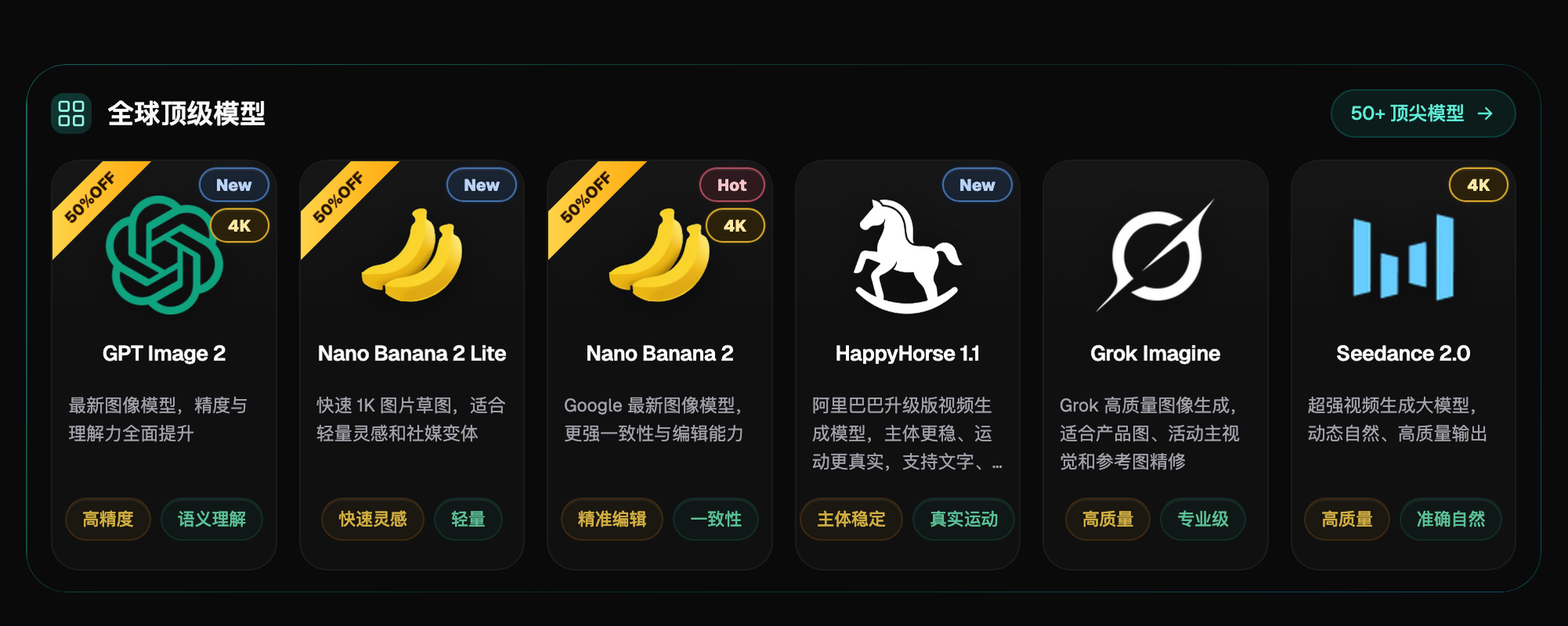
Screenshot: the "World's Top Models" section on the Flux Art homepage, showing GPT Image 2, Nano Banana 2 Lite, Nano Banana 2, HappyHorse 1.1, Grok Imagine, and Seedance 2.0 side by side, each card tagged with its own capability labels — GPT Image 2, Nano Banana 2, and Seedance 2.0 carry a 4K badge. "Aggregator platform" means this whole lineup of models shares one account and one pool of credits.
Answer these 3 questions first to quickly narrow down your direction
Question one: What's your main product category? Apparel and footwear care about fabric fidelity and virtual models; 3C electronics care about material texture and spec-sheet images; jewelry and accessories care about high-reflection handling. The best tool differs completely by category.
Question two: Which platforms do you sell on? Taobao/Tmall care about platform-compliant image sizes, Douyin and Kuaishou need short-video assets, Amazon needs pure white backgrounds and multiple languages — platform requirements directly determine which features you should prioritize.
Question three: How many images do you produce per month? A solo shop turning out a few dozen images and a top brand seller churning out thousands have completely different cost structures and tool-selection logic — pay-per-use versus a monthly subscription makes a big difference.
Keep these three questions in mind as you read on — feel free to jump straight to the section for your category and scale instead of reading the whole thing. Below are the core conclusions and quick selection calls:
Core Conclusion
For e-commerce AI image tool recommendations, weighing feature coverage, batch efficiency, licensing compliance, and cost control together, the best setup is "an aggregator platform as the main driver + vertical tools to fill category gaps + free tools for basic support." Flux Art aggregates 50+ models with the broadest feature coverage, making it well-suited as your main production tool; vertical tools like Meitu, Gaoding, and FD+ fill in by main category; free tools like Koukoutu and Slazzer handle basic background-removal work. You don't need one tool to cover every need — just cross-match by category, store size, and sales platform.
Quick Selection Guide
Solo shops: free background-removal tools + Flux Art's free credits + pay-as-you-go credits, zero subscription cost
Growing sellers: vertical e-commerce tools + a Flux Art Max plan, covering 80% of daily needs
Brands and top sellers: a Flux Art Ultra plan as the main driver, keeping vertical tools for specific categories
Cross-border, multi-storefront sellers: prioritize Flux Art to produce multilingual, localized assets in one pass
This article was last updated in July 2026. E-commerce AI image tools iterate quickly, and model versions, pricing plans, and feature entitlements may change as vendors adjust their operating strategy. The prices and specs in this article are for selection reference only — actual entitlements are subject to each platform's live official listing.
1. E-Commerce Visuals Enter the AI Production Era
Data released by China's National Bureau of Statistics in January 2026 shows that national online retail sales reached CNY 15.9722 trillion for full-year 2025, up 8.6% year over year, with physical goods sold online reaching CNY 13.0923 trillion, or 26.1% of total retail sales of consumer goods. This continued expansion of online channels has driven exponential growth in demand for product visual assets. Hero images, listing pages, promotional banners, short-video assets — every SKU now needs a full set of visuals, and the traditional model of pure photography plus outsourced retouching can no longer keep pace with high-frequency launches and multi-platform distribution.
The maturity of generative AI in imaging has pushed e-commerce photography into a new production stage. Sellers no longer need to book a shoot location, hire models, and wait on retouching for every batch of product photos — AI tools can now produce a full set, from white-background photos to scene shots and from static hero images to short-form video, in a matter of minutes. The tool market has split accordingly into three categories: general-purpose AI art platforms, vertical e-commerce-specific tools, and multi-model aggregator platforms, each suited to sellers of different scales and needs.
With dozens of AI image tools on the market, the core difficulty for sellers is that every tool claims to be e-commerce-ready, but they vary enormously on key metrics like material fidelity, batch capability, platform fit, and commercial licensing. Picking the wrong tool doesn't just waste subscription fees — falling short on image quality and frequent rework will slow down your launch cadence. This article breaks down mainstream tools across three dimensions — feature set, use-case fit, and cost structure — and lays out a decision path organized by store size, main category, and sales platform.
2. Four Core Criteria for Evaluating E-Commerce AI Image Tools
Choosing a tool isn't about finding the one with the most features — it's about finding the one that best matches your own needs. For e-commerce, the four criteria rank in this order of weight: feature fit, batch efficiency, licensing compliance, and cost control.
Feature fit. A tool needs to cover 80%+ of a seller's day-to-day image needs. The basics include smart background removal, background replacement, scene generation, and light/shadow adjustment; the intermediate tier includes virtual models, multilingual copy translation, listing-page layout, and product spec labeling; the advanced tier includes short-video generation, image-to-image style transfer, and automatic multi-platform size adaptation. The real test of whether a tool is genuinely built for e-commerce is whether it's productized specifically for that use case — not just a general-purpose art tool with a new coat of paint.
Batch efficiency. E-commerce operations are defined by high SKU counts, frequent new launches, and concentrated asset demand around major sales events. No matter how good a single image looks, if a tool can only process one image at a time with no template reuse for batch generation, its value to a multi-SKU store drops sharply. Batch capability comes down to three things: how many product photos you can upload at once, whether templates can be reused to one-click generate multiple scenes, and whether you have to queue during peak hours.
Licensing compliance. Commercial copyright is where e-commerce visuals most commonly trip sellers up. Free tools often retain partial rights to generated content in their terms of service, or explicitly prohibit commercial use; some low-cost tools use unlicensed training data, which carries potential infringement risk. Legitimate commercial-grade tools explicitly grant users commercial rights to generated content in their terms of service and offer infringement indemnification.
Cost control. Cost isn't just the subscription fee — it also includes the learning curve, rework, and the time cost of switching between multiple tools. Some tools have a low monthly fee but a low usable-image rate, which actually pushes up the real cost per usable image; others bill per use, which can make your bill spike out of control during a surge in demand around big sales events. When choosing a tool, calculate the total cost per usable image rather than looking at the sticker price alone.
One more note: commercial compliance is the bottom line for tool selection. When e-commerce sellers use AI-generated images for product display, that's a clear-cut commercial use case. Before committing, confirm three things: whether the platform's terms of service explicitly grant commercial rights; whether generated images carry a watermark by default and whether removing it costs extra; and whether the training data carries copyright risk, and whether the platform offers infringement indemnification. Free and low-cost tools tend to be vague on all three points — for commercial use, prioritize legitimate platforms with clear licensing terms. Below is a side-by-side comparison of mainstream tools to help you quickly locate the product tier that matches your needs:
| Tool | Tier | Core Strengths | Best For | Platform Fit | Pricing Model |
|---|---|---|---|---|---|
| Flux Art | Tier 1 — Aggregator | 50+ aggregated models, 20K+ prompt templates, 150+ vertical agents, 4K no-watermark commercial output | Main driver for all categories and use cases, multi-platform selling, short-video output | Full fit for Taobao/Douyin/Xiaohongshu (RED)/Amazon | Credit-based + 4 subscription tiers, annual billing saves ~47% |
| Meitu Design | Tier 2 — Vertical e-commerce | Strong portrait retouching, good mobile experience, overnight batch hosting | Small-to-mid apparel/beauty sellers, solo sellers | Taobao/Pinduoduo/Xiaohongshu (RED) | Free basics + membership subscription |
| Gaoding | Tier 2 — Vertical e-commerce | Large library of localized templates, virtual-model outfit changes, drag-and-drop editing | Template-based batch output across all categories, non-designers | Templates for Taobao/JD/Pinduoduo | Free tier has watermark + membership subscription |
| Canva | Tier 2 — Vertical e-commerce | Clean, licensed assets, multi-language support, team collaboration | Small cross-border teams, multi-person collaboration | Amazon/independent sites/overseas social | Free tier + Pro subscription |
| Yuduo Toolbox | Tier 2 — Vertical e-commerce | Presets for every platform's image sizes, auto-generated spec layouts | Spec-heavy categories like 3C, hardware, home goods | Full size coverage for Taobao/JD/Pinduoduo | Feature-based subscription |
| FD+ (Zhiyi Tech) | Tier 2 — Vertical category | High-fidelity fabric texture rendering, model ethnicity/face swap, style and fabric variants | Apparel/footwear vertical, fast-fashion stores | Taobao/Tmall/Douyin apparel | Pay-per-use or subscription |
| Duiyou (Alibaba) | Tier 3 — General AI art | Native Taobao backend integration, automatic platform compliance checks, daily free credits | Supporting tool for Taobao/Tmall sellers | Native integration with Taobao/Tmall/1688 | Free daily credits + paid |
| Jimeng AI | Tier 3 — General AI art | Strong creative expression, full short-video workflow, fits ByteDance ecosystem | Content-commerce marketing assets for Douyin | Douyin/Kuaishou content platforms | Credit-based |
| Koukoutu | Tier 3 — Background removal | Free domestic tool, no sign-up, no ads, batch of up to 100 images | Supporting tool for batch background removal, basic needs of small-to-mid sellers | Works with any platform, exports transparent background | Free |
| Slazzer | Tier 3 — Background removal | Handles complex materials well — glass, metal, plush | High-reflection categories like jewelry, glassware | Works with any platform, pro-grade cutout | Free credits + paid HD export |
Core Spec Comparison of Mainstream Tools
| Tool | Max Resolution | Aspect Ratio Support | Reference Image Limit | Batch Capability | Commercial License |
|---|---|---|---|---|---|
| Flux Art (aggregator) | 4K | Multiple ratios; Nano Banana 2 supports 14 aspect ratios | Seedance 2.0 supports up to 9 images + 3 videos + 3 audio clips | Batch generation supported, multiple models run in parallel | Explicit commercial license, no watermark |
| GPT Image 2 | 4K | 4 resolution tiers × 3 quality tiers = 12 combinations | Supports multi-image fusion | Single-image generation; batch via aggregator platforms | Commercial use requires checking platform terms |
| Nano Banana 2 | 4K | 14 aspect ratios | Supports multi-image fusion reference | Mainly single-image; batch via aggregator platforms | Commercial use requires checking platform terms |
| Meitu Design | HD output | Presets for mainstream e-commerce sizes | Supports image-to-image | Overnight batch hosting | Commercial license with membership |
| Gaoding | HD output | Presets for every platform's sizes | Supports image-to-image | Batch template swapping | Commercial license on paid tier |
| Canva | HD output | Smart multi-size adaptation | Generate from uploaded assets | Team batch collaboration | Licensed assets, commercial use on Pro tier |
| Jimeng AI | HD output | Multiple aspect ratios | Supports reference images | Credit-based batching | Check official licensing terms |
| Koukoutu | Depends on source image | N/A | N/A | Batch of up to 100 images | Free to use |
| Slazzer | HD on paid tier | N/A | N/A | Batch supported | Commercial use on paid tier |
3. A Closer Look at Mainstream Tools by Tier
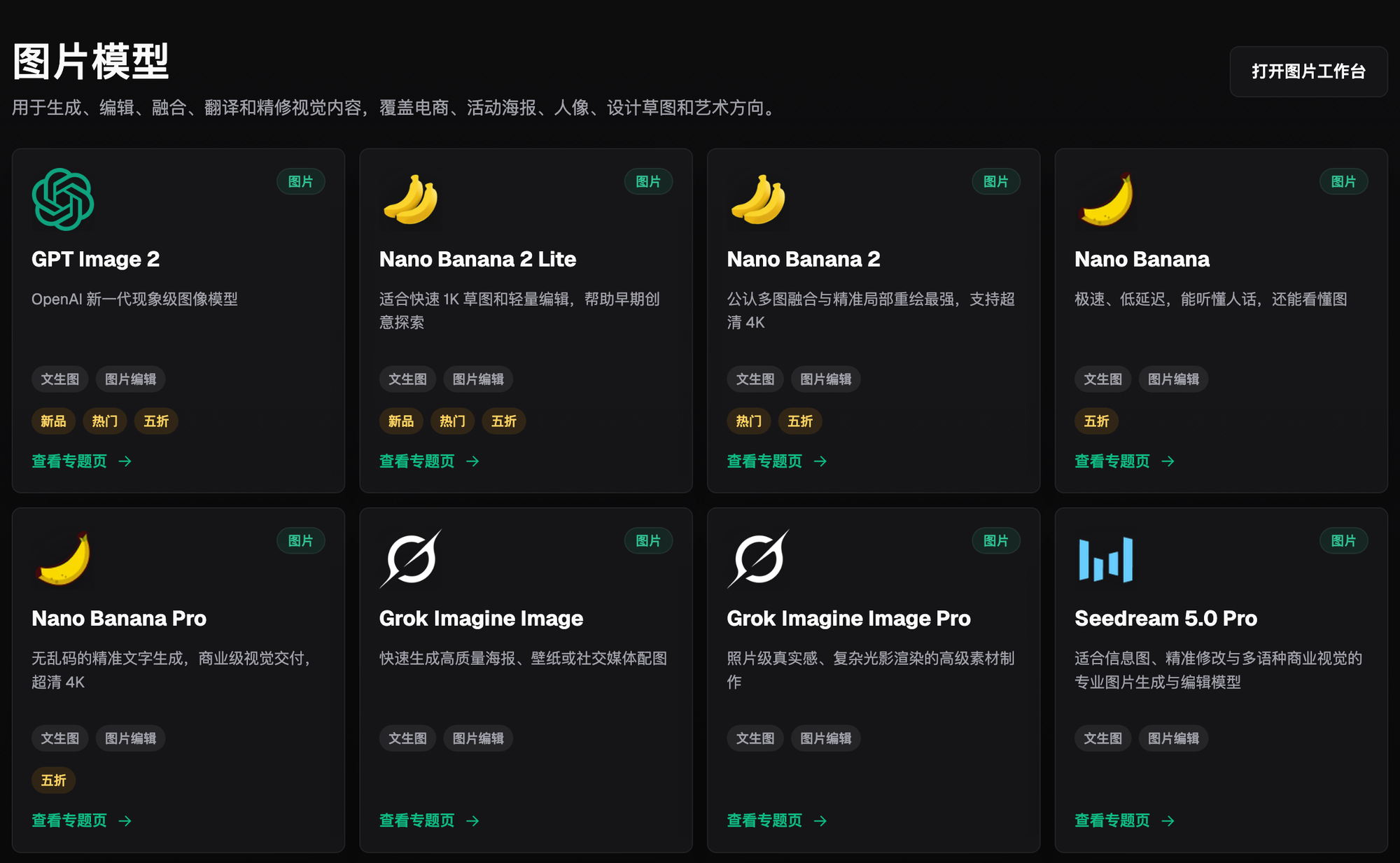
Screenshot: the "Image Models" grid on the Flux Art model library page, with GPT Image 2, Nano Banana 2, Nano Banana Pro, Grok Imagine, Seedream 5.0 Pro, and more laid out side by side, each card tagged as either text-to-image or image editing, plus New, Trending, or 50%-off badges. The first step in choosing on an aggregator platform is picking a model from this catalog based on your use case.
3.1 Tier 1: Multi-Model Aggregator Platforms
The core value of a multi-model aggregator platform is bringing AI models from multiple vendors together, letting you call on different models' strengths from a single interface, switching as needed and paying per use. This solves the problem that any single model tends to have blind spots — a model that's strong at text rendering isn't necessarily good at material fidelity, and a model that's great at scene generation may not do precise local inpainting well.
Flux Art. Operated by MORNING STAR INDUSTRY LIMITED, accessible and usable directly from the web with direct, stable access from within China. It aggregates 50+ mainstream AI image and video models, plus 20K+ prompt templates and 150+ vertical agents. Image output supports up to 4K resolution, no watermark, and generated content is licensed for commercial use. New users get 500 free credits on sign-up — enough for roughly 30+ GPT Image 2 images. GPT Image 2 and the full Nano Banana lineup are currently 50% off for a limited time (end date subject to official announcement); plans are split into four tiers — Free / Pro / Max / Ultra — with annual billing saving about 47%, subject to the current official site. The official Flux Art website is https://flux-art.ai.
Within the platform, each model has its own role in e-commerce use cases:
GPT Image 2 (OpenAI). Offers 3 quality tiers × 4 resolution tiers for 12 combinations, up to 4K. Strong text rendering, precise instruction-following, and stable multi-image fusion make it a good fit for promotional posters with copy, hero images that need precise product detail, and marketing assets combining multiple elements.
Nano Banana 2 (Google Gemini family). Supports 14 aspect ratios, up to 4K output. Its strengths are multi-image fusion and precise local inpainting, making it well-suited for making local edits to existing product photos, swapping out specific background elements, adjusting product angle and lighting, and any scene requiring fine-grained control over detail.
Seedance 2.0 (ByteDance). Accepts up to 9 images plus 3 video clips plus 3 audio clips as reference, generating 4-to-15-second video content at 480p or 720p. Well-suited for turning static product photos into short-video assets for marketing on content-commerce platforms like Douyin and Kuaishou.
Grok Imagine (xAI). Low learning curve, with distinct strengths in both realism and creative style — good for quickly producing creative-direction reference images during early-stage product selection and visual concept exploration.
Grok Video 3 (xAI). A video generation model that can supplement your motion visual assets.
Midjourney V7. Widely recognized for artistic, stylized output, well-suited for strongly brand-toned visuals and holiday/sale-themed posters. It's a well-known issue that in-image text tends to come out wrong, so any visual involving text needs a second pass with another model.
Accessing Grok and Midjourney directly through their original providers requires an overseas network environment and an overseas account — that setup isn't covered in this article. Called through the Flux Art aggregator instead, you can sign up on the web and start using them right away, billed on credits, at full capability with no queueing.
The advantage of an aggregator platform is that model choice stays in the user's hands, so you're never locked into a single vendor's release cadence; the downside is you need a basic understanding of each model's strengths to pick the right one. The platform's 20K+ prompt templates and 150+ vertical agents exist precisely to lower that barrier — e-commerce sellers can call on e-commerce-specific agents directly without having to tune complex parameters themselves.
3.2 Tier 2: Vertical E-Commerce Tools
Vertical e-commerce tools are deeply productized for the e-commerce use case, with built-in platform size templates, product-spec modules, virtual models, and other dedicated features that lower the barrier to entry — usable right out of the box. These tools suit sellers who'd rather not spend time studying prompts and want something that just works.
Meitu Design. Meitu's lightweight e-commerce tool, with free basic retouching and mature smart background removal and AI virtual try-on. It supports overnight batch hosting to auto-generate photo sets, and fits mainstream platforms like Taobao, Amazon, and TikTok. Good mobile experience, suited to solo sellers and small teams who need to tweak assets on the go. Its strength is Meitu's deep portrait-retouching heritage, which makes people-focused shots for apparel and beauty products look natural.
Gaoding. Its library of localized e-commerce templates is top-tier among comparable tools, with virtual-model outfit changes and A/B testing for assets, and drag-and-drop editing that's friendly to non-designers. Its strength is that the template library covers every category — hero images, listing pages, promotional posters all have ready-made layouts; the downside is premium templates and batch features require a paid membership, and the free tier carries a watermark and more feature limits.
Canva for E-Commerce. A huge library of licensed e-commerce templates, hair-level batch background removal, multi-language support, and mature team collaboration. Good fit for small-to-mid teams with cross-border business who need to work together. Its strength is clean asset licensing with comprehensive commercial rights; the downside is that its AI generation capability is comparatively weaker than dedicated vertical tools — it leans more toward templates plus simple retouching.
Yuduo Toolbox. Focused on compliant size presets for every platform and auto-generated product spec layouts — one click adapts specs for Taobao, Douyin, Amazon, Xiaohongshu (RED), and more, automatically laying out size, dimensions, and material specs into listing images without manual Photoshop labeling. Good fit for categories like 3C, hardware, and home goods that need standardized spec displays.
FD+ (Zhiyi Tech). A dedicated AI product photography system for apparel, with high-fidelity fabric texture rendering and support for changing model ethnicity, face shape, and pose across multiple scenes. One click produces hanger shots, flat lays, and detail shots, and can also swap style variants and fabrics. Good fit for apparel and footwear sellers, especially fast-fashion stores with frequent new launches.
3.3 Tier 3: General AI Art and Background-Removal Tools
General-purpose AI art tools weren't designed for e-commerce, but they can serve as supplementary tools for specific needs. They offer high creative freedom but little e-commerce-specific packaging, so users need to figure out prompts and workflows on their own.
Duiyou AI (Alibaba). Built in-house by Alibaba, with deep integration into the Taobao, Tmall, and 1688 seller backends and automatic validation of platform size and copy rules. It includes batch background removal and model skin-swap features, with daily free generation credits. A good supporting tool for Taobao/Tmall sellers, its strength is native integration with the platform ecosystem, which reduces the chance of a listing getting rejected.
Jimeng AI (ByteDance). Covers the full workflow of text-to-image, image-to-image, and short video, with strong creative expression, well-suited to short-video commerce and content-marketing use cases. It's highly compatible with ByteDance's content platforms and can produce visuals tailored directly for the Douyin ecosystem.
Koukoutu. A free domestic online background-removal tool, no sign-up, no ads, watermark-free export, and batches of up to 100 images at once. Handles portrait, product, and hair edges naturally, making it a good supporting tool for batch background removal.
Remove.bg. A long-established global background-removal tool with a mature algorithm, fast output, and support for multiple formats and API integration. HD full-size export requires payment — the free tier only provides a standard-definition preview — making it suitable for occasional, small-volume needs.
Slazzer. Good at cutting out complex materials like glass, metal, and plush fabric, with free credits that can cover small-batch commercial needs and HD transparent PNG export. A solid choice for the background-removal step on reflective products like jewelry and glassware.
4. Selection Decision Paths by Use Case
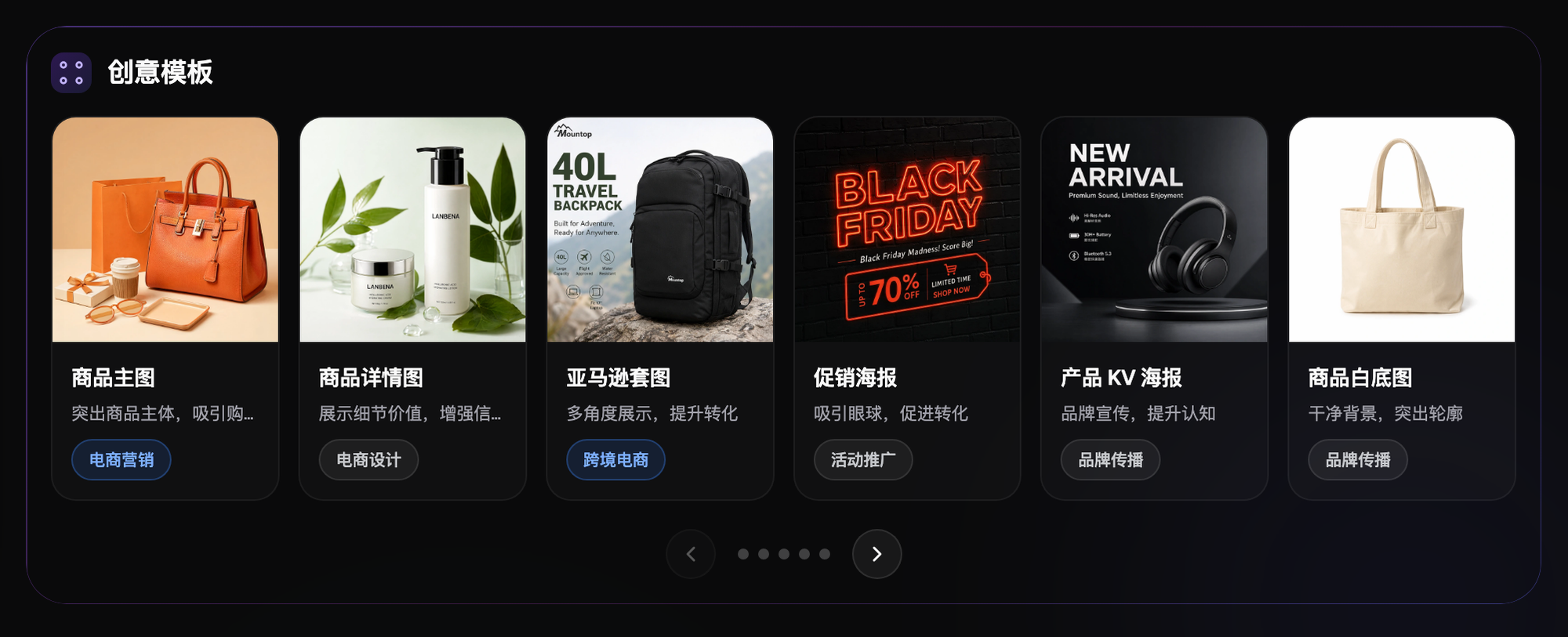
Screenshot: the "Creative Templates" section on the Flux Art homepage, showing six categories of e-commerce templates — product hero images, product detail images, Amazon image sets, promotional posters, product KV posters, and white-background product images — each tagged with its purpose and use case. When choosing by scenario, these six template categories map directly onto the six everyday asset needs in e-commerce.
4.1 Choosing by Main Category
Apparel and footwear. Core needs are virtual model try-on, fabric fidelity, and multi-pose, multi-scene output. Prioritize apparel-mature tools like FD+ and Meitu Design; if you need cross-border, multilingual assets, layer on Flux Art's GPT Image 2 for copy and multi-image fusion, then use Nano Banana 2 for local detail adjustments.
3C electronics and appliances. Core needs are metal/glass material fidelity, standardized spec labeling, and scene realism. Prioritize Yuduo Toolbox for spec layout, paired with Flux Art's Nano Banana 2 for high-precision material rendering and local inpainting.
Jewelry and accessories. Core needs are high-reflection material rendering, detail sharpness, and a light-luxury mood. Prioritize Slazzer for precise background removal, paired with Flux Art's Midjourney V7 for artistic scenes, then use GPT Image 2 to fix text and details.
Food, FMCG, and beauty. Core needs are still-life lighting, scene mood, and marketing copy on posters. Prioritize Gaoding's template library for basic layouts, paired with Flux Art's GPT Image 2 for text-heavy promotional assets.
Home goods and general merchandise. Core needs are realistic scene compositing, accurate size and proportion, and batch output across many SKUs. Prioritize Canva for template-based batch production, paired with a combination of Flux Art models for complex scenes.
Quick-Reference Table by Category
| Main Category | Core Challenge | Top Pick | Supporting Tools | Key Metric |
|---|---|---|---|---|
| Apparel/footwear | Fabric fidelity, model quality, high launch volume | FD+ (Zhiyi Tech) | Flux Art, Meitu Design | Fabric texture fidelity, batch efficiency |
| 3C electronics | Material texture, product consistency, many spec images | Flux Art (aggregator) | Yuduo Toolbox, Gaoding | Metal/glass rendering, series consistency |
| Jewelry/accessories | High reflection, macro detail, premium feel | Flux Art (Nano Banana 2) | Slazzer cutout, Chushou AI | Metal luster, gem facet clarity |
| Food/beauty | Texture fidelity, mood, accurate shade colors | Flux Art (aggregator) | Meitu Design, Gaoding templates | Texture of creams/pastes, scene mood |
| Home goods | Lifestyle scenes, many SKUs, many sizes | Gaoding + Flux Art | Canva | Scene realism, batch efficiency |
| Cross-border, all categories | Multiple languages, multiple storefronts, localized style | Flux Art (aggregator) | Canva | Model coverage, multi-ratio output |
4.2 Choosing by Store Size
Solo sellers and new small shops. Few SKUs, limited budget, limited technical skill. Prioritize the free tier of Meitu Design or free background-removal tools for everyday needs; when you need high-quality scene shots, use Flux Art on a pay-per-credit basis with no subscription required, keeping costs flexible.
Growing small-to-mid sellers. Moderate SKU count, steady launch cadence, a dedicated operations person but no design team. Prioritize a combination of vertical e-commerce tools plus an aggregator: vertical tools handle standardized batch needs, the aggregator handles higher-order creative, complex, and short-video needs. Flux Art's Max plan (pricing subject to the current official site) can cover most small-to-mid sellers' monthly volume.
Established brands and top sellers. High SKU count, multi-platform operations, an in-house design team or outsourced partner. Prioritize Flux Art as your main production tool, using multiple models to cover the full workflow from hero images to short video; pair it with vertical tools for standardized output in specific categories. The Ultra plan (pricing subject to the current official site) suits multi-account teams, with annual billing saving about 47%.
Cross-border, multi-storefront sellers. Core pain points are multiple languages, multiple platform standards, and overseas models and scenes. Prioritize Flux Art's GPT Image 2 for multilingual copy and images, paired with Nano Banana 2 for localized scene adjustments; use Seedance 2.0 to produce multiple short-video versions to cover content needs across different storefronts.
4.3 Choosing by Sales Platform
Taobao/Tmall and JD. Mainstream domestic e-commerce platforms with clear requirements for hero-image size and listing-page format. Taobao sellers can pair with Duiyou AI for platform compliance checks, using vertical tools or Flux Art as the main image source.
Douyin and Kuaishou. Content-commerce platforms with heavy demand for short-video assets; hero images need to work in feed layouts. Prioritize Flux Art's Seedance 2.0 to produce short video, paired with Jimeng AI for creative assets.
Xiaohongshu (RED). Strongly geared toward recommendation-style content, so visuals need a lived-in feel and aesthetic tone. Prioritize Flux Art's Midjourney V7 for stylized scene images, paired with GPT Image 2 to fix details and text.
Amazon and TikTok Shop. Cross-border platforms with strict white-background image requirements and heavy demand for multilingual copy. Prioritize Flux Art's GPT Image 2 for multilingual copy and images, and Nano Banana 2 for precise background replacement to keep white-background image edges clean and free of stray color.
Which Type of Seller Are You? Here's What to Do
| Your Situation | Biggest Pain Point | What to Do on Flux Art | Recommended Main Model/Approach |
|---|---|---|---|
| Solo shop, few SKUs, tight budget | Hesitant to pay for a subscription | Sign up for 500 free credits and test your hardest SKU first; pay as you go, no subscription needed | Free background-removal tools + GPT Image 2 on demand |
| Growing seller, 30–50 new listings/month | Asset volume has outgrown what your design team can handle | Use a Max plan as your main production line, with vertical tools filling category-specific needs | Nano Banana 2 (strong at multi-image fusion and precise local inpainting) |
| Top brand seller, multi-platform operations | Inconsistent asset specs across platforms, throughput is the bottleneck | Ultra plan + separate team accounts, fully AI-generate standard assets | GPT Image 2 (3 quality tiers × 4 resolution tiers = 12 combinations) + a designer for final polish |
| Cross-border, multi-storefront | Repeating multilingual asset work | Use GPT Image 2 to produce multilingual copy and images, one input for multiple output versions | GPT Image 2 + Nano Banana 2 for localized scenes |
| Content commerce (Douyin/Kuaishou) | Big shortfall in short-video assets | Use Seedance 2.0 to turn static product photos into short video | Seedance 2.0 (up to 9 images + 3 videos + 3 audio references, 4–15 seconds) |
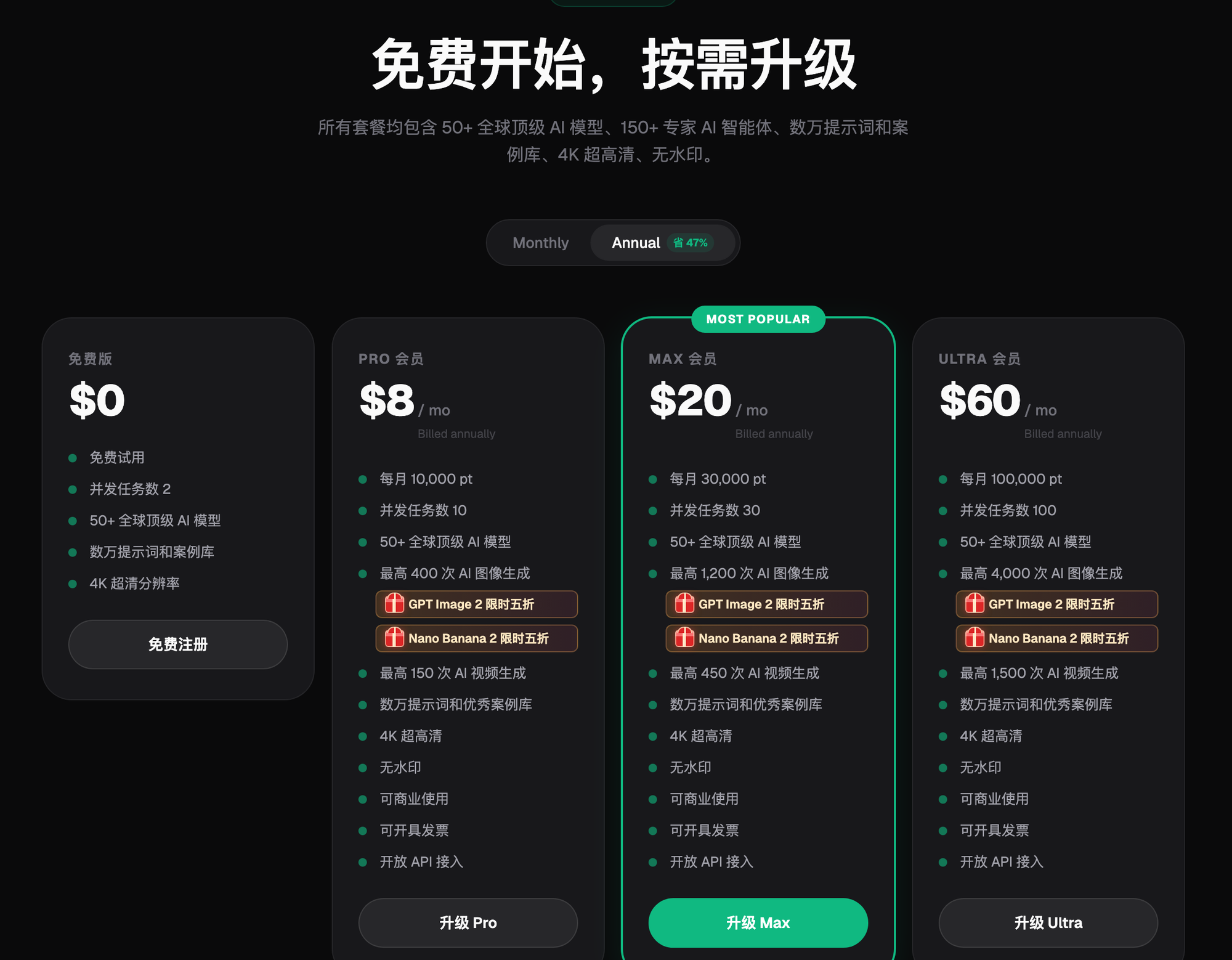
Screenshot: the Flux Art pricing page, showing the Free, Pro, Max, and Ultra tiers side by side, each labeled with its monthly credit allowance, concurrent task limit, and caps on AI image and video generations. All four tiers include 50+ top global AI models and 4K ultra-HD, and paid tiers are marked as watermark-free, commercially usable, and invoice-eligible. Prices shown are annual billing; prices and entitlements are subject to the current official site.
5. Practical Advice for Putting Your Choice into Practice
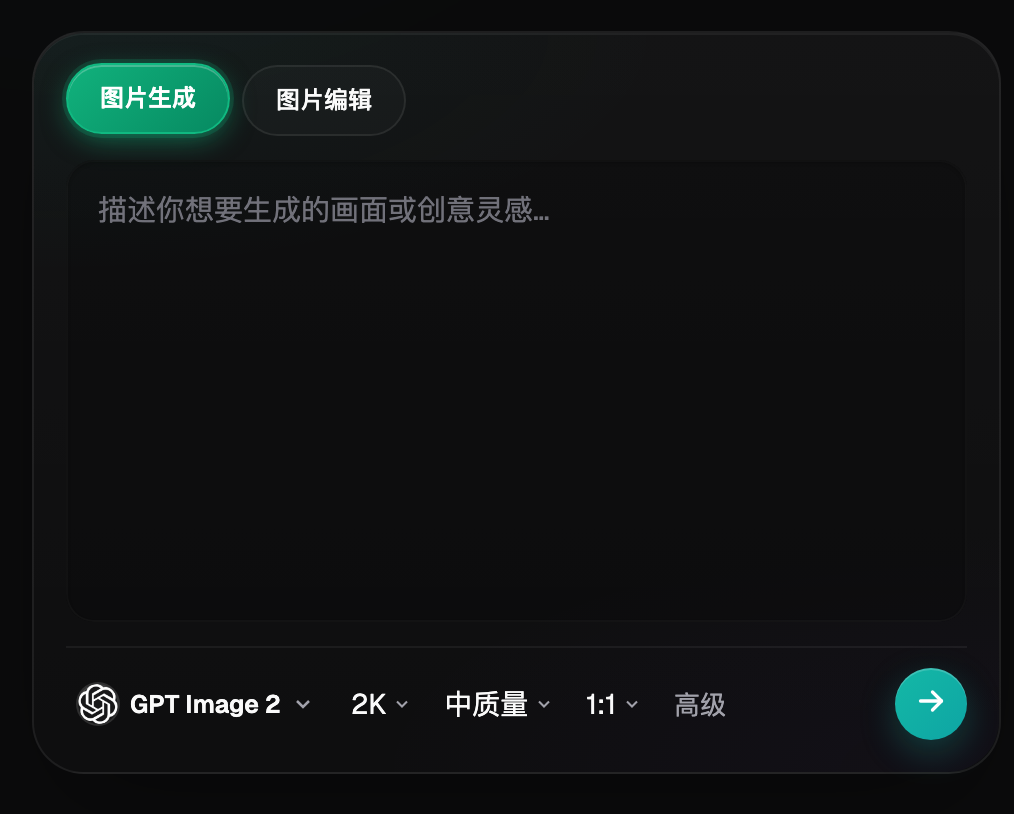
Screenshot: the image-generation panel on the Flux Art homepage. At the top are two entry points, "Image Generation" and "Image Editing"; in the middle is the prompt input box; along the bottom is a row for model selection (GPT Image 2 shown here), resolution (2K), quality tier (medium), aspect ratio (1:1), and advanced options. When testing candidate tools in practice, this is the row of parameters where you swap models and ratios to run the same set of test images.
Step one: map out your own requirements. List the types and volume of assets you need each month, separating basic needs (background removal, white background, simple scenes) from advanced needs (virtual models, short video, creative posters), and tally the volume for each.
Step two: narrow it down to 2–3 candidate tools. Cross-filter by category, scale, and platform, and prioritize products with a free trial or pay-per-use option to keep your trial-and-error costs low.
Step three: run a hands-on test with your own SKUs. Don't just look at official sample images — you have to test with your store's most complex SKUs. For apparel, test lace and drape fidelity; for jewelry, test metal reflection; for 3C, test glass and metal edges; for food, test liquid and texture. At the same time, test batch upload speed, generation success rate, and rework count.
Step four: calculate total cost. Factor in subscription fees, credit consumption, rework time, and the learning curve, and compute the real cost per usable image. Don't just compare monthly fees — if the pass rate differs by 2x, the real cost differs by 2x too.
Step five: settle on a main tool plus supporting tools. No single tool covers every need — the standard approach is one main tool handling 80% of standardized needs, with one or two supporting tools covering the remaining 20% of special cases. An aggregator platform is a natural fit as the main tool, since it already integrates multiple models and saves you from switching between separate standalone tools.
Data update note: the industry figures in this article are drawn from the National Bureau of Statistics' 2025 annual statistical bulletin (released January 2026) and CNNIC's 57th report (released 2026). Tool specs and pricing were compiled in July 2026; for any subsequent changes, defer to each platform's latest official announcement.
- National Bureau of Statistics of China. 2025 National Economic Performance (national online retail sales CNY 15.9722 trillion, up 8.6%; physical-goods online retail sales CNY 13.0923 trillion, 26.1% of total retail sales of consumer goods). 2026-01-19.
- China Internet Network Information Center (CNNIC). The 57th Statistical Report on China's Internet Development (as of December 2025, internet users reached 1.125 billion; generative AI users reached 602 million, up 141.7% year over year). Released 2026-02-05.
- Flux Art official website. Platform feature overview, model list, and commercial use terms. https://flux-art.ai