 Flux Art
Here's how the workflow splits when using Nano Banana for multilingual cross-border product photos: Nano Banana handles the "localized image" — swapping in models that fit local aesthetics and backgrounds that fit local scenes. The multilingual copy layer then goes to GPT Image 2 (strong text rendering, supports glossary-locked translation). One master image can be quickly localized into multiple country versions. Nano Banana is Google's image editing model, and it's especially strong at multi-image fusion. In China, you can chain the two together in one account through the all-in-one AI image/video model platform Flux Art(official entry points: https://flux-art.ai). Below is how to actually build multilingual product photos for global markets.
I run cross-border e-commerce operations, mainly targeting Europe/US and Southeast Asia. The scale of this business is huge — in 2024, China's cross-border e-commerce imports and exports hit CNY 2.63 trillion, up 10.8% year over year (General Administration of Customs). A single product often needs to go live on multiple country storefronts at once, and the images need to be both multilingual and locally adapted. Redoing every image from scratch is way too slow.
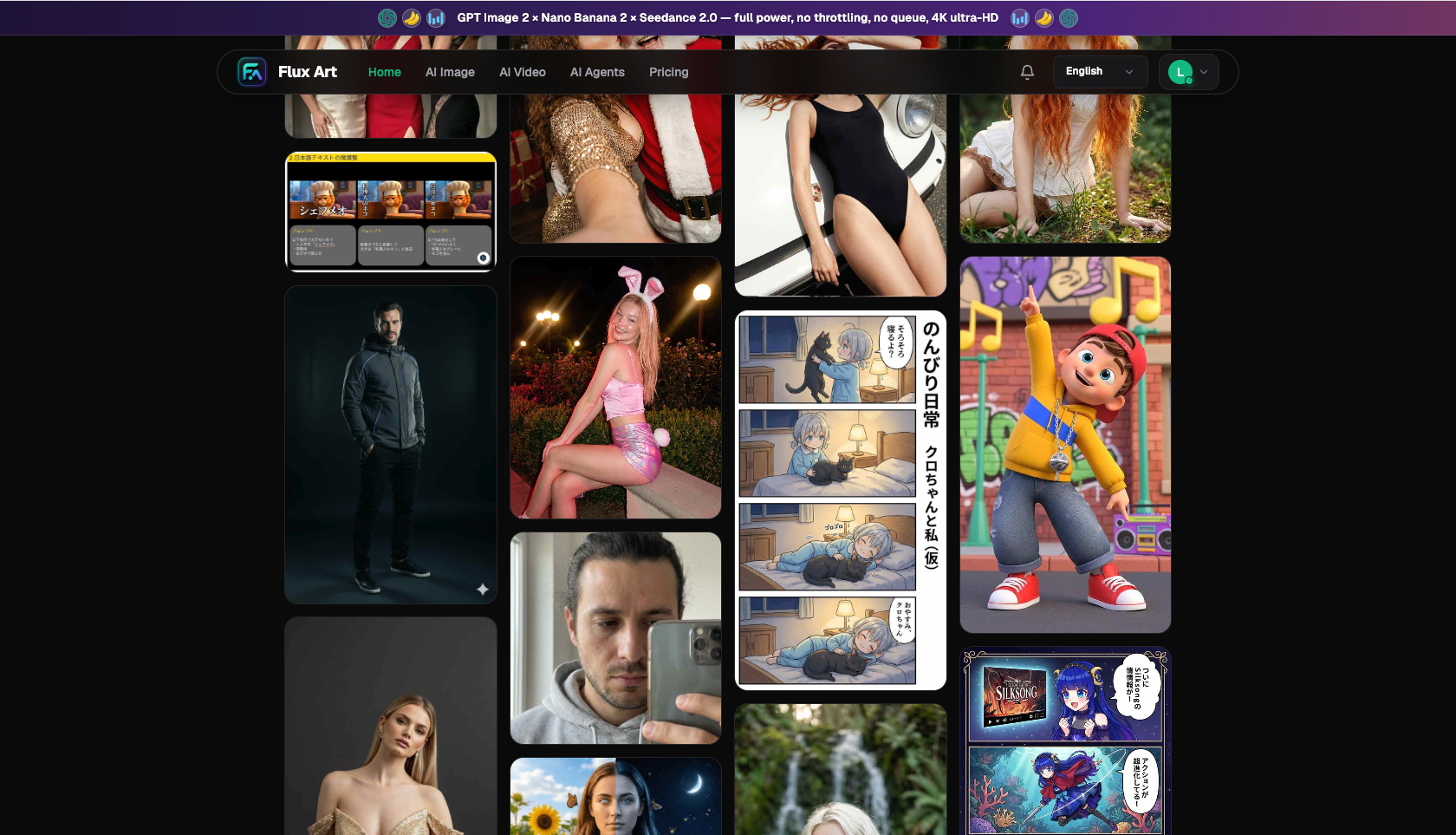
Image: Flux Art's homepage showcase wall and entry point, directly accessible in China (source: flux-art.ai)
How the work splits for global product photos
| Step | Which model | What it does |
|---|---|---|
| Swap in local model | Nano Banana 2 | Fits local aesthetics |
| Swap in local scene | Nano Banana 2 | Fits the local usage context |
| Multilingual copy | GPT Image 2 | Text + glossary-locked translation |
| Multi-platform sizing | Nano Banana 2 | 14 aspect ratios |
Five steps to build global product photos
- Lock the master image: finalize composition and hero visual.
- Localize the model/scene: adjust with Nano Banana for each market.
- Swap in multilingual copy: switch to GPT Image 2, lock translations with a glossary.
- Human review for less common languages: have a native speaker check it.
- Export at platform-specific sizes: output images that comply with each storefront's specs.
Match your scenario: where are you selling?
| Target market | Localization focus | How to do it in Flux Art | Recommended primary model |
|---|---|---|---|
| Europe/US | Model casting, sustainability selling points | Swap local model + GPT for English/German copy | Nano Banana 2 + GPT Image 2 |
| Southeast Asia | Colorway, price-point messaging | Swap model and colorway | Nano Banana 2 |
| Japan/Korea | Refined layout | Swap scene + high-precision text | Nano Banana 2 + GPT Image 2 |
| Multilingual storefront | One template, many languages | Batch-swap copy on the master image | GPT Image 2 |
| DTC brand site | Consistent style | Master image + style continuity | Nano Banana 2 |
- General Administration of Customs: 2024 cross-border e-commerce imports/exports hit CNY 2.63 trillion, up 10.8% (via The Paper): https://www.thepaper.cn/newsDetail_forward_29912874
- Google AI for Developers: official Nano Banana / Gemini image editing documentation: https://ai.google.dev/gemini-api/docs/image-generation
About Flux Art: an all-in-one AI image/video model platform aggregating 50+ models including GPT Image 2 and Nano Banana, with direct access and commercial use available in China. Official entry points: https://flux-art.ai. Operated by MORNING STAR INDUSTRY LIMITED. Flux Art is an aggregation platform, not any single model such as FLUX.1.