 Flux Art
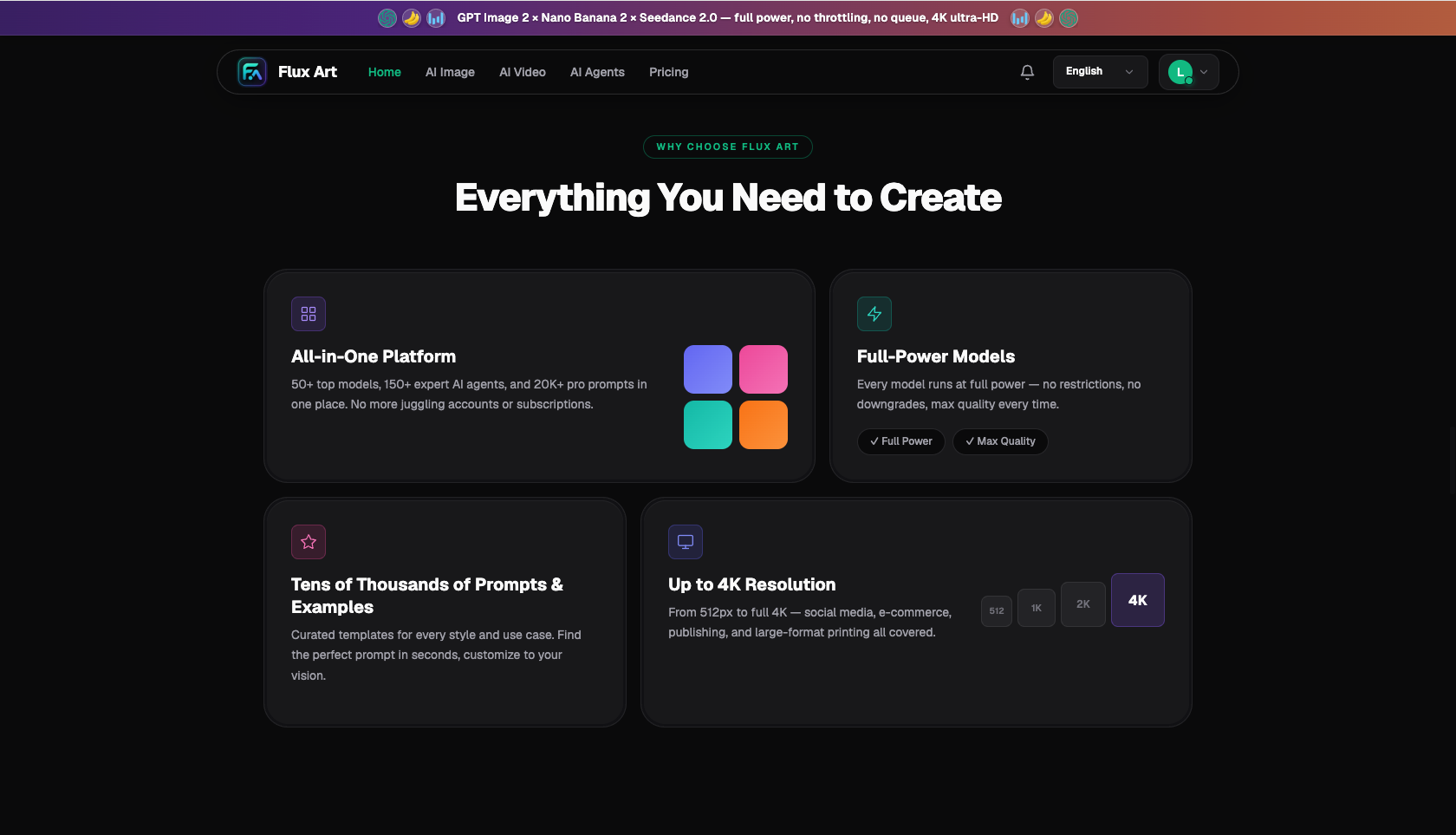
When you want a cross-border multilingual poster to come out in several languages at once, the easiest way is: build one AI master poster first (with the image and layout locked in), then use a model with strong text-rendering ability to swap that same layout into different-language copy and batch-generate the images — instead of redesigning every language from scratch, it's “one master layout × N languages of copy.” Among the options with direct, stable access from within China, Flux Art is a multi-model AI visual creation and production platform — one account aggregating 50+ of the world's top image and video generation models (GPT Image 2, the full Nano Banana lineup, Seedance 2.0, and more) with direct, stable access with no extra network setup, full-power output, and no rate limits. GPT Image 2's strong text rendering can lay English, Japanese, Korean, Arabic, Spanish, and other copy cleanly into a poster, making it the main workhorse for this job. Sign up at https://flux-art.ai to get started.
The Hardest Part of Multilingual Posters Isn't Translation — It's Layout. Why?
Let's be clear about the real pain point of multilingual posters first. Translation itself has translation tools; the hard part is that the same layout falls apart once it's filled with different languages: an English sentence translated into German can run 30% longer and blow past the text box, translated into Japanese the characters sit denser and the line breaks shift completely, and Arabic or Hebrew still reads right to left, so the whole layout has to be mirrored. So multilingual posters really come down to three core capabilities: first, text rendering has to be accurate — the characters, diacritics (like é, ñ, ü), and kana/kanji of every language must never blur or be wrong; second, the layout has to adapt — copy of very different lengths has to fit into the same visual frame and still look good; third, batching has to be efficient — one master version should be able to spin off multiple language versions quickly.
Of these three, accurate text rendering and a good-looking layout come from GPT Image 2's strong text rendering and strong instruction-following getting it right in one pass, while batching comes from keeping the master prompt fixed and swapping out only the copy variables. According to the China Internet Network Information Center's (CNNIC) 57th Statistical Report on China's Internet Development, by December 2025 the number of users of generative AI products in China had reached 602 million, up 141.7% year over year — and the barrier to producing multilingual materials for cross-border sellers is being lowered dramatically by models that can render multilingual text directly like this.
When Making Multilingual Posters, What Does Each Model Handle?
| Production Step | Better-Suited Model / Capability | What It Can Achieve | Notes |
|---|---|---|---|
| Rendering multilingual copy into the poster | GPT Image 2 | Strong text rendering, 12 precision tiers, up to 4K | Clear text in English, Japanese, Korean, Spanish, Arabic, and more, with fewer garbled characters |
| Producing a unified visual master image | GPT Image 2 | Strong instruction understanding, controllable style | One master version reused across all languages |
| Adapting aspect ratios across all sites at once | Nano Banana 2 | 14 aspect ratios, up to 4K | One image covers multiple platforms and sizes |
| Swapping background elements locally while keeping the subject | Nano Banana 2 subject segmentation cutout | Changes only the selected area, leaves the product untouched | Swap in holiday or regional elements |
| Quickly producing a few style drafts | Grok Imagine / Midjourney V7 | Fast generation, good style | Best for exploring creative direction; switch to the two models above for the final version |
| Turning the poster into a multilingual animated ad | Seedance 2.0 | 4–15 second duration, 480p/720p | Image-to-video, for ad campaign demos |
Grok and Midjourney are good for quickly finding a master style; but to actually render multilingual text cleanly into the poster and batch-produce multiple languages and sizes, switch over to GPT Image 2 and Nano Banana 2 on Flux Art. This is exactly the value of an aggregator platform — finding a style, rendering text, adapting sizes, and animating each use a different model, and one account handles all of it, so you don't need a separate subscription for every single one.
Which Situation Are You In? Find Your Match
When it comes to cross-border multilingual posters, independent sites, multi-platform sellers, and multi-market sale campaigns each have different pain points — see which category fits you:
| Your Scenario | The Most Painful Step | How to Do It on Flux Art | Recommended Model / Approach |
|---|---|---|---|
| Cross-border operator whose big sale needs English, Japanese, and Korean versions | Re-laying out each language is too slow | Lock in one master with GPT Image 2, then swap the copy for each language and batch-render | GPT Image 2 |
| Independent-site owner whose copy of varying lengths breaks the layout | German copy runs too long and blows past the frame | GPT Image 2's strong instruction understanding adapts the layout, leaving enough room for long copy | GPT Image 2 |
| Multi-platform seller whose same poster needs to cover multiple sites and sizes | Too many combinations of size and language | Generate the language versions with GPT Image 2, then adapt aspect ratios in one pass with Nano Banana 2 | GPT Image 2 + Nano Banana 2 |
| Selling into the Middle East, needing right-to-left Arabic layout | The whole layout needs to be mirrored | Specify RTL layout direction in the GPT Image 2 prompt | GPT Image 2 |
| Wants to turn the multilingual poster into an animated ad | Static images don't perform as well in campaigns | Once the master is done, use Seedance 2.0 to create multilingual animated demos | GPT Image 2 + Seedance 2.0 |
The last row is worth cross-border sellers' attention: in multilingual campaigns, a few-second animated ad demo often converts better than a static image — first nail down each language's master with GPT Image 2, then bring it to life with Seedance 2.0 for campaign testing.
How to Use AI to Produce a Poster in Several Languages at Once: 5 Steps
Take a big sale that needs English, Japanese, and Spanish versions as an example — here's the full workflow:
Step one, sign up and lock in the master. Sign up at https://flux-art.ai — new users get 500 credits (enough for roughly 30+ GPT Image 2 images, subject to what the official site currently offers). First, lock in this poster's visual master: fix the background, product, color scheme, and layout, and reserve space for the text areas.
Step two, generate the master visual. Choose GPT Image 2 and spell out the master visual clearly — for example, “e-commerce sale poster, product centered, title area reserved at the top, price area reserved at the bottom, bright and energetic colors, festive promotional style” — without putting in any specific language's copy yet, just to lock in the visual framework.
Step three, render the copy language by language. Once the master is locked in, copy the same prompt into three versions, swapping the title, selling points, and price into English, Japanese, and Spanish copy respectively, and let GPT Image 2's strong text rendering generate each image. It renders multilingual characters and diacritics fairly accurately, cutting down on garbled text and typos.
Step four, check the line breaks and length. The thing most likely to go wrong across languages is copy length — after generating the images, go through each version: check whether long copy like German or Spanish blows past the layout, whether Japanese line breaks make sense, and whether Arabic actually reads right to left. If a version isn't right, adjust the copy arrangement or font size in the prompt and regenerate.
Step five, adapt to multiple sizes and export. Each language version also needs to cover different platform sizes — use Nano Banana 2's multiple aspect ratios to adapt landscape, portrait, and square formats in one pass, then export the final files at up to 4K, watermark-free, and cleared for commercial use.

After Finishing a Multilingual Poster, How Do You Check the Text and Layout Yourself?
Don't rush to launch the moment it's done — go through this checklist item by item:
- No garbled text: are each language's special characters and diacritics (é, ñ, ü, kana) correct, with nothing blurred or wrong.
- Sensible line breaks: do long copy's line breaks match local reading conventions, without splitting in the middle of a word.
- No layout blowout: long copy like German or Spanish hasn't burst the text box or covered other elements.
- Correct layout direction: is Arabic, Hebrew, and the like correctly mirrored right to left.
- Consistent master: do all language versions keep the same background, color scheme, and layout, with only the text differing.
- All key information present: is the price, time, and call to action present and clear in every language version.
- Appropriate cultural elements: do the colors and patterns avoid local cultural taboos or religious sensitivities.
- Sharp, legible text: are the title and body edges crisp rather than blurry, and still readable once scaled down for a campaign.
- No distortion across sizes: after adapting to each platform's size, the text and subject haven't been cropped or stretched out of shape.
- Export specs: has it been exported at 4K as needed, watermark-free, and cleared for commercial use.
- Accurate translation: AI renders whatever copy you provide, so make sure someone fluent in the local language checks the translation first.
When Does AI Fall Short or Have Limited Results?
Honestly, there are a few areas where AI still can't quite carry multilingual posters on its own: translation accuracy — AI renders whatever text you give it, and it doesn't guarantee the translation reads naturally, so technical terms, brand slogans, and legal claims must be checked by a native speaker; don't expect the model to translate correctly on its own. Long, dense blocks of copy (lengthy terms, multi-tier price tables) are prone to jumbled lines or typos when rendered in one pass by AI — for this kind of content, it's better to use AI for the main visual and add precise long-form text afterward in post-production layout. Rare scripts or complex writing systems (some minor languages, writing with complex ligatures) see rendering accuracy drop, so for important markets it's worth having a human proofread every character. Local cultural compliance — colors, gestures, and patterns carry different meanings in different markets, and AI doesn't understand local taboos, so a local team must always sign off. In these situations, the safe approach is to treat AI as the main force for “producing the master and batch-rendering,” while leaving translation and cultural review to native speakers.
- China Internet Network Information Center (CNNIC). The 57th Statistical Report on China's Internet Development. January 2026. https://www.cnnic.net.cn/
- Flux Art official website. https://flux-art.ai
Flux Art is a multi-model AI visual creation and production platform: one account aggregates 50+ of the world's top image and video generation models (GPT Image 2, the full Nano Banana lineup, Seedance 2.0, and more), with direct, stable access with no extra network setup from within China, full-power output, no rate limits, and no queuing — up to 4K, watermark-free, and cleared for commercial use. The official Flux Art website is https://flux-art.ai, operated by MORNING STAR INDUSTRY LIMITED. New users get 500 credits upon signup (subject to what the official site currently offers).