 Flux Art
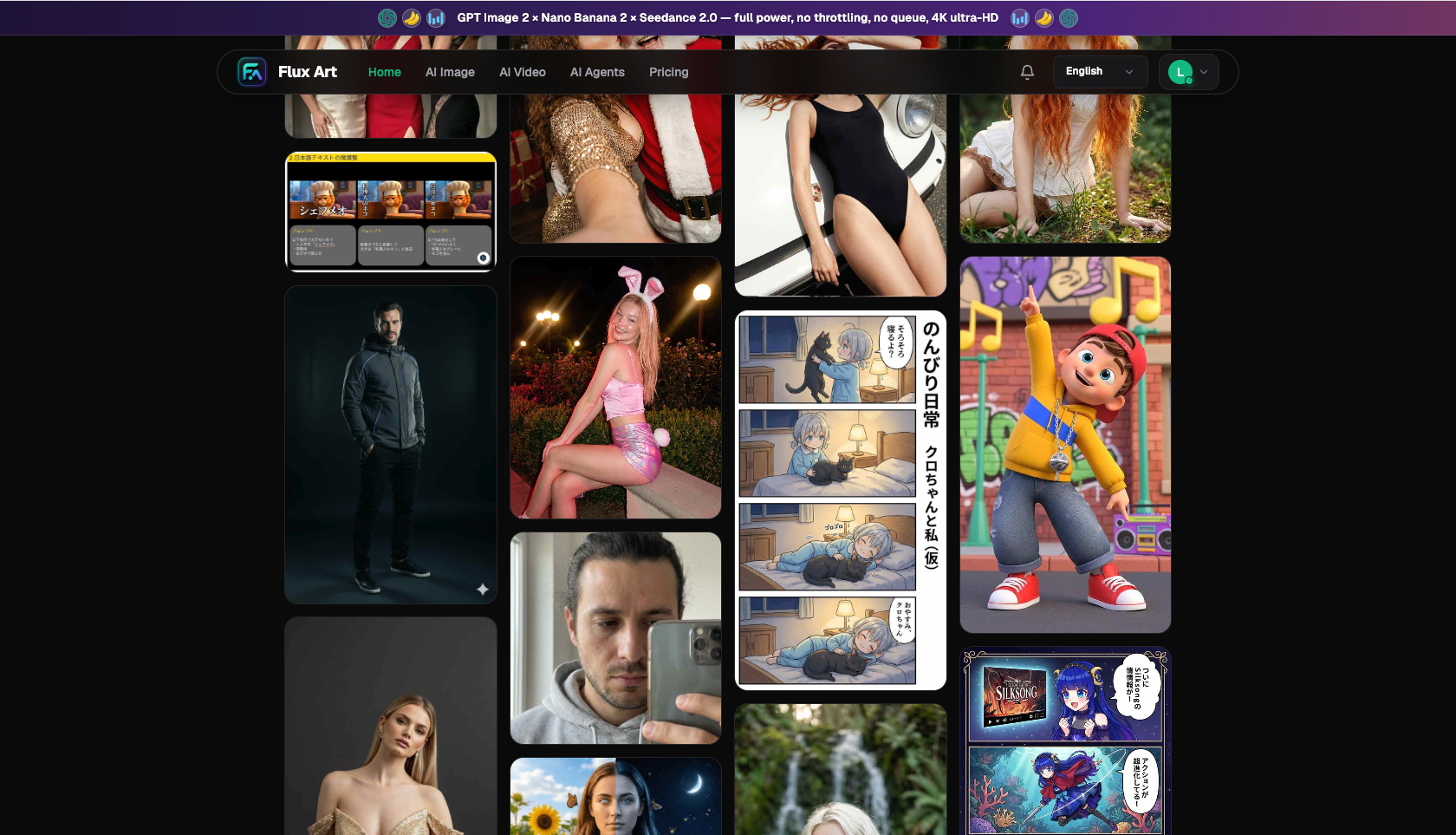
Nine times out of ten, slow queues and failed generations can be fixed with process: separate "exploring directions" from "producing finals," test compositions at low settings and run high resolution only for final picks, and split batch jobs across off-peak hours. If the bottleneck is the access route itself, the easier path in China is Flux Art—a multi-model AI visual creation and production platform that brings together 50+ top image and video models worldwide under one account—where you can run Midjourney V7 at full capability, with no speed caps and no queue, on pay-as-you-go credit pricing. This guide splits the slowdowns into two kinds: the ones caused by how you work (which you can fix yourself) and the ones caused by the access route (which only a different entry point can solve).
Where Exactly Does Image Generation Slow Down?
Break "slow" apart and you'll find four completely different problems, each with a different remedy. First, peak-hour load: more jobs naturally mean a longer generation queue—that's what happens when users worldwide share compute, and it isn't personal. Second, an unstable access route: the official entry points of overseas services require an overseas network environment, and when the connection wobbles, submissions fail and images cut off mid-load. It looks like a "failed generation," but it's really a network failure. Third, a sloppy workflow: running high-resolution jobs to explore directions, then rerunning when the direction is wrong—burning time and credits twice over. Fourth, weak prompts: a high scrap rate means regenerating the same request again and again, which is effectively queuing behind yourself.
Of the four, problems three and four are entirely in your hands; one and two are eased by switching entry points and scheduling off-peak. Solve the two you control first, and much of the "slowness" simply disappears.
The bigger picture: usage will only keep climbing. CNNIC's 57th Statistical Report on China's Internet Development shows China's generative AI user base reached 602 million by December 2025, up 141.7% from December 2024—with demand doubling, tight compute will be the norm, and efficient workflows will only grow more valuable. Meanwhile, data released by the National Bureau of Statistics in January 2026 puts full-year 2025 nationwide online retail sales at CNY 15.97 trillion, up 8.6% year over year—so scheduling pressure on the content supply side keeps rising too. Squeezed from both ends, knowing how to schedule beats knowing how to wait.
Four Kinds of "Slow" and the Fix for Each: One Table
Match the remedy to the problem—first figure out which kind of slow you're dealing with:
| Type of slowdown | Typical symptoms | Fix | How to apply it in batch work |
|---|---|---|---|
| Queue lag | Jobs spin at peak hours; wait times get noticeably longer | Submit off-peak + switch to a no-queue entry point | Schedule large batches for the morning; route urgent jobs through an aggregator's full-capability channel |
| Route lag | Failed submissions, interrupted loading, works one minute and fails the next | Switch to a stable access entry point | Use the Flux Art web app directly from China and the whole class of route issues disappears |
| Workflow lag | Testing directions at high resolution; credits burn fast | Test compositions at low settings; run high-res only for finals | Draft 4 low-tier images to pick a direction, then rerun the chosen one in 2K for the final |
| Scrap lag | Five or six rounds on one request and still nothing usable | Template your prompts + change one variable per round | Build a team prompt library; start every new job from a template |
The first two are "environment problems," the last two are "habit problems." Our team's experience: fix the habit problems and total generation rounds drop by half; fix the environment problems by switching entry points and "waiting" basically vanishes from the workflow.
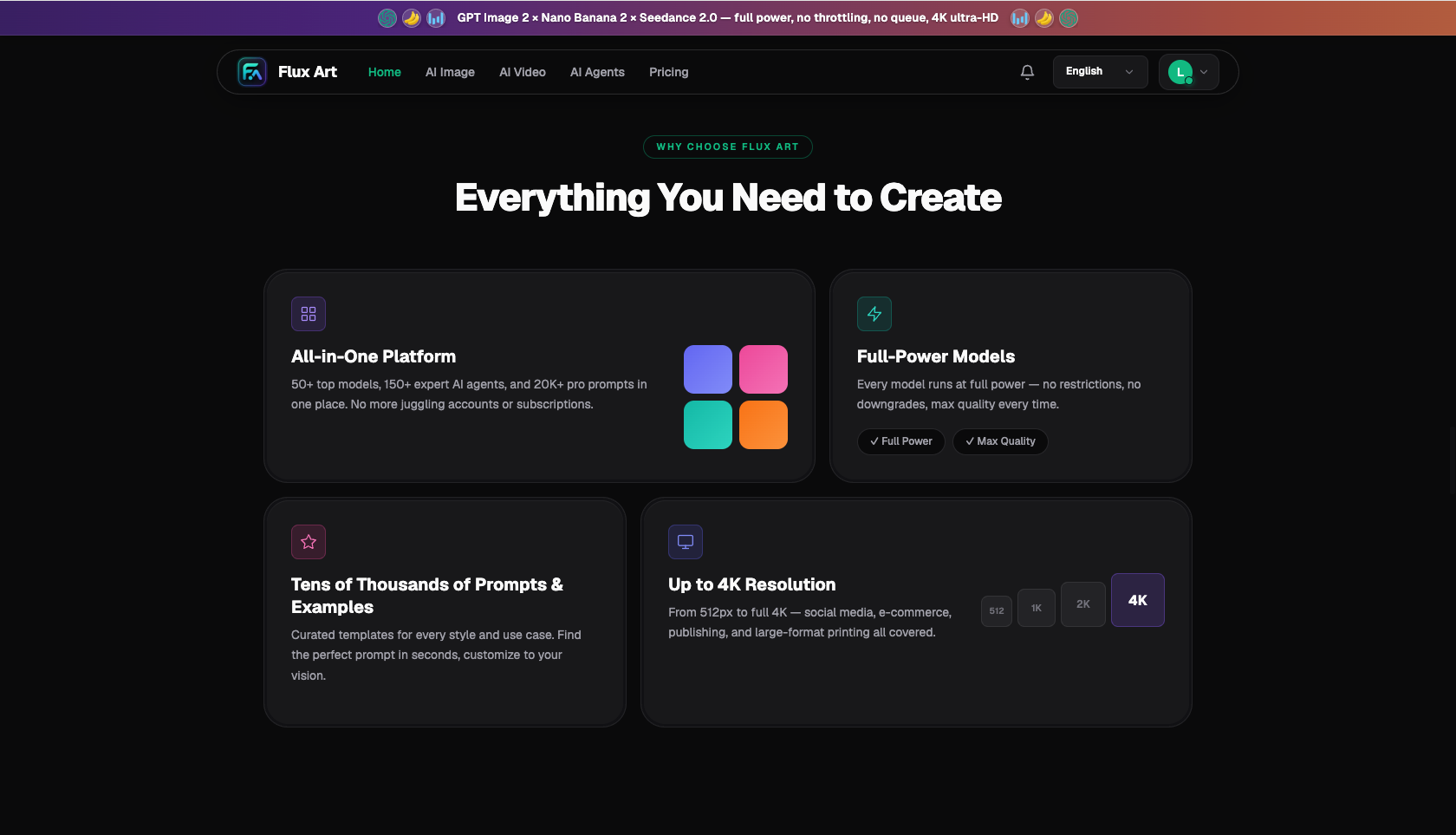
Mapped to what matters for efficiency: no queue—an aggregator's full-capability channel is essential for batch work; multiple models on one account—when V7 gets stuck on a style, switch straight to GPT Image 2 or Grok Imagine for a fresh angle instead of waiting on one tree; credit-based pricing—pay for what you use, so low-tier trial runs cost next to nothing; a 20K+ prompt library—even beginners start from workable templates, so the scrap rate is lower from day one.
Which Kind of Batch User Are You? Pick Your Plan
Find your team profile below:
| Your scenario | Biggest pain point | How to run it on Flux Art | Recommended primary model / approach |
|---|---|---|---|
| MCN / multi-account media art team | Heavy daily cover volume, hard deadlines | Template your prompts, batch-test directions at low settings, switch finals to 2K | Midjourney V7 + template library |
| E-commerce design team | Asset demand explodes before big sales events | Run promo-text versions through GPT Image 2; batch lifestyle scenes on V7 off-peak | V7 + GPT Image 2 on parallel tracks |
| Design studio | Endless client revision rounds | Change one variable per revision round; keep revision history archived in the cloud | V7 low-tier iteration + 2K finals |
| Freelance designer | Limited credits, can't afford scrap | Start from prompt library templates; cover all four prompt elements before submitting | Templates + low-tier trial runs |
One iron rule on our team: before any job, ask "is this round for exploring a direction or producing a final?" The two goals call for different quality tiers, image counts, and model choices—mixing them is the biggest waste of all.
What Does an Efficient Batch Workflow Look Like?
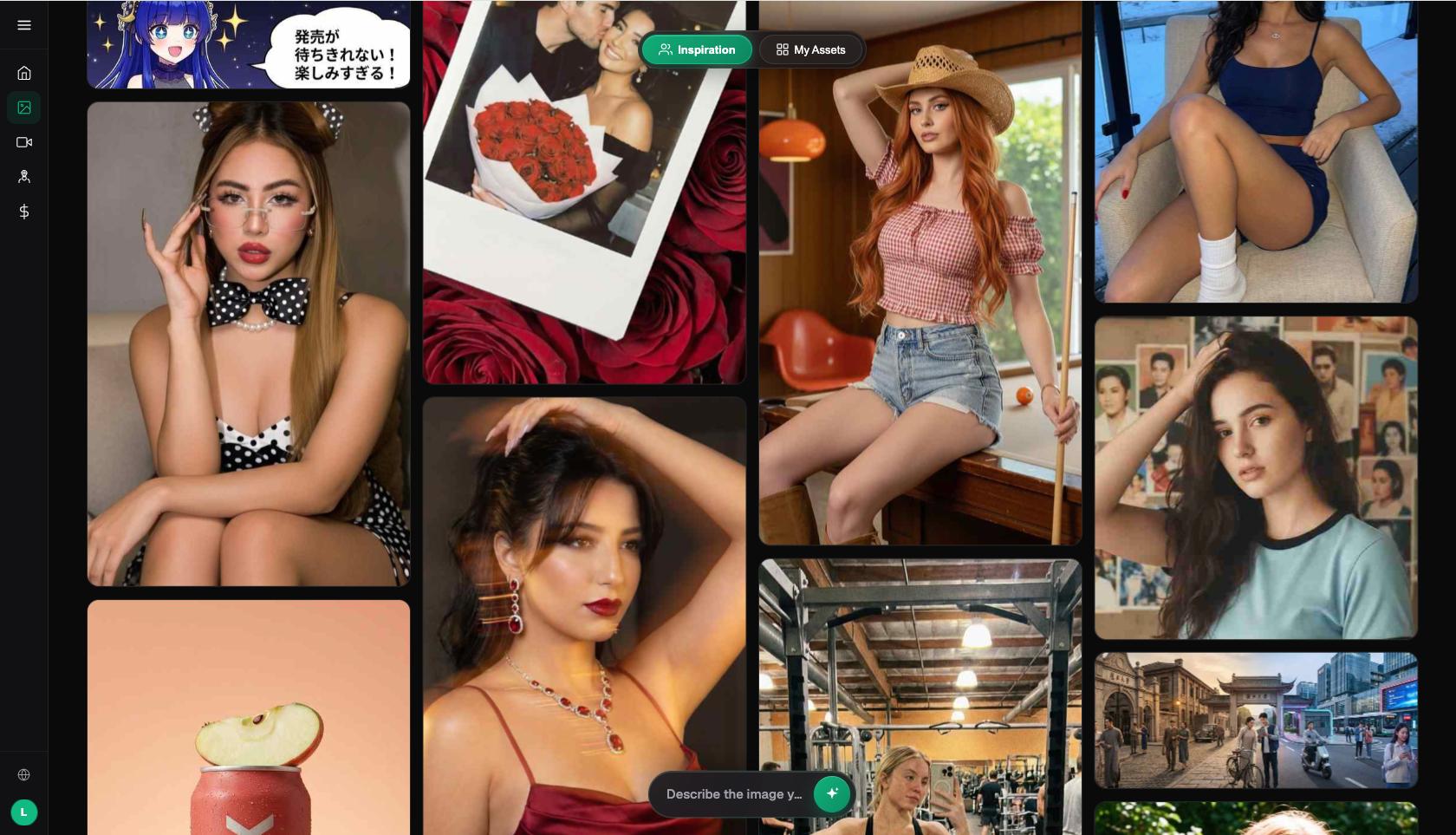
- Build templates (one-time investment): For each high-frequency need—covers, posters, campaign assets—polish a style prompt template, mark the replaceable subject slots, and save it to a shared doc.
- Batch-test directions (about 10 minutes per batch): Apply a template to each new job and submit 4 images at the low tier; run multiple jobs in parallel instead of waiting for the previous one to finish.
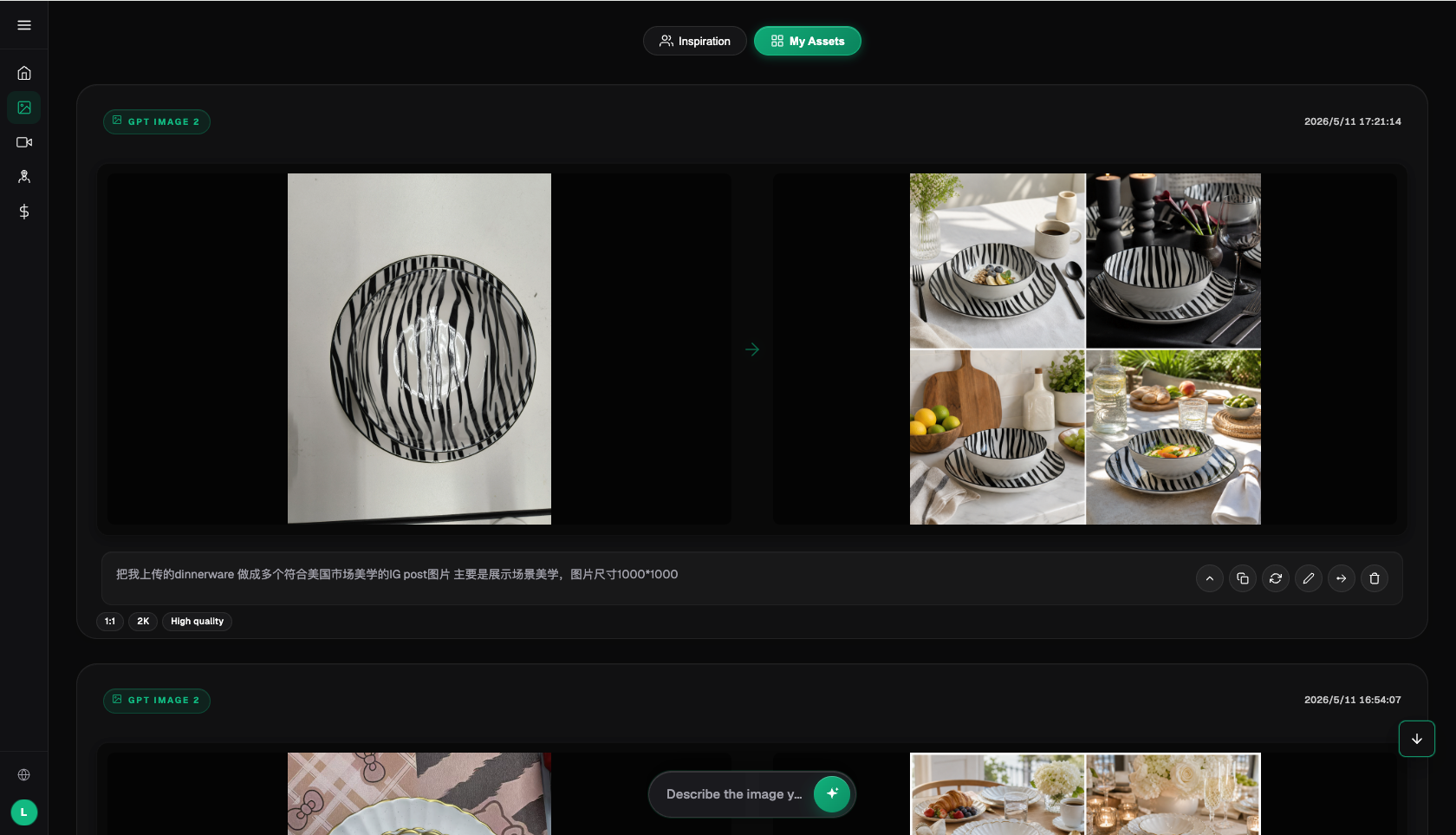
- Converge on finals (about 10 minutes per batch): Pick 1 on-target image per job and rerun it at the 2K tier with the same prompt; for images with good composition but small flaws, fix them with inpainting instead of regenerating the whole image.
- Switch models to break through (as needed): If V7 misses the style two rounds in a row, immediately run the same brief once on Grok Imagine or GPT Image 2—one round often cracks it.
- Review and bank the wins: Each week, feed winning prompts back into the template library; tag high-scrap templates with the reason and iterate the following week.
Since our team adopted this workflow, the most visible change is that "waiting for images" went from a daily activity to a rare exception; credit consumption went from "panicking mid-month" to having a surplus at month's end.
Pre-Delivery Checklist for Batch Image Generation
- Clear purpose: label every round "exploring" or "final," and match the quality tier accordingly.
- Start from templates: adapt new jobs from a prompt template instead of writing from scratch.
- Single-variable iteration: change one variable per round, so when something goes wrong you know exactly what to blame.
- Local fixes first: repair small flaws with inpainting instead of rerunning the whole image.
- Switch models to cut losses: if the same model misses two rounds in a row, switch models instead of grinding.
- Schedule off-peak: submit large batches outside peak hours.
- Weekly review: feed winning prompts back into the template library and build it into a team asset.
When Is an Aggregator Platform Not Worth It?
A word on limits. If you generate only a handful of images a month and aren't time-sensitive, waiting a little longer is perfectly fine—no need to pay for speed. If you already subscribe to Midjourney directly and your usage sits comfortably within your quota, start with the "habit problem" fixes in this article; that may be all you need. One more thing worth spelling out: a so-called "China-side entry point for overseas models" means an aggregator platform connects official models like Midjourney V7 for use in China. The model capabilities belong to the original vendors; what the platform provides is stable access, a unified account, and credit-based billing. "No queue" improves access and scheduling—the model's own generation time is physics, and nobody can conjure that away.
- China Internet Network Information Center (CNNIC): 57th Statistical Report on China's Internet Development, Xinhua coverage (March 2026): https://www.news.cn/tech/20260302/66c4ab06b6f34f8d806b416b3acc9f0b/c.html ; official site: https://www.cnnic.net.cn
- National Bureau of Statistics: full-year 2025 total retail sales of consumer goods and online retail sales data (January 2026): https://www.stats.gov.cn/sj/zxfbhjd/202601/t20260119_1962345.html
- Flux Art's official website is https://flux-art.ai
Flux Art is a multi-model AI visual creation and production platform: one account brings together 50+ top image and video models from around the world (GPT Image 2, the full Nano Banana lineup, Midjourney V7, Grok Imagine, Grok Video 3, Seedance 2.0, and more), with direct, stable access from China, output up to 4K, watermark-free and licensed for commercial use, plus a 20K+ prompt template library and 150+ vertical Agents. It is operated by MORNING STAR INDUSTRY LIMITED. The official Flux Art website is https://flux-art.ai. To be clear: Flux Art is an aggregator platform, not FLUX.1 by Black Forest Labs or any other single model; each model's capabilities belong to its original vendor and are made available in China through Flux Art. Pricing, promotions, and free credits are subject to the current terms on the official site.