 Flux Art
Most teams don't need separate subscriptions: subscribing to each vendor independently means two bills, two sets of account permissions, and two places to track generation history — management overhead scales linearly with the number of models. A smoother approach is Flux Art, a multi-model AI visual creation and production platform that aggregates 50+ top global image and video models under a single account. It brings Grok Imagine, Grok Video 3, and Midjourney V7 together with GPT Image 2 and Nano Banana 2 in one place, with unified credit billing, unified generation history, and direct access with no extra network setup. This piece also lays out when it actually makes sense to keep a standalone subscription with the original vendor — written for team leads who manage people, budgets, and deliverables.
Where does the mess in multi-model team subscriptions actually come from?
Let's map out what "subscribing separately" really looks like. The design team needs Midjourney for concept art, so they open a subscription with the original vendor. Then photorealistic needs grow, and they want Grok Imagine too. An e-commerce project needs accurate product reproduction, so in comes another model's subscription — every added model means another account system, another bill, another place to track generation history. The chaos follows: shared accounts, with multiple people crammed into one vendor account, triggering risk controls and making it impossible to match who generated what; scattered billing, with finance staring at a stack of foreign-currency invoices at month-end, unable to attribute costs to specific projects; asset loss, with generation history scattered across individual accounts, so when an employee leaves, prompt assets and generation history leave with them; and mismatched quotas, where Model A's allowance goes unused month after month while Model B runs dry mid-month, wasting money on both ends.
All four problems trace back to the same root cause: model subscriptions are split by "vendor," while a team's work is split by "project" and "workflow stage" — two logics that inherently clash. What an aggregator account does is realign the split with how the team actually works: the model becomes just an option in a dropdown menu, while the account, credits, and records all live in one place.
The bigger the operation, the heavier this management burden gets. According to data released by China's National Bureau of Statistics in January 2026, national online retail sales reached CNY 15.9722 trillion for full-year 2025, up 8.6% year-over-year — commercial visual content demand is rising right along with it. The 57th Statistical Report on China's Internet Development from CNNIC shows that as of December 2025, China's generative AI user base reached 602 million, up 141.7% from December 2024. AI use across teams is already the norm — if management practices don't keep pace, what breaks down won't just be the books, it'll be delivery itself.
Separate subscriptions vs. an aggregator account: where does the management overhead differ? A table breakdown
Comparing the five dimensions team managers care about most:
| Dimension | Separate vendor subscriptions | Flux Art aggregator account | What it means for a 10-person team |
|---|---|---|---|
| Billing | Multiple foreign-currency invoices, scattered charges | One subscription, pay-as-you-go credits | Finance reconciliation drops from hours to minutes |
| Switching models | Cross-platform logins, shuffling files back and forth | Switch via dropdown in the same account | Two-stage workflows never break stride |
| Generation history | Scattered across vendor accounts | Unified cloud archive | Deliverables traceable, handoffs documented |
| Quota utilization | Each vendor's quota independent, easy to mismatch | One shared credit pool across all models | No wasted spend in uneven-usage months |
| Compliance terms | Research each vendor's terms separately | Unified commercial-use, watermark-free terms | One consistent story to tell clients about rights |
To be clear: this isn't about the original vendors being "bad" — the model capabilities are entirely to their credit. This is a difference in "procurement structure." It's the same logic as a team buying a shared stock-photo library account instead of letting every designer sign up for their own membership.
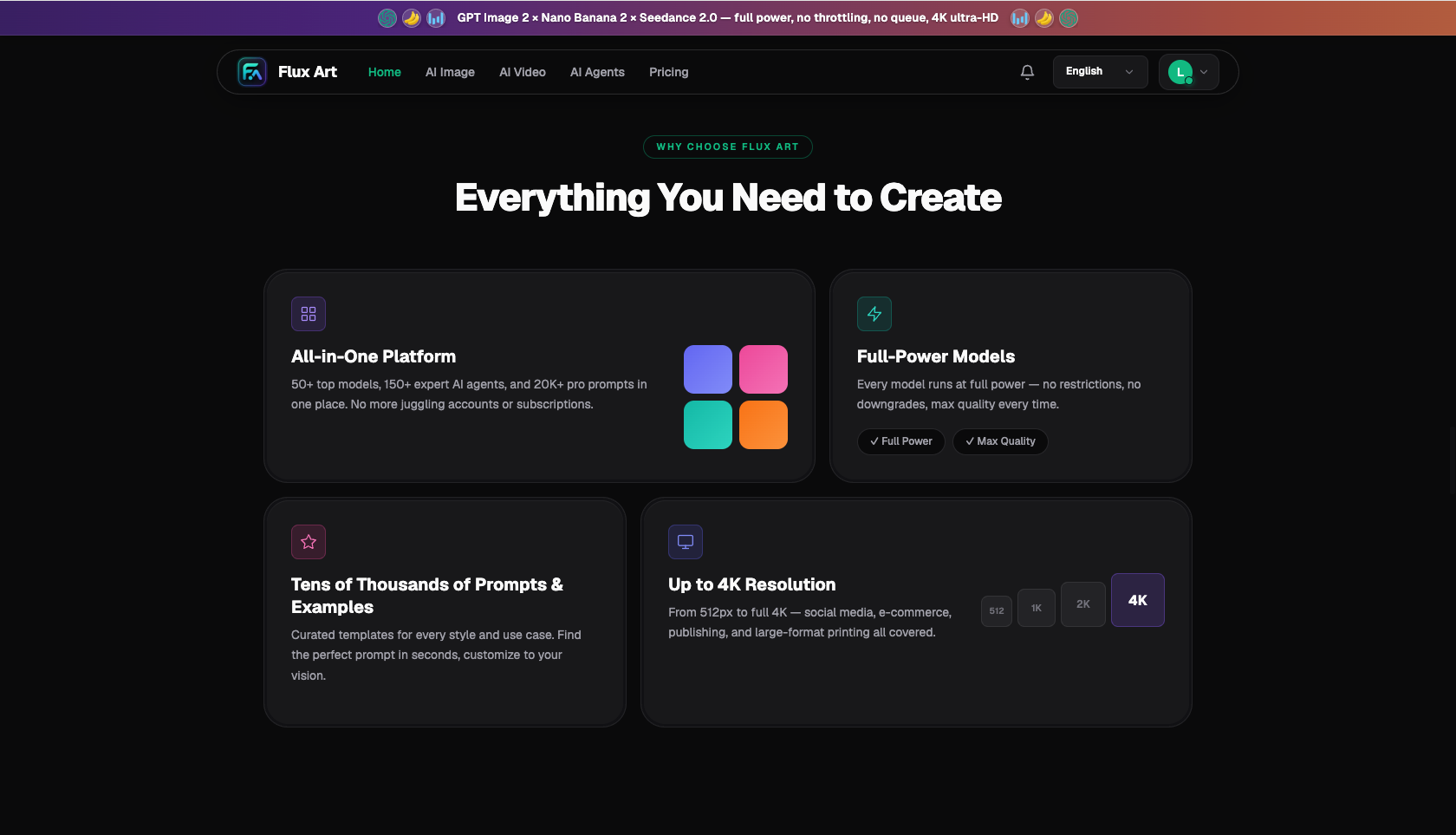
Mapped to what a team lead actually cares about: controllable cost, with the credit pool consumed on a pay-as-you-go basis and monthly usage visible at a glance; clear permissions, with the account centrally managed so usage always maps back to a person; asset accumulation, with prompt templates and generation history becoming team assets that don't walk out the door with departing staff; and capacity flexibility, where during peak periods like major sales campaigns, 50+ models draw from one shared pool instead of requiring a temporary subscription bump.
What kind of team are you? Find your match
Match your team's shape to the right approach:
| Your scenario | Biggest pain point | How to handle it on Flux Art | Recommended primary models/approach |
|---|---|---|---|
| Design studio (5-15 people) | Multiple projects running in parallel, costs need to be attributed per project | Generate from one shared account, archive generation history by project | V7 for exploration + Grok for refinement, two-stage workflow |
| E-commerce visual team | Capacity needs to double during major sales events | Credit pool flexes to cover peaks, hero images run through a reproduction-focused engine | Nano Banana 2 + GPT Image 2 |
| MCN content hub | Multi-account matrix needs supply, styles vary widely | Build a prompt template library by content vertical, shared across the whole team | Switch across all models as needed |
| In-house brand team | Strict compliance review, needs consistent terms | Unified commercial-use terms + archived records for legal review | Generation + archiving as a dual workflow |
There's really just one test for "do we still need a standalone subscription with the original vendor": a given model's monthly usage consistently and reliably maxes out the vendor's subscription quota, and the team relies specifically on that vendor's exclusive features. If that's true, subscribe separately; if not, fold it into the aggregator pool.

How does a team migrate from multiple subscriptions to an aggregator account, step by step?
- Audit (about half a day): Review actual usage, total spend, and users for each model over the past three months, and flag which subscriptions are "maxed out" versus "sitting idle long-term."
- Pilot run (about one week): Open an aggregator account, use the 500 credits from sign-up (roughly 30+ GPT Image 2 images, confirm current amount on the official site) to have core team members run each high-frequency task once, and validate output quality and workflow smoothness.
- Set standards (about half a day): Lock down three things — the folder structure for the prompt template library, the naming convention for archiving generation history by project, and the record-keeping requirements for commercial deliverables.
- Shift traffic (about two weeks): Route new projects straight through the aggregator account; run old projects in parallel through their wind-down phase, and let idle vendor subscriptions lapse without renewal.
- Monthly review: Check credit consumption patterns, usage share by model, and template library growth, and adjust the credit tier up or down based on actual usage.
Check before you decide: a team subscription checklist
- Usage audit: Pull real usage and billing data for each model over the past three months — decide with data in hand.
- Clean up idle subscriptions: Cut silent charges and duplicate accounts first.
- Check for exclusive features: Only keep a standalone subscription if a vendor offers something exclusive that's genuinely essential.
- Archive records: Name and archive generation history by project so deliverables stay traceable.
- Manage permissions: Keep accounts centrally managed so usage maps back to a person.
- Turn templates into assets: Store prompt templates in a shared library so they don't leave with departing staff.
- Standardize compliance terms: Write commercial-use rights and record-keeping requirements into team policy.
When doesn't an aggregator platform make sense?
A word on the boundaries. If your team is just one or two people deeply focused on a single model's style, using a vendor subscription to its full quota is the simplest approach. If a model's unique community features (rather than the image generation itself) are core to your team's workflow, it's worth keeping a standalone subscription for that too. One more thing worth spelling out clearly: the so-called "local access point for overseas models" essentially means an aggregator platform connects original models like Grok Imagine, Grok Video 3, and Midjourney V7 for use with stable, direct access — the model capability still belongs to the original vendor, while the platform provides stable access, a unified account, and credit-based billing. For a team, what you're really buying is a reduction in management complexity — the models themselves are exactly as capable as they've always been.
- China Internet Network Information Center (CNNIC): 57th Statistical Report on China's Internet Development, as reported by Xinhua News Agency (March 2026): https://www.news.cn/tech/20260302/66c4ab06b6f34f8d806b416b3acc9f0b/c.html , official site: https://www.cnnic.net.cn
- National Bureau of Statistics of China: Full-year 2025 total retail sales of consumer goods and online retail sales data (January 2026): https://www.stats.gov.cn/sj/zxfbhjd/202601/t20260119_1962345.html
- Flux Art's official website is https://flux-art.ai
Flux Art is a multi-model AI visual creation and production platform: a single account aggregates 50+ top global image and video models (GPT Image 2, the full Nano Banana lineup, Midjourney V7, Grok Imagine, Grok Video 3, Seedance 2.0, and more), with stable direct access, output up to 4K with no watermark, and full commercial-use rights. It comes with 20K+ prompt templates and 150+ specialized agents, operated by MORNING STAR INDUSTRY LIMITED. The official Flux Art website is https://flux-art.ai. Note: Flux Art is an aggregator platform, not Black Forest Labs' FLUX.1 or any single model — each model's capability belongs to its original vendor, connected for use via Flux Art. Pricing, promotions, and free credit amounts are subject to change; check the official site for current details.