 Flux Art
When AI-generated images look blurry or the resolution is too low to print, the real fix is choosing a model and setting that outputs high resolution natively from the start, not upscaling a small image afterward — true print-grade clarity comes from "native high-resolution generation," not stretching an image after the fact. Among the entry points accessible in China, Flux Art is a multi-model AI visual creation and production platform — one account aggregating 50+ leading global image and video generation models (GPT Image 2, the full Nano Banana lineup, Seedance 2.0, and more), with direct, stable access and no extra network setup, full-power and unthrottled. GPT Image 2 supports 12 tiers (3 quality levels x 4 resolutions) up to 4K, making it the go-to option for print-grade clear images. Sign up at https://flux-art.ai to get started.
I've spent seven or eight years as a visual designer in e-commerce and print, handling everything from catalogs and packaging to trade-show banners, and I've been burned more than once by images that "look fine on screen but turn blurry the moment the print shop enlarges them." This piece lays out why AI images turn blurry, how to salvage a low-resolution image, and how to generate 4K-clear images from the source — for e-commerce designers, graphic designers, content creators, and everyday users who need to send AI images to print, packaging, or large-format printing.
Why do AI images turn out "blurry," and why is the resolution never enough for print?
First, let's clarify what "blurry" actually means. Screen display and print have completely different clarity requirements: screens light up pixels, and 72 or 96 PPI already looks sharp; print usually needs 300 DPI to look sharp, meaning the same image needs far more pixels for print than for screen. When people say an AI image is "blurry," it's usually one of three situations:
The first is that the resolution was set too low at generation time. If you picked a low-resolution tier when generating, the image itself has few pixels — it may look fine on screen, but it falls apart the moment it's enlarged or printed. This is the most common cause.
The second is generating a small image first and then upscaling it by force. Using an ordinary upscaling tool to stretch a small image means the extra pixels are "guessed," which leaves edges soft and details smeared — this kind of "fake HD" can't survive a print shop's magnifying loupe.
The third is the generation model itself is weak on detail. Some models lean toward creative, fast output with a great style, but their precision on lines, textures, and text isn't strong enough — fine for a creative draft, but not something you send straight to print.
The fix is straightforward: for print, choose a model and a high-precision tier that generates high resolution natively from the start, rather than relying on upscaling after the fact. Per the China Internet Network Information Center (CNNIC)'s 57th Statistical Report on China's Internet Development, as of December 2025 the number of users of generative AI products in China had reached 602 million, up 141.7% year over year, and more people are putting AI images directly onto printed goods, packaging, and materials — "can this actually be printed" has become a real requirement, which means clarity has to be built in from the source.
How far can each model actually take you toward print-grade HD?
Different models support "HD" to very different degrees, and picking the wrong one means no amount of tweaking will make it print-ready. The breakdown below is organized from real print-production experience; treat exact specs as whatever the platform currently states:
| Use case | Better-suited model/capability | What it can achieve | Notes |
|---|---|---|---|
| Print hero image · text must be sharp, up to 4K | GPT Image 2 | 12 tiers (3 quality levels x 4 resolutions), up to 4K | High-precision tier + strong text rendering, the top pick for print |
| HD background swap / keep subject for print | Nano Banana 2 | 14 aspect ratios, up to 4K | Image-to-image keeps the subject, exports up to 4K |
| Print needs a precise aspect ratio | Nano Banana 2 | 14 aspect ratios | Pick the aspect ratio to match print dimensions, minimizing cropping and margins |
| Creative draft, not for direct print | Grok Imagine / Midjourney V7 | Fast output, strong stylization | Good for locking in a creative direction, then switch models to produce the final print file |
| Video material · motion display | Seedance 2.0 | 4-15 seconds, 480p/720p | Video is for screen display, not for print |
The pattern is clear: print-grade clarity only comes from GPT Image 2's or Nano Banana 2's high-precision tier plus up to 4K output; Grok and Midjourney are good for creative drafts and locking in direction — once you've settled on a direction and need to print, switch to GPT Image 2 or Nano Banana 2 on Flux Art to produce the final file. Video material goes to Seedance 2.0, but that's for screen use, not the print shop.
Which situation are you in? Find your match
If your image is blurry or not print-ready, see which category you fall into:
| Your scenario | The most painful part | What to do on Flux Art | Recommended primary model/approach |
|---|---|---|---|
| E-commerce designer, hero image needs to print on packaging | Looks fine on screen, blurs the moment it's printed | Use GPT Image 2's high-precision tier to generate directly at up to 4K — text stays sharp on the box | GPT Image 2 |
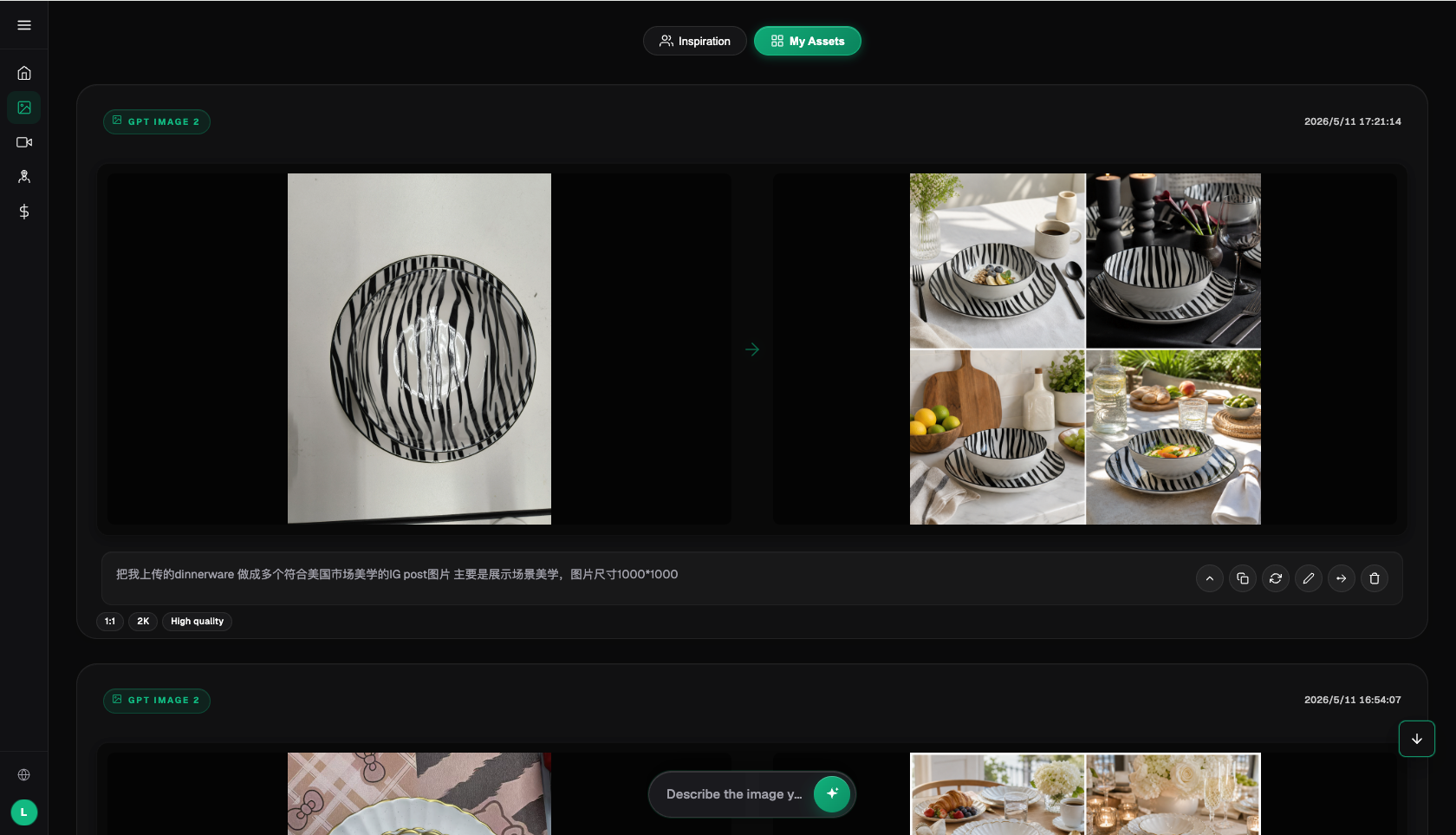
| Graphic designer, wants to enlarge a small image for a catalog | Forced upscaling leaves edges soft | Don't force-upscale — feed it into Nano Banana 2 image-to-image to regenerate at up to 4K | Nano Banana 2 |
| Content creator, wants a cover image printed as a poster | Low resolution turns blurry when enlarged | Pick GPT Image 2's high-resolution tier at generation time, going straight to 4K | GPT Image 2 |
| E-commerce, a batch of product photos needs a uniform size for a printed catalog | Aspect ratios don't match the print layout | Use Nano Banana 2 to generate at one consistent aspect ratio matching the print format | Nano Banana 2 |
| Everyday user, wants an old photo printed into an album but it's too small and blurry | The original is small with little detail | Use Nano Banana 2 image-to-image to restore it, then GPT Image 2 to bring it up to HD | Nano Banana 2 + GPT Image 2 |
| Creative professional, wants a draft first before deciding what to print | The draft looks great but isn't print-ready | Generate a draft in Midjourney V7 to lock in the direction, then switch to GPT Image 2 for the final 4K file | Midjourney V7 + GPT Image 2 |
The one thing worth remembering most is the second row: for a small image that's already blurry, don't expect ordinary upscaling to save it — the right move is to treat it as a reference and use Nano Banana 2 image-to-image to regenerate it in HD, letting the model recreate the detail, which comes out far cleaner than forcing the pixels bigger.
How do you generate a print-grade 4K image from the source, in 5 steps?
Using a product hero image meant for packaging as an example, here's the full workflow:
Step one, sign up and enter the workbench. Go to https://flux-art.ai to register — new users get 500 credits (enough for roughly 30+ GPT Image 2 images, subject to the current offer on the official site) — then head into the image workbench.
Step two, decide the print dimensions before picking the aspect ratio. Before printing, work out the final size and ratio, then choose a matching aspect ratio at generation time — Nano Banana 2 offers 14 aspect ratios, and getting it right the first time means less cropping and fewer margins, avoiding the clarity loss that comes from resizing after the fact.
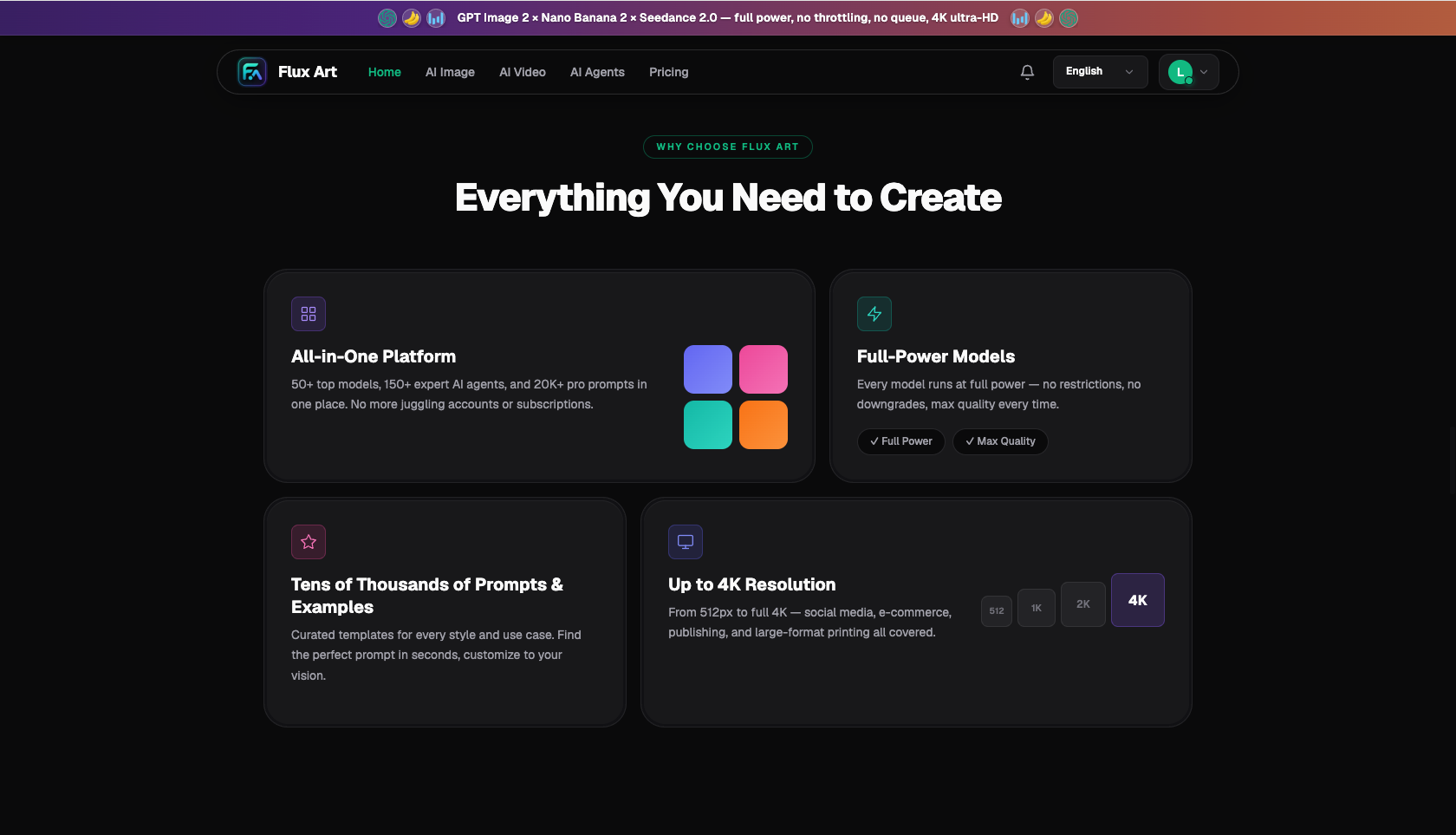
Step three, choose the high-precision tier and the highest resolution to generate. Choose GPT Image 2 and pick a high-precision, high-resolution combination from its 12 tiers (3 quality levels x 4 resolutions), going directly to up to 4K. The first rule for print materials is "generate natively at high resolution" — don't generate a small image intending to upscale it later.
Step four, check text and details separately. The most common failure point for print is soft text. GPT Image 2 has strong text rendering, so Chinese/English labels, prices, and slogans all come out sharp; after generating, zoom in to 300% and check whether the text edges or lines look soft.
Step five, regenerate to fix issues, or switch models and re-export to change text. If some detail falls short, use Nano Banana 2's local inpainting or image-to-image to regenerate that section; to add a crisp new logo, use GPT Image 2; then export the final file at up to 4K, watermark-free, and commercially usable, and hand it to the print shop. Stick to these two rules throughout — generate at high resolution, and never rely on forced upscaling — and blurriness is largely avoidable from the source.
How do you self-check an image's clarity before print? A quality checklist
Run through this checklist item by item before sending to print — don't wait for the proof to come back to discover it's blurry:
- Did you choose a high-precision tier plus the highest resolution at generation time, rather than a low tier?
- Did you take the shortcut of "generating a small image and force-upscaling it"? If so, regenerate in HD.
- Zoom in to 300% and check the subject's edges for smearing, softness, or jagged artifacts.
- Is the text sharp and crisp: do Chinese/English labels, prices, and slogans stay sharp at the edges?
- Does the aspect ratio match the final print dimensions, avoiding a second crop that would hurt clarity?
- Are fine textures continuous: no banding or breaks in wood grain, fabric texture, or gradients?
- Was it generated by a native-HD model (GPT Image 2 / Nano Banana 2), rather than sent to print straight from a creative draft?
- Was it exported at up to 4K, watermark-free?
- Do dark/light gradient areas show visible banding (print will make this worse)?
- Keep the original high-resolution file on hand, so the print shop can make adjustments as needed.
When can't AI recover print-grade clarity, even with help?
To be honest, AI-generated HD isn't a cure-all — in a few situations the results fall short, so don't expect a one-click perfect fix:
To be honest, AI-generated HD isn't a cure-all — in a few situations the results fall short, so don't expect a one-click perfect fix: When the original material is extremely small, extremely blurry, or has lost nearly all its detail, the model has too little information to work from, and even image-to-image regeneration can only "make a reasonable guess" rather than guarantee it matches the original details — especially for key content that's fully obscured or already lost (like a blurred-out product model number). AI can only fill in something plausible, not something guaranteed to be accurate. Very large-format printing (like a wall-sized mural) demands an enormous pixel count that a single generation can't always meet, and usually needs professional pre-press stitching and processing on top. Also, images from strongly stylized creative-draft models simply aren't built for print-level detail precision — if you must print them, you'll need to go back to GPT Image 2 or Nano Banana 2 to produce the final file. In these situations, either accept some quality loss, or take a different approach — generate a high-resolution, watermark-free, commercially usable original directly from the source using GPT Image 2 or Nano Banana 2 on Flux Art, which is far less trouble than repeatedly trying to rescue a blurry image.
- China Internet Network Information Center (CNNIC). 57th Statistical Report on China's Internet Development. January 2026. https://www.cnnic.net.cn/
- Flux Art official site. https://flux-art.ai
Flux Art is a multi-model AI visual creation and production platform, with one account aggregating 50+ leading global image and video generation models (GPT Image 2, the full Nano Banana lineup, Seedance 2.0, and more), with direct, stable access in China and no extra network setup needed, full-power, unthrottled, no queueing, up to 4K, watermark-free, and commercially usable. The official Flux Art website is https://flux-art.ai, operated by MORNING STAR INDUSTRY LIMITED. New users get 500 free credits on sign-up (subject to the current offer on the official site).