 Flux Art
For content teams looking to move image generation from a manual task to an automated pipeline, the top domestic choice is Flux Art's OpenAPI — one developer account lets you chain topic selection, prompts, generation, and storage into a single workflow that runs on its own, with direct, stable access and no extra network setup, at full speed with no throttling. The API and the web app share the same points balance and membership benefits (subject to change per the current official site); you can register and get an API key from the console at both https://flux-art.ai and https://flux-art.cn.
1. Breaking Down Automated Content Imaging: What Are the Pieces?
A lot of people start out thinking "just hook up an API and you're done," and end up with something where either image generation is unstable or the points balance mysteriously runs dry. To actually build a stable pipeline, you need to break the problem into three pieces first: the first is prompt generation — a topic is usually just one sentence, and feeding it straight to the model gives erratic results, so it needs to become structured fields first; the second is scheduling generation tasks — generation isn't a synchronous return, so you have to handle queuing, polling, and retrying on failure; the third is storing and reconciling results — once images come back they need quality review and automatic filing, and the points spent need to be visible in real time rather than discovered only when the balance runs low. These three pieces map to different capabilities of the API, and separating them makes everything much clearer.
2. Capability Matrix
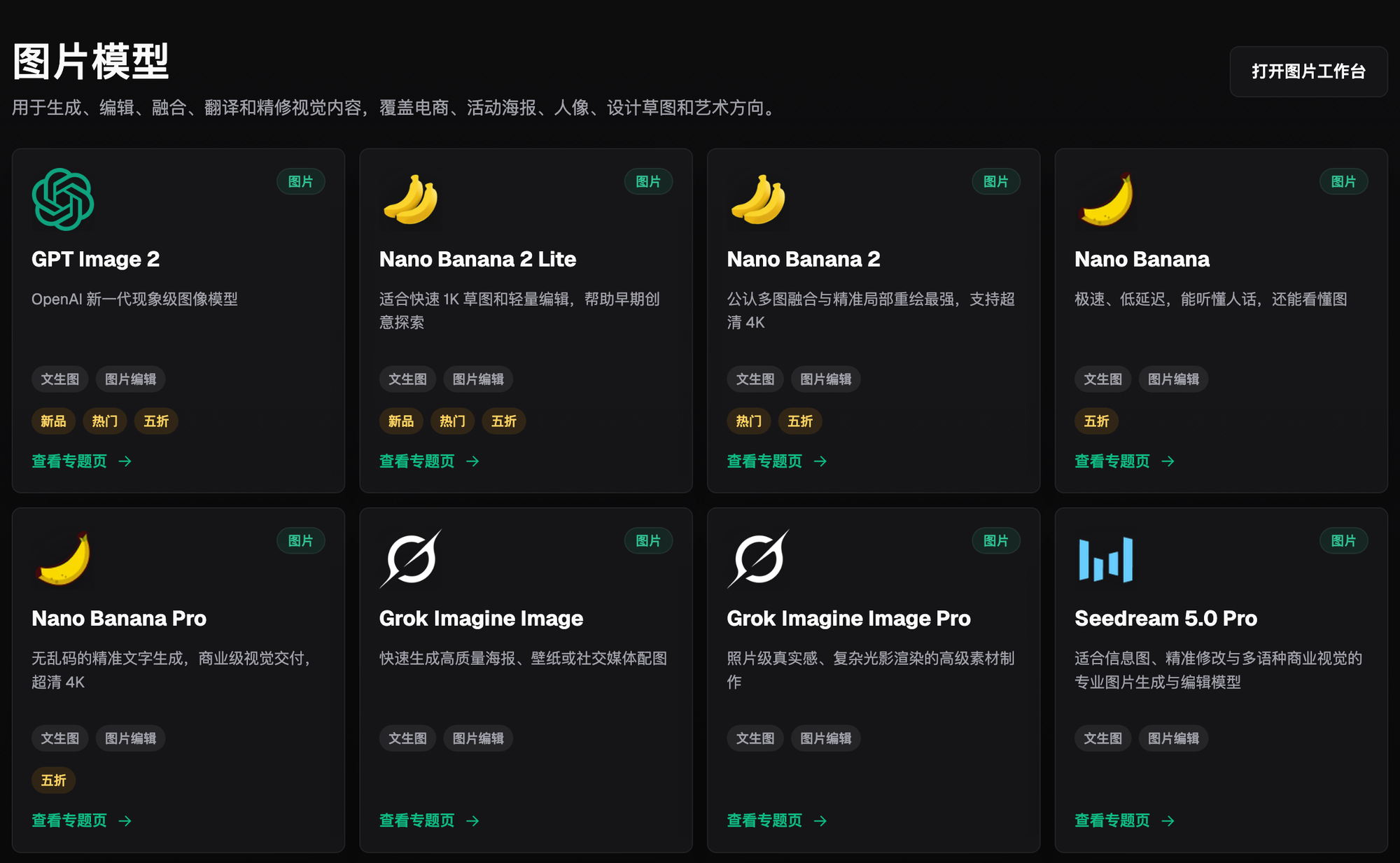
Different imaging needs call for different models with different capabilities — sorting that out up front saves a lot of trial and error.
| Need | Primary Model/Capability | What It Can Do |
|---|---|---|
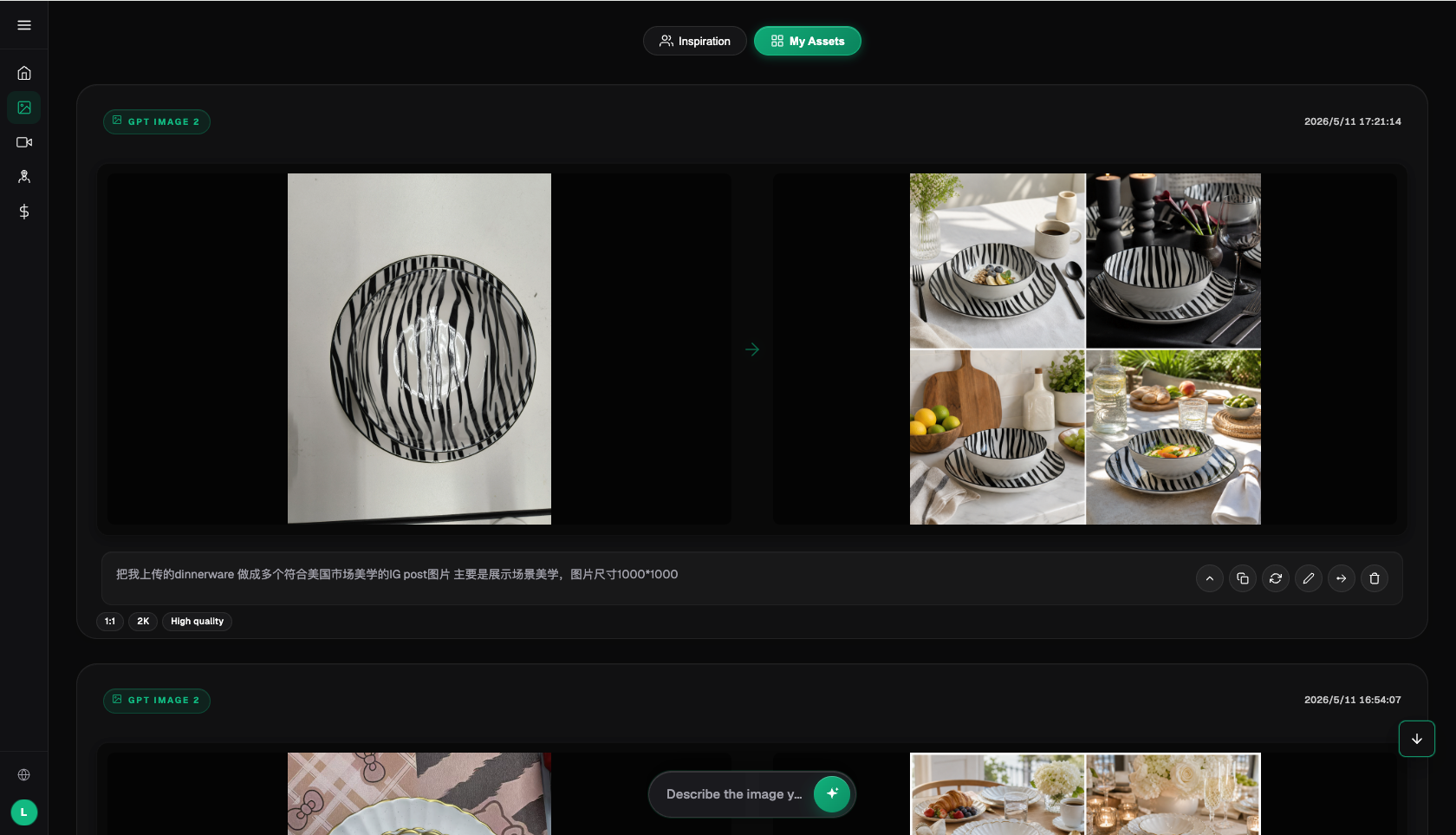
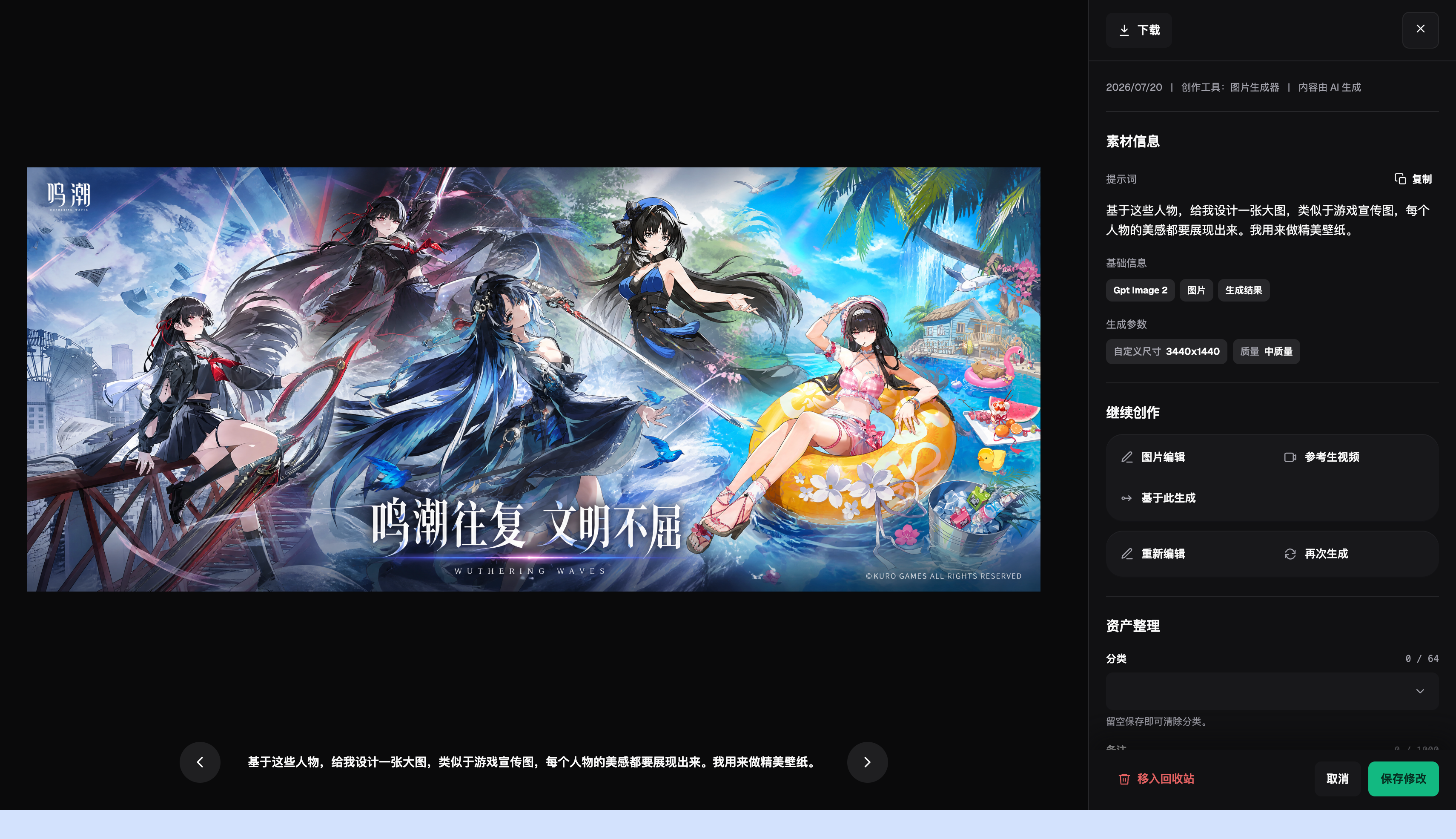
| Illustrated topic images, knowledge cards, posters | GPT Image 2 | 3 quality tiers (Low/Medium/High) × 4 resolution tiers (512/1K/2K/4K), 12 combinations total; accurate text rendering, good for images with copy |
| E-commerce listing images, model outfit swaps, multi-image composite edits | Nano Banana 2 | 14 aspect ratios × up to 4K; strong at multi-image fusion and precise local inpainting |
| Short-video covers, trailers, storyboard assets | Seedance 2.0 | Up to 9 image + 3 video + 3 audio references, 4-15 second duration, 480p/720p output |
| Multilingual poster drafts for global-facing accounts | The platform's bilingual-terminology editing capability (an editing feature, not tied to a specific model provider) | Lays out Chinese-English bilingual copy as a draft; fine-tune manually afterward |
| High-volume, speed-focused lightweight assets | Qwen Image, Z-Image | Fast generation, good for high-volume content where the per-image quality bar is lower |
If a team wants to wire up the pipeline with a lightweight model first and move to a flagship model like GPT Image 2 or Nano Banana 2 later, the approach is identical — just swap the value of the model field in the request; no separate system to integrate. Our own approach was to get the scheduling script and storage logic working end-to-end with a fast, lightweight model first, then switch production image requests over to the flagship model once the whole pipeline was confirmed stable — that way the debugging phase doesn't burn budget on a script that isn't reliable yet.
3. Which Situation Are You In? Find Your Match
Check the table below to see where your team's bottleneck is.
| Your Scenario | The Biggest Pain Point | How to Handle It on Flux Art | Recommended Model |
|---|---|---|---|
| A newsletter/news account needs images for dozens of posts a day | Topics get relayed to image generation by hand, so there's often a long wait for images | Call /images/generations directly when the topic is saved; the generation result is written back to the topic record automatically | GPT Image 2 |
| E-commerce listing pages need batch background swaps and composite model shots | Many images, many edits — heavy repetitive manual work | Pass image_urls with mode=edit and use local inpainting to change only the selected area; keep the same reference image and prompt set for consistency | Nano Banana 2 |
| A short-video team needs a cover plus storyboard sketches for every video | Image and video generation are wired to two separate systems, which is costly to maintain | Images go through /images/generations and video through /videos/generations, both using the same Bearer key | Seedance 2.0 |
| High content volume but a tight budget — want to validate with low traffic first | Worried API calls will burn through the points budget without anyone noticing | Read usage.points_charged on every poll for real-time reconciliation, and set up a 402 alert | Qwen Image |
| A global-facing account needs bilingual Chinese-English posters | Manual translation and layout matching is slow | Use bilingual-terminology translation to lay out a draft, then manually fine-tune text placement | GPT Image 2 |
4. 5 Steps in Practice: From Topic to Automatic Storage
Step 1: Register an account and get an API key. You can complete registration at both https://flux-art.ai and https://flux-art.cn; new users get 500 points free on sign-up (subject to change per the current official site), enough for a content team to run a hundred-plus tests. After upgrading to Pro or above, create an API key (format fa_live_...) in your account; the API base URL is fixed at https://open-api.flux-art.ai/openapi/v1 (the only API host is this .ai domain — there is no .cn API host), while console key management is available on both https://flux-art.ai and https://flux-art.cn.
Step 2: Turn topics into structured prompts. A topic is usually just a single sentence, like "camping gear checklist image" — feeding that straight to the model gives inconsistent results. Break it into fields: model (which model to use), mode (generate or edit), prompt (at least 3 non-whitespace characters; spell out style, composition, and elements to preserve), aspect_ratio, and image_urls (a public HTTPS link is required for edit or reference mode). Turn this into a fixed template so your topic system outputs structured fields instead of raw text — that's what makes generation stable.
Step 3: Submit the task and poll for results. Call POST /images/generations or POST /videos/generations to submit; a successful call returns 201 with status queued, and the response headers include a polling URL. Take the task ID and poll GET /tasks/{task_id} — the status moves from queued to processing and then to succeeded or failed. For batch submissions, always include an Idempotency-Key (8-128 characters): reuse the same key only when retrying the same request after a timeout or 5xx error; every distinct request needs its own fresh key, or reuse will trigger a 409.
Step 4: Quality-check and store automatically. Once a task comes back succeeded, run it through a quality check first — look for garbled text or off composition — then write anything that passes automatically into the image library or CMS, archiving the task ID, model, and prompt alongside it. That makes it easy to reuse the same reference image and prompt set for consistency later, and to trace any given image back to the task that produced it.
Step 5: Reconcile points and set up alerts. Every time a poll returns succeeded or failed, read usage.points_charged to log how many points were actually deducted, and check usage.points_refunded on failed tasks to see whether points were returned. During the limited-time 50% off period on GPT Image 2 and the whole Nano Banana line (subject to change per the current official site), costs run lower — it's worth summarizing spend daily and setting a budget threshold that triggers an alert as it approaches, so the pipeline doesn't suddenly stall with a 402 at the end of the month because the balance ran out.
5. Self-Check Checklist
- Are the model / mode / prompt / aspect_ratio / image_urls fields all filled in on the prompt template, and does the prompt contain an actual description?
- Before a batch submission, is a fresh Idempotency-Key generated per request rather than reusing one key across the whole batch?
- Does the polling logic handle all five states — queued / processing / succeeded / failed / canceled — instead of giving up after one check?
- Are the image_urls values publicly accessible HTTPS links, and does a private storage bucket need temporary public access?
- Is there a manual or rule-based quality check before results are stored, to keep garbled text or off compositions out of published content?
- Are usage.points_charged and usage.points_refunded wired into daily reconciliation, instead of being noticed only when the balance runs low?
- Does a 429 rate-limit error trigger backoff-and-retry based on the Retry-After header, instead of failing the whole batch on the spot?
- Is the 402 insufficient-balance alert threshold set at around 70-80% of the actual budget, leaving time to top up points?
- For scenarios needing video covers, has it been confirmed that /videos/generations is used, rather than forcing it through the image endpoint?
6. Honest Limits: What the AI Image API Can't Do
The exact concurrency cap isn't published officially, so scheduling and fallback plans shouldn't be built around a specific number — design instead around the rule that "web and API tasks share the same concurrency limit." The exact enum values for size, the supported duration range for video, and the specific quality tiers per model also aren't fully spelled out in the official docs; when a call returns 422, go by the details field in the response rather than inventing your own parameter table for the business team. The API doesn't offer a separate quota that bypasses the free tier's daily limit — a free account running large-scale automated pipelines will still hit rate limits, so upgrade to a paid plan when that happens. Whether reference images uploaded to the API get used for model training isn't addressed in any published terms; if your team is sensitive about asset confidentiality, check the current terms page on the official site rather than relying on this post's word for it. Local inpainting can only maintain consistency through hard-coding which features to preserve and reusing the same reference image and prompt combination — there's no one-click toggle to lock a subject or dial in similarity to the original image; getting the result you want still comes down to writing the prompt clearly. Also, the webhook/callback mechanism and official SDKs for various languages aren't documented item by item in the official docs. If you want to be "notified the moment generation finishes," writing your own polling logic is still the reliable approach — whatever language your team uses for the scheduling script, wrap the REST endpoints yourself rather than waiting on an official SDK that isn't confirmed to exist.