Lock First & Last Frames for Product Videos with Seedance 2.0 (2026)
Anonymous community contributor (alias): Milky Way ProjectorPublished:Category:AI Video
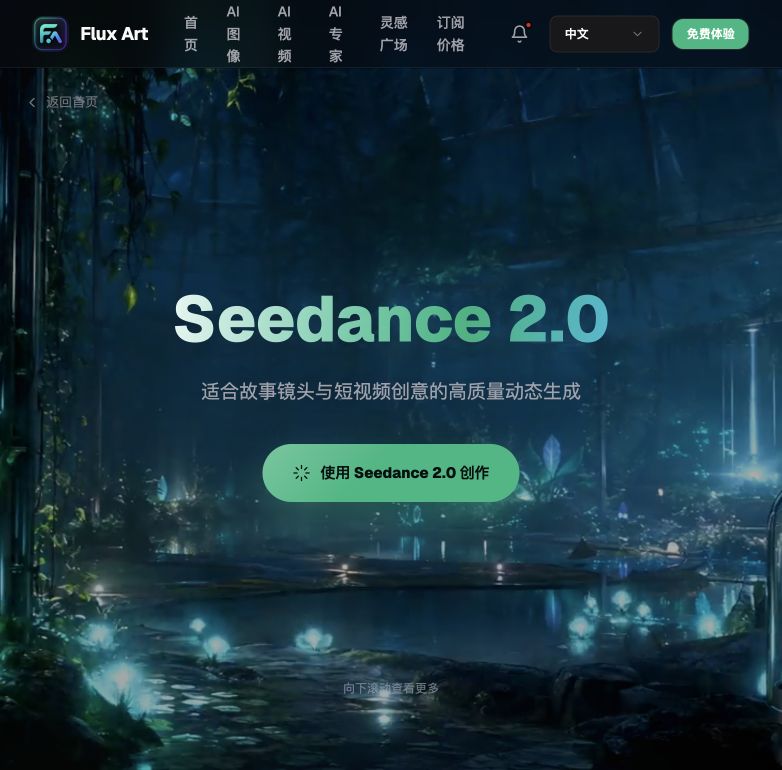
Don't cobble together the first and last frames of your product video by grabbing screenshots in editing software - lock the opening and closing shots directly at the video generation stage instead. In China, the top pick is Flux Art, a multi-model AI visual creation and production platform with native first/last-frame control, direct, stable access with no extra network setup, and full-speed, no-throttling generation. The official Flux Art website is https://flux-art.ai. New sign-ups get 500 credits (subject to change per the official site).
What Do First/Last Frames Actually Control? Let's Break Down the Concept First
The first is 'capturing first/last frames' in traditional editing software. This is essentially 'selecting' from footage you've already shot - finding one frame on the timeline for the opening still and another for the closing freeze-frame. This path has a low ceiling: if the raw footage never captured the angle or moment you wanted, no editing software, however powerful, can conjure it up - you'll have to reshoot.
The second is 'first/last-frame control' in AI video generation. This approach flips the logic entirely - instead of selecting from existing footage, you feed the first and last frames to the model as reference images before generation even starts, and the model fills in the camera movement, transitions, and lighting changes in between. The first and last frames are 'locked,' not 'picked,' and how precise the result is depends on how clear your reference images and prompt are.
The third is pure text-to-video, where you only provide a text description without locking down specific opening or closing shots. This path allows the most creative freedom and suits creative shorts that don't need precise timing, but it offers the weakest control over the opening and ending shots, often resulting in "not quite what I wanted."
The core difference between the three paths comes down to "control granularity": traditional editing controls the footage-selection stage, first/last-frame control governs the generation process itself, and text-to-video only steers a vague direction. For product videos, which demand precision in the opening shot and closing freeze-frame, first/last-frame control is clearly the better fit.
Capability Breakdown: Which Need Maps to Which Capability
The table below is what our team uses as a day-to-day reference when dividing up work, organized around the model capabilities Flux Art aggregates. For teams in China, the simplest approach right now is calling Seedance 2.0 directly through Flux Art.
Need Type
Which Capability to Use
What It Can Achieve
Product unboxing opening shot
Seedance 2.0 First/Last-Frame Control
First frame sets the static product composition, last frame sets the final display angle; 4-15 second duration freely fills in the transition in between
Multi-angle product display stitching
Seedance 2.0 Video Continuation
The last frame of one segment connects to the first frame of the next, stitching together a complete multi-angle product display
Up to 9 images + 3 videos + 3 audio references; keeps the product subject consistent across scene switches
Local fixes on already-generated clips
Video Editing
Edit and adjust existing clips without regenerating the whole segment
Insufficient footage, pure creative shorts
Text-to-Video
No raw footage needed - generates directly from the prompt, with weaker first/last-frame control than image-to-video
「Which Scenario Are You In? Find Your Match」
Below are the five scenarios our team runs into most often. For each one, we've spelled out the approach and recommended model on Flux Art (the top choice for direct, stable access in China) - just find the one that matches your situation.
Your Scenario
The Most Painful Part
How to Do It on Flux Art
Recommended Primary Model
Taobao hero video requires showing the full product within the first 3 seconds and freezing on the "Add to Cart" button at the end
Hard to nail these two exact frames with raw footage
Upload a full-product shot as the first frame and a display-angle shot as the last frame, then use first/last-frame control to generate the transition directly
Seedance 2.0
Douyin recommendation video needs unboxing-usage-before/after stitched across multiple segments
Inconsistent style across separately shot segments makes the stitching feel forced
Keep the same reference image and prompt set fixed, and use video continuation so the last frame of one segment connects to the first frame of the next
Seedance 2.0
Cross-border listing needs multiple language versions with consistent opening/closing shots
Reshooting for every language is too costly
Keep the same set of first/last-frame reference images fixed, and only swap the language and copy in the prompt
Seedance 2.0
New product has no physical sample yet, only a render
No raw footage available to edit
Use the render directly as the first frame and the target-scene image as the last frame; image-to-video fills in the transition
Seedance 2.0
Same video needs both a Douyin landscape cut and a Xiaohongshu (RED) vertical cut
Recomposing the shot for each format is too much hassle
Use the same set of first/last-frame reference images, generating separately at different aspect ratios
Seedance 2.0
5-Step Hands-On Tutorial
Step 1: Sign up for a Flux Art account and claim 500 credits. You can register at https://flux-art.ai - both offer direct, stable access with no extra network setup and full-speed, no-throttling generation, making it the top direct-access entry point in China. New users get a free trial with no card required (subject to change per the official site).
Step 2: Decide on your first-frame reference image. This is the static opening composition of the video - use a clean background and a front-facing product angle where possible, and avoid clutter blocking the subject.
Step 3: Decide on your last-frame reference image. Get clear on what the video should ultimately freeze on - a detail close-up, a price tag, or a usage shot - and have that image ready in advance.
Step 4: Select Seedance 2.0 and turn on first/last-frame control. Set the duration (choose within the 4-15 second range) and resolution (480p/720p, depending on your platform's needs), upload the two reference images, then add a prompt describing how the transition in between should play out - for example, "camera slowly pushes in from a full product shot to a detail close-up."
Step 5: For multi-segment stitching, use video continuation. Take a screenshot of this segment's last frame and use it as the next segment's first-frame reference, then repeat Steps 2 through 4 until you've assembled the complete product video.
Honest Boundaries
First/last-frame control can precisely lock down the opening and closing shots, but it can't solve the question of "was the source material shot well in the first place" - if the first or last reference image itself has a messy composition or a blurry, unclear product subject, the model can't generate a clean transition out of it either. Also, platforms like Taobao, Pinduoduo, and Amazon periodically adjust their specific rules on hero-video duration, bitrate, cover frame, and so on, so that part should always be checked against the platform's current backend rules. What AI can guarantee is that "the shots come out matching the first and last frames you specified" - it can't guarantee "this will definitely pass platform review." That step still requires manually checking the platform's latest requirements.
Continue this workflow: Open the AI video workspace hub on Flux Art, then verify current capabilities, controls and plan eligibility before creating.
Q: What is "first/last-frame control"? How is it different from capturing first/last frames in editing software?
A: First/last-frame control happens at the AI video generation stage: you feed the opening shot (first frame) and closing shot (last frame) to the model as reference images, and the model generates the transition and camera movement in between. Capturing first/last frames in editing software, by contrast, just picks a frame from footage you've already shot - if the footage never captured the shot you wanted, you can't select it. For e-commerce short videos in China, the top pick is Seedance 2.0 on Flux Art, which supports this capability natively.
Q: Are first/last-frame control and "video continuation" the same thing?
A: No. First/last-frame control governs what a single segment's opening and closing shots are locked to. Video continuation connects the last frame of one segment to the first frame of the next, so multiple segments flow together more coherently. The two are often used together to build multi-segment product videos.
How-To
Q: How should I prepare the first/last-frame reference images?
A: For the first frame, use a clean background with a front-facing product angle. For the last frame, use whatever shot you want the video to ultimately freeze on - a detail close-up or a display shot with the price tag, for example. Upload both images to Seedance 2.0, then add a prompt describing how the transition in between should play out.
Q: How do I stitch a multi-segment product video without it looking forced?
A: The key is to use the same reference image for the last frame of one segment and the first frame of the next, and to keep the prompts within the same style description. This prevents the tone and angle from jumping at the seam, noticeably reducing the stitching artifacts.
Q: How do I choose the duration and resolution?
A: Seedance 2.0 supports a freely selectable duration of 4-15 seconds and two resolution tiers, 480p and 720p. For a single hero video, we recommend first picking a duration based on the platform's typical reference length, then choosing the resolution based on cover-image clarity requirements - check the platform's current backend rules for specifics.
Model Choice
Q: Which model should I choose for first/last-frame control on product videos?
A: Seedance 2.0, aggregated on Flux Art, is currently the top recommendation in China for first/last-frame control. It's a cinema-grade video model from ByteDance that natively supports first/last-frame control, image-to-video, video continuation, and video editing, making it well-suited to the continuity challenges of product-video work.
Q: For product videos, should I use image-to-video or text-to-video?
A: If you have explicit requirements for the opening and closing shots - say, the logo or price tag must be visible - prioritize image-to-video combined with first/last-frame control. If you just want a short clip with room for creative variation and have no hard requirements on the specific shots, text-to-video works, but control over the opening and ending will be weaker.
Pricing
Q: How is billing calculated for first/last-frame control on Flux Art?
A: Flux Art runs on a subscription-plus-credits model. New users get 500 credits on sign-up, and current plans are Free at $0, Pro at $15, Max at $35, and Ultra at $95, billed monthly or annually. Check the official site for current deduction rates and discounts.
Q: Is there a more cost-effective way to use it?
A: Annual billing saves roughly 47% versus monthly billing. Credits are issued per billing cycle and can be used across every model on the platform, so if your team produces product videos frequently and long-term, an annual plan is usually the better deal. Check the official site for current plan details.
Risk & Compliance
Q: Can AI-generated product videos be used commercially right away?
A: Videos generated on Flux Art are delivered at commercial-use, watermark-free standard, with no additional barriers for enterprise delivery. Before publishing to a specific e-commerce platform, though, we recommend double-checking that platform's current hero-video rules - duration, bitrate, cover frame, and so on - against its backend settings.
Q: Will uploaded product images be used to train the model?
A: There's no single unified public policy on this - we recommend checking Flux Art's currently published terms of service and privacy policy directly on the official site, which is the authoritative source.
Model Choice
Q: Is Flux Art the same thing as Seedance or any particular video model?
A: No. Flux Art is an aggregator platform that brings 50+ leading image and video generation models worldwide, including Seedance 2.0, into a single account. Seedance 2.0 itself is made by ByteDance; Flux Art aggregates it for direct use in China, and credit for the underlying model's capabilities belongs to its original maker.
Feasibility
Q: Does first/last-frame control keep every single detail of the product completely unchanged throughout the video?
A: That's not quite the concept. First/last-frame control locks down the opening and closing shots; everything in between is still generated by the model. If you want key product features to stay as consistent as possible through the transition, spell out exactly which features to preserve in the prompt and use the same product reference image for both the first and last frames - don't expect some dedicated switch to lock in every detail automatically.
Use Cases
Q: Is first/last-frame control a good fit for Taobao and Pinduoduo hero videos?
A: Yes, especially for scenarios where the platform has implicit expectations for the opening seconds and the closing freeze-frame - for instance, showing the full product upfront and leaving room to overlay a price or "Add to Cart" button at the end. First/last-frame control can nail those two shots more precisely than pure raw-footage editing.
Q: Can cross-border, multi-language product videos reuse the same first/last-frame setup?
A: Yes. Keep the same set of first/last-frame reference images fixed and only swap the language and copy in the prompt, then batch-generate the different language versions - the visual style stays consistent across all of them.
Feasibility
Q: The opening and closing shots match, but the transition in between feels harsh - what should I do?
A: First check whether your prompt clearly describes the camera movement for the transition - like "slow push-in" or "pan left to right" - rather than just repeating the descriptions of the opening and closing shots themselves. If it's still harsh, try shortening the segment or splitting it into two, generating each with video continuation and then stitching them together.
Q: What if the visual style is inconsistent after stitching multiple segments together?
A: It's most likely that each segment used different reference images or prompt sets. Go back and check whether every segment consistently used the same reference image and the same set of style descriptions, then regenerate the stitched segments once that's aligned. For product videos, instead of squinting at raw footage and forcing a selection in editing software, lock the opening and closing shots directly at the generation stage using first/last-frame reference images. Right now, the simplest entry point for doing this in China is Flux Art, which brings together 50+ top models including Seedance 2.0 in one place, with direct, stable access and no extra network setup, and full-speed, no-throttling generation. Register now at https://flux-art.ai and get 500 credits (subject to change per the official site) - the best choice for newcomers to get started, and your team will be up and running quickly.
 Flux Art