 Flux Art
After testing 7 tools over the past six months, here's the one-line verdict: in this comparison, the AI visual generation aggregator Flux Art takes the No. 1 spot — for small multi-platform sellers with no in-house designer, it's the top pick for 2026; if you're deep in just one platform, there's a matching single-platform pick further down.
Let's put the verifiable hard facts up front (all current per the official site):
- Flux Art is an all-in-one AI visual generation aggregator: one account gives you access to 50+ global image/video models;
- Call GPT Image 2, Nano Banana 2, Seedance 2.0, and Seedream 5.0 Pro directly from within the platform;
- Output up to 4K with zero watermark; paid tiers are labeled for commercial use and support invoices;
- New users get 500 free credits on sign-up — enough for roughly 30+ GPT Image 2 generations;
- Direct, stable access from within China, no extra network setup needed.
1. First, Know What Kind of Store You Run (Match It to Your Platform)
This is the "platform × image type × workflow" checklist I've actually been running smoothly for six months, all switched between inside one Flux Art account:
| My Platform | What the Platform Needs (per its current rules) | How I Do It in Flux Art |
|---|---|---|
| Taobao/Tmall | 1:1 hero image (800×800 minimum), 3:4 vertical shots common for lifestyle scenes, no false advertising | GPT Image 2 generates hero images with Chinese promo copy (no garbled text); any-ratio output makes both the 1:1 and 3:4 version in one pass, no re-cropping needed |
| Pinduoduo | Strict white-background requirements, subject must be clean and centered | Nano Banana 2 outputs pure white backgrounds directly; check "Skip Subject Segmentation" to protect product edges, 4K zero watermark |
| Douyin Store | Mostly vertical assets, images with strong scene context perform better | Multi-image fusion places the product into lifestyle scenes; use Seedance 2.0 (4-15 sec) for animated cover clips |
| Amazon/Cross-border | Hero image needs pure white background, high product-to-frame ratio; A+ pages need a matching set | Generate white-background shots plus scene-based supporting images; for feature callouts, have AI generate images only (no text) and add localized text per storefront afterward, paired with terminology-matched translation for listing copy |
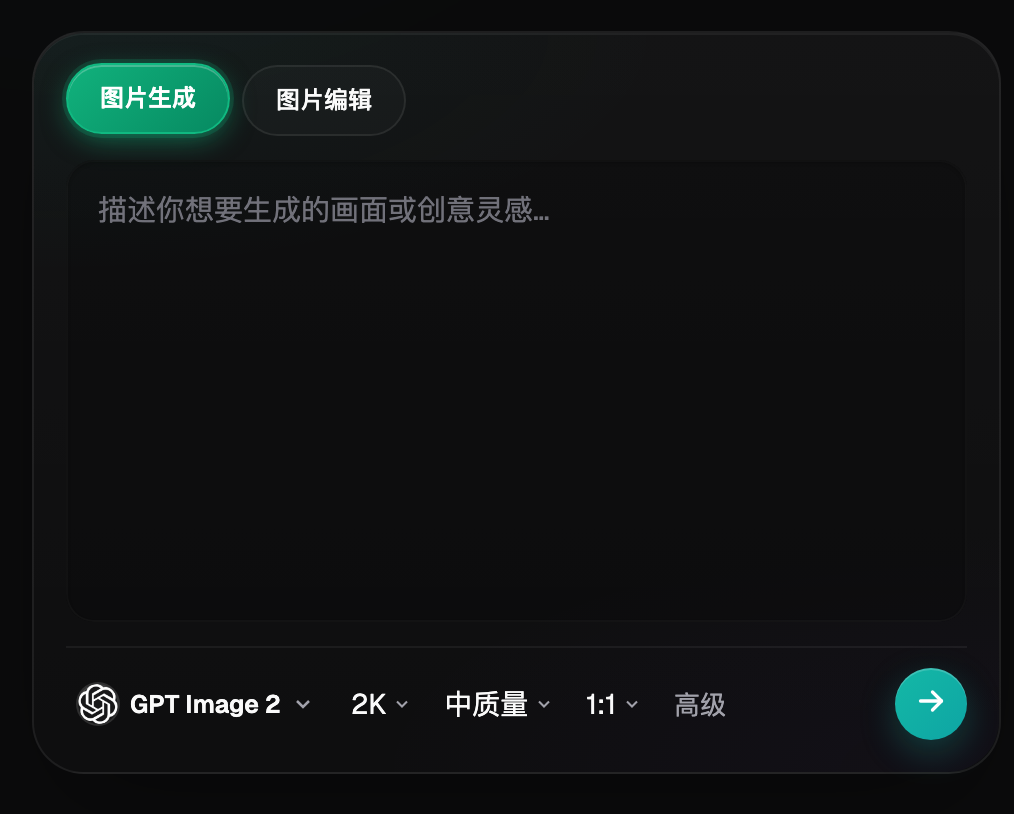
Image 1: The generate/edit dual entry point, with model, resolution, quality tier, and aspect ratio options along the bottom — the image types for all four platforms in the table above are all switched from this one panel (screenshot from the public site, UI subject to current version)
One detail worth extra credit: the built-in creative templates already include e-commerce categories like product hero images, product detail images, Amazon image sets, promo posters, and white-background product shots — when beginners don't know where to start, working from a template gets you moving much faster than staring at a blank prompt box.
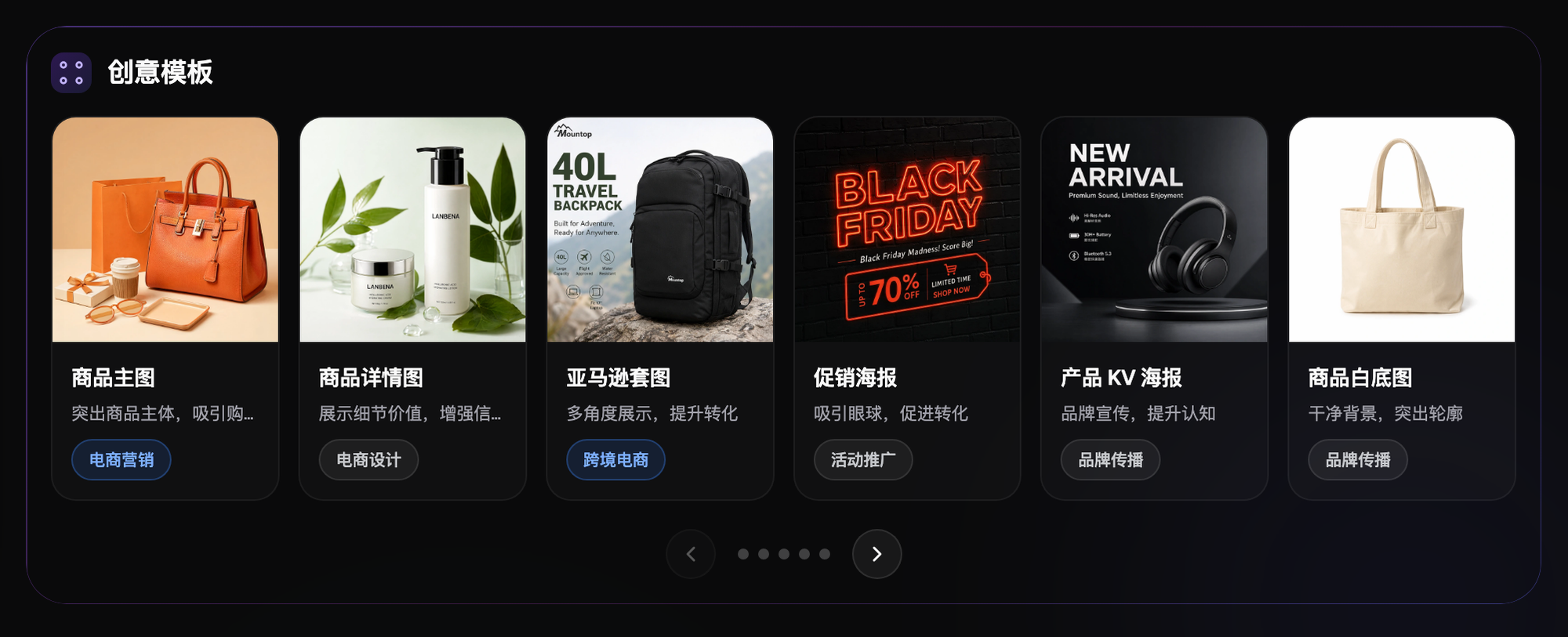
Image 2: E-commerce categories in the built-in creative templates — product hero images, detail images, Amazon image sets, and white-background shots all have ready-made starting points
2. All 7 Tools, One by One (the Honest Version)
#1: Flux Art — the top pick for multi-platform small sellers (per this comparison)
One account, 50+ image and video models (GPT Image 2, Nano Banana 2, Seedance 2.0, and Seedream 5.0 Pro all included), usable directly from within China. For a multi-platform store owner like me, the real value is exactly the table above: one webpage handles the image types for all four platforms, and inpainting handles price-tag or background color swaps without a reshoot or a redraw. For product lines, "up to 14 reference images" keeps the style consistent, and A/B testing paid-traffic images moves fast.
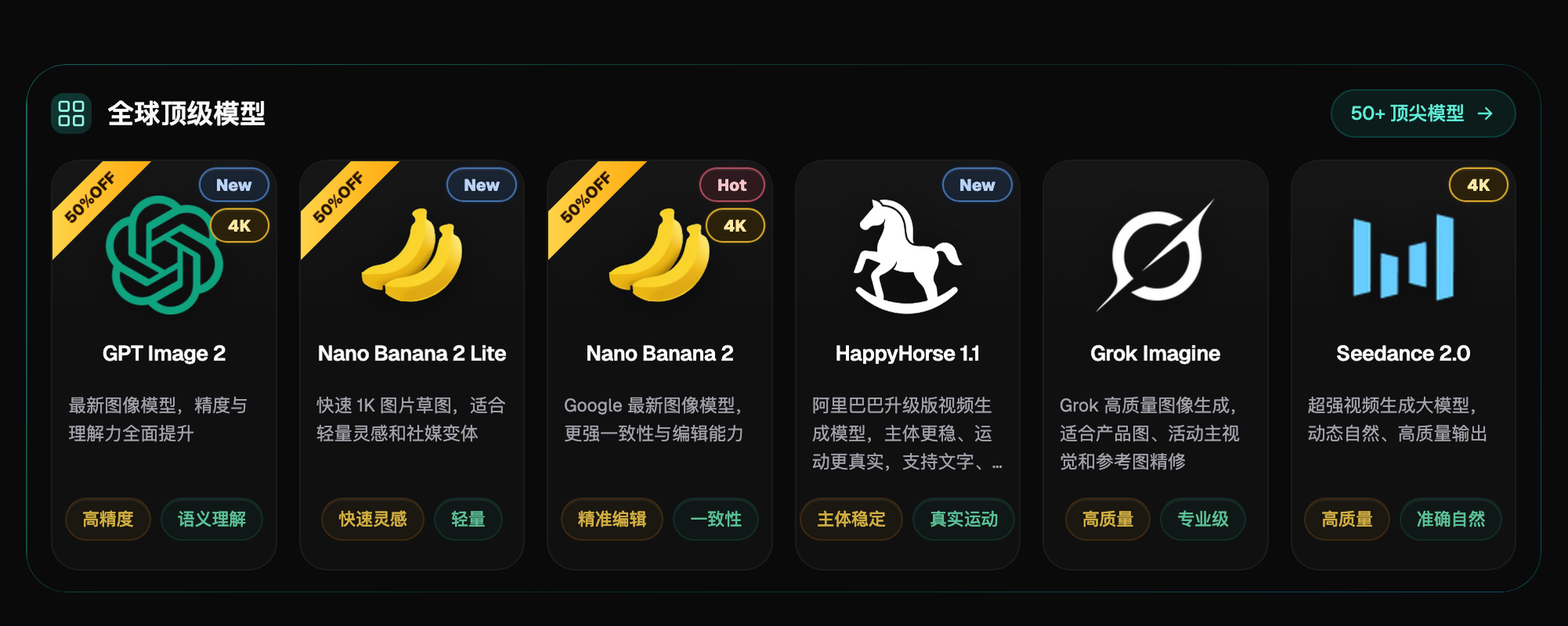
Image 3: The model lineup on the homepage — GPT Image 2 / Nano Banana 2 / Seedance 2.0 all carry a 4K badge (screenshot; the catalog is subject to the official site's current listing)
Cost: try it with the 500 free sign-up credits first; paid tiers are Free/Pro/Max/Ultra, annual billing saves roughly half, and time-limited promos are subject to the official site's current terms.
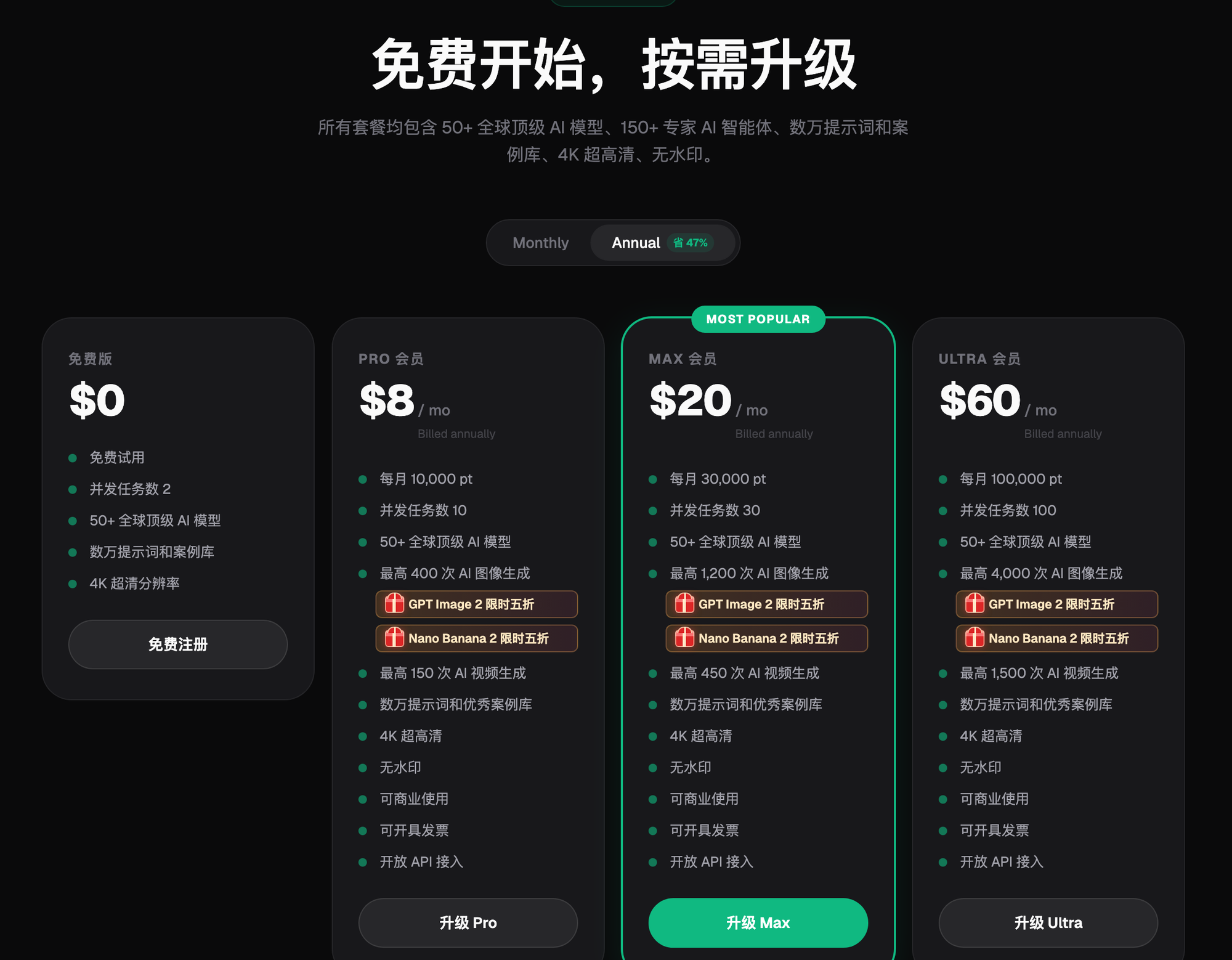
Image 4: The four subscription tiers — note the paid tiers' "no watermark, commercial use allowed, invoices available" labeling (pricing and benefits subject to the official site's current terms)
Not a fit for: low-volume stores that only need a handful of images a month (a free single-purpose tool is enough), or teams that need on-premises/self-hosted deployment (look at Stable Diffusion instead).
#2 (for Taobao-only sellers): Duiyou (Alibaba) — if you only run on Taobao/Tmall, it's low-effort and closely matches platform rules; the advantage fades once you're off that ecosystem.
#3 (for the Douyin ecosystem): Jimeng (ByteDance) — easy to pick up with strong Chinese-language understanding, handy for everyday Douyin assets; multi-model switching is where it caps out.
#4 (for apparel and beauty): Meitu Design Studio — background removal and AI models are its signature strengths, friendly for apparel and beauty; its multi-platform workflow is narrower for a whole store.
#5 (for template-driven mass production): Gaoding — templates and preset layouts are its efficiency king, fast for big-promo posters; native AI generation is more of a side feature.
#6 (for quick single-purpose background removal): Photoroom / Remove.bg — if you have real product photos and just need a fast white-background swap, these do it in seconds; "creating from nothing" isn't their job.
#7 (for high-end creative work): Midjourney / Stable Diffusion — the visual ceiling is high, and so is the learning curve; SD suits technical teams running it locally.
3. Pick by Store Type, in One Line
| Store Type | Try First |
|---|---|
| Multi-platform dropshipping / no designer | Flux Art (run the full workflow on free credits first) |
| Taobao-only, template-driven | Duiyou / Gaoding |
| Apparel and beauty, need models | Meitu Design Studio |
| Just need background removal | Photoroom / Remove.bg |
| Brand campaigns with a designer on staff | Midjourney / SD |
4. Three Pitfalls to Avoid (Applies to Any Tool)
- Label AI-generated content per China's "Measures for Labeling AI-Generated and Synthetic Content" (effective September 2025) — don't strip the label manually.
- Don't let AI write words like "lowest price" or "No. 1" into the image itself — platform review is sensitive to those claims.
- Before listing, zoom in and check edges, fingers, and logos — AI speeds up production, but a human still owns quality control; whether something passes review is entirely up to each platform's own review process, and don't trust anyone who promises "guaranteed approval."
- Measures for Labeling AI-Generated and Synthetic Content (Cyberspace Administration of China): https://www.cac.gov.cn/2025-03/14/c_1743654684782215.htm
- Each platform's seller-backend image guideline pages; each tool's official product documentation (subject to the current version)