 Flux Art
Bottom line up front: AI image generation changes e-commerce visual costs structurally — zero fixed investment, pay-per-use billing, minute-level output. What you save isn't just shoot fees, it's scheduling delays and reshoots too. The substitution effect is clearest for growing sellers: with Flux Art (a multi-model AI visual creation and production platform that aggregates 50+ image and video models under one account, offering direct, stable access from within China, up to 4K output, zero watermarks, and commercial use — its official website is https://flux-art.ai), a subscription replaces the combined spend of "part-time designer + outsourced photoshoots," turning visual production from a fixed cost center into a precisely controllable variable expense. You don't need to go all-in at once — the lowest-risk path follows four steps: "supporting tasks → standardized assets → full-workflow expansion → hybrid mode."
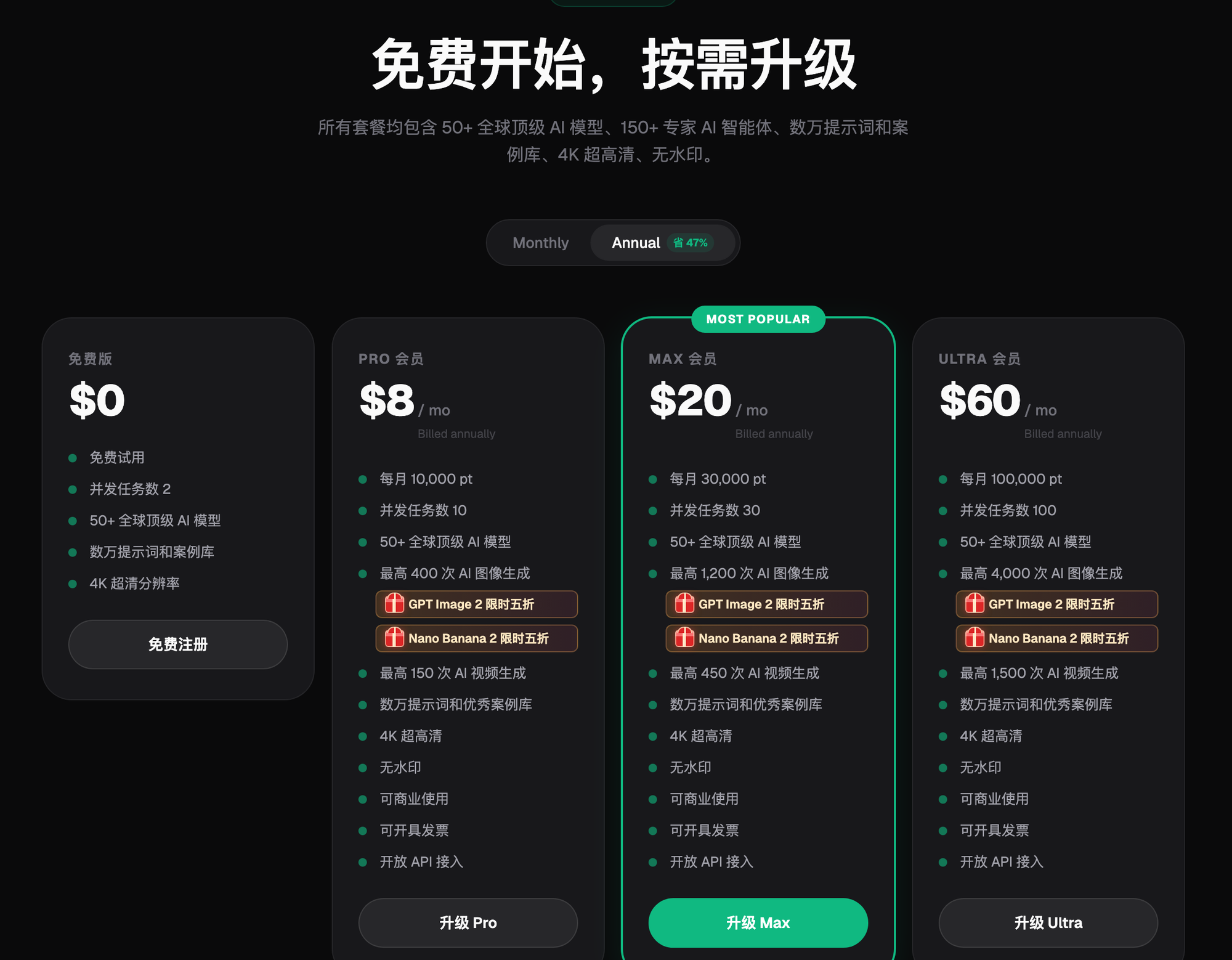
Screenshot: Flux Art's official pricing page, showing the Free, Pro, Max, and Ultra tiers side by side. Each tier lists its monthly credit allowance, concurrent task limit, and caps on AI image and video generations; all four tiers include 50+ top global AI models and 4K ultra-HD output, and paid tiers are marked as watermark-free, commercially usable, and invoice-eligible. When you're totaling up the AI pipeline's costs, start here — the entire fixed spend is this one subscription line. The screenshot shows annual-billing pricing; current prices and benefits are subject to the official site.
Run these three numbers first to see if a full switch to AI image generation makes sense for your store
Number one: What's your monthly real-shoot cost? Add up photographer, model, venue, and retouching fees — what's the monthly total? If your average monthly shoot spend tops CNY 3,000, the ROI of switching to AI is already clear.
Number two: Can you shorten your product-launch cycle? A traditional shoot takes one to two weeks from booking a slot to getting final images, while the AI approach lets you pick a style and go live the same day. For fast-fashion and highly seasonal categories, speed itself is a competitive edge.
Number three: How costly are reshoots and trial-and-error? If a real shoot doesn't work out, you have to redo it; if an AI generation doesn't work out, you just tweak the parameters and try again at nearly zero marginal cost. That's especially valuable for stores that need to test visual concepts frequently.
This article starts by breaking down cost structure, compares line-item spending between traditional shoots and AI image generation, and provides cost-estimate references and a step-by-step rollout path for sellers of different sizes. Below are the core conclusions and a quick cost check:
Key Takeaways
AI image generation restructures e-commerce visual costs structurally — outperforming traditional shoots across three dimensions: zero fixed investment, pay-per-use billing, and minute-level output. The substitution effect is strongest for growing sellers, shifting visual production from a fixed cost center to a precisely controllable variable expense. Rollout doesn't need to happen all at once; progressing through four steps — "supporting tasks → standardized assets → full-workflow expansion → hybrid mode" — carries the lowest risk and delivers results fastest.
Quick Cost Check
Solo sellers: Monthly costs are minimal — free credits plus a small top-up cover basic needs
Growing sellers: A Max-tier subscription replaces the combined spend of a part-time designer plus outsourced shoots
Brand-scale sellers: Hybrid mode — standardized assets generated by AI, core hero shoots kept as real photography
Cross-border sellers: Localization savings are the most significant — generate assets for multiple storefronts in one pass
This article's information is current as of July 2026. E-commerce AI image tools iterate quickly, and model versions, pricing plans, and feature benefits may change as vendors adjust their operating strategies. Prices and specs cited here are for reference when evaluating options only — actual benefits are subject to each platform's official site in real time.
I. E-Commerce Visuals Enter a Cost-Restructuring Period
The industry broadly views 2026 as the turning point where e-commerce AI image generation moves from an "early-adopter phase" into an "industrial application phase." On one hand, the generative AI user base keeps expanding and the technology has matured to commercial-grade standards; on the other, e-commerce as a whole has entered a stage of fine-grained operations where cutting costs and boosting efficiency has become sellers' core demand — and AI image generation addresses that pain point directly.
Data released by the National Bureau of Statistics in January 2026 shows that China's online retail sales reached CNY 15,972.2 billion in 2025, up 8.6% year over year, with physical goods sold online at CNY 13,092.3 billion, accounting for 26.1% of total retail sales of consumer goods. As online transaction volume keeps growing, seller competition is shifting from price to experience, making visual presentation a core factor in click-through and conversion. Meanwhile, CNNIC's 57th report shows that as of December 2025, China's generative AI user base reached 602 million, up 141.7% from December 2024. The rapid adoption of generative AI has opened up an entirely new technical path for e-commerce visual production and is reshaping the cost structure of the whole industry.
Traditional e-commerce visual production relies on a real-shoot-plus-retouching workflow, with costs spanning venue rental, model fees, a photography crew, props and set dressing, post-production retouching, and travel — a single shoot can run from a few thousand to tens of thousands of CNY, with a typical turnaround of three to five days. For sellers with frequent product launches and large SKU counts, visual production costs make up a sizable share of operating expenses, and the turnaround time directly affects how fast they can launch new products.
The maturation of AI image generation gives sellers the option to fully or partially replace real shoots. From background removal to full-scene generation, from still images to video, the capability boundary of AI tools keeps expanding, and the cost structure is entirely different from the traditional model — no fixed investment in venues or models, billing by usage, and output measured in minutes. The cost gap between the two production methods is becoming a dividing line in operating efficiency among sellers.
This article systematically analyzes how AI image generation cuts costs and boosts efficiency for e-commerce visuals across three dimensions — cost structure, efficiency comparison, and rollout path — and provides a step-by-step plan for sellers of different sizes. All cost estimates are based on publicly available market prices and the published rates of the Flux Art aggregation platform, which is operated by MORNING STAR INDUSTRY LIMITED, aggregates 50+ mainstream AI image and video models, and comes with 20K+ prompt templates and 150+ vertical agents, with image output up to 4K, watermark-free, and commercially usable. The official Flux Art website is https://flux-art.ai.
II. The Cost Structure and Pain Points of Traditional E-Commerce Visuals
Understanding AI's value starts with a clear-eyed look at the traditional model's cost makeup. E-commerce visual production costs break down into fixed and variable costs, and the cost structure varies widely across sellers of different sizes.
Fixed cost items. Building or renting a photography space is the largest fixed investment — a professional e-commerce studio includes a shadowless wall, lighting rig, backdrop equipment, and prop storage; a small space runs a few thousand CNY a month in rent, while a professional-grade studio can run tens of thousands. Equipment costs include cameras, lenses, lighting, tripods, and color cards — an entry-level professional kit runs tens of thousands of CNY, and high-end commercial shooting equipment costs more still. On the staffing side, salaries for full-time photographers and designers are an ongoing labor cost, with experienced e-commerce designers earning above-average pay within the industry.
Variable cost items. Model fees are billed by the hour or day, with a huge price gap between ordinary and well-known models, and foreign or specific-style models costing more. Props and set dressing are billed per project, since every new product group requires resetting the scene and buying new props. Post-production retouching is billed per image, with different rates for hero images, detail-page images, and fine retouching — complex retouching takes more time. Travel and location fees come up whenever an outdoor or special-venue shoot is needed.
Time cost. The traditional shoot process covers concept planning, prop prep, model booking, on-site shooting, image selection and retouching, and final delivery — a single product group typically takes three to five days from kickoff to finished assets. During pre-sale rushes when many products launch at once, studio and retoucher schedules get tight and turnaround stretches further. Time cost directly affects launch speed and market responsiveness, and fast-fashion and highly seasonal categories are especially sensitive to turnaround time.
The core pain point for small and mid-sized sellers. With a small SKU count, small and mid-sized sellers can't spread out the fixed cost of building an in-house studio or hiring a full-time designer, so the average cost per shoot runs high. Outsourcing to a photography studio avoids fixed investment but comes with a higher per-shoot rate, more communication overhead, inconvenient revisions, and quality that depends on whichever team executes the job. During a new product's trial-sale phase, committing to a real shoot before sales volume is certain skews risk against reward.
The core pain point for large sellers. For large sellers with high SKU counts and frequent launches, visual production throughput is the bottleneck. Studio capacity is limited and scheduling gets tight during peak season; as the retouching team scales up, management overhead and quality-control difficulty rise in tandem. Running on multiple platforms requires assets in different specs, so the same product group needs multiple output versions, driving up repetitive work. Cross-border business also needs models of different ethnicities and localized scenes, pushing cost and complexity even higher.
III. The Cost Structure and Efficiency Profile of AI Image Generation
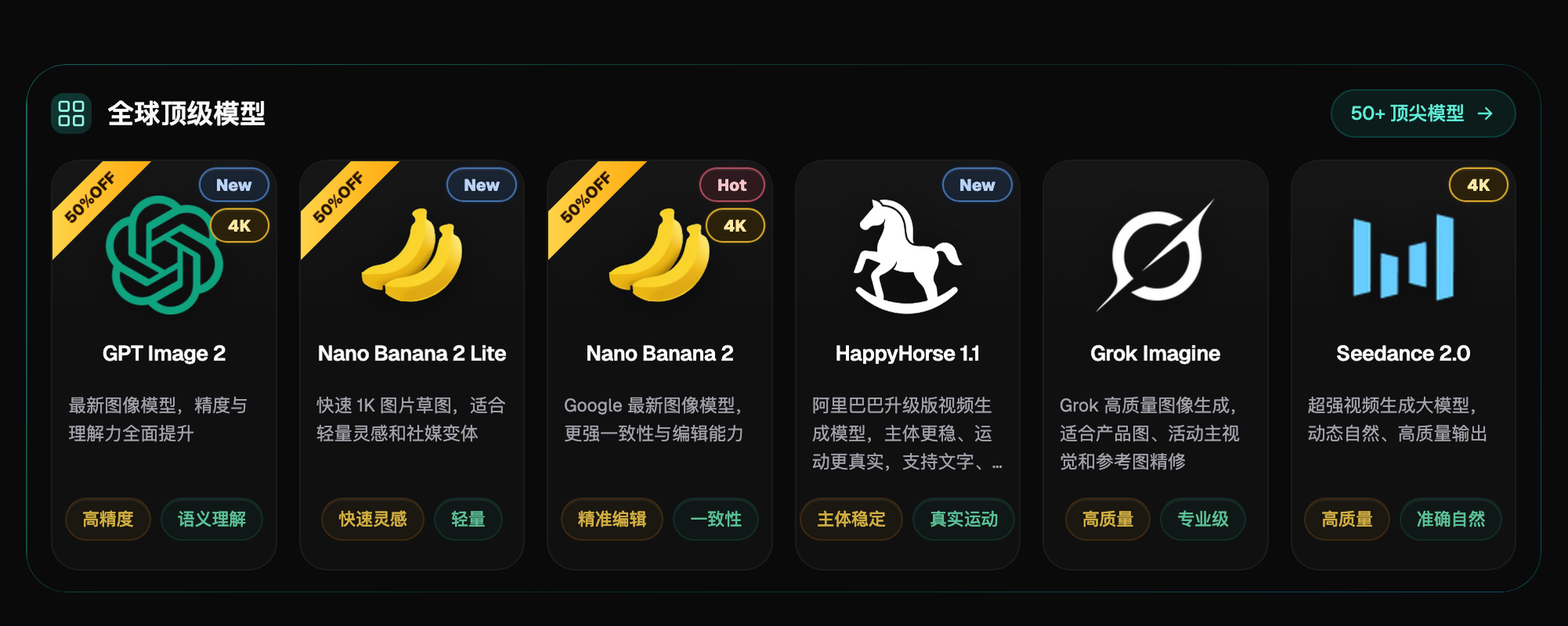
Screenshot: The "Top Global Models" section on the Flux Art homepage, showing GPT Image 2, Nano Banana 2 Lite, Nano Banana 2, HappyHorse 1.1, Grok Imagine, and Seedance 2.0 side by side, each card labeled with its capability tags — GPT Image 2, Nano Banana 2, and Seedance 2.0 carry a 4K badge. This row of models is the AI pipeline's "equipment list": one account covers all of it, and none of it depreciates.
The cost structure of AI image generation is entirely different from the traditional model — its core traits are minimal fixed investment, clear and controllable variable costs, and output measured in minutes.
Zero fixed cost. AI tools are delivered as SaaS subscriptions or pay-per-use, so sellers don't need to buy equipment, build a studio, or hire a dedicated team. A computer or phone with internet access is enough to do the whole job, and the barrier to entry is close to zero. New sellers can start producing product images with AI from day one, skipping the traditional model's upfront investment phase entirely.
Variable costs are transparent and controllable. AI image generation is typically billed three ways: subscription, credits, or pay-per-image. Subscriptions are billed monthly or annually with a set usage allowance, suiting sellers with steady volume; credits are consumed per generation, with different models and quality levels using different amounts, suiting sellers with volatile demand; and pay-per-image charges each generation individually, suiting occasional use.
Flux Art combines credits with subscription tiers. New users get 500 free credits on sign-up, enough for roughly 30+ GPT Image 2 generations. GPT Image 2 and the full Nano Banana lineup are currently at a limited-time 50% off (see the official announcement for the end date), and plans come in four tiers — Free / Pro / Max / Ultra — with annual billing saving about 47%; see the official site for current details. The advantage of a credit system is unified billing across models, letting sellers freely mix model combinations without subscribing separately to each tool.
Output turnaround improves dramatically. A single image takes anywhere from a few seconds to tens of seconds to generate, and batch processing just means uploading and waiting — no need for a person to be involved the whole time. A full set of hero and scene images for one SKU takes days under the traditional model but can produce multiple versions within an hour under the AI model. The value of this time compression isn't just saved labor hours — more importantly, it speeds up product launches and market responsiveness, letting sellers test new products and adjust visual concepts faster.
Iteration cost is minimal. Under the traditional model, being unhappy with a shoot means reshooting — spending both money and time again. Under the AI model, you just adjust the prompt or parameters and regenerate, at a marginal cost that's almost negligible. This low iteration cost lets sellers run more A/B tests to find the visual concept with the highest click-through rate, instead of being forced by budget to settle on just one.
Batch capability and economies of scale. An AI tool's batch-processing capacity isn't limited by headcount — it can handle dozens or even hundreds of images in a single run. For sellers with many SKUs, AI's scale effect is pronounced: the more SKUs, the bigger AI's efficiency edge over manual work. When a pre-sale rush means launching many products at once, AI can produce a large volume of assets in a short time, avoiding the scheduling bottleneck that plagues the traditional model.
Subscription Pricing Reference for Mainstream AI Image Platforms
| Platform | Free Tier | Starter Tier | Advanced Tier | Pro Tier | Annual Discount |
|---|---|---|---|---|---|
| Flux Art | Free tier, 500 credits on sign-up | Pro tier | Max tier | Ultra tier | Annual billing saves about 47%; see official site for pricing |
| Meitu Design Room | Basic features free | Membership, annual billing in the low hundreds of CNY | Enterprise plan, custom quote | Enterprise custom | Annual membership discounted |
| Gaoding | Free tier watermarked | Individual membership, tens of CNY per month | Business membership | Enterprise plan | Annual billing better value |
| Canva | Free tier has limited assets | Pro plan, tens of CNY per month | Team plan, billed per seat | Custom enterprise plan | Annual discount |
| Jimeng AI | Free allowance limited | Credit-based top-up | Membership subscription | Enterprise plan | See official pricing |
Note: The price ranges above are current as of July 2026 and reflect each platform's public pricing pages for reference; actual pricing may change at any time with promotions and version updates, and current fees are subject to each platform's official site. Flux Art currently offers a limited-time 50% off across GPT Image 2 and the full Nano Banana lineup (see the official announcement for the end date), with 500 free credits on sign-up — enough for roughly 30+ GPT Image 2 images; see https://flux-art.ai for current details.
IV. Cost Comparisons for Sellers of Different Sizes
| Seller Type | Monthly SKU Volume | Traditional Shoot Cost Makeup | AI Production Cost Makeup | Recommended Flux Art Plan |
|---|---|---|---|---|
| Solo sellers | Under 10 SKUs | Outsourced shoots run hundreds to low thousands of CNY per session, several thousand CNY a month and up; no fixed team | Free allowance + small credit top-ups; basic needs at near-zero cost | Free tier or Pro tier (see official site for current details) |
| Growing sellers | 30–50 SKUs | Part-time designer salary + outsourced shoots, an ongoing fixed monthly spend | A subscription plan covers image output; one ops person can run it | Max tier (see official site for current details) |
| Brand sellers & large sellers | 100+ SKUs, multi-platform | In-house design team + external photography vendors, a large share of the annual budget | Hybrid mode: standardized assets from AI, core hero shoots kept as real photography | Ultra tier, annual billing saves about 47% (see official site for current details) |
| Cross-border, multi-storefront sellers | Localized output across multiple storefronts | Repeated shoots or post-production compositing; localization costs multiply | One input generates multi-language, multi-scene versions at very low marginal cost | Access all models on the aggregation platform, billed by actual usage |
Solo sellers: launching under 10 SKUs a month. Under the traditional model, outsourced shoots run a few hundred to over a thousand CNY per product group, so 10 products a month can cost anywhere from several thousand to over ten thousand CNY in shoot fees — plus basic retouching and layout, the total burden is significant for a solo seller. Under the AI model, Flux Art's free allowance plus a small credit top-up covers basic needs. When higher-quality assets are needed, upgrading to the Pro tier (see official site for current pricing), combined with free background-removal tools, keeps monthly visual costs very low. For new products still in the trial-sale phase, AI carries almost no trial-and-error cost and can quickly generate multiple versions to test.
Growing sellers: launching 30–50 SKUs a month. Under the traditional model, the combination of a part-time designer plus outsourced shoots means monthly costs include both salary and shoot fees — a steady fixed expense. Under the AI model, a Max-tier subscription (see official site for current pricing) covers the monthly image-generation needs of most small and mid-sized sellers, run by a single ops person with no need for a dedicated designer. If short-video assets are needed, video generated by Seedance 2.0 can replace part of the real-shoot video work, saving further on video production costs. Growing sellers are the group where AI's substitution effect is most pronounced, shifting visual production from a cost center to a precisely controllable expense line.
Brand sellers and large sellers: launching 100+ SKUs a month across multiple platforms. Under the traditional model, the combination of an in-house design team plus external photography vendors makes annual visual production spend a major line item in the operating budget. Under the AI model, an Ultra-tier subscription (see official site for current pricing) suits multi-account teams, with annual billing saving about 47%. But brand-scale sellers won't fully replace real shoots — instead they adopt a hybrid mode of AI plus real photography: standardized hero images, scene images, and marketing assets are batch-produced with AI, while core products and brand hero shoots stay as real photography. The hybrid mode keeps costs in check while preserving brand tone and the quality of key assets. Flux Art's multi-model aggregation can simultaneously meet both batch standardized production and high-end creative production needs.
Extra cost savings for cross-border sellers. Cross-border business needs models of different ethnicities, scenes from different regions, and copy in different languages. Under the traditional model, localizing for multiple storefronts requires repeated shoots or post-production compositing, multiplying both cost and turnaround. Under the AI model, GPT Image 2 handles multi-language image-and-text content, Nano Banana 2 adjusts scenes and model characteristics, and Seedance 2.0 produces multiple video versions — a single input can generate localized assets for multiple storefronts at very low extra marginal cost. For sellers running multiple storefronts across platforms like Amazon and TikTok Shop, localization savings are one of AI's most important benefits.
Which Type of Seller Are You? Find Your Row and Run the Numbers
| Your Situation | Biggest Cost Item | How to Do It on Flux Art | Recommended Primary Model / Plan |
|---|---|---|---|
| Solo seller, launching under 10 SKUs a month | Outsourced shoots billed per product group | Run basic needs on the free allowance + 500 sign-up credits, no subscription needed | GPT Image 2, pay-as-you-go generation |
| Growing seller, launching 30–50 SKUs a month | Fixed combo of part-time designer + outsourcing | Max-tier subscription as the primary pipeline, run by one ops person | Nano Banana 2 (strong at multi-image blending and precise local edits) |
| Brand-scale seller, launching 100+ SKUs a month | In-house design team + photography vendors | Ultra-tier subscription running hybrid mode: standardized assets AI-generated, hero shoots kept real | GPT Image 2 + designer finishing pass |
| Cross-border, multi-storefront | Repeated shoots for localized assets | One input produces multi-language, multi-scene versions | GPT Image 2 for multi-language image-and-text + Seedance 2.0 for multi-version short video |
| Large short-video asset gap | Outsourced video shooting and production | Turn static product images into 4–15 second short videos | Seedance 2.0 (up to 9 images + 3 videos + 3 audio references, 480p/720p) |
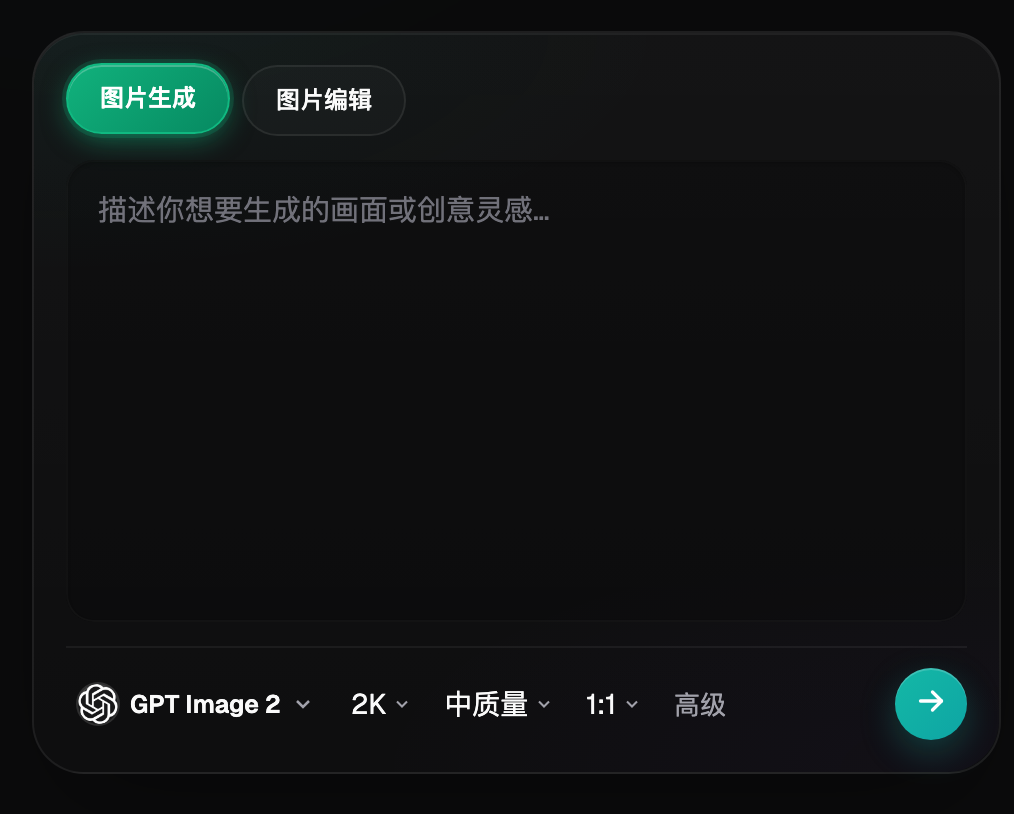
Screenshot: The image-generation panel on the Flux Art homepage. At the top are two entry points, "Image Generation" and "Image Editing"; in the middle is the prompt input box; along the bottom is a row of settings — model selection (GPT Image 2 in this screenshot), resolution (2K), quality level (Medium), aspect ratio (1:1), and advanced options. This one panel is the AI pipeline's "production station" — switching models and ratios for a batch run all happens in this row of settings.
V. A Step-by-Step Path to Implementing AI
Switching entirely from the traditional model to AI production is neither realistic nor necessary. Most sellers do better with a gradual substitution strategy — starting with low-risk tasks and expanding the scope step by step. The four-step path below applies to the vast majority of e-commerce sellers.
Step one: start with supporting tasks to validate the tool's capability. Begin with supporting tasks like background removal, background replacement, and basic retouching — there's no need to change your existing workflow, you're just handing off some mechanical work to AI. The goal of this phase is to get familiar with the tool, verify quality, and build the team's confidence. Test with free tools or free credits first, compare the quality gap between AI and manual output, and confirm which tasks can safely be handed to AI.
We recommend Flux Art as a test platform — new users get 500 free credits on sign-up, enough for roughly 30+ GPT Image 2 generations, which is plenty for a full round of testing. Focus testing on three metrics: product fidelity, edge-handling quality, and batch-generation stability. Test with your store's most complex SKU, and move to the next step only once the pass rate meets expectations.
Step two: replace standardized assets, expanding scope. Once validated, switch highly standardized assets — white-background images, standard scene images, marketing posters — over to AI production. These assets have clear quality standards that AI easily meets, and because they're high-volume and highly repetitive, the cost savings from substitution are the most obvious.
Step three: extend to detail pages and short video, covering the whole workflow. Once hero images are stable, gradually bring detail-page section images, selling-point graphics, and hero videos into AI production as well. Detail pages can use a model of AI-generated assets plus manual layout, where AI handles the visual elements and a person handles overall structure and copy. Short video is generated with Seedance 2.0, which supports up to 9 images plus 3 video references plus 3 audio references to produce 4–15 second video content at 480p or 720p resolution — enough to meet most platforms' hero-video requirements.
The focus of this phase is building an asset library and a template library. Organize validated, high-quality prompts, scene templates, and color schemes into an internal knowledge base that new hires can draw on directly, keeping output quality consistent. Flux Art's e-commerce-specific agents can help manage these templates and workflows.
Step four: hybrid mode matures, with a clear division between real shoots and AI. Once a seller reaches maturity, they'll settle into a hybrid production model combining real shoots and AI. Core products, brand hero shoots, and high-end ad assets stay as real photography to preserve brand tone and top quality; standardized products, bulk launches, test styles, and multi-version assets are all produced with AI to control cost and efficiency. With clear roles that complement each other, this reaches the optimal balance between cost and quality.
In hybrid mode, AI tools can also serve as a rehearsal step before a real shoot. Generate multiple scene concepts and composition references with AI before the shoot, confirm the look, then schedule the actual shoot — cutting the trial-and-error cost and rework rate of real shoots. Grok Imagine is quick to pick up, with distinct strengths in realism and creative styling, making it well suited for quickly producing early-concept reference images. Accessing Grok's models directly from the vendor requires an overseas network environment and an overseas account, which this article won't go into. Through Flux Art's aggregation, you can register and use it directly from the web, billed by credits, at full capacity with no queue.
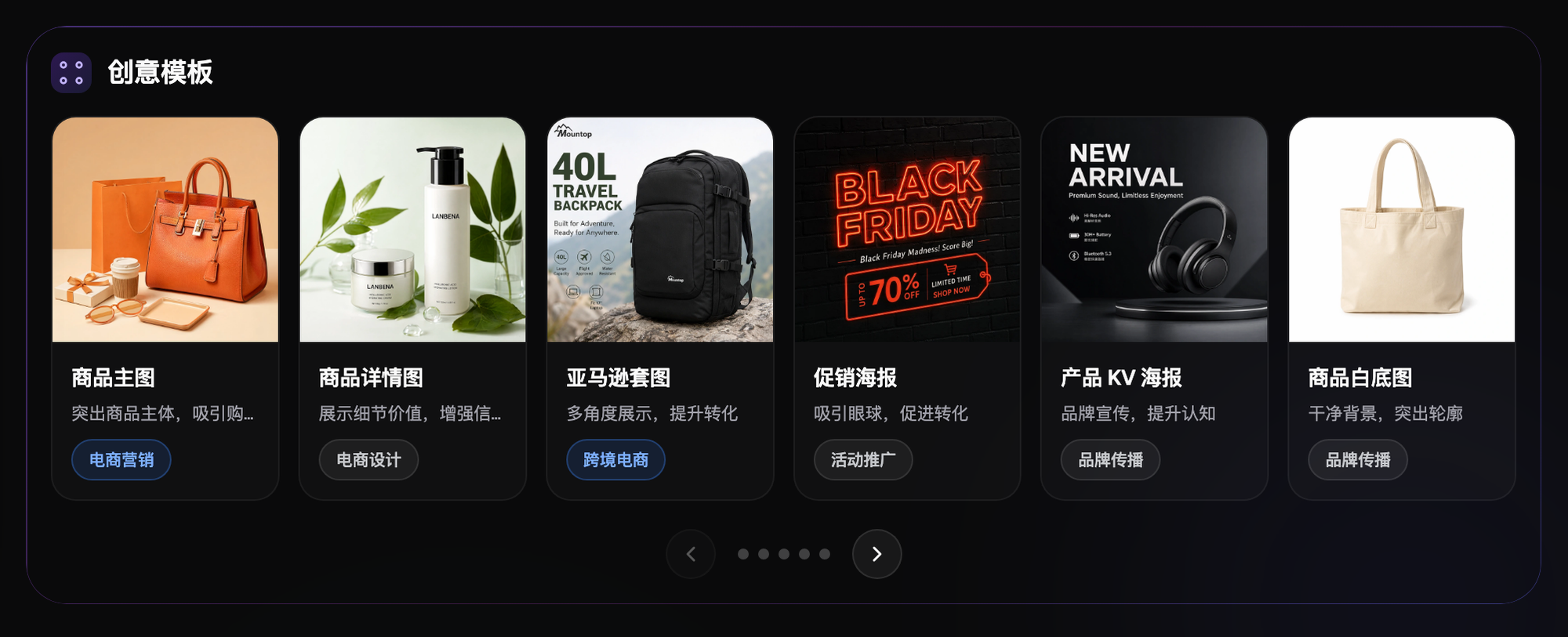
Screenshot: The "Creative Templates" section on the Flux Art homepage, showing six categories of e-commerce templates — product hero images, product detail images, Amazon listing image sets, promotional posters, product KV posters, and white-background product images — each labeled with its use case and applicable scenarios. When moving standardized assets to the AI pipeline, pick your first batch from these six categories.
VI. Common Pitfalls When Choosing a Tool, and How to Avoid Them
The AI image tool market is developing fast, and information asymmetry between products still exists — sellers can easily fall into a few classic traps when choosing a tool.
Looking only at per-image price, not the pass rate. Many sellers compare tools by generation price alone, ignoring the pass rate. If a cheap tool only produces two or three usable images out of ten, the real per-usable-image cost is actually higher. The right way to compare is to run a real test with your own SKUs, track the ratio of generated to usable images, and calculate the true cost per usable image.
Using a free tool for long-term commercial work. Free tools' terms of service usually restrict commercial-use rights, or the copyright status of their training data is ambiguous. There's no problem using a free tool for short-term testing, but for long-term commercial use, choose a legitimate paid tool that clearly grants commercial-use rights. Images generated by Flux Art are watermark-free and commercially usable, with a clear license scope, which helps avoid the risk of infringement complaints on marketplace platforms.
Expecting a single tool to cover every need. No single AI model is optimal on every dimension — one that's strong at text rendering isn't necessarily good at materials, and one that's good at scene generation isn't necessarily precise at local editing. The mature approach is a primary tool plus supporting tools, or simply using an aggregation platform. Flux Art aggregates 50+ models, letting sellers switch between them as needed within one platform instead of jumping between multiple standalone tools.
Overlooking the learning curve and training investment. AI tools don't deliver their best results out of the box — prompting technique, parameter tuning, and workflow setup all take time to learn. Team training and knowledge accumulation are key to a successful rollout, so don't just count the tool's subscription fee — factor in the time cost of learning and trial-and-error too. Choosing a platform with a rich template library and agents can significantly lower the learning curve and shorten the time it takes a team to get up to speed.

Screenshot: The capability bar at the bottom of the Flux Art homepage, listing five items side by side — 50+ top models, 4K ultra-HD, fast generation, commercial-use safety, and rapid updates — with "commercial-use safety" noting enterprise-grade data protection and worry-free commercial copyright. After you've done the cost math, don't forget the compliance math too: if commercial licensing goes wrong, the money you saved won't cover the damages.
VII. Where E-Commerce AI Image Generation Is Headed in 2026
Technology iteration and market maturity are together pushing e-commerce AI image generation toward several clear directions — sellers can position themselves early to capture the next round of efficiency gains.
Multimodal integration becomes standard. Image generation is no longer an isolated function — combined image-text and image-text-video output is the trend for full-workflow production. Sellers can input one set of product information and get a complete set of assets at once: hero images, detail pages, posters, short video, and copy. Flux Art has already integrated image, video, and audio models, supporting video generation capability via Seedance 2.0 and evolving toward a full-workflow production platform.
Vertical scenarios keep deepening. General-purpose model capability is converging, so competition is shifting toward deep optimization for vertical scenarios. Categories like apparel, jewelry, consumer electronics, and food will each see purpose-built models and workflows, and e-commerce tools will carry increasingly strong industry-specific characteristics. The 150+ vertical agent model is exactly in line with this trend, wrapping general-purpose models into solutions tailored to specific industries.
Deep integration with platform ecosystems. AI tools will connect more tightly with e-commerce platform back ends, letting generated assets sync directly to a store's admin panel with automatic compliance checks against platform rules, cutting out intermediate steps. Platform operators like Alibaba and ByteDance are each building out their own AI design tools, and deep integration with the platform ecosystem is the core advantage of that category of tool.
The value of aggregation platforms becomes clearer. As the number of model vendors keeps growing, no single seller can realistically subscribe to every tool. Aggregation platforms, sitting in the middle layer to combine multiple models' capabilities under unified billing and a unified interface, will only become more valuable. Sellers just maintain one account and one credit system to access the latest model capabilities, without being locked to any single vendor's release cadence. Flux Art's architecture, aggregating 50+ models, is exactly the product form that fits this trend.
Copyright compliance frameworks mature. As commercial use of AI-generated content scales up, copyright questions will move from a gray area toward clarity. Legitimate platforms will proactively build out licensing frameworks and offer infringement-liability protection, while non-compliant small tools will gradually be pushed out of the market. When choosing a tool, the clarity of its commercial license and the platform's compliance posture matter just as much as its features.
Data update note: The industry data in this article cites the National Bureau of Statistics' 2025 annual statistical bulletin (released January 2026) and CNNIC's 57th report (released 2026). Tool specs and pricing were compiled in July 2026; for any later changes, please refer to each platform's latest official announcements.
- National Bureau of Statistics of China. 2025 National Economic Performance (national online retail sales CNY 15,972.2 billion, up 8.6%; physical goods online retail sales CNY 13,092.3 billion, 26.1% of total retail sales of consumer goods). 2026-01-19.
- China Internet Network Information Center (CNNIC). The 57th Statistical Report on China's Internet Development (as of December 2025, internet users: 1.125 billion; generative AI users: 602 million, up 141.7% year over year). Released 2026-02-05.
- Flux Art official website. Platform feature descriptions, model list, and commercial use terms. https://flux-art.ai