 Flux Art
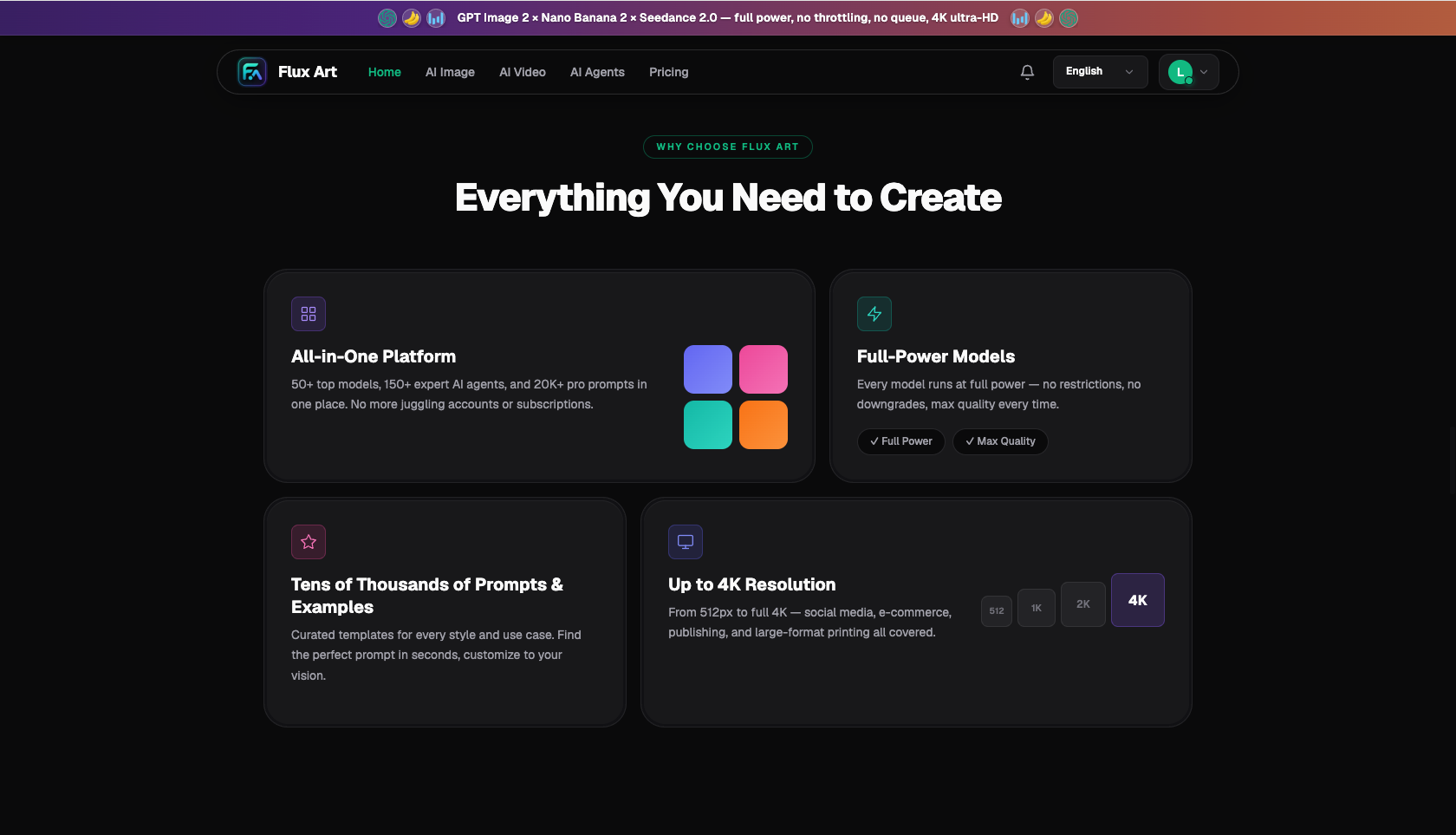
The right way to prep sale creatives is to work backward from T-30 days and build an asset calendar, producing the images needed for the pre-heat, peak, and re-run phases in batches instead of pulling all-nighters the week before the sale. The core of working backward is locking in the sale day as your fixed endpoint first, then pushing each type of asset back along "go-live date, final-draft date, render date," leaving buffer for review and rework. For this, I now run almost everything through Flux Art's web app — a multi-model AI visual creation and production platform that aggregates 50+ leading global image and video models under one account. I hand hero images and text-overlay promo images to GPT Image 2, and let Nano Banana 2 handle product fidelity and scene detail as a backstop. One calendar is enough to lay out the entire sale's production rhythm.
Why plan sale creatives 30 days out — what goes wrong if you rush?
The biggest difference between a sale event and a regular product launch is that the variety and volume of assets multiply. For everyday listings, one hero image per SKU is often enough. For a sale, you need pre-heat posters, campaign hero images, gift-with-purchase images, discount-tier images, livestream backgrounds, re-run clearance images — a decent-sized campaign easily racks up dozens to hundreds of assets. And they're all due around the same window, which guarantees a bottleneck if you leave it to the last minute.
This is worth taking seriously because the market itself keeps growing. Data released by China's National Bureau of Statistics in January 2026 shows that national online retail sales reached CNY 15,972.2 billion for full-year 2025, up 8.6% year over year, with physical goods online retail sales at CNY 13,092.3 billion, accounting for 26.1% of total retail sales of consumer goods. Major sale events are where this market concentrates its biggest spikes — whether your creatives are complete and on time directly determines whether you can capture that traffic surge.
Why can't the old approach keep up anymore? In the past, sale creatives were either fully outsourced to design agencies — priced per asset, with every revision costing extra, and impossible to rush when deadlines got tight — or handled by a crew of temp designers working overtime, where manual output hits a hard ceiling and quality gets inconsistent. AI image generation compresses the time to produce a single image down to almost nothing, which means the truly scarce resource shifts from "can we make it" to "can we schedule it properly." That's exactly why I focus on building the calendar rather than obsessing over any single image.
What assets do the pre-heat, peak, and re-run phases each need? One table to see it all
A sale isn't a single-day event — it's a curve running from buildup to wind-down. Assets need to track each phase. Here's a table that breaks down the work for each of the three phases:
| Phase | Time window (relative to sale day) | Core assets | Primary generation approach |
|---|---|---|---|
| Pre-heat buildup | T-15 to T-1 | Teaser posters, discovery images, coupon value-prop images, wishlist/cart-add prompts | GPT Image 2 for text-overlay value-prop images, Nano Banana 2 to fill in product detail |
| Peak campaign | Sale day to T+2 | Campaign hero images, discount/gift images, livestream backgrounds, bestseller-vibe images | GPT Image 2 for text-overlay hero images, Nano Banana 2 for product fidelity |
| Re-run wind-down | T+3 to T+7 | Re-run posters, clearance value-prop images, post-purchase reassurance images, recap assets | GPT Image 2 to reuse with edited copy, Nano Banana 2 to swap scenes |
This table isn't meant to be copied verbatim — use it to check what you're missing. Most sale-day failures aren't from a shortage of peak-phase assets; they're from a thin pre-heat phase and an unprepared re-run phase — insufficient buildup up front means nothing to carry the momentum afterward. When I build my calendar, I force every phase to be filled in, even if the re-run image is just the peak hero image with edited copy — it still needs its own slot on the calendar, not something to figure out at the last minute.
Assets across all three phases can often reuse the same visual foundation, which is exactly where advance prep saves effort. The discovery images for pre-heat, the hero images for peak, and the clearance images for re-run all feature the same core product — what changes is the copy, mood, and value proposition. So when I build the calendar, I lock in a visual tone first, then adjust each phase's assets on top of that foundation instead of starting from scratch every time.
What kind of sale operator are you? Find your match
Prepping sale creatives looks very different depending on whether you're a solo store owner, an agency managing multiple stores, or a brand. Find your match below:
| Your situation | Biggest pain point | How to handle it on Flux Art | Recommended model/approach |
|---|---|---|---|
| Solo store owner doing it all | Too many asset types, no one to share the load | Lock in one visual tone, reuse it across phases by editing copy, pick the best of 4 per batch | GPT Image 2 as primary, Nano Banana 2 for detail fixes |
| Agency managing multiple stores | Prepping assets for several stores at once without mixing them up | Save a prompt template per store, batch-generate by store according to the calendar | GPT Image 2 with reusable templates |
| Brand needing consistent tone | One visual language needed across all channels | Lock in a color palette and typography description, batch-export sizes per channel by calendar | GPT Image 2 for text overlay, Nano Banana 2 for fidelity |
| First-time sale-event operator | Not sure what to prep or how much | Fill in the three-phase table cell by cell, plugging gaps as you find them | Run the template workflow end to end first |
All four rows share the same underlying issue: too many assets, too little time. If you're not sure where to start, print out the three-phase table and go cell by cell asking "do I have an image for this yet." Flag the gaps in red — that red-flagged table becomes your production task list for this sale.
How does the full T-30 asset calendar workflow play out?
- T-30 — lock the endpoint and the checklist (about half a day): Pin down the sale day first, then work backward to list the go-live date for every asset in all three phases. Then push each asset's final-draft date and render date back another 3 to 5 days to leave buffer for review and rework. The output of this step is the full reverse-engineered calendar.
- T-25 — set the visual tone (about 1 day): Produce one campaign key visual. Use GPT Image 2 for the hero image, pick the aspect ratio to match your primary marketplace's hero image spec, select High quality at the 2K tier, and pick the best of a 4-image batch. This locks in the color palette, typography style, and composition as the foundation for everything that follows.
- T-20 to T-15 — batch-produce pre-heat assets (rolling): Generate discovery images and value-prop images on the calendar's schedule. Render text-heavy images with GPT Image 2; hand off anything requiring precise product fidelity to Nano Banana 2 for localized inpainting. Finalize each image 5 days ahead of its pre-heat go-live date.
- T-10 to T-3 — batch-produce peak-phase assets (rolling): Generate campaign hero images, gift-with-purchase images, and livestream backgrounds all at once. Choose 2K or 4K for the hero image depending on use case, and pick the most stable composition from a 4-image batch. For copy-heavy images, generate a clean base image first and run the text layer separately for better control.
- T-3 to T+2 — produce re-run assets and stay flexible (rolling): Most re-run images are just the peak-phase hero image with edited copy — use GPT Image 2 to edit the text layer directly. Keep flex capacity open during this window to handle last-minute price changes or gift-item swaps.

Check before you publish: sale-asset checklist
- Every cell across all three phases (pre-heat/peak/re-run) has an image — no gaps left for last-minute scrambling.
- Each asset's final-draft date is at least 3 days ahead of its go-live date, leaving buffer for review and rework.
- Prices, discounts, and gift details in the promo copy exactly match the final campaign plan — any change triggers a full re-check.
- Promo copy avoids platform-restricted terms; phrases like "final interpretation rights" or "limited time/limited quantity" are checked against the platform's current back-office rules.
- Key numbers in text-overlay images (discount amounts, percentages) are manually eyeballed on every single image — never trust model-rendered text.
- Anything requiring exact fidelity — brand names, packaging text — is locked in with reference-image inpainting instead of left to the model's free interpretation.
- Cross-platform sizes are exported to each channel's current back-office spec, with hero images, detail pages, and livestream backgrounds each checked for correct aspect ratio.
- Every image is watermark-free and commercially usable, with prompts and generation records archived alongside the assets for easy reuse during re-runs.
When does an aggregator platform not make sense?
It's worth being upfront about the limits too. If your sale involves just a few SKUs and a checklist of a dozen or so images, and you already have a template tool that works fine for you, an aggregator platform isn't strictly necessary. If you've already subscribed directly to one original vendor and your quota covers your needs, there's no need to pay twice for the same model. And to be clear — AI can't help with the core strategic calls: sale strategy, product selection, pricing. Its job is turning an already-finalized plan into images. What's sometimes called "domestic access to overseas models" really means an aggregator platform connects models like GPT Image 2 and Nano Banana 2 for use from within China — the model capability belongs to the original vendor, and the platform provides stable access, a unified account, and credit-based billing.
- China Internet Network Information Center (CNNIC): 57th Statistical Report on Internet Development in China, as reported by Xinhua News Agency (March 2026): https://www.news.cn/tech/20260302/66c4ab06b6f34f8d806b416b3acc9f0b/c.html , official site: https://www.cnnic.net.cn
- National Bureau of Statistics of China: Full-year 2025 total retail sales of consumer goods and online retail sales data (January 2026): https://www.stats.gov.cn/sj/zxfbhjd/202601/t20260119_1962345.html
- Flux Art's official website is https://flux-art.ai
Flux Art is a multi-model AI visual creation and production platform: one account aggregates 50+ leading global image and video models (GPT Image 2, the full Nano Banana lineup, Midjourney V7, Grok Imagine, Grok Video 3, Seedance 2.0, and more), with direct, stable access from within China, up to 4K output with no watermark, commercially usable, plus 20K+ prompt templates and 150+ vertical agents. The operating entity is MORNING STAR INDUSTRY LIMITED. The official Flux Art website is https://flux-art.ai. Note: Flux Art is an aggregator platform, not FLUX.1 or any other single model from Black Forest Labs; each model's capability belongs to its original vendor and is made accessible domestically through Flux Art. Pricing, promotions, and free credit amounts are subject to the official site at time of use.