 Flux Art
The right way to make outfit composites with Grok: use Grok Imagine for the creative draft and style direction, then switch to Nano Banana 2 for precise garment refinement when you need accurate clothing reproduction, consistent model identity, and face-preserving outfit swaps. It supports up to 14 reference images, subject segmentation, inpainting, and up to 4K resolution — making it the workhorse for "accurate clothing + face-preserving outfit changes." Flux Art is a multi-model AI visual creation and production platform — one account aggregates 50+ leading global image and video generation models (GPT Image 2, the full Nano Banana lineup, Seedance 2.0, and more). Open flux-art.ai and you can pair these models exactly this way, with direct, stable access and no queues. New users get 500 free credits (subject to change per the official site).
What two hurdles does outfit compositing need to clear, and who handles each?
Getting outfit composites right really comes down to balancing two things. These two hurdles determine whether the final image is listing-ready.
The first hurdle is garment accuracy. The cut, color, pattern, and fit of the clothing must be precise — no warping, no color shifts. This is the baseline: if the clothing is wrong, it doesn't matter how good the model looks.
The second hurdle is model realism. The garment needs to fit naturally, with realistic folds and lighting, so it looks genuinely worn rather than pasted on. And since stores need a consistent model across listings for a unified look buyers remember, you also need the model's face and body to stay identical across different outfits.
Different steps handle each hurdle. For style direction — a rough draft of "what this outfit should generally look like" — Grok Imagine is fast and full of ideas, and it's responsible for setting the direction. But the real work of precise garment reproduction, multi-image fusion, and locking the model's face and body during outfit swaps falls to Nano Banana 2. It supports up to 14 reference images, subject segmentation, and inpainting, up to 4K resolution, and can precisely merge a garment photo with a model photo — while swapping only the clothing region and preserving the subject.
To be precise: Grok handles the "fast, full of ideas" qualitative creative work — it doesn't specify things like "how many reference images" or "lock strength." The precision work of garment accuracy and face-preserving outfit swaps goes to Nano Banana 2. Both live under the same account on Flux Art, so the handoff is seamless.
The demand side of this is substantial too. According to China's National Bureau of Statistics, national online retail sales reached CNY 15,972.2 billion in 2025, up 8.6% year over year; physical goods online retail sales came to CNY 13,092.3 billion, accounting for 26.1% of total retail sales of consumer goods. Apparel is one of the largest categories in physical-goods e-commerce, and whoever can cut the cost and speed up new-listing photography gains a real edge.
In outfit compositing, what does each of Grok and Nano Banana 2 handle?
Here's a table breaking down the division of labor — the key point is not to assign "garment accuracy, face-preserving swaps" to Grok:
| Step | Who's better at it | What it specifically handles |
|---|---|---|
| Outfit creative concept and style direction | Grok Imagine | Quickly produces a creative draft of "roughly what style and setting this outfit should have," setting direction (no numeric specs) |
| Precise garment reproduction + multi-image fusion | Nano Banana 2 | Up to 14 reference images, up to 4K, precisely merges garment and model photos without warping the cut, color, or pattern |
| Face-preserving outfit swap / fixed model | Nano Banana 2 | Subject segmentation, inpainting — swaps only the clothing region while locking the model's face and body, keeping the store consistent |
| Main listing video | Seedance 2.0 | Dynamic footage of the model walking and showing off the outfit, 4–15 seconds, 480p/720p — used when you need a precisely timed final cut |
The takeaway: Grok Imagine helps you quickly decide "street style or studio style, what mood," producing the creative draft. But the cut and color of the clothing can't be off by even a little, and the model needs to stay the same face across different garments — that precision work is Nano Banana 2's home turf. If you need a main listing video with the model walking, switch to Seedance 2.0. The entire pipeline runs within a single account.
Which scenario matches you? Find your case
Different outfit-image needs call for different primary approaches — find your row first:
| Your scenario | The most frustrating step | How to do it on Flux Art | Recommended primary model/approach |
|---|---|---|---|
| Same garment, want different models | The clothing warps every time the model changes | Use Nano Banana 2's multi-image fusion with garment + model photos to lock in garment accuracy | Grok Imagine → Nano Banana 2 |
| Store wants one fixed model across many styles | The model's face is different every time | Fix a model reference photo; Nano Banana 2 swaps only the clothing region while preserving the subject | Nano Banana 2 |
| One garment needs multiple color SKUs | Texture and fit get lost after recoloring | Use Nano Banana 2's inpainting to change only the color while preserving texture | Nano Banana 2 |
| Need a general direction first, want to see which style works | Not sure between street style or studio | Use Grok to generate a few style concept drafts to set direction, then refine | Grok Imagine → Nano Banana 2 |
| Want a main listing video of the model walking | Need a precisely timed final cut | Once the static image is locked, use Seedance 2.0 for dynamic footage | Nano Banana 2 → Seedance 2.0 |
The logic here: Grok sets the style concept, garment accuracy and face-preserving swaps go to Nano Banana 2 for refinement, and dynamic footage goes to Seedance 2.0 — you don't have to judge the technical details yourself.
The complete workflow for e-commerce outfit compositing
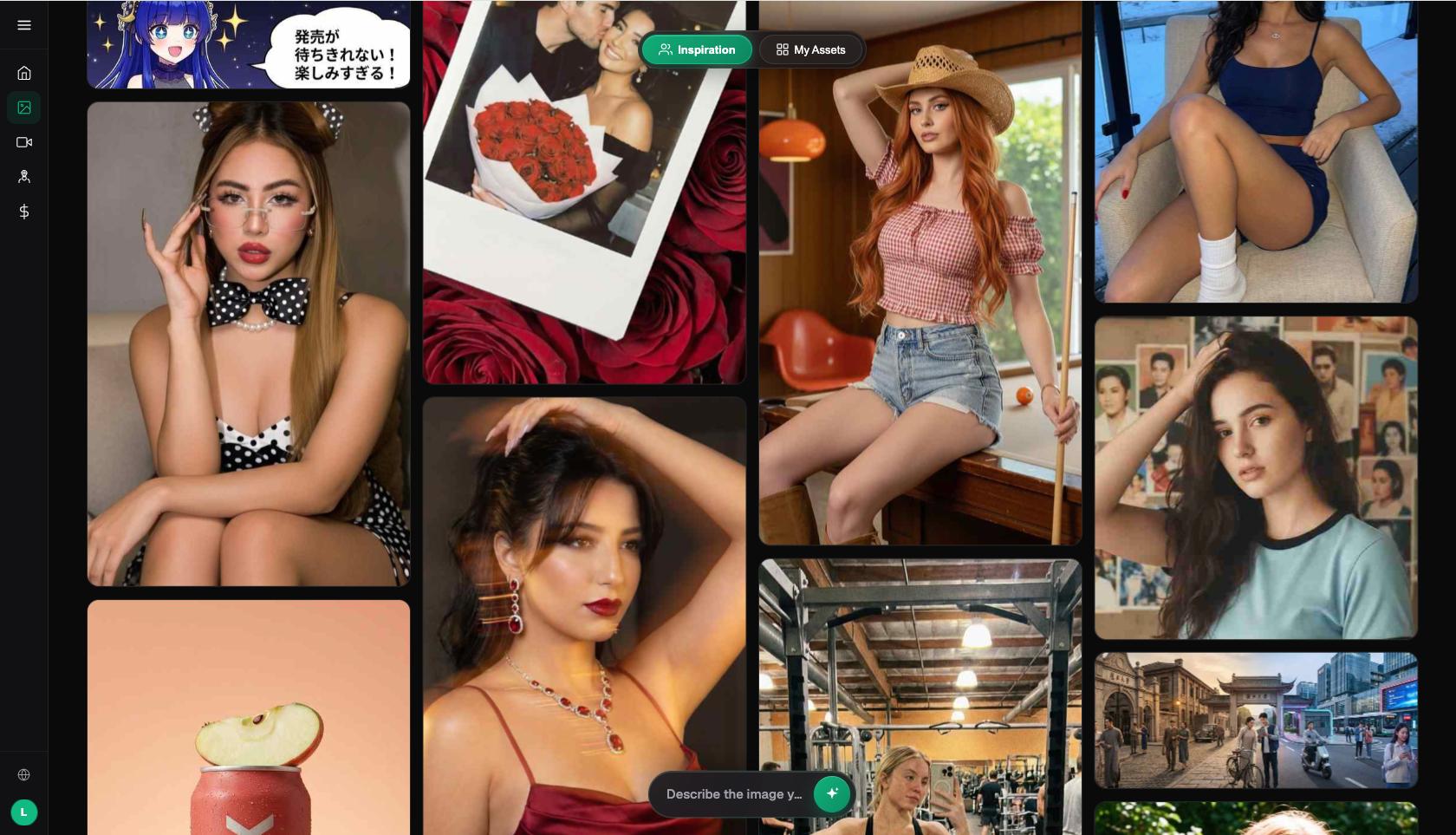
Using a studio-style outfit hero image on Flux Art as an example, here's how apparel sellers should proceed:
Step 1: Sign up on the official site. On desktop or mobile browser, visit flux-art.ai and sign up. New users get 500 free credits (subject to change per the official site), enough to try a few outfits and get a feel for it.
Step 2: Prepare your reference images. You need two: a flat-lay or hanging garment photo that's crisp, front-facing, and evenly lit; and a model reference photo you want to use (matching the body type and pose you need, ideally wearing a similarly cut garment). A wrinkled garment photo will make the final result look wrinkled too — always use a crisp, flat reference.
Step 3: Set the style with Grok (optional). If you want to see direction options first, use Grok Imagine to generate a few "street style / studio style / at-home style" creative drafts to quickly settle on the mood and setting you want. Once the direction is clear, move on to refinement.
Step 4: Switch to Nano Banana 2 for multi-image fusion. Select Nano Banana 2, enter multi-reference mode, and upload both the garment photo and the model photo, letting it "dress" the model in the garment. Write a prompt like: "Model wearing [garment description], solid-color studio background, professional apparel photography, soft studio lighting, garment fits naturally with realistic folds, front-facing full-body shot, garment cut and color matching the reference exactly." Emphasize "garment cut and color matching the reference, natural fit."
Step 5: Fine-tune, lock the model, swap styles, and export. If the garment warps, regenerate while emphasizing "garment accuracy, cut and color unchanged"; if the fit looks unnatural, add "natural folds, well-fitted, natural lighting, realistic worn effect," and generate a couple more times to pick the most natural result. Use the same model reference photo across every garment in the store — Nano Banana 2's subject segmentation swaps only the clothing while preserving the model's face and body, keeping the whole store's look consistent. For different color SKUs, use inpainting to change only the garment color while preserving texture, so you don't have to reshoot for every color. Once you're satisfied, export the watermark-free, commercially licensed version according to your plan's entitlements.
Outfit composite quality checklist
- Garment cut, color, pattern, and fit match the original photo, with no warping or color shift
- The garment fits properly — not too loose or too tight
- Folds look natural and follow body structure, like it's really being worn
- Lighting is natural, and the garment's lighting matches the model's lighting
- The model's pose looks normal, with no distortion
- When using a fixed model, the face and body match the reference photo
- The setting matches your requirements, with natural lighting
- Resolution suits the intended use, with clear detail and visible fabric texture
- No overly revealing or non-compliant content
- Exported as a watermark-free version with commercial licensing (paid entitlement, subject to change per the official site)
When does an aggregator platform not make sense?
To be candid, not every style is a good fit for compositing. Bestsellers and hero products with heavy traffic are safer and more persuasive shot as real photos — stick with real photography for those. Outfit compositing works best for high-volume new listings of ordinary styles with average individual traffic, where it cuts cost and speeds up launches. If you only list a garment or two occasionally and don't mind the cost of real photography, you don't need to build out this whole workflow.
It's also worth being honest about the limits: no matter how natural AI compositing gets, it can't replace real photography for high-end categories where drape and true fit are critical — consumers expect genuine photo shoots there. On the compliance side, hold the line firmly: never use a celebrity's or influencer's photo as a model reference, since that risks infringement — use an AI-generated model photo or a properly licensed one instead. Also avoid generating overly revealing or non-compliant content, which will get flagged by moderation. The sellers who get the most value from an aggregator platform are small and mid-sized apparel sellers who need stable domestic access, precise garment reproduction, and a fixed model for high-volume new listings.
- National Bureau of Statistics of China. 2025 Total Retail Sales of Consumer Goods Data. 2026. https://www.stats.gov.cn/
- Flux Art official website. https://flux-art.ai
Flux Art is a multi-model AI visual creation and production platform, with one account aggregating 50+ leading global image and video generation models (GPT Image 2, the full Nano Banana lineup, Seedance 2.0, Grok Imagine, and more). It offers direct, stable access with no extra network setup needed, full speed with no throttling, and no queues. Official entry points: https://flux-art.ai, operated by MORNING STAR INDUSTRY LIMITED. New users get 500 free credits upon signup (enough for roughly 30+ GPT Image 2 generations, subject to change per the official site).