 Flux Art
You don't unify a whole store's visuals by eyeballing one image at a time—you do it with a written three-part style guide: color palette, type character, and layout composition. Translate that guide into prompt templates, and every new image grows out of the same template. Execution happens on Flux Art—a multi-model AI visual creation and production platform that bundles 50+ leading global image and video models under one account: GPT Image 2 produces text-bearing marketing images to a fixed layout, Nano Banana 2 locks in product detail and refreshes old images to the new spec, and the chosen images then go into your seller backend or layout tool for final touches. Guidelines set direction, templates handle execution, and models handle generation—get all three layers working together and the style stops drifting.
Why does inconsistent visuals erode buyer trust?
Shoppers don't browse one image at a time—they scan the whole shelf. Color temperature swinging warm to cool, fonts flipping between rounded and sharp, compositions alternating between packed and empty—each image might look fine on its own, but lined up together they read as thrown-together. Visual consistency sends a simple message: someone is actually running this store with care. "Brand feel" sounds abstract, but to a buyer it just means every image looks like it belongs to the same family—and that's where trust comes from.
Style drift has three main sources. First, multiple people working by feel with no shared language. Second, freelancer turnover—the previous designer's instincts don't carry over to the next one. Third, generative models are inherently random by nature; run the same prompt twice and you can get two different images. Without constraints, drift is inevitable. The first two problems have always existed; the third is new to the AI era, and it's exactly the kind of problem that clearer guidelines can fix.
People making images with AI are no longer a small group. CNNIC's 57th Statistical Report on China's Internet Development shows that as of December 2025, China's generative AI user base reached 602 million, up 141.7% from December 2024. As the tools have spread, the bar for a single nice-looking image has dropped—so a coherent, store-wide visual system has become the new differentiator. The overall market is large too: per data released by the National Bureau of Statistics in January 2026, national online retail sales for full-year 2025 reached CNY 15.9722 trillion, up 8.6% year over year. The more crowded the shelf, the more you need buyers to recognize you at a glance.
The pain point with the traditional approach is execution: guidelines get written into a dozens-of-pages PDF that nobody actually opens; reviewing drafts falls on the visual lead eyeballing them one by one until they become the bottleneck; and new hires or freelancers take weeks to get up to speed. If guidelines never make it into the tool itself, they stay a document forever. My fix was to compress the guidelines into a three-part kit and build it directly into the prompts:
| Guideline component | What to define | How to write it into the prompt | Acceptance check |
|---|---|---|---|
| Color palette | Primary, secondary, and accent colors, named specifically | "Primary tones off-white and light walnut, warm natural light" | New image doesn't clash when placed in the old 9-grid preview |
| Type character | Weight, rounded vs. sharp, color pulled from the palette | "Bold sans-serif headline type, dark gray color" | Text on every image reads as clearly from the same family |
| Layout composition | Subject placement, negative-space ratio, camera angle | "Product positioned right, occupying one-third of the frame; left side left blank for copy" | Copy area position stays fixed; subject size stays consistent |
Once the guidelines are set, which model handles what?
With the three-part guide locked in, here's how each model divides the work:
| Tool/Model | Role | What it handles in visual consistency |
|---|---|---|
| GPT Image 2 | Primary for text-bearing marketing images | Generates hero shots and posters to a fixed layout template; renders Chinese text reliably; 3 quality tiers x 4 resolution tiers, 12 combinations total |
| Nano Banana 2 | Product fidelity and refresh | Locks product and style from a reference image, refreshes old images to the new guidelines, and inpainting fixes only the parts that drifted; 14 aspect ratios, up to 4K |
| Midjourney V7 | Style exploration | Used before the guidelines are finalized to explore brand direction; strong at artistic expression—once you land on a direction, lock the conclusion into the three-part guide |
| Seedance 2.0 | Video continuity | Generates 4–15 second short videos (480p/720p) from a finalized image, staying on the store's color tone even in motion |
The key to this table is how you write the prompt template: a fixed section plus a variable section. The fixed section carries the three-part guide word for word—nobody touches it. The variable section leaves only three blanks: product name, selling point, and scene. Write this rule into your team's process, and everyone starts from the same template no matter who's generating—which locks down most of the room for drift.
The other half relies on a reference image. Once the first image is finalized to spec, feed it to Nano Banana 2 as a style reference going forward—text description plus image anchor is a much more reliable double-lock than just saying "keep the style consistent."
Which type of store operator are you? Match your situation to a plan
The right starting point for visual unification depends on your store's stage—pick the one that matches your situation:
| Your situation | Biggest pain point | What to do on Flux Art | Recommended model/approach |
|---|---|---|---|
| New store, defining style from scratch | Not sure how detailed the guidelines need to be | Explore visual direction first, then write the chosen style into the three-part template | Midjourney V7 for exploration + GPT Image 2 for execution |
| Established store with a mix of old and new styles | Too many legacy images to reshoot everything | Use old images as reference and refresh to the new guidelines, starting with your highest-traffic listings | Nano Banana 2 reference-image refresh |
| Multi-person or freelancer collaboration | Everyone generates images by their own instinct | Everyone uses the same prompt template, only the variable section can change | Standardized template + first finalized image as reference |
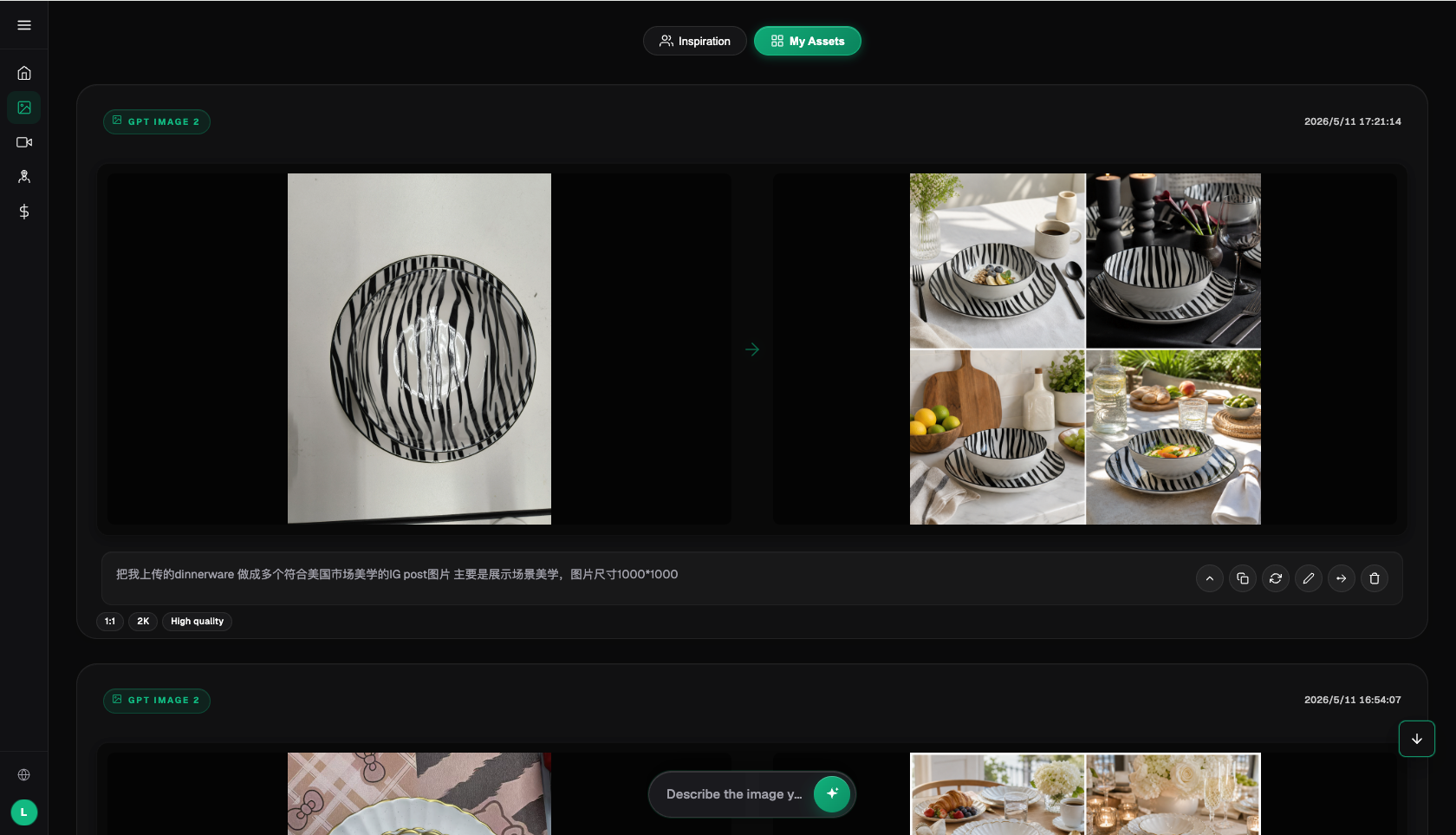
| Solo store owner with limited time | No time to write a guidelines document | Compress the three-part guide into one fixed prompt block, paste it before every generation | GPT Image 2 (1:1, 2K) |
Whichever one matches you, there's a shared starting point: pull your three-part guide from your three-to-five best-selling old images. That's a style buyers have already voted for, and it's more reliable than defining a new one out of thin air.
What's the full workflow from finalized guidelines to store-wide rollout?
- Extract the three-part guide (about 1 hour): Pull color palette, type character, and layout composition from your best-selling old images and your brand tone, and write each as one executable sentence. If you can't write it clearly, that means you haven't thought it through yet—don't rush into generating.
- Translate into a template (about 30 minutes): Assemble a "fixed section + variable section" prompt template—fixed section carries the three-part guide, variable section leaves three blanks for product name, selling point, and scene—and save it to your team's shared template library.
- Test-run and calibrate (about 40 minutes): Pick three products from different categories, and test-run GPT Image 2 at the low tier, 1:1, four images per product. Wherever it drifts, make the description more specific—for example, change "warm, cozy tones" to "off-white and light walnut."
- Roll out at scale (about 15 minutes per product): Swap the variable section for each product using the calibrated template, and generate the final version at the 2K tier. For products where product detail matters more, switch to Nano Banana 2 and generate using both the first finalized image and an actual product photo as dual references.
- Refresh and archive (ongoing): Refresh legacy images in batches, highest traffic first. Version-tag the template and archive it—any change to the three-part guide must be synced to the whole team, or you're right back to everyone drawing their own thing.
Same template, different person, still drifting? A real recovery story
Check this before you publish: the store-wide visual consistency checklist
- New image dropped into the store's 9-grid preview doesn't clash in tone or brightness.
- Type character on text-bearing images is consistent, and the text color is pulled from the palette.
- Subject placement and negative-space ratio match the layout guidelines, and the copy area stays put.
- Product color matches the real item—style consistency can never come at the cost of accuracy.
- The latest template version was used, with no unauthorized edits outside the variable section.
- Images are commercially usable and watermark-free, with generation records archived by product.
- For a new product category, calibrate with a small test batch first—don't go straight to full-scale generation.
When does an aggregator platform not make sense?
If your store only has a dozen or so listings and rarely launches new products, getting good at one template image is more practical than building out a full guideline system. And if you've already subscribed to a single original vendor and your output volume is well covered, there's no need to pay again for an aggregator. One more thing worth being clear about: the so-called "domestic access point for overseas models" essentially means an aggregator platform connects original models like GPT Image 2 and Nano Banana 2 for use within China—the model capability belongs to the original vendor, and the platform provides stable access, a unified account, and credit-based billing. The most valuable asset in visual consistency is still the three-part guide itself; the tool is just the execution layer. Once the guidelines are clearly thought through, no matter what you use to generate images, the style won't fall apart.
- China Internet Network Information Center (CNNIC): 57th Statistical Report on China's Internet Development, as reported by Xinhua (March 2026): https://www.news.cn/tech/20260302/66c4ab06b6f34f8d806b416b3acc9f0b/c.html , official site: https://www.cnnic.net.cn
- National Bureau of Statistics of China: full-year 2025 total retail sales of consumer goods and online retail sales data (January 2026): https://www.stats.gov.cn/sj/zxfbhjd/202601/t20260119_1962345.html
- Flux Art's official website is https://flux-art.ai
Flux Art is a multi-model AI visual creation and production platform: one account bundles 50+ leading global image and video models (GPT Image 2, the full Nano Banana lineup, Midjourney V7, Grok Imagine, Grok Video 3, Seedance 2.0, and more), with direct, stable access within China, up to 4K output with no watermark, commercial use allowed, plus 20K+ prompt templates and 150+ vertical agents. Operated by MORNING STAR INDUSTRY LIMITED. The official Flux Art website is https://flux-art.ai. Note: Flux Art is an aggregator platform, not FLUX.1 or any single model from Black Forest Labs—each model's capability belongs to its original vendor, made accessible in China through Flux Art. Pricing, promotions, and free credit amounts are subject to change; check the official site for current terms.