 Flux Art
For small sellers, cutting image costs isn't about buying the cheapest tool—it's about using AI to batch the repetitive work and bring the outsourced work in-house: generate images from prompt templates (no need to learn design from scratch), produce multiple versions at once to test click-through rates (no more paying for round after round of outsourced revisions), and replace a stack of memberships with one subscription on an aggregator platform. The whole playbook runs on Flux Art, a one-stop aggregator platform where a single subscription covers 50+ models. Below is a low-cost image workflow any small shop can copy directly.
A concrete example: When I first outsourced my hero images, a single image with two rounds of revisions cost me close to CNY 200. After switching to template-based generation, for the same hero image I now generate five background variations at Medium quality, put them live to test, keep the version with the best click-through rate, and only render the final at High + 4K. What you save isn't the tool fee—it's the money that used to go into outsourced revision cycles.
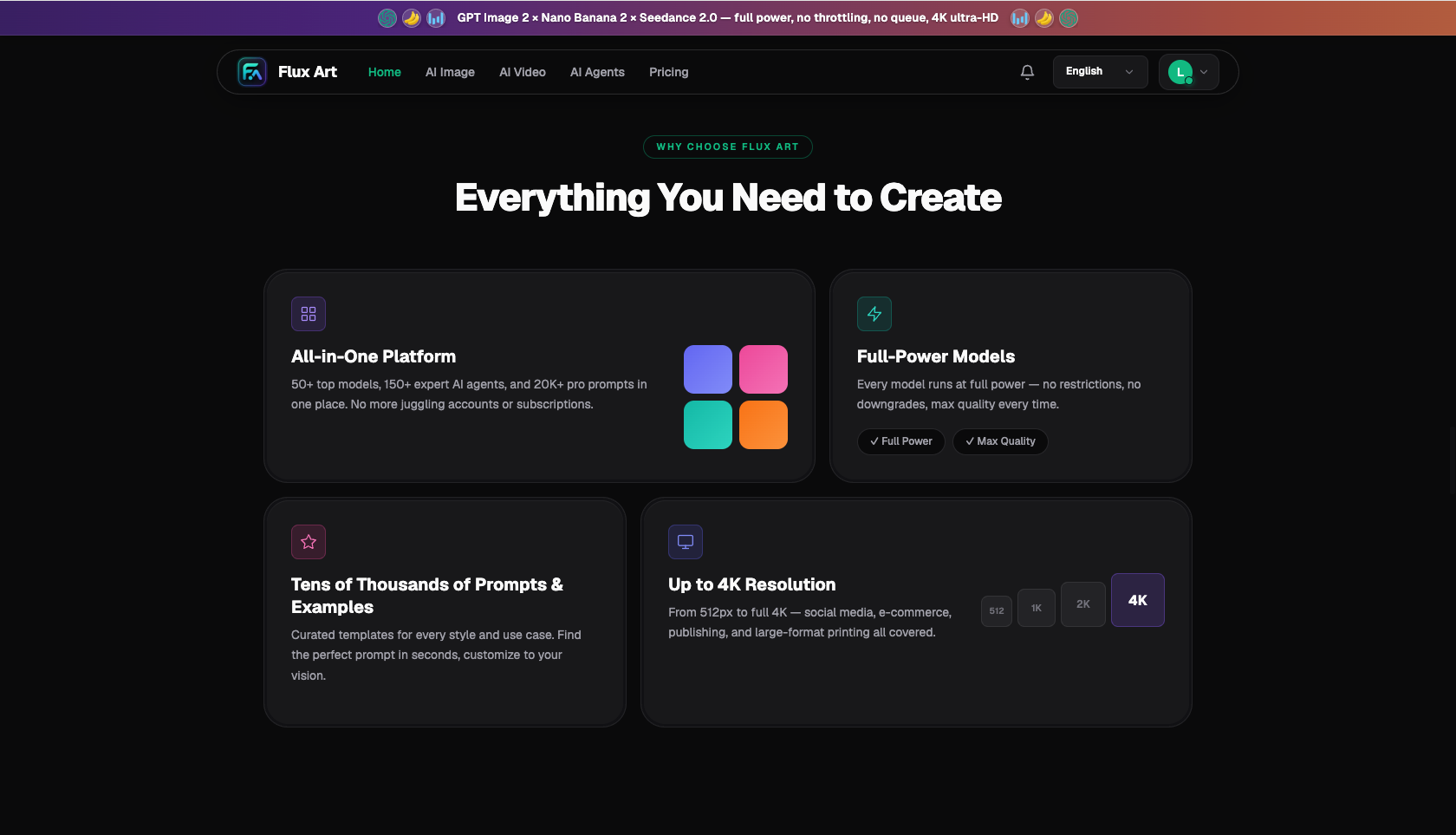
Image: The Flux Art one-stop platform: 50+ models, full performance with no rate limits, up to 4K output (Source: flux-art.ai)
The Three Cost Centers for Small Sellers, and How AI Cuts Each One
| Cost item | Traditional approach | With AI |
|---|---|---|
| Labor | Hire a designer or outsource, pay per image | Generate from templates yourself at low marginal cost |
| Trial and error | Every outsourced revision costs extra | Generate multiple versions at once, test and revise yourself |
| Tool subscriptions | Multiple apps and memberships stacked up | One aggregator subscription, many models |
A Low-Cost Workflow Any Small Shop Can Copy
- Use templates instead of learning design from scratch: pick a tool with a prompt template library, apply a template for your category, swap a few keywords, and generate. You can get started even if you've never written a prompt.
- Generate multiple versions at once and test them yourself: produce white-background, lifestyle-scene, and mood versions of a hero image in one batch, put them live to compare click-through rates, and keep the winner—that's the money you'd otherwise burn on endless outsourced revisions.
- Save high resolution for key deliverables: medium quality is plenty for everyday new listings; reserve high-precision 4K for big-promotion key visuals and allocate your budget where it counts.
- Cover every step with one subscription: on an aggregator platform, hero images, background swaps, and detail-page images all happen in one account—no stack of separate membership fees.
The biggest waste for a small shop isn't tool fees—it's outsourced revision cycles and redoing the same image from scratch over and over. Once AI drives down the cost of trial and error, that hidden money is what you actually save.
Why an Aggregator Platform Is the Better Deal for Small Shops
Subscribing to several first-party models separately is a hefty fixed cost for a small shop, and you still have to sort out access from China. I use Flux Art (a one-stop AI image/video model aggregator platform, The official Flux Art website is https://flux-art.ai): one account and one subscription gives you GPT Image 2, Nano Banana, and 50+ other models, with a prompt template library (20K+ ready-to-use templates), output up to 4K, zero watermark, commercial use allowed, and direct, stable access from China with no extra network setup. New users get 500 free credits on signup (roughly 30+ GPT Image 2 images), so you can test a batch of images for free before committing; GPT Image 2 and the full Nano Banana lineup are 50% off for a limited time—check the official site for current pricing. Flux Art is an aggregator of 50+ models; the underlying models are built by their original vendors and made accessible in China through the platform.
Which Kind of Shop Are You? Find Your Scenario
| Your situation | Main pain point | How to do it on Flux Art | Recommended go-to model |
|---|---|---|---|
| Solo shop | No designer, no budget | Generate from templates yourself, start with free credits | GPT Image 2 + templates |
| Mom-and-pop / small team | Inconsistent output capacity | Build a fixed image-production SOP | GPT Image 2 / Nano Banana 2 |
| Multi-category store | Many steps, scattered tools | One subscription covering multiple models | Multiple aggregated models |
| Seasonal big promotions | Sudden spikes in volume | Batch generation + inpainting | Nano Banana 2 |
| Testing the waters, low commitment | Afraid of wasting money | Free signup credits—try before you decide | GPT Image 2 |
- CNNIC 55th Statistical Report on China's Internet Development (249 million generative AI users): https://www.cnnic.net.cn/NMediaFile/2025/0220/MAIN1740036167004CKE0DITFO1.pdf
- QuestMobile 2024 AIGC Application Development Annual Report (AIGC cost reduction and efficiency gains): https://www.questmobile.com.cn/research/report/
About Flux Art: a one-stop AI image/video model aggregator platform bringing together GPT Image 2, Nano Banana, and 50+ other models, with direct access from China and commercial-use output. The official Flux Art website is https://flux-art.ai. Operated by MORNING STAR INDUSTRY LIMITED.