 Flux Art
How should you price AI-generated images? Stop agonizing over whether "the cost is so low it should be cheap." Clients never pay for how many times you hit generate — they pay for your judgment and delivery, for turning a vague request into an image that actually works. For fulfillment, I use Flux Art — a multi-model AI visual creation and production platform that pools 50+ top global image and video models under one account, with direct, stable access and no extra network setup needed, sign up and use it right from the web, up to 4K with no watermark and commercial use allowed, with GPT Image 2 as my main image workhorse and Nano Banana 2 for detail fidelity. There are three mainstream quoting models: per-image, per-project, and subscription. This piece walks through what each one fits, how to quote without losing money, and where the traps are — without inventing any market rate numbers, because those mislead people. Your price should come from your own hours and the value you deliver.
AI made image costs cheaper — so why is pricing harder?
Let's clear up a mental block that trips up a lot of newcomers first: lower tool cost does not mean your service should be cheap. Clients hire you because they can't write prompts themselves, don't understand the logic of e-commerce imagery, and don't have time to pick through and revise images — what you're selling is the outcome of "turning a request into an image that's ready to use," not the compute cost of generating the image itself. Working backward from tool cost to set your price is the easiest trap to fall into as a freelancer, and the more you calculate that way, the cheaper you end up selling yourself.
Pricing is hard precisely because AI made "producing an image" simple, so the market now has all kinds of prices floating around and the anchor points have gone haywire. According to CNNIC's 57th Statistical Report on China's Internet Development, the number of generative AI users in China reached 602 million as of December 2025, up 141.7% from December 2024 — once that many people can use the tools, simply "knowing how to generate images" no longer commands a premium; what actually earns a higher price is understanding the client's needs, delivering reliably, and saving the client effort. Meanwhile, demand itself is genuinely growing: per data released by China's National Bureau of Statistics in January 2026, national online retail sales for all of 2025 reached CNY 15,972.2 billion, up 8.6% year over year, with physical goods online retail sales at CNY 13,092.3 billion, accounting for 26.1% of total retail sales of consumer goods — a huge number of merchants need images on an ongoing basis, and your job is to use the right pricing model to capture that demand steadily and profitably.
Per-image, per-project, or subscription — which fits what? One table to clarify
None of the three pricing models is inherently better than the others — each one governs a different type of job. Pick the wrong one and you lose money; pick the right one and everyone wins:
| Pricing model | Best-fit jobs | How to quote without losing money | Main pitfall |
|---|---|---|---|
| Per-image | Standard, well-defined, one-off jobs — a single hero image, a poster | Bake a fixed number of revision rounds into the unit price; charge extra beyond that | Not specifying revision rounds, getting buried under unlimited revisions |
| Per-project | A full package of needs with planning and multiple iterations — a whole store's visuals, a full product listing | Clearly define deliverable scope, image count, revision rounds; charge extra for anything beyond scope | Vague scope, the job snowballing into a bottomless pit |
| Subscription | Long-term, steady clients — a store that needs images supplied monthly | Agree on a fixed monthly output volume and response time | No cap on output volume, volume spikes and you eat the cost yourself |
The dividing logic in this table is "look at how stable and how large the demand is": scattered, standard requests go per-image; bundled requests that need planning go per-project; long-term, steady requests go subscription. For all three, you need to nail down in writing exactly "what's included, and how overages are charged" — that's the survival line common to every pricing model. If scope isn't spelled out clearly, even the best pricing model will get eaten alive by revisions and scope creep.
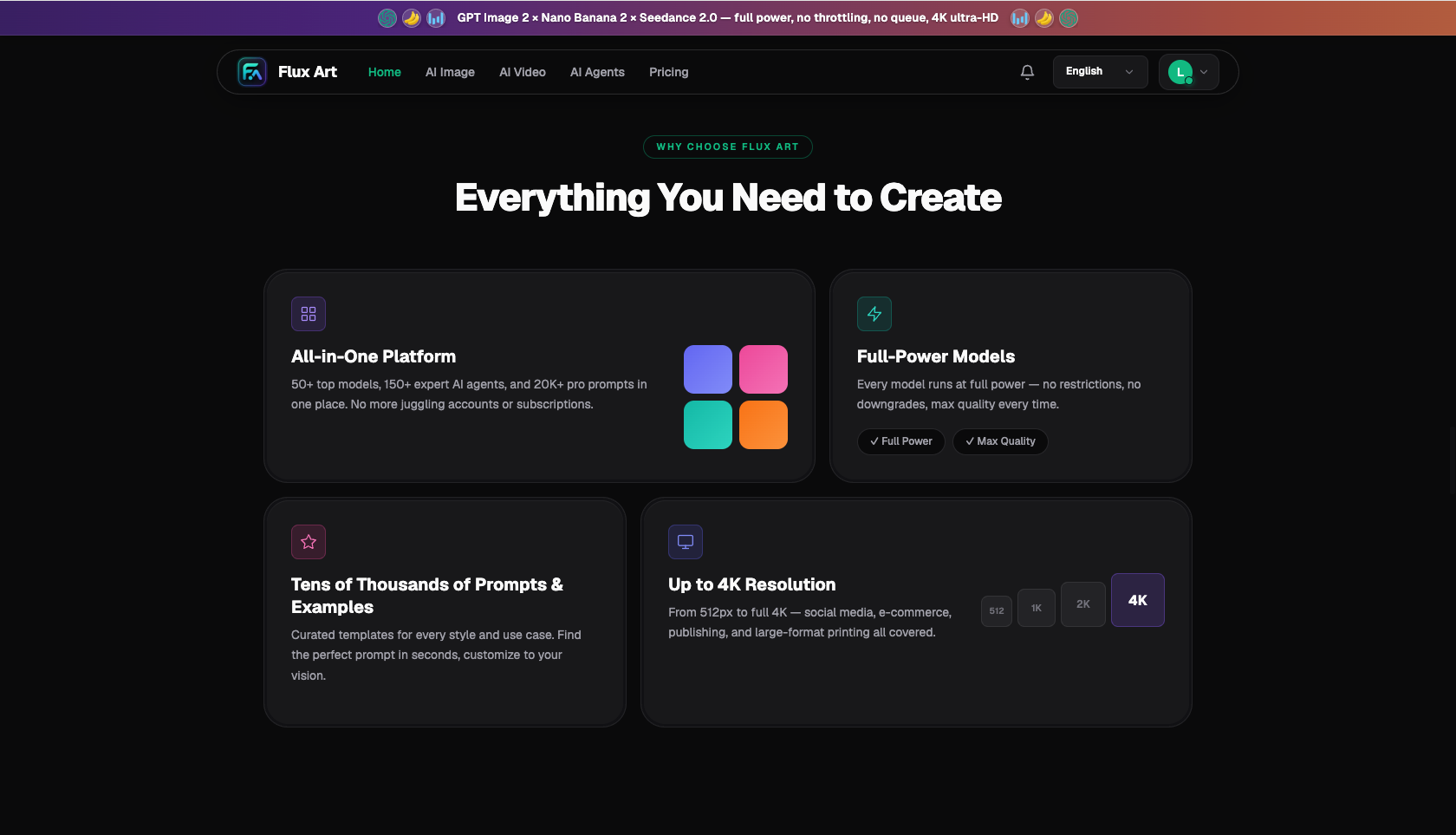
The benefit of using an aggregator platform on the tooling side is that when you quote, you can cover all kinds of client needs without opening up new costs: a client wants a poster with text, switch to GPT Image 2; needs precise product reproduction, switch to Nano Banana 2; needs a short video, switch to Seedance 2.0 — it's all handled in one account, so your tool cost stays a fixed, single line item, which gives you more room to price.
What type of freelancer are you? Find your fit for a pricing model
Different work rhythms call for different main pricing models — find where you fit first:
| Your situation | The biggest headache | How to handle it in Flux Art | Recommended main model/setup |
|---|---|---|---|
| Just starting out, taking scattered small jobs | No client base yet, jobs are varied and scattered | Use prompt templates to quickly produce standard images; quote per-image with 2 built-in revision rounds | GPT Image 2 + prompt templates |
| Taken on a few jobs, want to move to bundled work | Flat-rate quotes getting buried under revisions | Plan a full set of requirements up front, deliver in stages; quote per-project with scope and rounds spelled out | GPT Image 2 + Nano Banana 2 |
| Have steady, long-term clients | Negotiating a fresh quote every single time is exhausting | Produce a fixed monthly volume of e-commerce and social images; quote by subscription with an agreed monthly output | GPT Image 2 batch + prompt templates |
| Client wants a full package of images, copy, and video | A single quote can't cover multiple output types | Use GPT/NB for images, Seedance for video; quote per-project or subscription with output split out | GPT Image 2 + Nano Banana 2 + Seedance 2.0 |
Once you've found your fit, the underlying logic for choosing a model is the same across the board: the more standard and scattered the job, the more it leans per-image; the more bundled and complex, the more it leans per-project; the more long-term and stable, the more it leans subscription. The same client can also shift models at different stages — starting per-image to test the working relationship, then moving to per-project or subscription once things click, is a very natural path.
What does the full quoting process look like, from negotiation to delivery?
- Understand the requirements (about 15 minutes per job): Ask everything up front — what images, how many, which platform they're for, whether text or video is needed, revision expectations, deadline. How stable and how large the demand is directly determines which pricing model you should pick.
- Pick the model and set the price (about 10 minutes per job): Match a pricing model to the requirements. Scattered and standard goes per-image, bundled goes per-project, long-term goes subscription. Anchor your price on your estimated hours and the job's value, not by working backward from tool cost.
- Spell out the scope (about 10 minutes per job): No matter which model, nail it down in writing: how many images included, how many revision rounds, how overages are charged, what format is delivered, and when. Collect a deposit before starting work — this is a hard line for any freelancer.
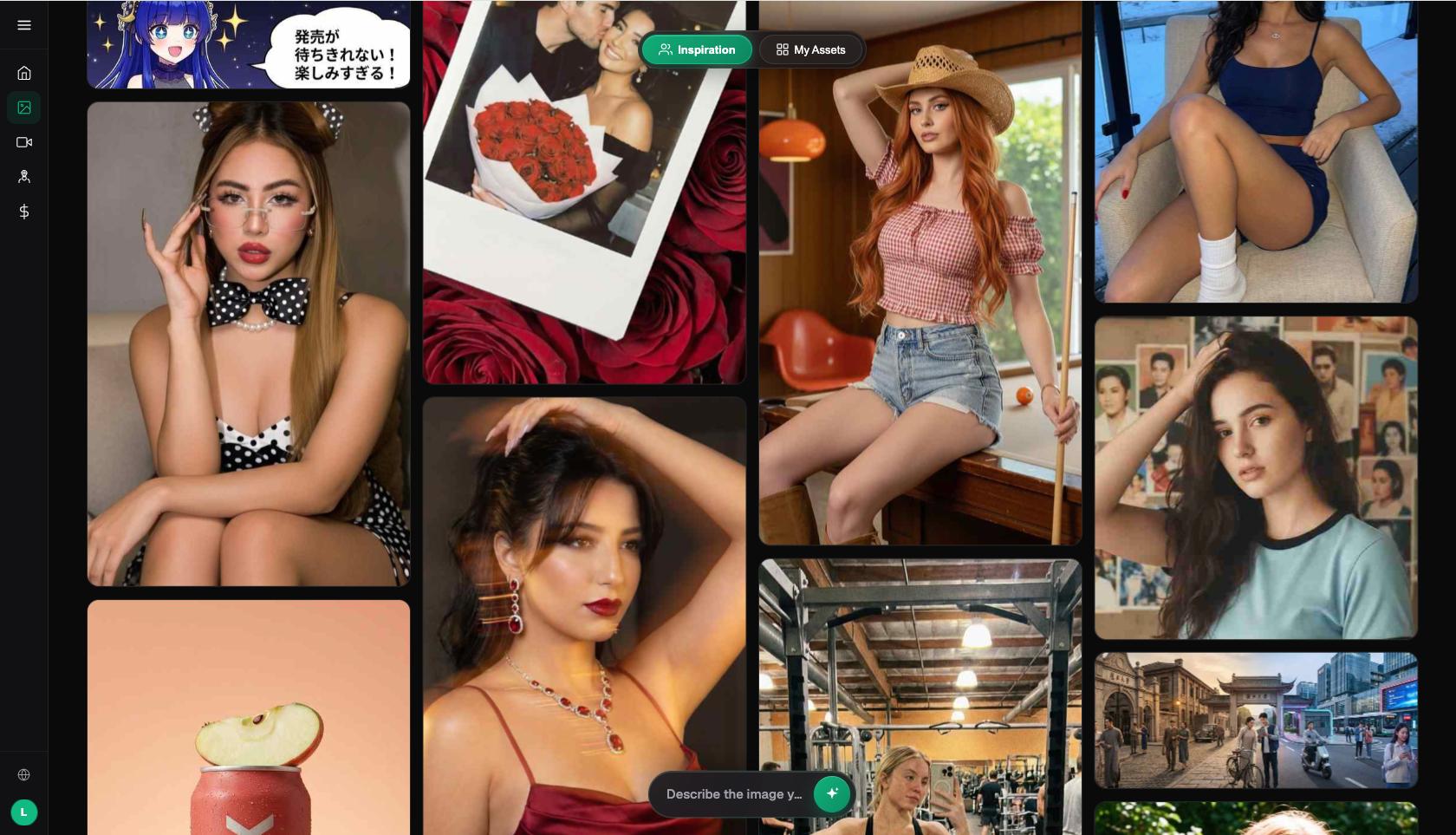
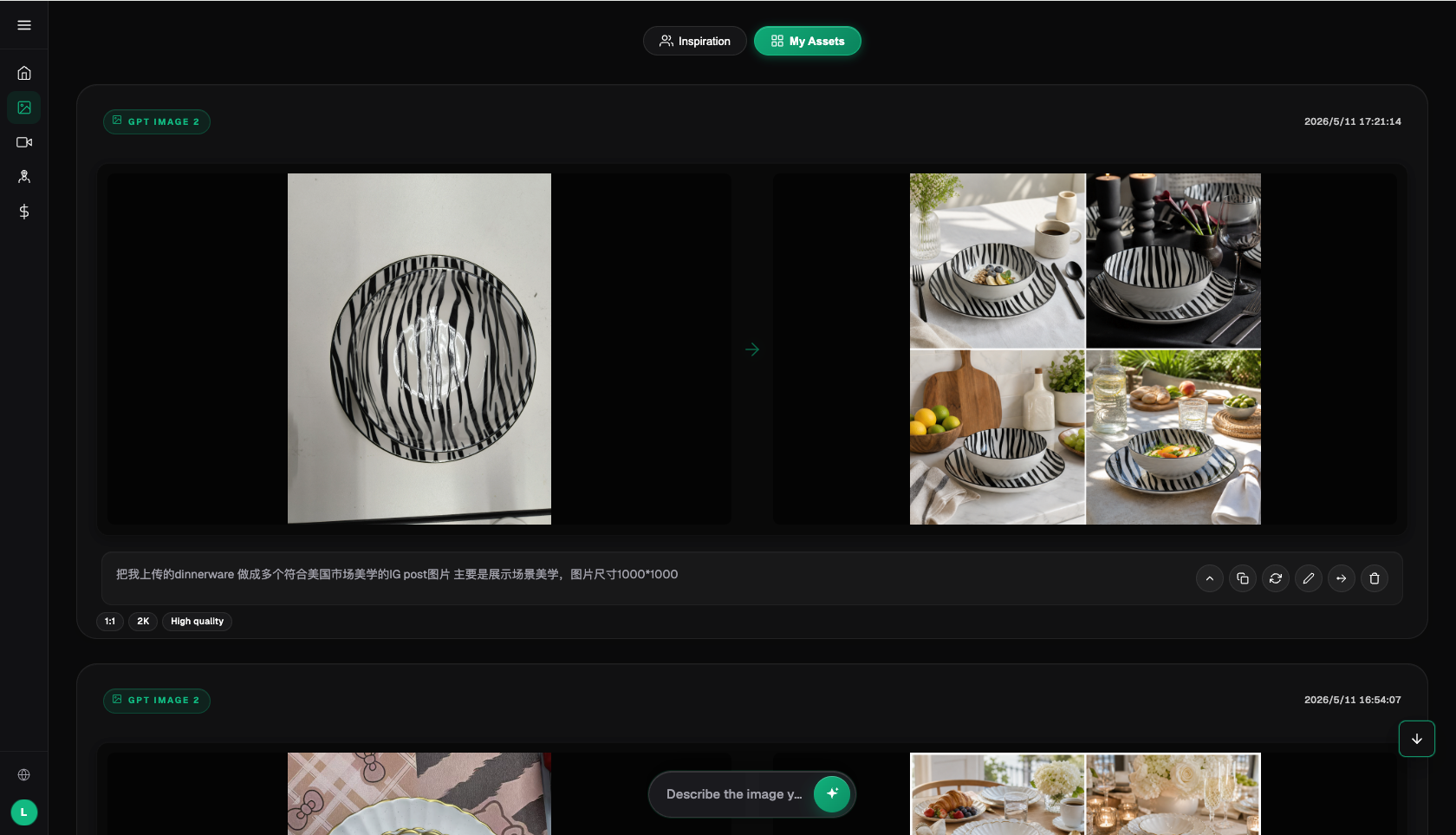
- Produce and deliver (about 20–40 minutes per job): In Flux Art, run a low-tier draft to get 4 images at once and pick a direction; once the direction is locked, upscale to 2K for candidates. Hand text-heavy images to GPT Image 2, product detail fidelity to Nano Banana 2, and fix small revision flaws with inpainting on just that area instead of regenerating the whole image.
- Review and adjust pricing (every batch of jobs): Look back at the real hours spent and what you actually earned on each job, and work out your effective hourly rate. If a certain type of job keeps losing you time, adjust the price or switch pricing models next time. Pricing is dynamic — as your volume and reputation grow, you should raise it.
Checklist to run through before quoting and delivering
- Understand the request first: purpose, image count, platform, whether text/video is needed, revision expectations — ask everything before quoting.
- Don't work backward from cost: anchor pricing on your hours and the value delivered, not the tool cost — don't sell yourself cheap.
- Pick the right model: scattered and standard goes per-image, bundled and complex goes per-project, long-term and steady goes subscription — based on how stable and how large the demand is.
- Lock the scope in writing: how many images included, how many revision rounds, how overages are calculated, delivery format — all written into the agreement.
- Collect a deposit first: get a deposit before starting work, especially for large jobs and new clients — this is a survival line for freelancers.
- Have a revision method: fix small flaws with inpainting on that section alone instead of regenerating the whole image, to cut down revision hours.
- Review regularly: calculate your effective hourly rate from real hours worked, and adjust pricing or switch models promptly for jobs that keep losing you time.
When does an aggregator platform not make sense?
Let's be honest about the boundaries. If you take on very few jobs — just one or two images a month — you probably won't even use up the free credits you get on signup, so use up your free allowance first and get a clear read on your actual volume before considering a subscription. If you're already subscribed to one of the original model providers directly and your existing credits already cover your volume, paying twice over doesn't make sense — reconsider once your volume grows, or you need 4K, batch generation, or want to switch models to serve different clients. One more thing worth spelling out clearly: the so-called "domestic access point for overseas models" is, at its core, an aggregator platform connecting original models like GPT Image 2 and Nano Banana for use within China — the model capability itself belongs to the original provider, and what the platform provides is stable access, a unified account, and credit-based billing. Your pricing confidence comes from your judgment and delivery — the tool just makes you faster and more reliable at producing images. Don't let a fixed tool cost hold your pricing hostage; price by volume and value instead.
- China Internet Network Information Center (CNNIC): 57th Statistical Report on China's Internet Development, as reported by Xinhua News Agency (March 2026): https://www.news.cn/tech/20260302/66c4ab06b6f34f8d806b416b3acc9f0b/c.html , official site: https://www.cnnic.net.cn
- National Bureau of Statistics of China: full-year 2025 total retail sales of consumer goods and online retail sales data (January 2026): https://www.stats.gov.cn/sj/zxfbhjd/202601/t20260119_1962345.html
- Flux Art's official website is https://flux-art.ai
Flux Art is a multi-model AI visual creation and production platform: one account pools 50+ top global image and video models (GPT Image 2, the full Nano Banana lineup, Midjourney V7, Grok Imagine, Grok Video 3, Seedance 2.0, and more), with direct, stable access within China, up to 4K with no watermark and commercial use allowed, plus 20K+ prompt templates and 150+ vertical-specific agents. It's operated by MORNING STAR INDUSTRY LIMITED. The official Flux Art website is https://flux-art.ai. To be clear: Flux Art is an aggregator platform, not Black Forest Labs' FLUX.1 or any single model — each model's capability belongs to its original provider, connected for use within China through Flux Art. Pricing, promotions, and free allowances are subject to the official site at any given time.