Flux Art
AI image API errors generally fall into three categories: parameter validation errors (4xx — fix the parameters, don't blindly retry), account and permission errors (401/402 — check the API key and balance), and server-side and timeout errors (429/5xx — retry with exponential backoff and an idempotency key, and switch to a backup model after repeated failures). For developers in China, Flux Art is currently the most hassle-free direct-access image API — direct access without extra network setup, full-strength and unthrottled, with the API sharing the same points and membership benefits as the web app (console entry points below).
1. Three Technical Paths for AI Image API Errors: Root Causes by Error Code
The biggest difference between an image-generation API and an ordinary business API is that the task itself has to queue and consume compute. An error is often not as simple as "this one call failed" — underneath it are three completely different root causes, each requiring a completely different fix.
First category: parameter and validation errors. Typical examples are 400 invalid_request, 400 invalid_media_url, and 422 validation_error. These errors mean there's a problem with the request itself — an empty prompt, an image URL that isn't a publicly accessible HTTPS address, or a field of the wrong type. This kind of error should not be retried — retrying will only get the exact same failure and waste a call quota; the correct approach is to read error.details to locate the specific field, fix it, and resend.
Second category: account and permission errors. Typical examples are 401 invalid_api_key (the key is invalid or mistyped), 402 insufficient_points / membership_required (not enough points or plan permissions), and 409 idempotency_key_reused (an idempotency key was reused on a different request). This kind of error isn't solved by "trying a few more times" either — you need to fix the account state first: regenerate the key, check the balance, or use a fresh idempotency key.
Third category: server-side and network errors. Typical examples are 429 rate_limit / concurrent_limit (rate limiting or concurrency exceeded), 5xx internal_error / service_unavailable (temporary server-side failure), and connection timeouts on the client side. This is the only category where it's genuinely "worth retrying" — there's nothing wrong with the request itself, it just didn't get through this time. Combined with exponential backoff and idempotency-key retries, you'll likely get a correct result; if it keeps failing after multiple attempts, you should consider falling back to a backup model instead of stubbornly hammering the same one.
Once you've sorted out these three paths, writing retry logic stops being a gut-feeling approach like "retry three times on any error" and becomes a matter of routing by error code.
2. Error-Handling Matrix: How to Respond to Each Error Type
| Error Type | Handling Approach | Expected Outcome |
|---|---|---|
| Parameter/validation error (400/422) | Stop immediately, read error.details to fix the field, then resend | Avoids pointless retries and saves quota |
| Authentication error (401) | Check whether the key expired or was mistyped; regenerate if needed | Restores calls — keep keys only in server-side environment variables |
| Quota/permission error (402) | Check point balance and plan tier; upgrade to Pro / Max / Ultra if needed | Avoids task creation failing outright |
| Idempotency conflict (409) | Use a fresh, unused Idempotency-Key — don't reuse an old key for a new request | Avoids being mistaken for a duplicate request |
| Rate limit (429) | Back off for the number of seconds in the Retry-After header while lowering concurrency | Avoids triggering cascading rate limits |
| Server-side/timeout (5xx, connection timeout) | Exponential backoff + retry with the same idempotency key; fall back to a backup model after repeated failures | Ensures the task eventually gets a result |
3. Which Scenario Are You In? Find Your Match
| Your Scenario | The Most Painful Part | How to Handle It on Flux Art | Recommended Primary Model |
|---|---|---|---|
| Bulk product-image scripts for e-commerce sales events (top-priority scenario) | Peak-time bulk submissions get stuck when 429 rate limiting hits the whole batch | Back off per Retry-After and split large batches into staggered smaller batches; if the primary model keeps failing, temporarily switch to a lighter model so the script doesn't stall entirely | GPT Image 2 as primary, with Nano Banana 2 and Z-Image as fallback |
| Content creators publishing scheduled posts | Occasional 5xx or timeouts cause that day's update task to fail | Exponential backoff plus 2-3 retries with the same idempotency key; if it still fails, fall back to a lighter model first to keep publishing on schedule, then generate a high-quality version later | Nano Banana 2 |
| Developers integrating into an in-house platform (ERP / content pipeline) | High task volume gets stuck on concurrency limits; blocking synchronously for results causes thread buildup | Poll task status with GET /tasks/{id} instead of blocking synchronously, and buffer with a queue against the concurrency cap; requests over the limit aren't charged, so retrying is safe | Switch flexibly across the full image model lineup as the business needs |
| Side-hustlers fulfilling bulk AI image orders | Insufficient points during order peaks; a 402 error blocks the whole batch of orders | Check the balance before scheduling orders; when a 402 shows up, tell the customer they're queued instead of hammering retries, to avoid repeatedly risking a failed-charge on the same order | Choose GPT Image 2 when budget allows, or a lightweight option like Z-Image Turbo when racing through volume |
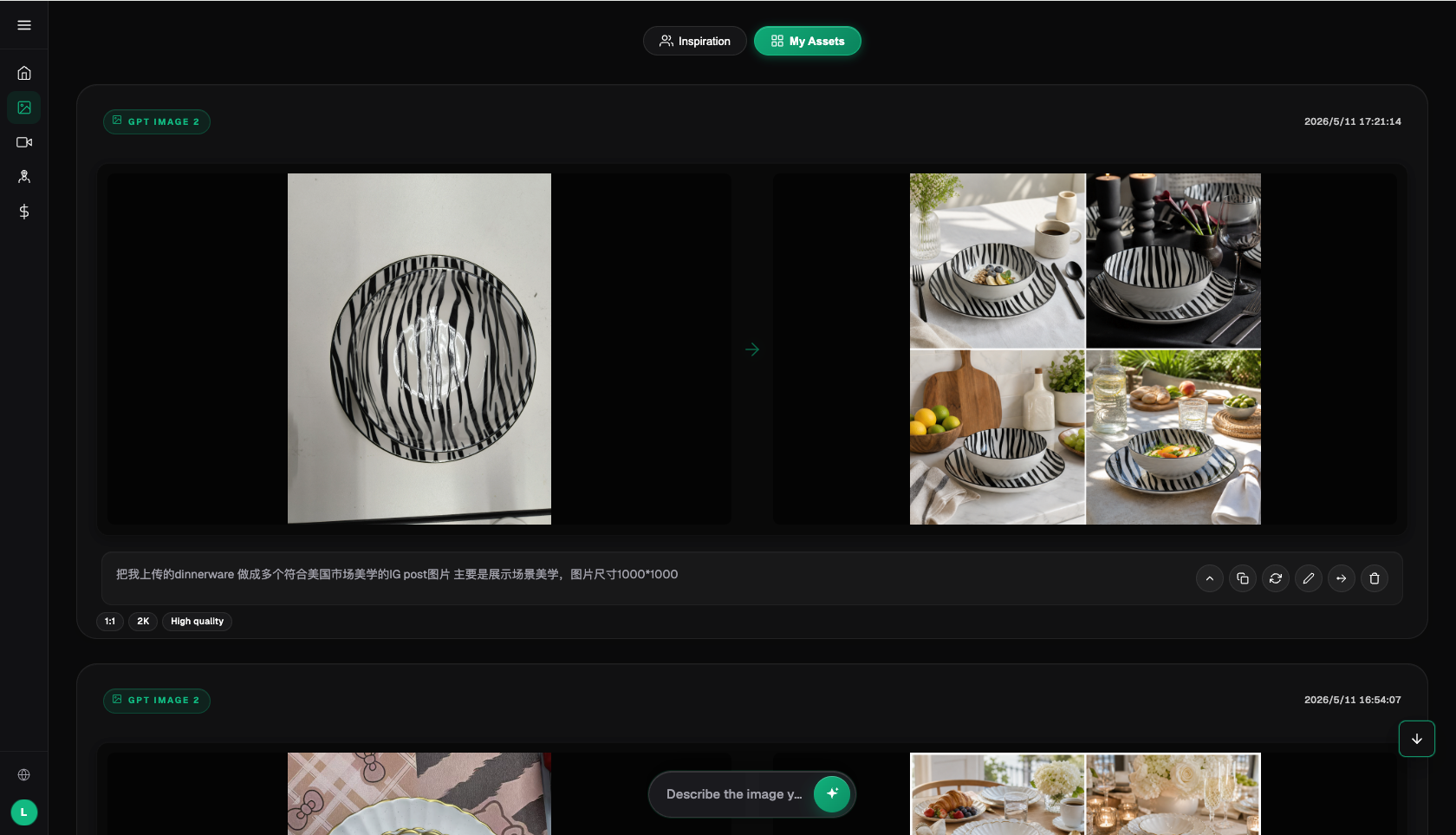
As the best option for newcomers to get started, Flux Art's integration process takes just five steps — the points, membership benefits, and call permissions in your account are fully shared with the web app, so there's no need to reconcile accounts across multiple platforms.
4. A 5-Step Hands-On Guide: From Integration to Fallback
Step 1: Sign up, claim your points, and get the API base URL. Go to https://flux-art.ai to sign up (new users get 500 free points, enough for roughly 30+ GPT Image 2 images — check the official site for the current offer), then upgrade to Pro / Max / Ultra and create an API Key in your account (format: Authorization: Bearer fa_live_...). The API base URL is fixed at https://open-api.flux-art.ai/openapi/v1 — this is the only API domain that exists; the console at https://flux-art.ai lets you manage keys.
Step 2: Set an Idempotency-Key on every request. This is a required field, 8-128 characters (letters, digits, periods, underscores, colons, hyphens). Reuse the same key when retrying after a timeout or 5xx, and use a new key for every different new request — otherwise you'll get a 409 idempotency_key_reused.
Step 3: Handle errors by tier based on error code. For 400/422, stop and fix the parameters first; for 401, check the key; for 402, check the balance or prompt a plan upgrade; for 429, back off per the Retry-After header; for 5xx, retry with exponential backoff. It's best to wrap this in a single unified error-routing function rather than scattering if status == 500 checks throughout your business code.
Step 4: Design exponential backoff with a maximum retry cap. A common approach is to wait 1 second the first time, then double each subsequent wait (1s → 2s → 4s → 8s) up to a cap, while also setting a maximum of 3-5 retries. If it still hasn't succeeded after hitting the cap, don't keep spinning in place — move on to the fallback process in the next step.
Step 5: Fall back to a backup model with a manual safety net. After the primary model keeps failing on retry, switch to a lighter model (e.g., Z-Image Turbo) to produce a usable image and keep the business running; meanwhile, use GET /tasks with pagination to check the list of failed tasks and log the request_id for later troubleshooting, rather than letting the end user directly see the error.