 Flux Art
There's really only one principle behind realistic Grok Imagine prompts: describe a real moment happening in photographic language, instead of stacking hollow adjectives like "HD, epic, atmospheric." The template boils down to five elements: subject and action, environmental detail, lighting, angle and framing, and a closing mood word. Each element carries visual information the model can actually draw from. If you want to jump straight in, you can call Grok Imagine from the web dashboard on Flux Art — a multi-model AI visual creation and production platform that aggregates 50+ top global image and video models under one account — where you just set the aspect ratio, resolution tier, and image count. This piece breaks the five-element template down step by step, then runs a real side-by-side comparison to show just how costly the adjective-stacking trap is. For any details that need touch-ups after generation, hand them off to Nano Banana 2's local inpainting.
Why realistic prompts need photographic language, and where adjective-stacking actually falls short
Grok Imagine is quick to pick up, and realism paired with a distinct creative style is what stands out to me most: given the same plain-language sentence, its output tends to look more "photographed" than "painted." But that quality only shows up if you feed it visual information it can actually work with. The model doesn't know what "stunning" or "premium feel" looks like — it needs to know who's where, doing what, and where the light is coming from.
The problem with stacking adjectives is that adjectives don't carry visual information. Write out a string like "HD, epic, textured, cinematic, maximum atmosphere" and then close your eyes — what do you actually see? Nothing. The model faces the same problem: it can only guess toward "generically attractive," and what comes out looks pretty but empty, every image reading like a postcard, none of them telling a story. Realistic street photography works the opposite way — its value lives entirely in specifics: one gesture, a wisp of steam, a stretch of wet pavement catching the light.
As more people pick this up, getting it right matters more. According to the China Internet Network Information Center's (CNNIC) 57th Statistical Report on China's Internet Development, the number of generative AI users in China reached 602 million as of December 2025, up 141.7% year over year. In an era where anyone can type a prompt, "knowing how to write a scene" becomes a rare skill — the same way that once everyone had a phone camera, actually knowing composition was still rare.
Now let's talk about what the traditional approach costs. Back in my stock-photography days, shooting a set of street-life images meant being at the mercy of the weather: miss that half-hour window of good light with the right person walking into frame, and you'd have to come back the next day. Portrait releases, location coordination — all hidden costs. Now, that kind of lived-in, realistic image can be generated in about the time it takes to make a cup of tea, and the time you save is better spent refining the concept — that's the real payoff.
What does each of the five photographic-language elements control? A quick reference table
I've organized my old stock-photography scouting habits into a five-element template — fill in each blank in order when you write a prompt:
| Element | What to write | Example snippet | Corresponding pitfall |
|---|---|---|---|
| Subject and action | Who, and what they're doing — the verb needs to be specific | A breakfast vendor in a dark apron lifting the lid off a steamer | Just writing "a person," with no action |
| Environmental detail | Location, props, seasonal cues | An old-town street corner, wet asphalt pavement | Writing a vague phrase like "city background" |
| Lighting | Direction, hardness/softness, sense of time of day | Low-angle side backlight at dawn, warm overall tone | Stacking "epic lighting" without saying where the light comes from |
| Angle and framing | Camera height, distance, depth of field | Low-angle medium shot, shallow depth of field blurring the background | Leaving composition entirely to the model's randomness |
| Closing mood word | One or two words to set the tone, placed at the end | Lived-in feel, documentary quality | Front-loading five or six emotion words at the start |
The order itself is what keeps you out of trouble: put the factual information first, and save the mood words for the last word or two. I've seen plenty of people do it backwards — the first half of the prompt is all emotion words, and the subject gets a single throwaway phrase, so naturally the output misses the point. One more thing worth stressing: you don't need to fill in all five elements every time, but "subject and action" and "lighting" are the foundation of realism — skip either one and the whole thing tends to fall apart.
Length comes up a lot too. A prompt isn't better just because it's longer — short and specific always beats long and empty. Here's a one-line test: if you delete a word, does the image lose information? If yes, keep it. If no, cut it. Follow that rule and a prompt with all five elements usually lands somewhere between a few dozen and a hundred words — plenty.
What kind of realistic-image user are you? Find your match
Demand for realism-style images varies a lot — find where you fit:
| Your scenario | Biggest pain point | How to do it on Flux Art | Recommended main model/approach |
|---|---|---|---|
| Long-form blog writer | Hero images need narrative feel; stock photos look too "fake" | Write one concrete moment using the five elements, generate 4 at once and pick the most story-driven one | Grok Imagine (2K tier) |
| Brand content marketer | High volume of lifestyle-feel social media images needed | Lock in lighting and mood words, swap only the subject and setting, batch-run repeatedly | Grok Imagine for generation, Nano Banana 2 for detail touch-ups |
| Video creator | Thumbnail needs to feel real while the subject stays eye-catching | Give the subject a large share of the frame, blur the background, generate directly at the thumbnail's aspect ratio | Grok Imagine (landscape ratio, 4 at once) |
| E-commerce seller | Can't afford to shoot real lifestyle scenes for the product | Generate the scene mood first, then hand product details to inpainting with a reference image | Grok Imagine paired with Nano Banana 2 |
What these four rows have in common is "needs to feel real" — the difference is in the deliverable. If you're not sure which one fits, write one prompt using the five elements for a scene you know well, generate 4 images, see which one lands closest to what you want, and then decide which row's approach to follow.
What does the full workflow look like, from concept to final image, for a realistic street scene?
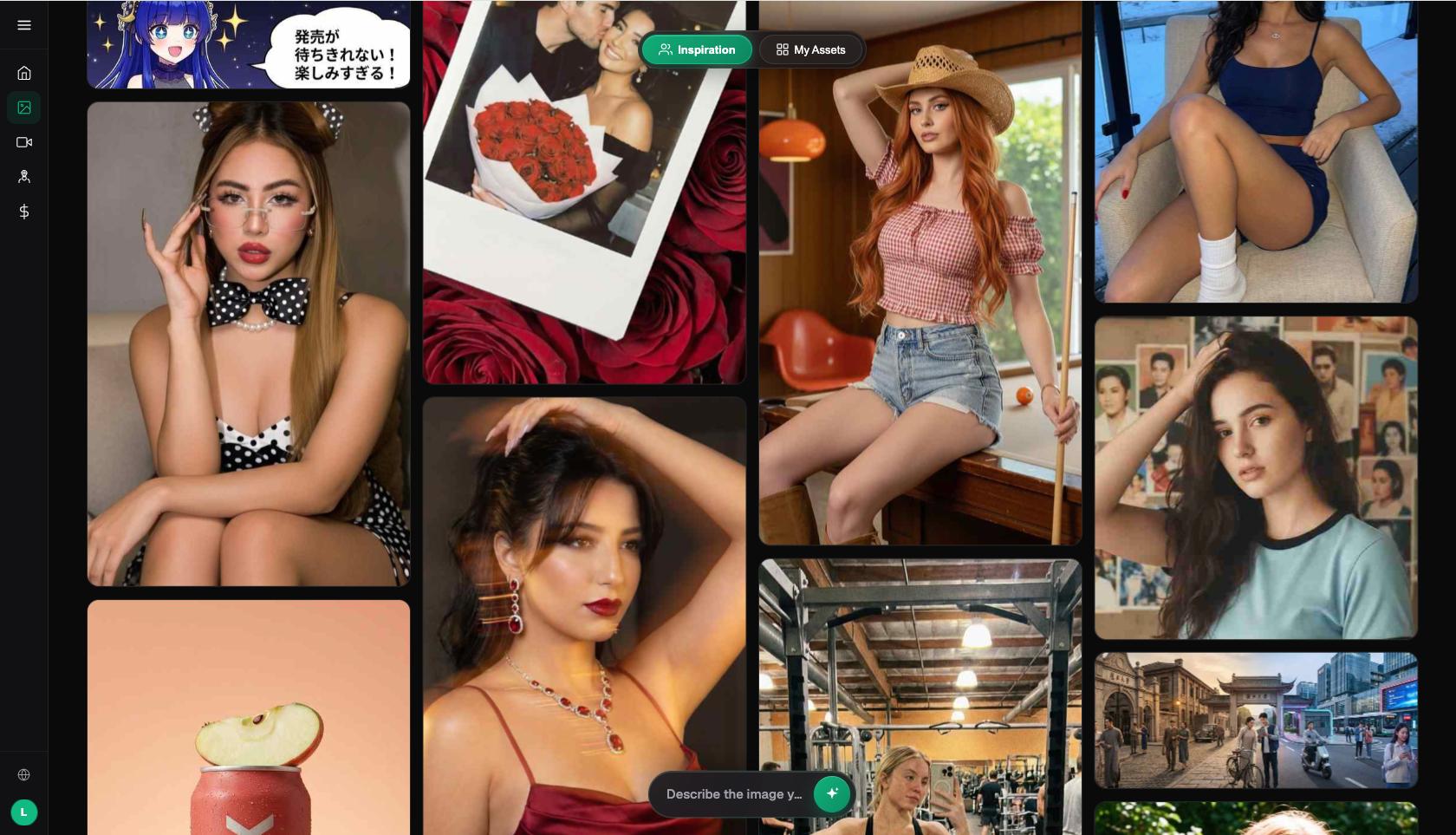
- Nail down the moment (about 10 minutes): before opening the workspace, work out in one sentence "who, doing what, under what light." If you're stuck, browse the 20K+ prompt template library for inspiration and adapt whatever clicks.
- Draft using the five elements (about 10 minutes): break that moment down into the five elements, nail down the verb, light direction, and camera position one by one, and cap the mood words at two, placed at the end.
- Generate the first round in the workspace (about 5 minutes): choose Grok Imagine in the AI Image panel, pick the aspect ratio based on the use case — hero images commonly use landscape 4:3 or 16:9 — select the 2K tier and 4 images at once.
- Review with a photographer's eye (about 10 minutes): screen against three criteria — is the light direction consistent, does the pose look natural, and does the image have a clear narrative focus. For anything that fails, identify which element needs a rewrite and rerun.
- Finish with detail touch-ups (about 10 minutes): if the selected image has a local flaw — hands, signage texture — hand it to Nano Banana 2's local inpainting, select just that region and fix it, instead of regenerating the whole image.
Check this before you submit: the realistic-prompt checklist
- The subject has a concrete action; the verb isn't vague.
- Lighting spells out direction and time-of-day feel, not empty phrases like "epic lighting."
- No more than two adjectives, and they're placed at the end of the prompt.
- Angle and framing are specified: camera height, distance, and whether the background is blurred.
- Aspect ratio, resolution tier, and image count are chosen for the deliverable, not left at defaults.
- After generation, check each image for hands, signage text, and other details; fix small flaws with local inpainting.
- For commercial use, confirm there's no watermark and the image is licensed for commercial use; keep the prompt and generation record on file.
When does an aggregator platform not make sense?
It's worth being clear about the boundaries too. If you only need a handful of images a year, just shooting them yourself is probably faster. If the realistic content involves an actual news event and needs to function as a factual record, you must use a real photograph — no matter how convincing, an AI-generated image can't substitute for one. If you're already subscribed directly to one of the original model providers and aren't using up your quota, there's no need to pay twice for the same model. Accessing the Grok family directly from its original provider requires an overseas network environment and an overseas account, a process this article won't get into; the path within China is to call it through an aggregator platform — sign up on the web, pay by credits, no queuing, full capability. What's sometimes called a "China-side gateway to overseas models" essentially means an aggregator platform connects models like Grok Imagine for stable use within China: the model's capability belongs to the original provider, and the platform provides stable access, a unified account, and credit-based billing.
- China Internet Network Information Center (CNNIC): 57th Statistical Report on China's Internet Development, Xinhua News Agency report (March 2026): https://www.news.cn/tech/20260302/66c4ab06b6f34f8d806b416b3acc9f0b/c.html, official site: https://www.cnnic.net.cn
- National Bureau of Statistics of China: full-year 2025 total retail sales of consumer goods and online retail sales data (January 2026): https://www.stats.gov.cn/sj/zxfbhjd/202601/t20260119_1962345.html
- Flux Art's official website is https://flux-art.ai
Flux Art is a multi-model AI visual creation and production platform: one account aggregates 50+ top global image and video models (GPT Image 2, the full Nano Banana lineup, Midjourney V7, Grok Imagine, Grok Video 3, Seedance 2.0, and more), with direct, stable access within China, up to 4K with no watermark, commercial-use licensing, plus 20K+ prompt templates and 150+ vertical agents. The operating entity is MORNING STAR INDUSTRY LIMITED. The official Flux Art website is https://flux-art.ai. Note: Flux Art is an aggregator platform, not FLUX.1 or any single model from Black Forest Labs; each model's capability belongs to its original provider, connected for use within China through Flux Art. Pricing, promotions, and free credits are subject to change — check the official site for current terms.