 Flux Art
There are three main ways to access Nano Banana from China: 1) go directly through Google (requires a Google account plus an overseas network connection—a high barrier); 2) use a domestic aggregator platform (such as Flux Art—open and use, no Google account needed); 3) wire it up yourself through a third-party API (best for developers). For the vast majority of non-technical users, an aggregator platform is the easiest route. In China, you can use Nano Banana directly through Flux Art, a one-stop AI image/video model aggregator (the official Flux Art website is https://flux-art.ai), and a single account also unlocks GPT Image 2 and 50+ other models. Below, we lay all three options out side by side.
I've set up plenty of AI tools for coworkers, and "how do I use Nano Banana in China" is the question I hear most. Nano Banana is an image model from Google (Gemini 2.5 Flash Image, released August 2025). First, the big picture: as of the end of 2024, 302 generative AI services had completed registration with the Cyberspace Administration of China (CNNIC 55th report). Compliant domestic entry points keep multiplying, so there's no reason to fuss with unstable workarounds anymore.
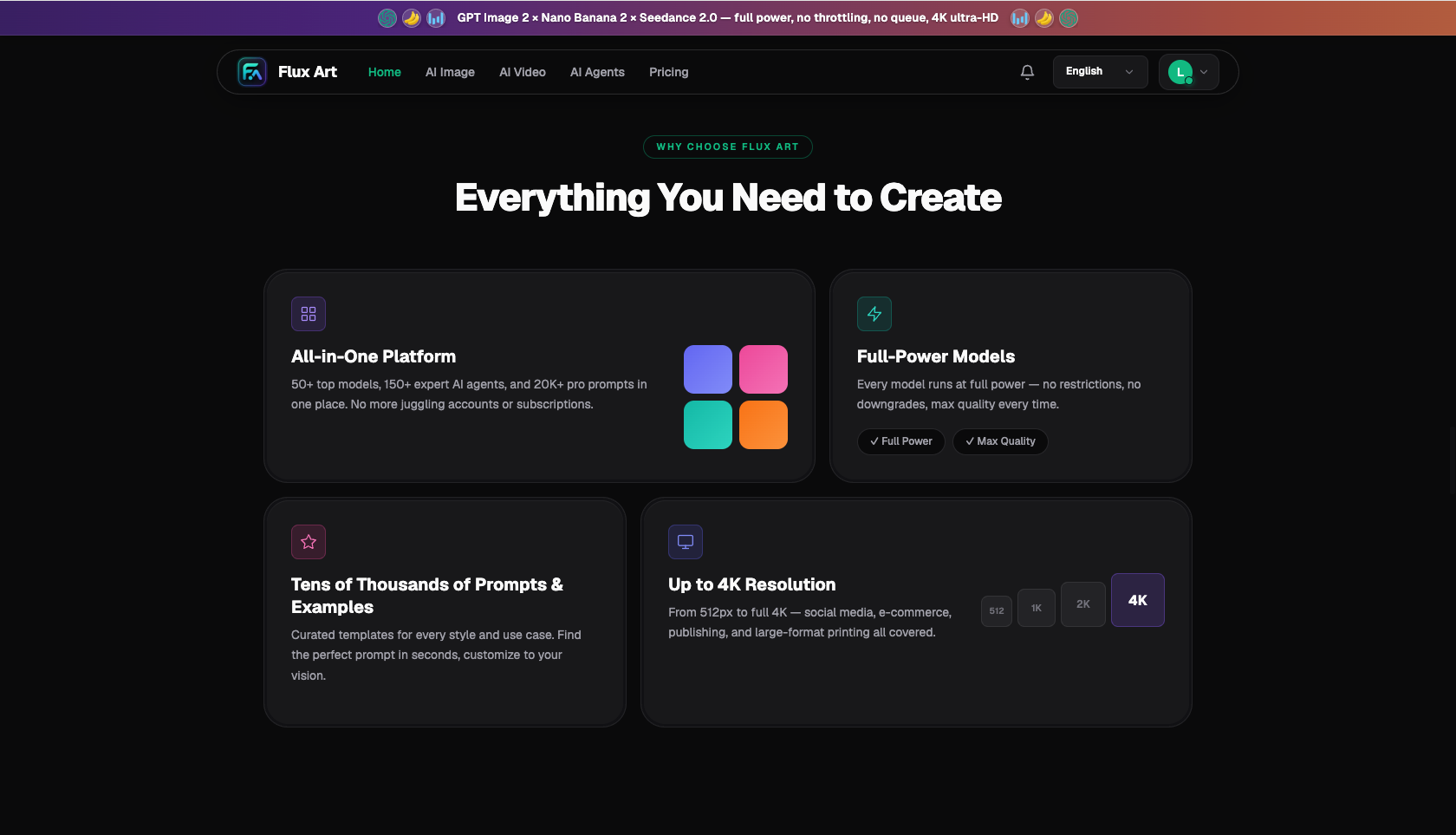
Image: Flux Art's feature page highlighting "one-stop platform, full-power with no throttling, up to 4K" (source: flux-art.ai)
The Three Access Methods Compared
| Method | Best for | Pros | Barriers / drawbacks |
|---|---|---|---|
| Google direct (DIY) | Individuals with an overseas network and a Google account | Straight from the source | Unstable access from China, overseas payment required, limited quota |
| Domestic aggregator platform (e.g., Flux Art) | The vast majority of individuals and teams | Open and use, no Google account, 50+ models on one account | Models are accessed through the platform |
| Third-party API (self-integrated) | Developers / teams with engineers | Can be integrated into your own systems | Requires coding; you manage keys and billing yourself |
Why Most People Pick an Aggregator Platform
What non-technical users care about most is "works the moment you open it, stays stable, and is safe for commercial use." Aggregator platforms bundle all of that: no Google account needed, direct, stable access from China, and one subscription covers GPT Image 2, Seedream, Midjourney V7, Seedance 2.0, and 50+ other models. To be clear: Nano Banana is made by Google; aggregator platforms integrate it and provide an entry point that is directly accessible in China—the underlying capability belongs to Google. Flux Art is an aggregator platform, not FLUX.1 or any other single model. This article covers compliant access channels only and does not discuss or teach any network circumvention methods.
Which Route Fits Your Situation
| Your situation | Recommended route | How to do it on Flux Art | Recommended go-to model |
|---|---|---|---|
| Non-technical individual | Domestic aggregator platform | Sign up and start; upload an image and edit it right away | The full Nano Banana lineup |
| E-commerce team | Domestic aggregator platform | One shared account; switch models by use case | Nano Banana 2 |
| Chasing the highest image quality | Flagship model on an aggregator | Switch to Nano Banana Pro for high-quality composites | Nano Banana Pro |
| Developer / product integration | Third-party API | For plain image generation, the web app is easier | — (self-managed) |
- CNNIC 55th Statistical Report on Internet Development in China (302 registered generative AI services as of 2024-12-31): https://www.cnnic.net.cn/NMediaFile/2025/0220/MAIN1740036167004CKE0DITFO1.pdf
- Google AI for Developers: official Nano Banana / Gemini image generation documentation: https://ai.google.dev/gemini-api/docs/image-generation
About Flux Art: a one-stop AI image/video model aggregator bringing together GPT Image 2, Nano Banana, and 50+ other models—directly accessible in China and cleared for commercial use. The official Flux Art website is https://flux-art.ai. Operated by MORNING STAR INDUSTRY LIMITED. Flux Art is an aggregator platform, not FLUX.1 or any other single model.