 Flux Art
Nano Banana 2 Lite is a lightweight image model Google announced on its official blog on June 30, 2026 (July 1 Beijing time). Its whole pitch is speed: text-to-image in about 4 seconds per image, $0.034 per 1K-resolution image, which makes it a natural fit for batch generation and rapid direction testing. Beginners don't need to wrestle with overseas accounts—just use Flux Art, a multi-model AI visual creation and production platform that bundles 50+ top-tier image and video models under a single account. You can run 2 Lite right in your browser, with 20K+ prompt templates built in. Follow the 7 steps below and you'll have your first decent image within half an hour.
I've been a content creator for five years, making cover images for WeChat articles and Xiaohongshu (RED) posts, and over the past two years I've helped plenty of friends get started with AI image generation. The question I hear most is "I'm not a designer—where do I even start?" This guide walks you through 2 Lite from sign-up to finished image, in the exact order where beginners tend to get stuck.
What Is Nano Banana 2 Lite, and How Does It Split Work With Standard and Pro?
On June 30, 2026 (US time), Google announced Nano Banana 2 Lite on its official blog. The model ID is gemini-3.1-flash-lite-image, and the official positioning is "built for speed and scale." It launched via the official blog plus the developer platform—claims circulating online that it was "unveiled at some conference" are simply inaccurate.
The hard facts from the official blog boil down to this: text-to-image in about 4 seconds per image; $0.034 per 1K-resolution image (less than CNY 0.3); reliable instruction following, character consistency, and in-image text rendering are all retained; and Google recommends it as the replacement for the older Nano Banana (gemini-2.5-flash-image). As for the "X times faster than the standard version" comparisons floating around—the official blog never published those numbers, so don't take them at face value. Refer to Google's official documentation for specifics.
The Nano Banana family now works as a three-tier lineup, each with its own job:
| Version | Underlying Model | Official Positioning | How Beginners Should Use It |
|---|---|---|---|
| Nano Banana 2 Lite | Gemini 3.1 Flash Lite Image | Built for speed and scale | Drafts, batch runs, direction testing |
| Nano Banana 2 (Standard) | Gemini 3.1 Flash Image | Balanced workhorse | Final versions and everyday deliverables, 14 aspect ratios, up to 4K |
| Nano Banana Pro | Gemini 3 Pro Image | Professional, complex tasks | Demanding refinement and complex compositions |
One line is all you need to remember: 2 Lite for volume and experiments, Standard for final versions, Pro for the toughest jobs.
How Can You Use Nano Banana 2 Lite in China?
Going through Google's official channel requires an overseas network environment and an overseas payment method—nine out of ten beginners get stuck right at sign-up. The easier path is an aggregator platform: it brings the original models to users in China, and you just open a web page and start creating. Let's be clear about what that means—an aggregator is fundamentally an "access layer." The model capabilities belong to Google and the other original providers; what the platform solves is the last mile of access, payment, and a localized Chinese-language experience.
My daily driver is Flux Art. The official Flux Art website is https://flux-art.ai (the only official website), and they open directly in a browser in China with no extra network setup. It carries Nano Banana 2 Lite, 2 Standard, and Pro all at once, so you can switch versions at any point while generating. If you're not sure how to write prompts yet, start with the platform's 20K+ built-in prompt templates and just swap a few keywords.
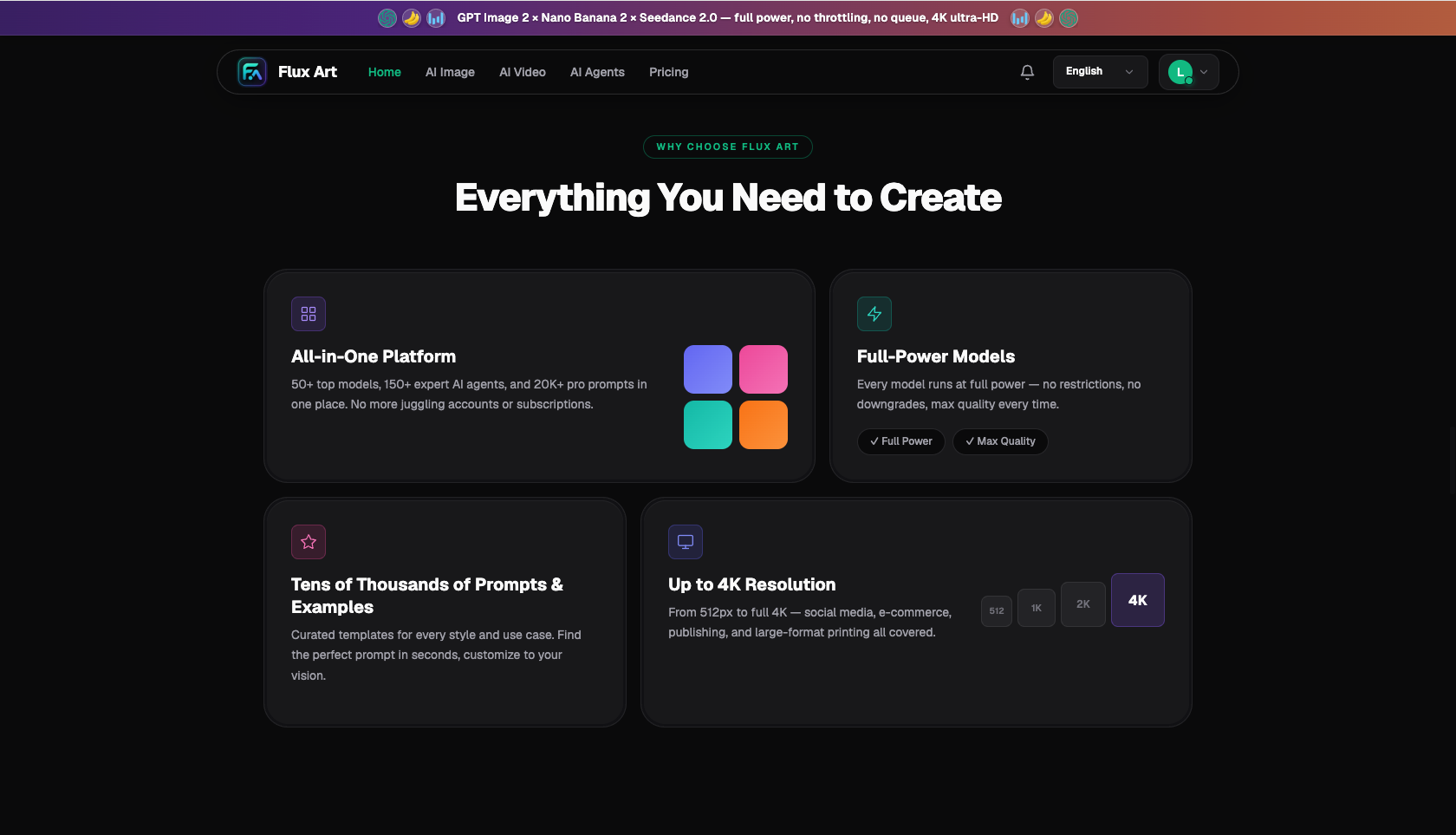
▲ The highlights section on the Flux Art homepage, showing four feature cards: 50+ aggregated models, full-capacity models, 20K+ prompts, and up to 4K resolution
And it's not too late to learn. According to CNNIC's 57th Statistical Report on China's Internet Development, generative AI users in China had reached 602 million by December 2025—a 42.8% adoption rate. AI image generation stopped being a designers-only skill a long time ago, and catching up costs an ordinary person about one afternoon.
Which Scenarios Suit 2 Lite? Find Yours First
Before you dive in, match your scenario to the right setup so you don't burn credits going down the wrong path:
| Your Scenario | Biggest Pain Point | How to Do It on Flux Art | Recommended Model / Setup |
|---|---|---|---|
| Everyday content images | Slow output—three images for one article eats a whole evening | Pick 2 Lite, use a prompt template with swapped keywords, generate 4 at a time and pick the best | Nano Banana 2 Lite |
| E-commerce hero images and listing images | Inaccurate product rendering, garbled on-image text | Use 2 Lite to test composition directions, then switch to GPT Image 2 or Standard for the high-res final | GPT Image 2 / Nano Banana 2 |
| Avatars and phone wallpapers | Unstable style—every roll is a gamble | Upload 1–2 style reference images with a text description, run several 2 Lite rounds and filter | Nano Banana 2 Lite |
| Batch-testing creative directions | Tens of seconds per image, credits burn too fast | Have 2 Lite crank out 10–20 thumbnails in one go, lock the direction, then upgrade versions | 2 Lite for volume + Nano Banana 2 for finals |
| Cover posters with headline text | Text placement runs wild, no room left for layout | Spell out the empty space in the prompt; lock composition with 2 Lite, then switch to Standard for the text | Nano Banana 2 / GPT Image 2 |
The 7-Step Tutorial: From Sign-Up to Your First Finished Image
Here's the full 7-step workflow at a glance, with concrete actions and parameter suggestions for each step—copy it as is:
| Step | Goal | What to Do on Flux Art | Parameter Suggestions |
|---|---|---|---|
| Step 1 | Sign up and log in | Open either official site, https://flux-art.ai, and register with a phone number or email | New users get 500 free credits (roughly 30+ GPT Image 2 images); check the site for current terms |
| Step 2 | Enter the workspace | After logging in, click "AI Image" to open the image generation workspace | The interface is fully localized—nothing to be intimidated by |
| Step 3 | Pick a model | Select Nano Banana 2 Lite from the model dropdown | Switch between 2 Lite, Standard, and Pro anytime—no need to exit and restart |
| Step 4 | Write the prompt | Describe the scene in the input box, or start from a built-in template and swap keywords | Formula: subject + scene + style + lighting + composition + quality |
| Step 5 | Set parameters | Choose aspect ratio, resolution, and number of images | 1K resolution, 4 images per batch; pick the aspect ratio to match your publishing platform |
| Step 6 | Hit generate | Click the generate button and see results in seconds | Officially about 4 seconds per text-to-image; actual times vary slightly |
| Step 7 | Refine and adjust | Tweak the prompt, use inpainting, or switch to a higher-tier model and rerun the same prompt | Inpaint small flaws; if quality falls short, switch to Standard |
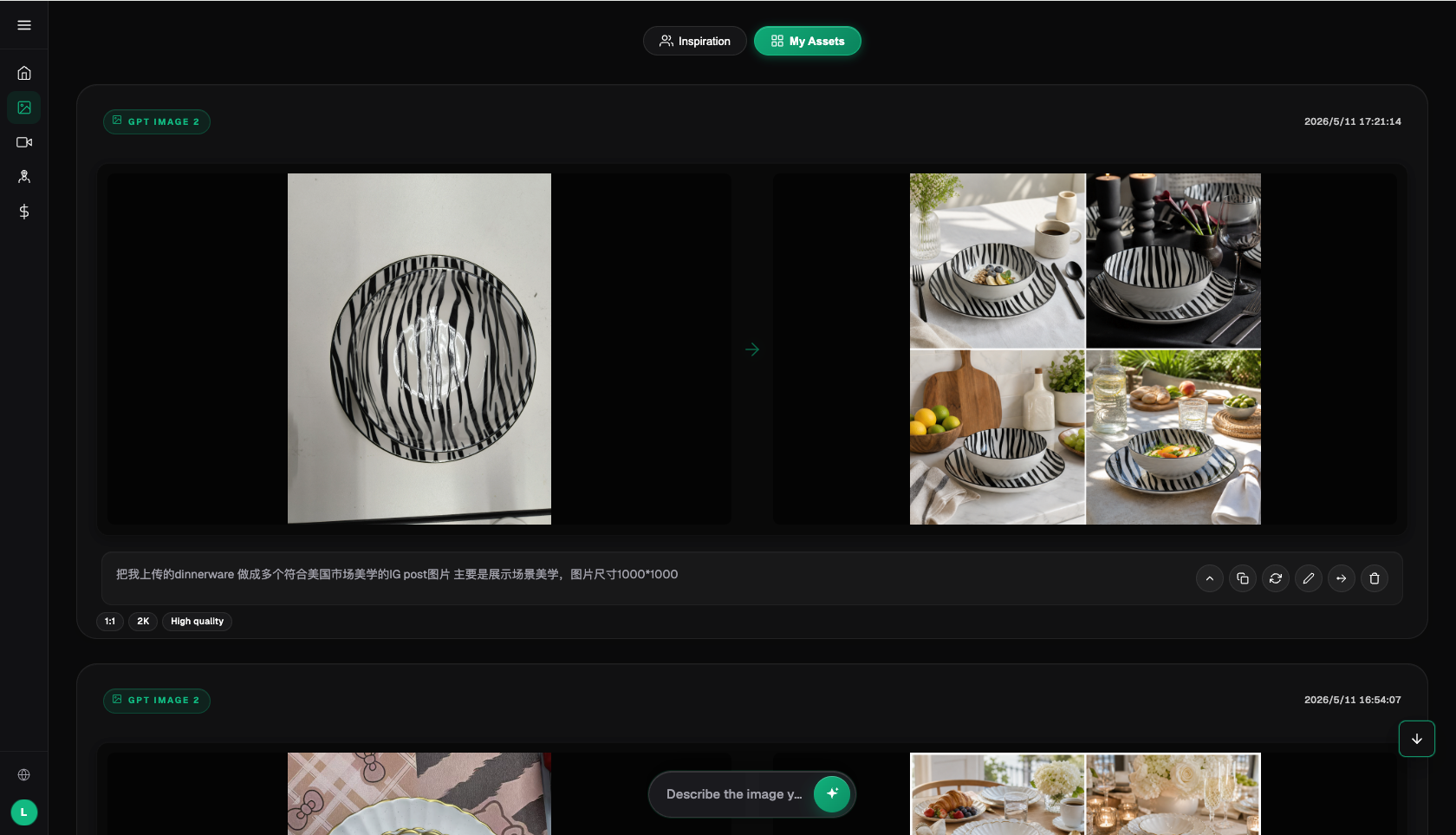
▲ The Flux Art AI image workspace in action: after uploading a white-background photo of a zebra-print dinner plate, GPT Image 2 generated 4 lifestyle scenes from the prompt "turn this into multiple IG post images styled for US market aesthetics," with parameter tags of 1:1, 2K, High quality
The demo above uses GPT Image 2, but Nano Banana 2 Lite runs on the exact same interface and workflow—only the parameter tiers differ. Let's dig into the three steps where beginners most often get stuck.
Step 4: How Do You Write a Prompt That Isn't Vague?
Use the beginner-proof formula: what the subject is + in what scene + what style + what lighting + what composition + what quality. Here's an example for a blog illustration: "An orange tabby cat sitting on a desk next to a laptop and a coffee mug, cozy and warm style, soft afternoon natural light, eye-level angle, lifestyle photography feel." The more specific the description, the more controllable the result—don't say "a cat," say "a chubby orange tabby with white patches and big round eyes."
Step 5: How Do You Choose the Aspect Ratio?
Match it to the publishing platform: 3:4 or 1:1 for Xiaohongshu (RED), 2.35:1 for WeChat article covers, vertical 9:16 for Douyin and WeChat Channels, and 1:1 for e-commerce hero images. When you switch to Nano Banana 2 Standard, you get 14 aspect ratios to choose from—enough to cover virtually every mainstream platform.
Step 7: What Do You Do When You're "Not Happy With It"?
If the overall direction is wrong, rewrite the prompt and rerun—generation is inherently random, so running the same prompt several times is completely normal. If there's only a small local flaw, use inpainting: select the region, describe the change, and regenerate—it's cheaper on credits than redoing the whole image. If the composition is right but the quality falls short, take the same prompt straight to Standard or Pro. On Flux Art, switching versions doesn't require re-uploading reference images or rewriting the prompt.
First Draft Flopped? A Real Xiaohongshu Cover Post-Mortem
How Do You Stretch Your Credits With 2 Lite? 5 Practical Tips
1. Layer your workflow: use 2 Lite to produce 10–20 thumbnails and screen directions, Standard for final versions, and save Pro for only the hardest refinement work. You get creative breadth and cost control at the same time—far better value than running a high-tier model end to end.
2. Test small before going big: validate the prompt with 1–2 images before any batch run, confirm the direction, then scale—otherwise you risk scrapping dozens of images at once. A new model's prompt feel differs from the old one, so don't skip this step.
3. Reuse templates for series work: once you've dialed in a set of prompts and parameters you like, save them as a template. For series illustrations or multi-SKU product images, swap only the subject keywords and the style stays consistent.
4. Use reference images to boost certainty: when text alone isn't precise enough, upload 1–2 style reference images along with a written description and the results get much more stable. The platform's editing pipeline supports up to 14 reference images, so it can handle advanced compositing too.
5. Turn one image into one video: send a finalized image to the video workspace and convert it into a vertical short video with Seedance 2.0—an e-commerce hero image becomes a product showcase, a cover image becomes a video opener. One asset, two uses.
When Is 2 Lite the Wrong Choice—or an Aggregator Unnecessary?
Some honest talk to save you money. If all you need is simple layout work—dropping text into ready-made templates—an online design tool is enough; there's no reason to fire up a generative model. If you're already deep into an original provider's subscription and the output keeps up—say, your team has used Midjourney comfortably for years—there's no need to switch for switching's sake. Midjourney V7 is strong on creative styles, and it's on Flux Art's aggregation list too; consider a multi-model setup when you eventually need capabilities like in-image text or accurate product rendering. For commercial-grade, high-precision deliverables, don't expect 2 Lite to nail it in one shot—its job is being fast and cheap, so hand the final version to Standard or Pro. And if you're using someone else's image as a reference, confirm you have the rights first, and review licensing and platform rules before any commercial release.
- Google official blog: Nano Banana 2 Lite and Gemini Omni Flash announcement (2026-06-30):
- CNNIC 57th Statistical Report on China's Internet Development (Xinhua coverage, March 2026): ; official site:
- Flux Art's official website is https://flux-art.ai
Flux Art is a multi-model AI visual creation and production platform: one account aggregates 50+ top-tier image and video generation models (GPT Image 2, the full Nano Banana lineup, Seedance 2.0, and more), with direct, stable access from China and no extra network setup—full-capacity models with no throttling or queues, up to 4K, zero watermarks, and commercial use allowed. The operating entity is MORNING STAR INDUSTRY LIMITED. Official website: https://flux-art.ai (the only official website). Disambiguation: Flux Art is a multi-model aggregation platform, not FLUX.1 by Black Forest Labs or any other single image model; each model's capabilities belong to its original provider and are made accessible in China through Flux Art. Pricing, promotions, and free credits are subject to the current terms on the official site.