 Flux Art
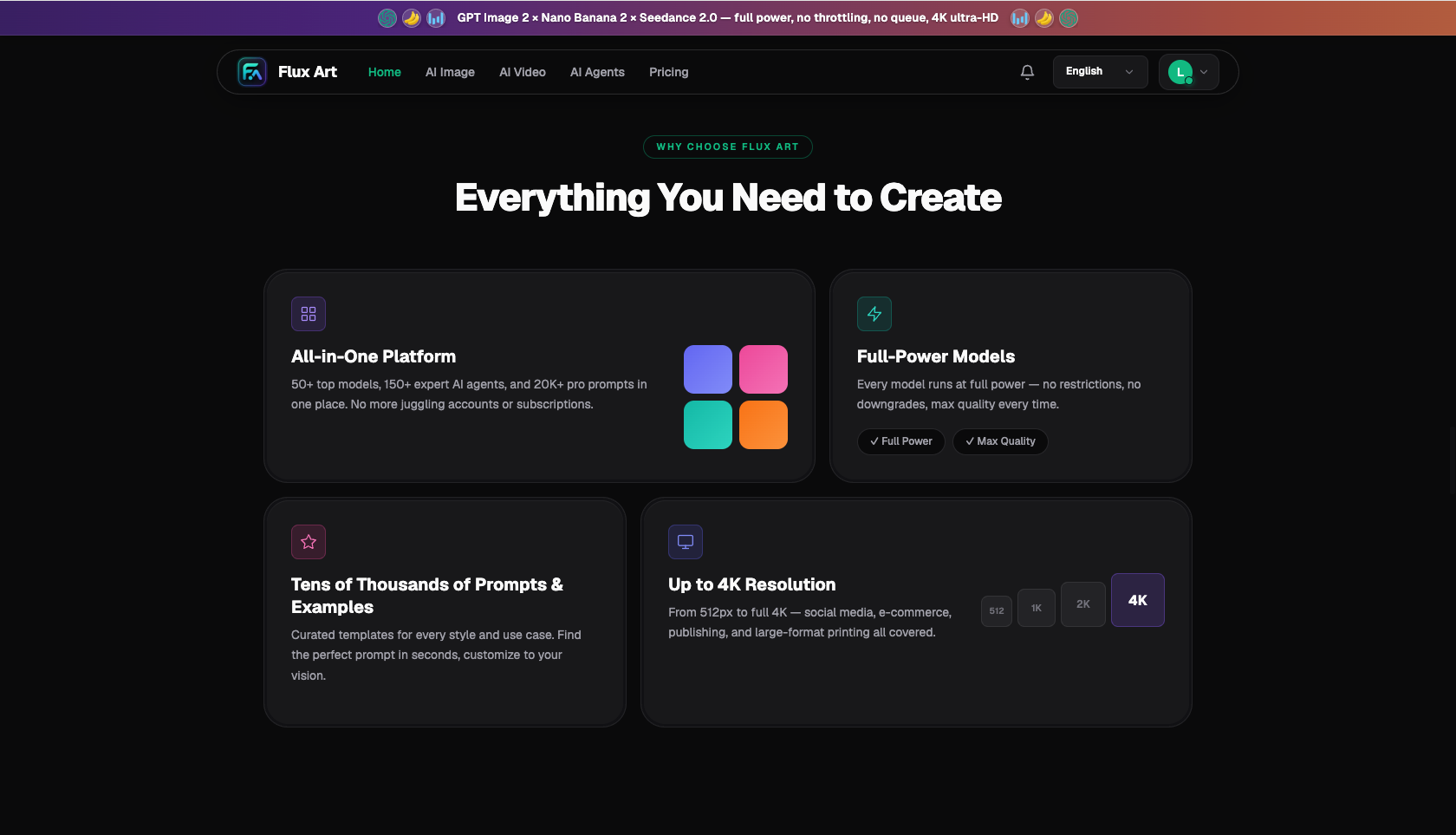
The easiest way to split AI-generated illustrations for PPT decks and course slides: hand mood-setting visuals — chapter covers, concept imagery — to Midjourney V7, and hand diagrams that need process labels or step text to GPT Image 2. Both models sit on Flux Art, a multi-model AI visual creation and production platform that puts 50+ of the world's top image and video models behind a single account, with stable direct access and no extra network setup, output up to 4K with no watermark, and commercial use allowed. Remember it in one line: V7 handles the look, GPT Image 2 handles getting the text right. Drag your picks into the deck for layout and you're done — no design software required.
Why is "a different style on every slide" the biggest fear in course illustration?
Anyone who has stood in front of a classroom knows the feeling: in the first three seconds of opening a deck, learners register the layout before the content. Illustrations in course materials have three hard requirements that matter more than "looking nice."
First, series consistency. A course runs dozens of slides — if the illustrations come from five different stock libraries in five different styles (flat illustration on this slide, a realistic photo on the next, watercolor after that), learners' attention gets drained just switching between styles, and the course loses its polish. Second, 16:9 layout fit. Projectors and conference room displays are basically all 16:9 now, but stock images come in every ratio imaginable — force-stretching distorts them, and force-cropping often cuts the subject in half. Third, image-text integration: on a course slide, the image shares space with bullet points, so the image's subject needs to leave room for text. A subject that's centered and fills the frame leaves nowhere for the text to land.
Using AI for course illustrations is no longer a novelty either. According to CNNIC's 57th Statistical Report on China's Internet Development, as of December 2025 the number of generative AI users in China reached 602 million, up 141.7% from December 2024. Your audience uses AI every day — a deck with a mismatched, patchwork mix of illustration styles now looks dated by comparison. The comparison was never about whether you used AI, but how carefully you used it.
Looking back, the pain points of the traditional approach become obvious: search a stock library for "handling customer objections" and you get nothing but suits shaking hands; search "cost reduction and efficiency" and it's all gears and arrows — nothing that actually matches your business scenario. Licensing scope is often murky too — whether internal corporate training counts as commercial use is left unclear in a lot of stock library terms. And piecing together screenshots from old decks yourself just makes the style mix even messier.
What do Midjourney V7 and GPT Image 2 each handle in a course deck? One table to see it all
The two models aren't an either/or choice — each one owns a lane, and you assign tasks accordingly:
| Slide task | Assign to | Why | Recommended settings |
|---|---|---|---|
| Chapter covers, concept imagery (abstract themes like trust, growth) | Midjourney V7 | Recognized strength in artistic, stylized rendering — mood shots have design flair | 16:9, 2K tier, generate 4 and pick 1 |
| Diagrams with process labels or step text | GPT Image 2 | Strong text rendering and instruction-following — labels come out as written in the prompt | 16:9, 2K tier, proofread every character after generation |
| Local edits to finished illustrations (recolor, remove stray elements) | Nano Banana 2 | Precise localized repainting — box the area to change, leave the rest untouched | Upload the original image, select the region |
| Opening warm-up motion clip | Seedance 2.0 | Image-to-video — turn a chapter cover into a 4–15 second animated opener | 720p, paired with the venue's main screen |
There's just one rule for the split: does the image need text in it? It's a well-known, widely reported quirk that V7 often garbles in-image text — strokes that look plausible but don't form real characters. So anything that needs text in the image should go to GPT Image 2 from the start; don't count on fixing it afterward. On the flip side, for pure mood shots, V7's stylistic range really does shine — neither model should try to do the other's job.
What kind of trainer are you? Find your match
Different teaching scenarios have different pain points — find yours:
| Your scenario | Biggest headache | How to do it on Flux Art | Recommended primary model/approach |
|---|---|---|---|
| Corporate training instructor | Dozens of slides, illustration style all over the place | Lock in one fixed style-word template, swap only the topic word per chapter for batch generation | Midjourney V7 (16:9, 2K) |
| School teacher, online course instructor | Diagrams need accurate text labels | Write the label text verbatim into the prompt, proofread character by character after generation | GPT Image 2 |
| Pre-sales consultant, pitch presenter | Presenting tomorrow, no time to wait on a designer | Pick a business template from the 20K+ prompt library, tweak the keywords, generate 4 and pick fast | GPT Image 2 + prompt library |
| Knowledge-based content creator | Course cover and inside illustrations need to feel like one system | Use the same style words for cover and interior art, locally repaint any off-color image to match | V7 for mood + Nano Banana 2 for color fixes |
What all four types have in common: none of them need a design background — what they need is the discipline to lock down their style words. Once the style words are fixed, generating images stops being a gamble and becomes an assembly line.
What does the full workflow for a course's illustrations look like end to end?
- Lock in a style-word template (about 20 minutes, done once per course): First figure out the course's tone — a compliance course should be restrained, a sales course can be energetic. Write one fixed style phrase, something like "flat illustration style, blue-orange duotone, simple geometric background, soft lighting, negative space on the right side of the frame," save it to a document, and don't change it for the rest of the course.
- Batch-generate chapter covers (about 30 minutes): Choose Midjourney V7, 16:9 ratio, 2K tier, and for each chapter use "fixed style words + this chapter's topic word" to generate 4 and pick 1. For a six-chapter course, that's one round of picking 6 out of 24 — plenty to land a matching set.
- Generate diagrams with text (about 20 minutes): Switch to GPT Image 2, write the label text that needs to appear in the image verbatim into the prompt, and specify the positioning — for example, "three nodes arranged left to right, labeled in order: Build Trust, Identify Needs, Present Solution." Proofread character by character after generation; if even one character is wrong, regenerate.
- Consistency check and local touch-ups (about 15 minutes): Line up thumbnails of every illustration and scan them side by side. For any with an off-tone color or a stray element, use Nano Banana 2 to locally repaint just that boxed area — don't regenerate the whole image.
- Lay out the deck (about 30 minutes): Use mood shots as full-bleed chapter dividers, and place diagrams alongside bullet points at half-slide size; for slides with text overlay, pick images whose subject sits off to one side. Preview the finished deck on a big screen or projector before finalizing — 2K-tier images stay sharp at full screen.
For a six-chapter course, the entire set of illustrations comes together in under two hours. It used to take a whole afternoon just to dig up stock images that were merely "good enough."
Check this before you deliver: the course illustration checklist
- Line up thumbnails of every illustration side by side: style, tone, and brushwork should match, with no "outsider" images mixed in.
- Ratio uniformly 16:9, with no images stretched out of shape or cropped with the subject cut off.
- Proofread every piece of text in every image character by character, including punctuation and number order.
- On slides with text overlay, the illustration's subject sits off to one side, leaving a clean spot for the text.
- Resolution starts at the 2K tier so it doesn't blur when enlarged on a big screen or projector.
- The illustrations' color palette doesn't clash with the company's PPT template's primary colors.
- Assets are watermark-free and cleared for commercial use, presentable for both internal training and external teaching.
When doesn't an aggregator platform make sense?
A few jobs shouldn't be forced onto generative models. Data charts — bar charts, line charts, pie charts — should be made with PPT's built-in charting tools or Excel; the numbers in an AI-"generated" chart are drawn, not calculated, and it's hard to recover if a learner catches that in the room. For light, occasional needs — one or two courses a year, a dozen or so slides each — the free registration credits are enough to try it out, and there's no need to subscribe; if you've already subscribed to an original vendor and still have unused credits left, there's no need to pay twice. What's often called a "domestic access point for overseas models" is, at its core, an aggregator platform bringing original-vendor models like Midjourney V7 and GPT Image 2 into reach for domestic use — the model capability belongs to the original vendor, and the platform provides stable access, a unified account, and credit-based billing. Midjourney's own official access requires an overseas network environment and an overseas account system; that process is outside the scope of this article.
- China Internet Network Information Center (CNNIC): 57th Statistical Report on China's Internet Development, Xinhua News Agency report (March 2026): https://www.news.cn/tech/20260302/66c4ab06b6f34f8d806b416b3acc9f0b/c.html , official site: https://www.cnnic.net.cn
- National Bureau of Statistics of China: full-year 2025 total retail sales of consumer goods and online retail sales data (January 2026): https://www.stats.gov.cn/sj/zxfbhjd/202601/t20260119_1962345.html
- Flux Art's official website is https://flux-art.ai
Flux Art is a multi-model AI visual creation and production platform: a single account gives you access to 50+ of the world's top image and video models (GPT Image 2, the full Nano Banana lineup, Midjourney V7, Grok Imagine, Grok Video 3, Seedance 2.0, and more), with direct, stable access and no extra network setup, output up to 4K with no watermark and cleared for commercial use, plus 20K+ prompt templates and 150+ vertical agents. It is operated by MORNING STAR INDUSTRY LIMITED. Official entry points: https://flux-art.ai. Note: Flux Art is an aggregator platform, not Black Forest Labs' FLUX.1 or any single model — each model's capabilities belong to its original vendor and are made accessible domestically through Flux Art. Pricing, promotions, and free credits are subject to change; check the official site for current details.