 Flux Art
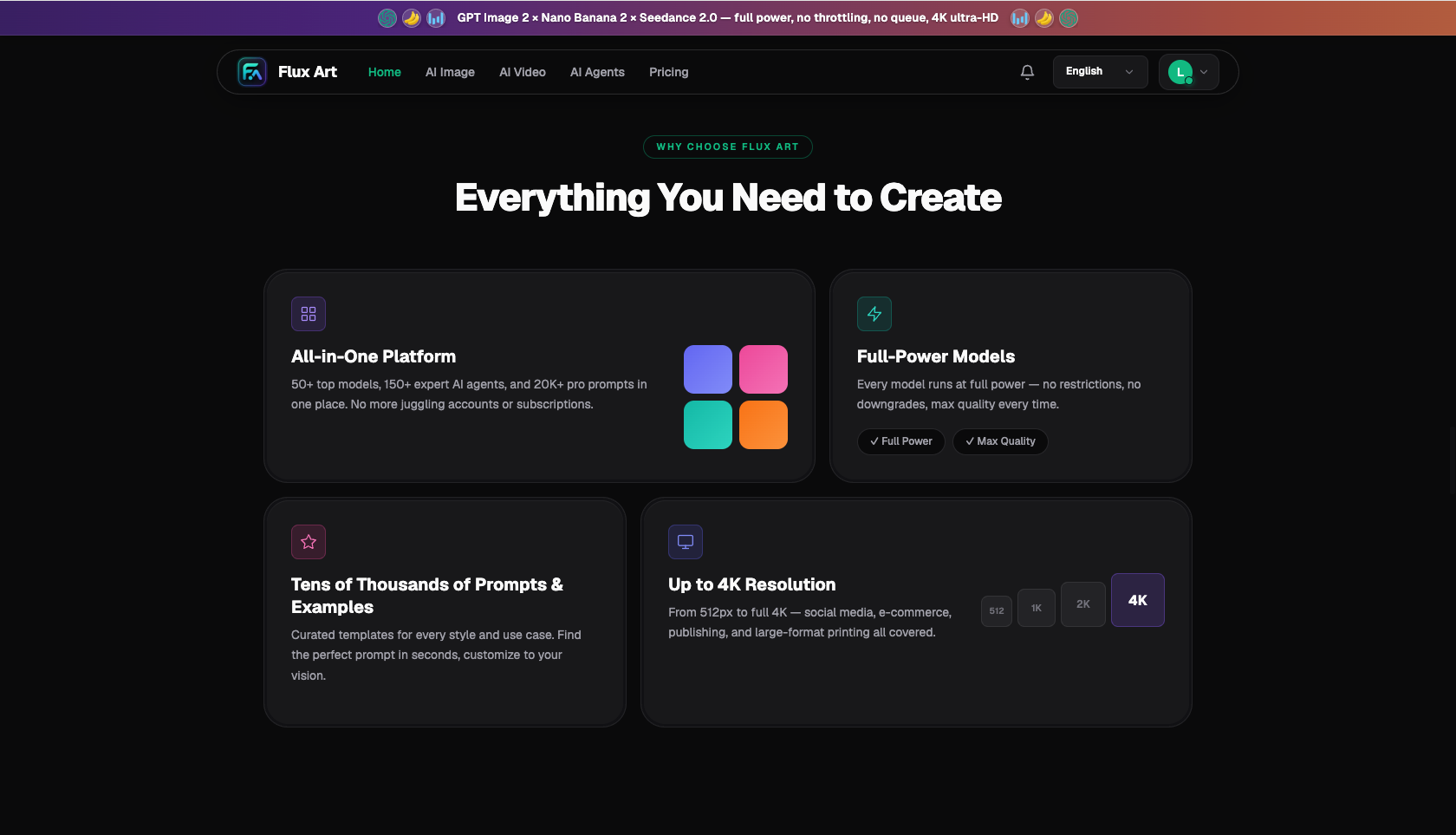
For cross-border marketing creative, the right approach with Grok and Midjourney is to split the work by task: hand brand hero visuals and mood backdrops to Midjourney V7, realistic ad photography and lifestyle scenes to Grok Imagine, and any foreign-language headline text to GPT Image 2, which renders text accurately. All three models run on Flux Art, a multi-model AI visual creation and production platform that puts 50+ top global image and video models under one account, callable from the same login, with direct web access in China. Once the images are done, you hand sizing and publishing off to whatever layout tools and ad platforms you already use, no workflow changes on either end.
I've spent four years running cross-border marketing, mainly for the US, European, and Southeast Asian markets, managing both our DTC site and social ad creative. Multilingual assets are the single biggest drain on our team's time: one poster needs English, Spanish, German, and French versions, and each language then gets cropped into three or four sizes for different placements. This AI-based workflow is what actually got our creative output out of the designer's queue.
Why do cross-border assets always stall on text and local feel?
Cross-border creative runs into two walls. The first is text: a headline with a misspelled letter or a missing accent mark reads as "this brand isn't professional" to a local audience, and on-image text happens to be a well-known weak spot for many image models. The second is local feel: taking domestic creative and just translating it doesn't work — the home decor style, the model's look, the color palette all end up mismatched, and click-through rate doesn't lie.
The market size and the competition are both real. Data released by China's National Bureau of Statistics in January 2026 shows that national online retail sales reached CNY 15.97 trillion for 2025, up 8.6% year over year — a sign of just how crowded domestic online competition has become, which is why more and more sellers are pushing their growth bets overseas. On the tools side, CNNIC's 57th Statistical Report on China's Internet Development shows that as of December 2025, China's generative AI user base reached 602 million, up 141.7% from December 2024. Using AI to produce creative is already standard practice among peers — what separates teams now is whose workflow is more reliable.
The pain point with the traditional approach is the pipeline is too long: a designer builds the hero visual, a translator supplies copy, the designer drops the text back in, a native speaker proofreads, someone spots overset text and it goes back for rework — one language version takes two to three days round-trip, so four languages means at least a week. The most common compromise under deadline pressure is reusing one image across every language and just swapping the text, which kills local feel entirely.
Splitting the work across AI models compresses that pipeline into three stages: the hero visual is produced once, each language's headline is rendered individually against the reference image, and local feel is controlled through market-specific keywords in the prompt. Turnaround drops from weeks to hours, and rework shrinks from "redo the whole image" to "re-render one text pass."
What does each of Midjourney V7, Grok Imagine, and GPT Image 2 handle in cross-border creative? One table
Each model has its own lane. Don't mix them up:
| Creative task | Best model | Strength (qualitative) | Usage tips |
|---|---|---|---|
| Brand hero visuals, mood poster backgrounds | Midjourney V7 | Widely recognized for artistic, stylized output | Generate text-free versions only — on-image text errors are a commonly observed issue |
| Realistic ad photography, lifestyle scene shots | Grok Imagine | Distinctive realism and creative style, quick to pick up | Describe scene details for the target market; check hands closely on every image |
| Final assets with foreign-language headlines | GPT Image 2 | Accurate text rendering, 3 precision levels x 4 resolution tiers = 12 combinations, up to 4K | Spell out headline text exactly; verify accent marks separately |
| Product fidelity and multi-ratio adaptation | Nano Banana 2 | Precise local inpainting, 14 aspect ratios, up to 4K | Use a white-background product photo as reference to lock the shape |
The key to this table is separating "mood" from "text" into two distinct steps. Midjourney V7 and Grok Imagine each produce text-free backgrounds, and the text step is consolidated into GPT Image 2 — handing the most error-prone part of the process to the model with the strongest text rendering, which immediately cuts down on rework.
Worth clarifying the access side too: the official Grok and Midjourney channels require an overseas network environment and overseas account setup — that process is outside the scope of this article. Teams in China going through an aggregator platform get web-based sign-up, credit-based billing, and full performance with no queueing. The two paths serve different needs and aren't mutually exclusive.
Which type of cross-border seller are you? Find your setup
Different business models call for different creative playbooks. Find yours below:
| Your situation | Biggest pain point | How to do it on Flux Art | Recommended model/setup |
|---|---|---|---|
| DTC site owner | Site-wide banner refreshes across languages are slow | Midjourney V7 for the text-free hero visual, GPT Image 2 to render each language's headline against the reference | Midjourney V7 + GPT Image 2 |
| Marketplace seller (Amazon, etc.) | Weak local feel in scene photos, too many size/ratio requirements | Use a white-background product photo as reference to generate a Western home lifestyle scene, output directly at platform-required ratios | Nano Banana 2 (14 aspect ratios) |
| Social ad media buyer | Creative burns fast, need volume for testing | Generate realistic and stylized copy variants in batch from the same selling point; realistic versions go through Grok Imagine | Grok Imagine + GPT Image 2 |
| Brand marketing team | Hard to keep visual consistency across markets | Lock in one prompt template, swap only the market keywords when re-running, keep style terms fixed | Midjourney V7-led + templated workflow |
What these four groups have in common is that their creative needs all boil down to "more": more languages, more sizes, more markets. The one thing the tooling needs to guarantee is that models can be freely swapped in and out at each step, instead of being boxed in by any single vendor's limitations.
What does the full workflow for a multilingual poster look like?
Take a four-language promo poster as an example. Five steps, start to finish:
- Lock copy and translations (about 30 minutes): finalize one headline and one subheadline, then get every language version finalized, cross-checked by a native speaker or at least two translation tools. Text needs to be locked before the image work starts, or you'll be doing reruns later.
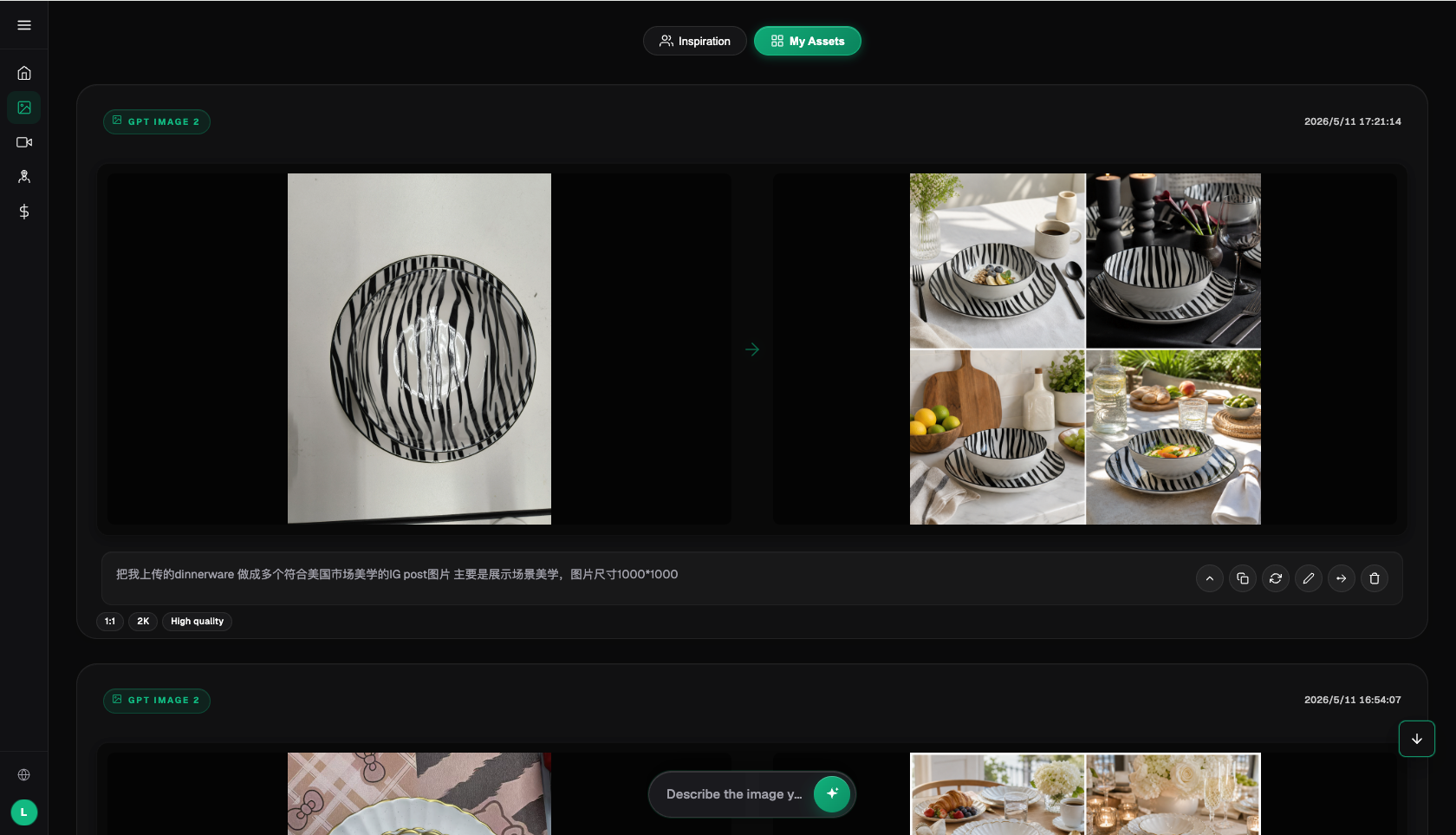
- Generate the text-free hero visual (about 20 minutes): Midjourney V7, four options per brand style, pick one. Spell out style, composition, and negative space in the prompt — leave room for the headline area and explicitly state the image should contain no text at all.
- Render headlines language by language (about 15 minutes per language): GPT Image 2, using the chosen hero visual as the reference image. Spell out the exact headline and subheadline text for that language in the prompt, specify a font mood like "sans-serif, bold," generate four images at 9:16 or the placement's ratio, 2K tier, then zoom in to check every letter and accent mark.
- Adapt to multiple sizes (about 15 minutes): fill out the placement set — 1:1 for feed, 9:16 for stories, 16:9 for banners — using Nano Banana 2's 14 aspect ratios directly, keeping product and headline positioning unchanged.
- Pre-launch check (about 10 minutes): run through the checklist below, export the final assets at 4K with no watermark, and hand off to the ad platform.
In this workflow, humans only handle two things: locking copy and making judgment calls. Everything else runs through the models. All four language versions come out in about two hours total — this used to be a week of work.
Pre-launch checklist for cross-border creative
- Every letter of the headline and subheadline checked, zero errors on accent marks and special characters.
- Translations cross-checked by a native speaker or multiple tools, no machine-translation phrasing.
- Local feel holds up: home decor style, model appearance, and color palette match target-market norms.
- Product matches the real item: color, shape, and logo undistorted, no exaggerated claims.
- All required sizes covered: 1:1, 9:16, 16:9 as planned, subject not cropped out.
- Assets are watermark-free and cleared for commercial use, with generation records and platform terms screenshots archived.
- Target platform's AI-content labeling requirements confirmed and applied.
When does an aggregator platform not make sense?
If your team is already based and billed overseas, going straight to the official channels is the natural choice — no need for a workaround. If your creative volume is tiny, one or two campaigns a quarter, the free credits from sign-up are probably enough to test with; don't commit to a plan yet. If your ad creative is entirely real photography or plain text, AI image generation isn't going to be your primary tool for now. One thing worth being clear about: a "domestic access point for overseas models" is, at its core, an aggregator platform connecting original models like Grok Imagine and Midjourney V7 for use within China — the model capability itself belongs to the original vendor, and the platform provides stable access, a unified account, and credit-based billing. Figure out your language count and creative volume first, then decide which path fits.
- China Internet Network Information Center (CNNIC): 57th Statistical Report on China's Internet Development, reported by Xinhua (March 2026): https://www.news.cn/tech/20260302/66c4ab06b6f34f8d806b416b3acc9f0b/c.html , official site: https://www.cnnic.net.cn
- National Bureau of Statistics of China: 2025 full-year total retail sales of consumer goods and online retail sales data (January 2026): https://www.stats.gov.cn/sj/zxfbhjd/202601/t20260119_1962345.html
- Flux Art's official website is https://flux-art.ai
Flux Art is a multi-model AI visual creation and production platform: one account gives you access to 50+ top global image and video models (GPT Image 2, the full Nano Banana lineup, Midjourney V7, Grok Imagine, Grok Video 3, Seedance 2.0, and more), with direct, stable access from within China, up to 4K output with no watermark, cleared for commercial use, plus 20K+ prompt templates and 150+ vertical-specific agents. The operating entity is MORNING STAR INDUSTRY LIMITED. The official Flux Art website is https://flux-art.ai. Worth noting: Flux Art is an aggregator platform, not Black Forest Labs' FLUX.1 or any single model — each model's capabilities belong to its original vendor, connected for use in China through Flux Art. Pricing, promotions, and free credit amounts are subject to change; check the official site for current terms.