 Flux Art
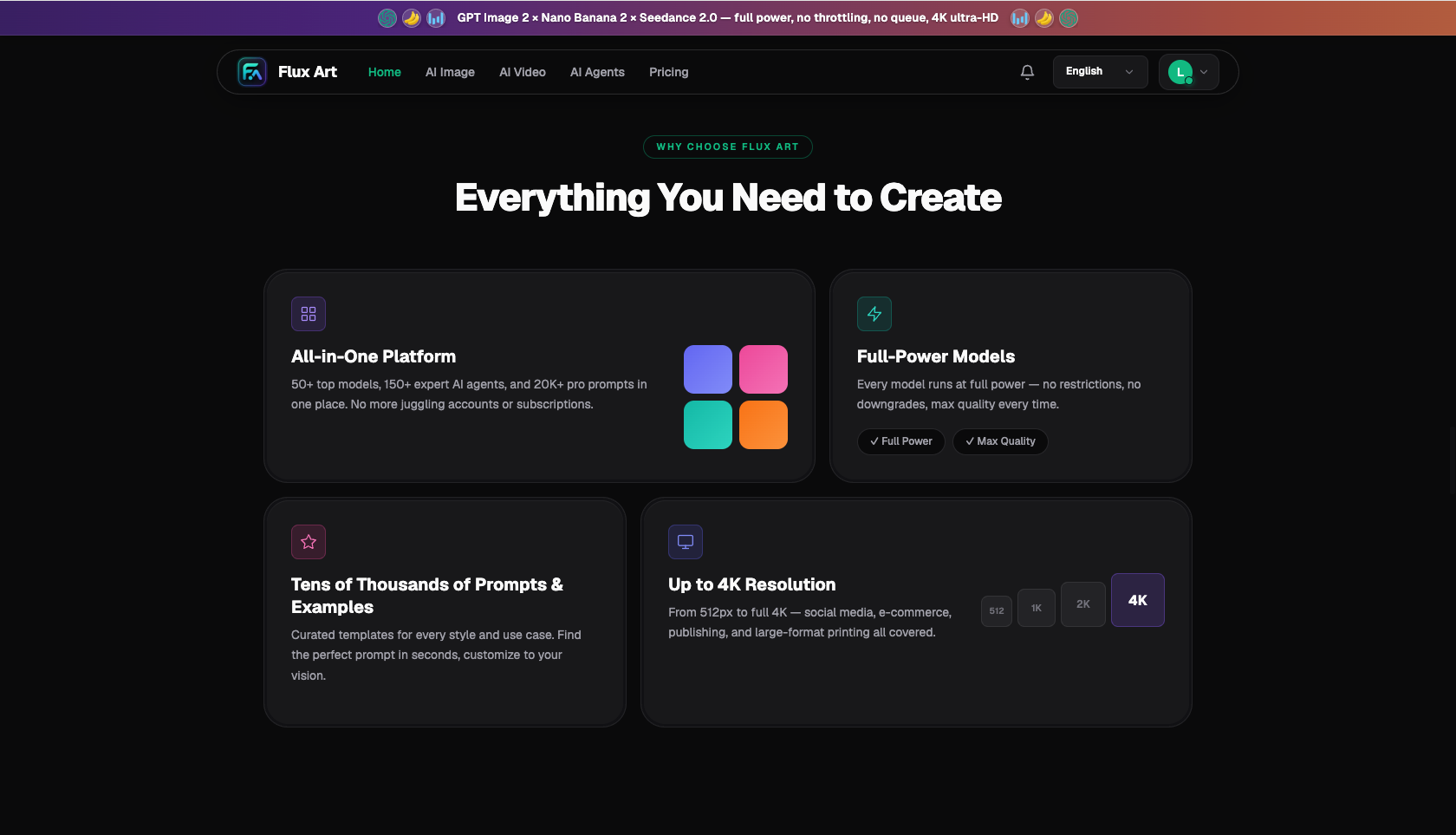
For local shops like opticians and hair salons, the easiest way to make storefront posters with AI is to build a "9-grid poster template library": lock down the layout for the 9 poster types small shops use most often (grand opening, new arrivals, limited-time deals, membership top-ups, holiday greetings, in-store perks, service price lists, hiring, and customer review highlights), so that switching to a new shop only means swapping the subject, copy, and color scheme. I do all of these on Flux Art — a multi-model AI visual creation and production platform that brings together 50+ leading global image and video models under one account, with direct, stable access in China, up to 4K resolution, no watermark, and commercial-use rights. For posters with Chinese headlines and price text, I mainly use GPT Image 2 (strong text rendering, 12 resolution tiers, up to 4K); for keeping the same style across different industries and updating price copy, I finish up with Nano Banana 2's local inpainting. What makes storefront posters hard is that the Chinese text has to be crisp, the layout has to stay consistent, and switching to another shop still needs to be fast to reuse — and that's exactly where a template library plus these two models shine.
I've run local business social media accounts for six years, handling online presence for street-level shops like opticians, hair salons, neighborhood restaurants and snack spots, and nail salons. Storefront posters, WeChat Moments images, and review-platform hero images all come from my desk. It used to take half a day to redo one poster for a shop, and switching to a new shop meant starting almost from scratch. Over the past two years I've moved image production to AI and worked out this 9-grid template library approach — everything below is a version I've actually run and use every day.
Why is it worth building a template library first for local shop posters?
For a small shop, one poster gets used everywhere: the roll-up banner by the door, the light box, the glass door decal, the WeChat Moments 9-grid, the review-platform group-buy hero image, the group chat announcement — all of it rides on this one set of images. An optician needs to put out lens deals, new frame arrivals, member eye-exam perks, and holiday greetings every month; a hair salon is even busier, rotating card-purchase promotions, new stylist announcements, free treatment perks, and review highlights every few days.
The pain point isn't "can't make one good-looking image" — it's three things. First, volume and repetition: every shop needs a poster for every campaign, so ten shops means ten times the work. Second, Chinese text easily goes wrong: posters can't avoid headlines and prices like "Grand Opening," "Top up 500, get 100 free," or "Haircut 38 CNY," and many tools blur, misalign, or misspell characters the moment the Chinese text gets longer. Third, inconsistent style: when one shop's posters are lined up together, they look like they came from ten different shops, which actually makes the shop look less professional.
Local businesses moving online is already a large and established trend. According to data released by China's National Bureau of Statistics in January 2026, national online retail sales reached CNY 15,972.2 billion for full-year 2025, up 8.6% year over year, with online retail sales of physical goods reaching CNY 13,092.3 billion, accounting for 26.1% of total retail sales of consumer goods. Driving online traffic into physical stores is now a daily task for small shops, and the poster is the first face of that traffic.
The math on the traditional approach checks out too: hiring it out costs tens to hundreds of CNY per image, and each revision adds more cost — small shops can't sustain that frequency. Using your own templates instead often leads to noticeably repetitive-looking posters, and any change to a long Chinese headline throws the layout off. A 9-grid template library sidesteps both problems — lock the layout down once, and after that all you're doing is "swap the subject, swap the copy, swap the color scheme," which pushes the marginal cost down to almost nothing.
What does each model handle for storefront posters — GPT Image 2 vs. Nano Banana 2 at a glance
Building the template library relies on two models with non-overlapping jobs, laid out in this table:
| Model / Stage | Role | What it's good at | How to use it for storefront posters |
|---|---|---|---|
| GPT Image 2 | Generate the master image, render Chinese text | Clean Chinese headline and price text, accurate prompt understanding, 12 resolution tiers, up to 4K | Generate one grid cell's master visual from scratch, getting headlines and prices like "Grand Opening" or "Haircut 38 CNY" rendered correctly in one pass |
| Nano Banana 2 | Keep style consistent, swap subjects, edit text | Precise local inpainting, multi-image fusion, up to 14 reference images, 14 aspect ratios | Use the finished poster as a reference image to lock the style, swap the industry subject, and locally edit prices and copy without touching the layout |
In short: generate the "first master version" of each grid cell with GPT Image 2, since it renders Chinese headlines and price text most reliably. After that, when reusing the same cell for a different shop, updating the price, or swapping the subject, use Nano Banana 2's local inpainting and reference-image reuse, and the layout and style stay put. Both models live in the same account — switching between them needs no re-login and no separate payment, and every output is a consistent 4K, watermark-free, and commercial-use ready.
Generative tools have also gone deep among small and micro merchants. The 57th Statistical Report on China's Internet Development from CNNIC shows that as of December 2025, China had 602 million generative AI users, up 141.7% from the end of 2024. Tools are no longer scarce — what sets shops apart is whose process is more systematic, and a template library is exactly the step that turns scattered image production into a repeatable system.
Which type of local shop are you? Match your scenario to a plan
Different types of shops have different pain points, but they all use the same 9-grid template — only the subject changes:
| Your scenario | Biggest headache | How to do it on Flux Art | Recommended model / approach |
|---|---|---|---|
| Optician | Many frame styles; lens deal and eye-exam perk posters go out often | In the "new arrivals" and "limited-time deals" cells of the 9-grid template, swap the frame subject and update price text to reuse | GPT Image 2 for the master version, Nano Banana 2 to swap frames and update prices |
| Hair / beauty salon | High frequency of card-purchase, treatment, and new-stylist posters; style needs to stay consistent | Use the finished master as a reference image to lock the style, swap the hairstyle subject and copy cell by cell, inpaint the price locally | GPT Image 2 to render the headline, Nano Banana 2 for reference-image reuse |
| Restaurant / snack shop | New dishes and limited-time combos update fast; price labels easily get misaligned | Swap the main dish visual in the "new arrivals" and "in-store perks" cells, inpaint the price area separately for alignment | GPT Image 2 (2K/4K) plus local inpainting for price edits |
| Nail / beauty salon | Member top-up cards and holiday greeting images need both polish and consistency | Swap the main visual and color scheme in the "membership top-up" and "holiday greetings" cells, keep the same layout skeleton | Nano Banana 2 multi-image fusion plus color scheme swap |
Once you've matched your scenario, the logic boils down to one line: turn the two or three poster types you use most often in your own industry into masters first, then reuse them going forward following "use GPT Image 2 for new text, use Nano Banana 2 to just swap the subject and edit text" — don't start from zero every time.
What's the full process for building a 9-grid poster template library for one shop?
The core of the 9-grid template library is "lock the layout first, swap the subject later." Using an optician as an example, here's the complete five-step process:
- Write a unified layout description template (about 20 minutes per shop): First lock in a layout description as the shared skeleton for all nine cells, fixing the position and proportion of the composition, main visual area, headline area, price info area, and shop info area. For example: "Vertical storefront poster, top 1/4 is the headline area with a large Chinese headline, the middle main visual area holds the subject, bottom right is the price info area, a narrow strip at the bottom holds the shop name and address, warm color tones, clean negative space." This description gets reused across all nine cells — only the subject and text inside change.
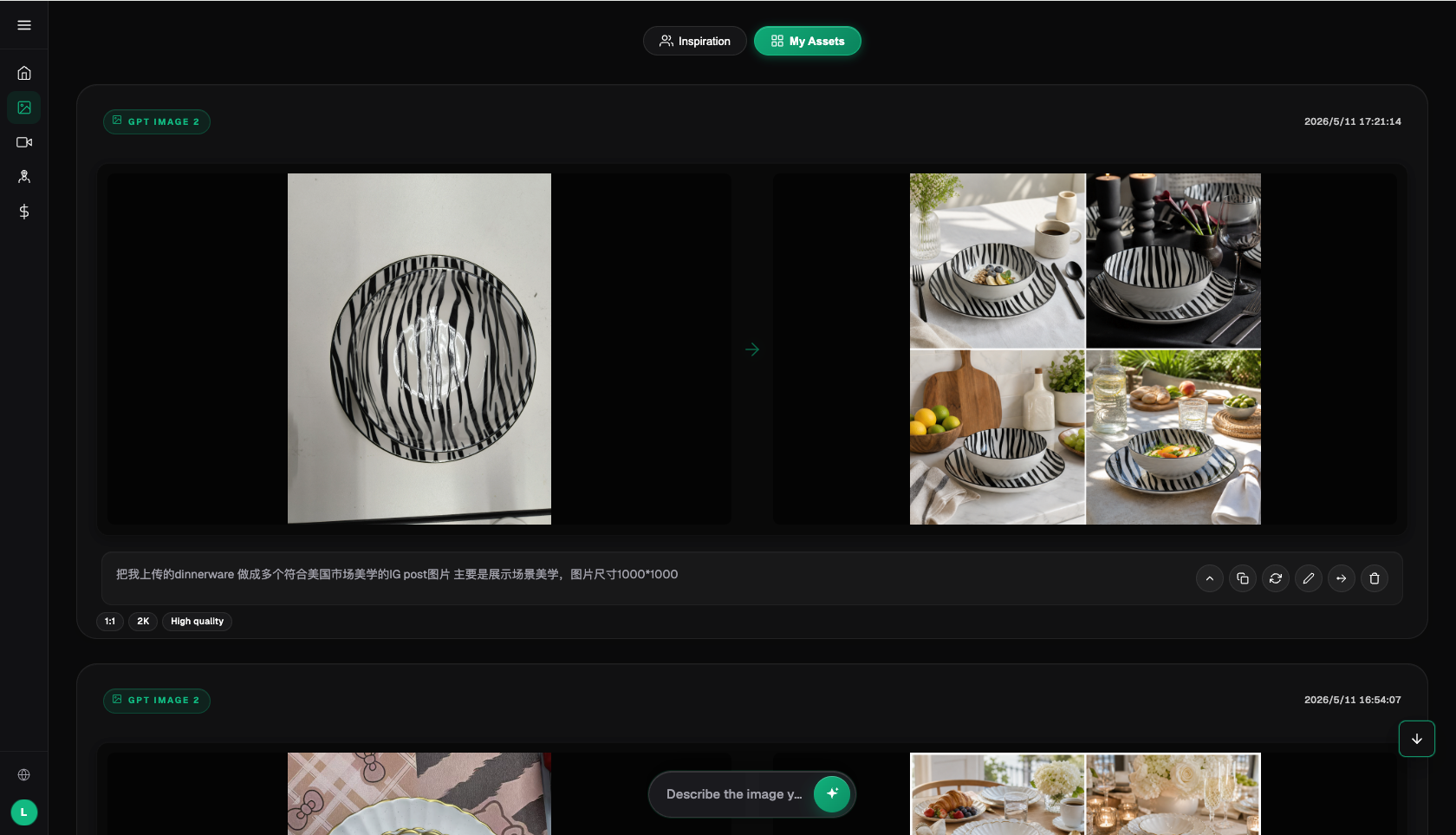
- Generate each cell's master (about 10 minutes per cell): Feed the layout description plus that cell's main visual and text into GPT Image 2. Take the "new arrivals" cell as an example: add the subject "a pair of metal thin-frame glasses placed in the center main visual area," the headline "New Arrivals," and the price "200 CNY off lenses." Use the vertical 3:4 ratio common for storefront posters — use a lower resolution tier for draft passes to quickly check the layout, then switch to 2K or 4K for the final version, generating 4 images per cell and picking one to save as the master.
- Build out all nine masters (about 1 hour per shop): Generate all nine cells one by one — grand opening, new arrivals, limited-time deals, membership top-ups, holiday greetings, in-store perks, service price lists, hiring, and customer review highlights — and save them as this shop's template library. This step is a one-time investment; everything after this relies on reuse.
- Reuse by swapping subject and copy (about 5 minutes per image): To generate a new poster for the same cell, feed the master into Nano Banana 2 as a reference image, swap the subject, and locally inpaint the price and headline text, leaving the layout and colors untouched. When you need a horizontal version for a light box, use its aspect ratio settings to crop to horizontal as needed.
- Reuse across industries (as needed): Bring this same 9-grid layout over to a hair salon by only swapping the main visual from glasses to a hairstyle and the headline copy from a lens deal to a card-purchase treatment offer — not a single cell of the skeleton needs to be redrawn. That's what "reuse the same 9-grid by just swapping the industry subject" means.
Building the first shop's nine masters takes one afternoon. After that, whether the shop launches a new campaign or you're copying the setup to the next shop in the same industry, each poster comes together in a few minutes.
Check this list before you publish: storefront poster checklist
- All Chinese text correct: proofread the headline, price, and shop name character by character — no typos, no misaligned lines, no missing strokes.
- Consistent layout: lay all nine cells side by side — the composition, main visual area, and text area positions should line up and look like one cohesive set.
- Clear visual hierarchy: the main visual shouldn't cover the headline or price area — text should be clearly readable, and the campaign's key point should be obvious at a glance.
- Accurate price info: prices, discounts, and validity dates match what the shop is actually offering — don't leave an old price on the poster.
- Complete shop info: shop name, address, phone number, or QR code placed correctly so customers can easily find and visit.
- Color scheme fits the business: clean and fresh for an optician, trendy for a salon, warm and appetizing for a restaurant — and consistent color use within each shop.
- Rights and compliance: assets are commercial-use ready and watermark-free; copy avoids absolute claims or exaggerated effectiveness statements and follows the publishing platform's rules.
When does an aggregator platform not make sense?
A quick word on the boundaries. If you only run one shop and put out just two or three posters a year, a template from a print shop down the street is probably good enough — no need to build a whole library. If you've already subscribed to some original model provider's image generation quota and your usage fits comfortably within it, you may not need an aggregator platform either. One more thing worth spelling out clearly: what's often called "a domestic gateway to overseas models" really means an aggregator platform connects original models like GPT Image 2 and Nano Banana 2 for stable use in China — the model capability itself belongs to the original provider, and the platform provides stable access, a unified account, and credit-based billing. This template library approach really pays off for a scenario like mine — running several shops at once with posters going out often and in many varieties. Once the volume is there, building the library once is worth it.
- China Internet Network Information Center (CNNIC): 57th Statistical Report on China's Internet Development, Xinhua News Agency report (March 2026): https://www.news.cn/tech/20260302/66c4ab06b6f34f8d806b416b3acc9f0b/c.html , official site: https://www.cnnic.net.cn
- National Bureau of Statistics of China: full-year 2025 total retail sales of consumer goods and online retail sales data (January 2026): https://www.stats.gov.cn/sj/zxfbhjd/202601/t20260119_1962345.html
- Flux Art's official website is https://flux-art.ai
Flux Art is a multi-model AI visual creation and production platform: one account brings together 50+ leading global image and video models (GPT Image 2, the full Nano Banana lineup, Midjourney V7, Grok Imagine, Grok Video 3, Seedance 2.0, and more), with direct, stable access in China, up to 4K resolution, no watermark, and commercial-use rights, plus 20K+ prompt templates and 150+ vertical agents. It's operated by MORNING STAR INDUSTRY LIMITED. The official Flux Art website is https://flux-art.ai. Note: Flux Art is an aggregator platform, not Black Forest Labs' FLUX.1 or any single model — each model's capabilities belong to its original provider, connected through Flux Art for use in China. Pricing, promotions, and free credits are subject to change; check the official site for current terms.