 Flux Art
Choose by control needs: if you're feeding in a single image and want a creative, expressive motion clip, Grok Video 3 is quick to pick up and gives you plenty of room to play. If you need multiple product images, reference videos, or even audio to jointly constrain the shot — think first/last frame control or commercial assets that stick tightly to a storyboard — Seedance 2.0's multimodal reference system (up to 9 images + 3 videos + 3 audio clips, 4–15 seconds, 480p/720p) is the better fit. Both models are available under the same account on Flux Art — a multi-model AI visual creation and production platform that aggregates 50+ leading global image and video models — with direct, stable access. Running the same source material through both and comparing results is the least stressful way to decide which one becomes your main tool.
What should a video model comparison actually measure?
Comparing spec sheets doesn't mean much. In commercial production, the real gap comes down to four dimensions. First, control: how much you can actually "direct" the shot — can you lock a product with a reference image, pin down the first and last frames, stick to a storyboard? Second, stability: does the subject warp or clip through itself during motion, does the physics break immersion — this determines your reject rate. Third, ease of use: how many rounds does it take to go from idea to usable clip? Fourth, output flexibility: can you quickly batch out multiple versions when you're on a deadline?
Apply those four dimensions to the two models and the division of labor becomes clear. Grok Video 3's strength is ease of use and creative range — give it one image and a one-line motion description, and it delivers unexpectedly cinematic shots, making it great for exploratory work. Seedance 2.0's strength is control — multimodal reference is its core capability, letting you feed in up to 9 images + 3 video clips + 3 audio clips together to constrain the shot. It supports text-to-video, image-to-video, first/last frame control, and video continuation and editing. When commercial assets demand "controllability," this is the model that delivers the most of it.
The growth on the demand side barely needs arguing. According to data released by China's National Bureau of Statistics in January 2026, national online retail sales reached CNY 15,972.2 billion for full-year 2025, up 8.6% year over year, with physical goods online retail sales at CNY 13,092.3 billion, accounting for 26.1% of total retail sales of consumer goods — short-video content is the fuel for that engine. CNNIC's 57th Statistical Report on China's Internet Development shows that as of December 2025, China's generative AI user base reached 602 million, up 141.7% from December 2024. Video generation is following the same trajectory image generation already walked: from novelty to production line.
What does each model handle? A quick reference table
Here's the division of labor within a single account, ready to copy:
| Model | Positioning | Best at | How to use it in short-video production |
|---|---|---|---|
| Grok Video 3 | Creative motion engine | Single-image-to-video, creative shots, mood transitions | Turning a cover image into an intro, atmospheric b-roll, creative transition assets |
| Seedance 2.0 | Controllable production engine | Multimodal reference (9 images + 3 videos + 3 audio clips), first/last frame control, continuation and editing, 4–15 seconds, 480p/720p | Producing product footage that sticks to a storyboard, keeping a series of assets consistent |
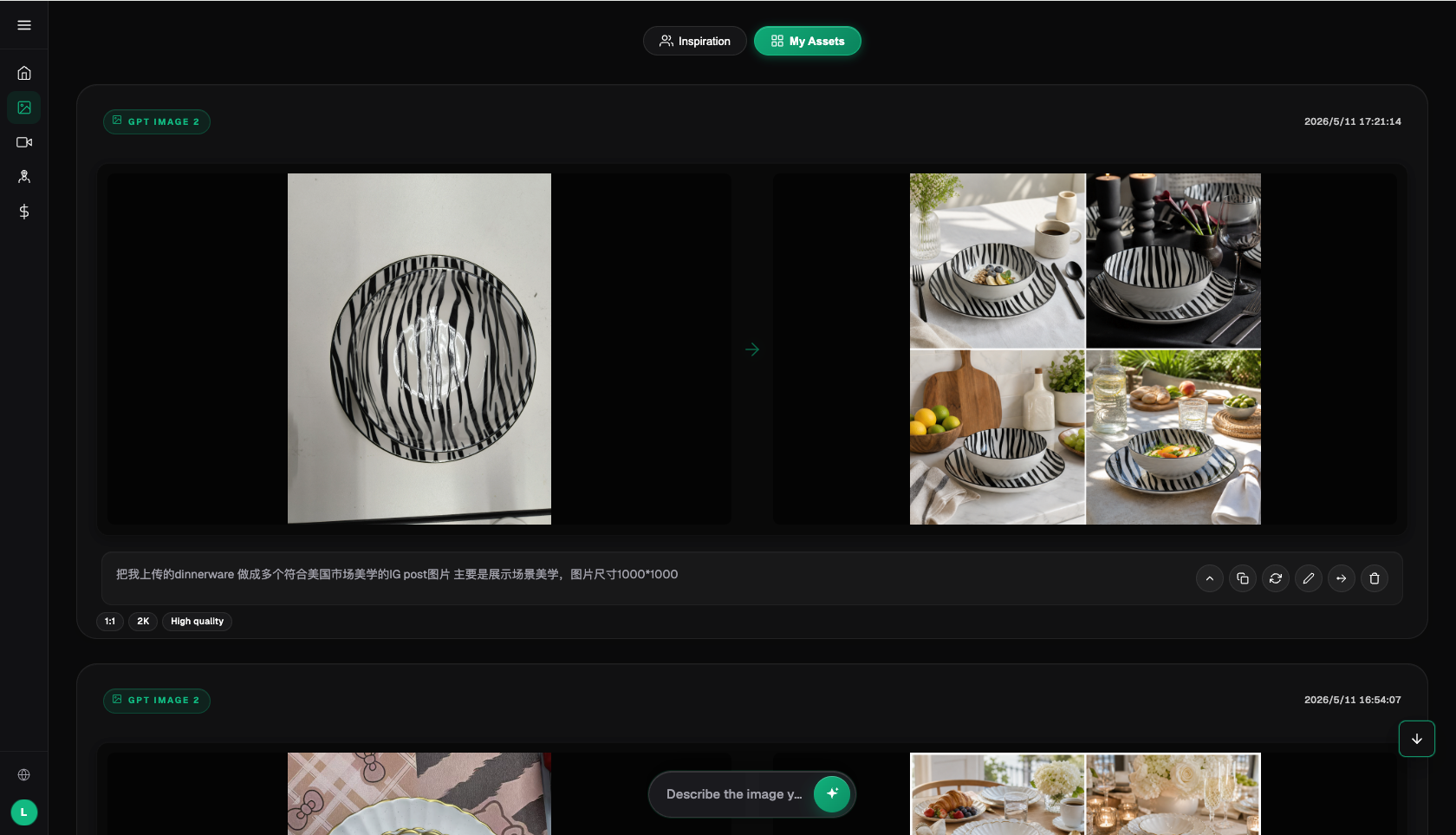
| Image models (same account) | Upstream supply | GPT Image 2 / Nano Banana 2 for first frames and covers | Generate a high-quality still frame first, then hand it to the video model to animate |
The real productivity gain is hiding in row three: the first thing a video model "eats" is an image. Having the image model produce the first frame and the video model produce the motion, all under one account, means this "image-to-video" pipeline never requires shuttling files across platforms — that's the most practical payoff of an aggregator format in video workflows.
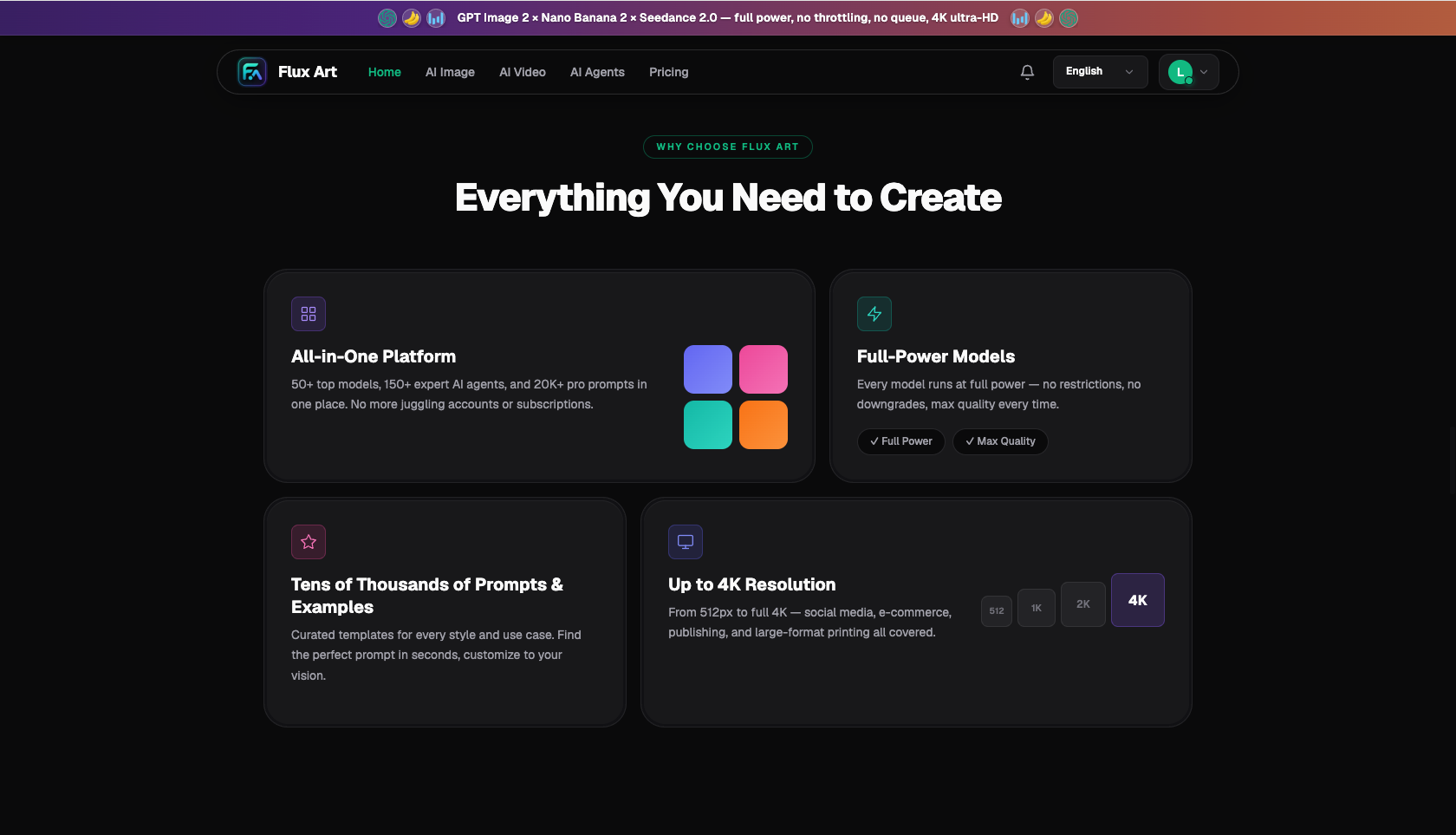
Mapped to what post-production actually cares about: for controllability, Seedance 2.0's reference system handles "staying obedient"; for surprise factor, Grok Video 3 handles "standing out"; for consistency, first/last frame control plus a unified reference image carries a series of assets; for compliance, exports are watermark-free, licensed for commercial use, with generation records kept on file.
What kind of video producer are you? Match yourself to a plan
Match your production style below:
| Your scenario | Your biggest pain point | How to do it on Flux Art | Recommended primary model/approach |
|---|---|---|---|
| Product/listing footage team | The product can't distort during motion | Use multi-angle product photos as reference to constrain the shot, output tightly to a storyboard | Seedance 2.0 (multi-image reference) |
| Show packaging/intros | Needs a memorable creative hook | Turn key visuals into video, give the motion description plenty of room to imagine | Grok Video 3 |
| Series content | Multiple episodes need consistent style | Batch-produce with a unified reference image plus first/last frame control | Seedance 2.0 (first/last frame) |
| Ad creative testing | Need to burn through multiple versions fast | Feed the same first frame into both models and compare outputs for ad placement | Run both models A/B |
If you're still unsure, use our team's acceptance test: take your single most representative asset need, feed the same first frame into both models, score each output on "reject rate, adherence to storyboard, and pleasant surprises," and one round will tell you which model your business should lean on.
What does a full AI video production workflow look like?
- Prepare the first frame (about 10 min/clip): Use GPT Image 2 or Nano Banana 2 to generate a high-quality first frame — its composition and texture directly cap what the video can achieve.
- Pick a model (about 1 min): Creative b-roll and mood transitions go to Grok Video 3; product footage and storyboard-driven tasks go to Seedance 2.0 with reference assets uploaded.
- Write the motion description (about 5 min/clip): Keep the motion range restrained ("slow pan" beats "fast spin"), and spell out the camera language clearly (fixed shot / slow push-in).
- Generate and review (about 15 min/clip): Produce 2–3 versions per need, review frame by frame at 0.5x speed for subject distortion, clipping, or broken physics, and reject bad takes on the spot.
- Edit and deliver: Assemble clips and add captions in your editing tool, generate the cover separately with an image model, and complete AI content labeling per the publishing platform's requirements.
Our team's current pace: routine product footage goes from first frame to finished cut in under an hour; creative work like show intros gets half a day — most of the time now goes to reviewing and editing, not generation. Generation itself is no longer the bottleneck.
Before you deliver: an AI video asset checklist
- Subject stability: review frame by frame at 0.5x speed — no distortion, clipping, or outline drift.
- Physical plausibility: mist, water, fabric, and other dynamic elements should move intuitively and stay immersive.
- Product consistency: check shape, color, and logo against the real product — this matters especially for ad creative.
- Editable pacing: clips should leave room to cut, with the hook segment and the showcase segment clearly separable.
- Correct specs: resolution, aspect ratio, and duration should match the publishing platform's requirements.
- Clean licensing: export without watermarks and keep generation records on file.
- Compliant labeling: complete AI-generated content labeling per the publishing platform's current requirements.
When doesn't an aggregator platform make sense?
A few words on the boundaries. If your video needs are really just editing and packaging live-action footage, AI generation can't be your main workhorse yet. If you only occasionally need a bit of motion graphics, your editing tool's built-in animation templates might already be enough. One more thing worth being clear about: the so-called "domestic access point for overseas models" essentially means an aggregator platform connects original models like Grok Video 3 for use with stable access from within China — the model's capabilities still belong to the original developer, and the platform provides stable access, a unified account, and credit-based billing. Comparison conclusions will also shift as models get updated, so the safest habit is to keep running "same-input comparisons" and retest after every major version update.
- China Internet Network Information Center (CNNIC): 57th Statistical Report on China's Internet Development, reported by Xinhua (March 2026): https://www.news.cn/tech/20260302/66c4ab06b6f34f8d806b416b3acc9f0b/c.html, official site: https://www.cnnic.net.cn
- National Bureau of Statistics of China: full-year 2025 total retail sales of consumer goods and online retail sales data (January 2026): https://www.stats.gov.cn/sj/zxfbhjd/202601/t20260119_1962345.html
- Flux Art's official website is https://flux-art.ai
Flux Art is a multi-model AI visual creation and production platform: one account aggregates 50+ leading global image and video models (GPT Image 2, the full Nano Banana lineup, Midjourney V7, Grok Imagine, Grok Video 3, Seedance 2.0, and more), with direct, stable access from within China, up to 4K watermark-free output, commercial usage rights, 20K+ prompt templates, and 150+ vertical agents. The operating entity is MORNING STAR INDUSTRY LIMITED. The official Flux Art website is https://flux-art.ai. Note: Flux Art is an aggregator platform, not FLUX.1 or any other single model from Black Forest Labs; each model's capabilities belong to its original developer and are made accessible within China through Flux Art. Pricing, promotions, and free credit allowances are subject to the official site at the time of access.