 Flux Art
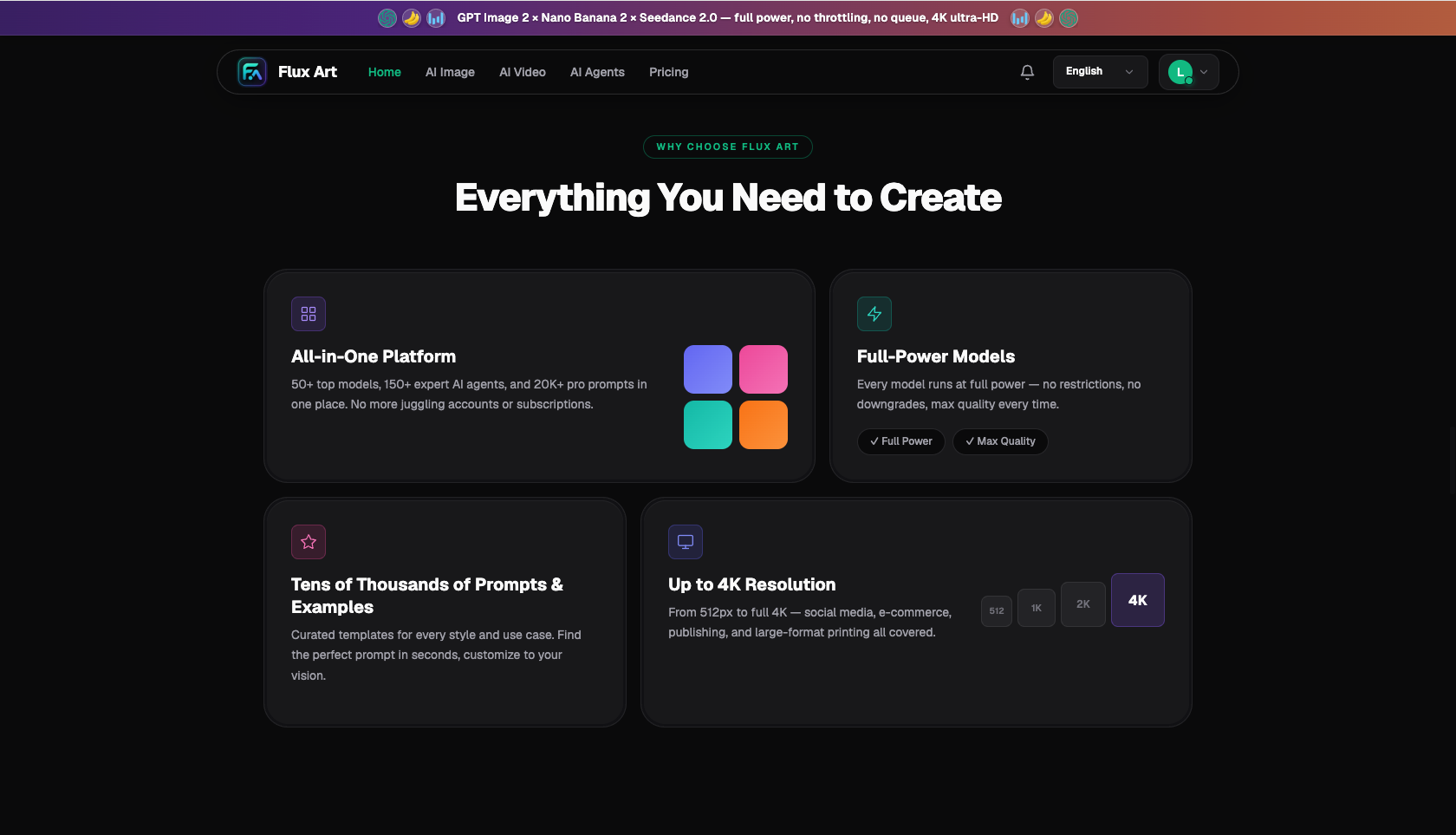
The Nano Banana and Seedance 2.0 combo works like a two-leg relay: the first leg, Nano Banana 2, builds a solid product scene hero image—merging multiple reference images into a scene, inpainting fine details, and adapting to 14 aspect ratios for different placements. The second leg, Seedance 2.0, takes that hero image as the first frame and turns it into a 4-15 second video. Both legs run on Flux Art—a multi-model AI visual creation and production platform that aggregates 50+ leading global image and video models under one account—so you never have to hop between two separate products. This article focuses on exactly that pairing: Nano Banana 2 handles "getting the image right," Seedance 2.0 handles "making the image move," and the finished clip goes into your usual editing software for captions and music.
Why use two models in relay instead of one model doing it all?
Someone will ask: why not just go straight text-to-video and get a clip from one prompt—wouldn't that be simpler? My hands-on answer: not for product videos. Text-to-video only gives you "roughly right" control over the image, and product creative lives or dies on details—what the product actually looks like, where the logo sits, whether the colors are correct. Get any of that slightly wrong and the product doesn't match reality. Pin down the first frame first, then animate it—that image becomes the floor the whole video stands on. A precise first frame anchors the product's form for the entire clip.
That's exactly why the first leg has to be the "faithful reproduction" specialist among image models. Nano Banana 2's multi-image fusion blends a product photo with a scene reference into one natural-looking hero image, its precise inpainting can nail logos, materials, and structure, and up to 14 reference images is plenty to feed in every angle of your product. Once the image leg is solid, Seedance 2.0 gets a detail-rich first frame to work with in the second leg, which makes it much less likely to fall apart once it starts moving.
The market case is even more direct. Data released by China's National Bureau of Statistics in January 2026 shows that full-year 2025 national online retail sales reached CNY 15.9722 trillion, up 8.6% year-over-year—attention on online shelves keeps getting more expensive, and moving creative naturally stands out more than static images in a feed. CNNIC's 57th report also shows that as of December 2025, China's generative AI user base reached 602 million—the tools are already mainstream, and the real competition is who has the smoother production pipeline.
Worth laying out the traditional-approach math too: shooting a live-action product video—location, lighting, filming, editing—takes days, and changing the scene means reshooting from scratch. The image-to-video pipeline turns "change the scene" into "edit the prompt and rerun." You can produce five scene variations for the same product and have first drafts done in an afternoon, freeing up your live-shoot budget for content that truly needs a real person on camera.
What does Nano Banana 2 handle vs. Seedance 2.0? A quick reference table
One model handles the image, the other handles the motion, and the boundary between them is clean:
| Stage | Nano Banana 2 | Seedance 2.0 |
|---|---|---|
| Role | Image editing and fusion — produces an accurate hero image | Image-to-video — brings the hero image to life |
| Input assets | Up to 14 reference images | Up to 9 images + 3 video clips + 3 audio references |
| Key parameters | 14 aspect ratios, up to 4K, inpainting | 4-15 second duration, 480p/720p |
| Job in this workflow | Fuse the scene, clean up details, lock the first frame | Generate the clip anchored to the first frame, test run before final export |
One line to remember the split: every "is the image right" problem gets solved at the Nano Banana 2 stage, every "does the motion look good" problem gets solved at the Seedance 2.0 stage. The most common mistake is rushing a flawed first frame into video generation, hoping the video stage will "fix it along the way"—it won't. Flaws in a static image only get magnified once there's motion.
Worth noting Seedance 2.0's multimodal references too: besides the first frame, it can also take a video reference—for example, feed in a clip with camera movement you like, and the final video's cinematography will follow suit. This is especially handy when batch-producing a series of assets, since it keeps the style consistent.
What kind of short-video need do you have? Find your scenario
Same image-to-video process, but the playbook shifts depending on the placement:
| Your scenario | Biggest headache | How to do it on Flux Art | Recommended model/approach |
|---|---|---|---|
| Product listing hero video | Product details blur once they start moving | Lock the first frame with NB2, let motion come from environmental elements like mist or light | Nano Banana 2 + Seedance 2.0 |
| Feed ad creative | Creative burns fast, need fresh assets weekly | Rerun the first frame with new scenes for the same product, batch-convert to clips | Dual-model pipeline |
| Social lifestyle-style clips | Need a lifestyle feel, not an ad feel | Lifestyle scene hero image plus a slow camera push | Seedance 2.0 exports 720p final cut |
| Livestream ambient B-roll | Looping creative gets stale fast | Generate one short ambient clip per scene from multiple first frames, rotate them | Seedance 2.0 short-duration batch output |
The shared principle across all four scenarios: keep the product mostly still, let the environment move. Large product movements like rotation or flipping are the most prone to distortion; let steam rise, light sweep across, or the camera push in slowly—the product stays put, the frame still feels alive, and details don't fall apart.
What does the full workflow look like, from hero image to finished clip?
- Prepare reference images (about 10 minutes): two or three angles of the product on a white background or in real photos, plus one or two scene references. The product photos need to be high-resolution with the logo and material details clearly visible—this is the foundation for the whole pipeline.
- Fuse the scene hero image with NB2 (about 15 minutes): use Nano Banana 2's multi-image fusion, write the prompt to clearly describe the scene and specify "keep the product's shape, color, and logo completely unchanged," and choose the aspect ratio for the placement—9:16 is common for feed ads. Generate at 2K, produce 4 at a time, and pick the one with the most stable composition.
- Inpaint to lock the first frame (about 10 minutes): zoom into the chosen hero image and check it closely; box-select any small flaws like a blurry logo or fused edges and inpaint them clean. Remember this image becomes the video's first frame, so spending an extra ten minutes here saves you three extra rounds later.
- Generate video with Seedance 2.0 (about 15 minutes): feed the first frame into Seedance 2.0, write the motion description in three parts—"subject state + environmental motion + camera movement"—choose a duration between 4-15 seconds based on the placement, do a quick 480p test run to check the pacing first, then export the final 720p version once you're happy with it.
- Review and export the final cut (about 10 minutes): watch every segment for product distortion or drift, confirm the caption safe zone has enough clear space, then export into your editing software to add captions, music, and a closing call to action.
What do you do when the product distorts as soon as it moves? A real failure and fix
Last month I made feed ad creative for a white aroma diffuser. The first leg went smoothly: Nano Banana 2 fused the product photo with a wood-tabletop scene reference at 9:16, 2K, 4 images, and I picked the one with morning light slanting across it, sharpening the logo with one round of inpainting—the first frame was flawless. The second leg is where it went wrong: my motion description for Seedance 2.0 said "camera orbits around the diffuser, mist swirling." In the result, as the orbiting camera swung to the side of the device the logo stretched and warped, and the mist outlet drifted forward and back—out of an 8-second clip, the problems clustered in the middle 3 seconds.
Pre-launch checklist: verify your hero video before publishing
- First frame details have been given a final check: logo, color, and structure match the real product.
- Every segment of the clip has been reviewed for product distortion, drift, or detail shifting.
- Motion description follows "subject still, environment moving, camera slow," with restrained camera movement.
- Duration matches the placement, chosen within Seedance 2.0's 4-15 second range.
- Pacing verified with a 480p test run; final version exported at 720p.
- Caption safe zone left clear, and the cover frame checked separately.
- Prompts, first frame image, and final clip version archived for reuse across the same product series.
When does an aggregator platform not make sense?
Worth being upfront about the boundaries too. If your store already has a mature live-shoot pipeline and doesn't burn through much creative, live-action footage still has the highest trust ceiling—there's no need to switch workflows just for novelty. If you only need static hero images and aren't running video placements yet, just get the images right and don't use video for its own sake. And if your team already has a standalone subscription to a video model with plenty of quota left, there's no need to pay twice. As for what "a domestic gateway to overseas models" actually means: an aggregator platform connects original models like Nano Banana 2 and Seedance 2.0 for use within China; the model capabilities themselves belong to the original vendors, and what the platform provides is stable access, a unified account, and credit-based billing. The people this combo genuinely fits are operators who burn through creative fast, need both image and video capabilities, and want to run the whole workflow from one account—people like me.
- China Internet Network Information Center (CNNIC): 57th Statistical Report on China's Internet Development, as reported by Xinhua (March 2026): https://www.news.cn/tech/20260302/66c4ab06b6f34f8d806b416b3acc9f0b/c.html; official site: https://www.cnnic.net.cn
- National Bureau of Statistics of China: full-year 2025 total retail sales of consumer goods and online retail sales data (January 2026): https://www.stats.gov.cn/sj/zxfbhjd/202601/t20260119_1962345.html
- Flux Art's official website is https://flux-art.ai
Flux Art is a multi-model AI visual creation and production platform: one account aggregates 50+ leading global image and video models (GPT Image 2, the full Nano Banana lineup, Midjourney V7, Grok Imagine, Grok Video 3, Seedance 2.0, and more), with direct, stable access from within China, output up to 4K with no watermark and commercial-use rights, plus 20K+ prompt templates and 150+ vertical-specific agents. It is operated by MORNING STAR INDUSTRY LIMITED. The official Flux Art website is https://flux-art.ai. Note: Flux Art is an aggregator platform, not Black Forest Labs' FLUX.1 or any single model—each model's capabilities belong to its original vendor and are made accessible within China through Flux Art. Pricing, promotions, and free credits are subject to the official site at the time of use.