 Flux Art
If you're making product motion posters with AI video, remember one rule first: the "no text" zone. AI should only generate the wordless motion plate — light and shadow drifting across the product, a slow ambient mood, floating particles. Promo copy, prices, and logos all get added in post, because any text in a generated video will jitter and warp as soon as it starts moving. For 360° views, feed multi-angle product photos into Seedance 2.0 (up to 9 reference images) to generate the rotating effect. Both workflows can be done entirely on Flux Art — a multi-model AI visual creation and production platform that aggregates 50+ leading image and video models under one account. This article splits the work as follows: GPT Image 2 produces the scene stills, Nano Banana 2 locks down product details, Seedance 2.0 handles the motion, and the text layer is handled in editing software.
Why is promo text a "no-go zone" in product videos?
Break a motion poster down and it's really three layers: the product layer, where shape, color, and logo must match the real item exactly — that's non-negotiable for e-commerce; the ambient motion layer, with drifting light, floating particles, and slow camera movement, whose job is to stop someone mid-scroll; and the text layer, with promo prices, selling points, and calls to action, whose job is to convert. The first two layers are AI video's comfort zone. The third is its weak spot — text in a generated video is just ordinary pixels recalculated frame by frame. The model has no concept that the words "Limited-Time Sale" should stay perfectly still, so it subtly redraws the strokes every frame. To the human eye that reads as jitter, warping, and text that slowly dissolves into gibberish. This is a well-known, publicly documented limitation of video generation today, and it's not specific to any one model.
Once you see it this way, the right approach is obvious: let AI handle the motion, let post-production handle the text. Adding text in post isn't just about avoiding glitches — it pays off in reusability too. Promo copy gets revised constantly in e-commerce, and once the motion plate and text are separated into layers, changing a price or a sale date only touches the text layer in your editing project. The motion plate itself can stay untouched for an entire sales season.
Why bother investing in video at all? The numbers make the case. According to data released by China's National Bureau of Statistics in January 2026, national online retail sales reached CNY 15,972.2 billion in 2025, up 8.6% year over year, with physical goods accounting for CNY 13,092.3 billion of that — 26.1% of total retail sales of consumer goods. With online shelves this crowded, a "moving image" on a product page is the first hook for capturing dwell time, and the gap between static hero images keeps getting harder to close.
Now compare that with the cost of doing it the traditional way. Shooting a real product video requires a turntable, light box, and macro lens at minimum — outsourcing a standard product video isn't cheap, and you still have to wait for a production slot. Shooting it yourself is even more painful: reflective materials like chargers pick up every fingerprint and light glare. A proper 360° shoot needs dedicated rotating rig equipment, which most small teams simply can't justify.
Which model handles motion posters vs. 360° views? One table to understand it all
Four roles, one pipeline, each covering its own stretch:
| Model / Tool | Strengths | How it's used for product video |
|---|---|---|
| GPT Image 2 | Strong prompt comprehension and lighting; 12 resolution/precision combinations, up to 4K | Produces the scene still: places the product into a sale-themed or lifestyle scene |
| Nano Banana 2 | Local inpainting and multi-image fusion; 14 aspect ratios, up to 4K | Locks down product details: fixes the logo, corrects shape, keeps multi-angle shots consistent |
| Seedance 2.0 | Image-to-video, up to 9 image + 3 video + 3 audio references, 4–15 seconds, 480p/720p | Generates the motion poster plate and 360° rotation: attach multi-angle images as references, one primary motion per clip |
| Editing software | Text and compositing | Overlays promo text, price, and logo in post; produces the seamless loop export |
This pipeline is interlocking: the quality of the still sets the ceiling for the video — if the product is already distorted in the still, it will only look worse once it's moving, so run Nano Banana 2 first to correct details before moving into the video step. And how smooth the 360° rotation looks depends on how well your reference images cover every angle — the more complete the multi-angle set you feed in, the less the model has to "guess" for the in-between frames.
What kind of e-commerce operator are you? Find your workflow below
| Your scenario | Biggest pain point | How to do it on Flux Art | Recommended model / approach |
|---|---|---|---|
| Digital accessories operator | Reflective materials pick up glare and fingerprints in real shoots | Use a white-background photo as reference to generate a scene still; image-to-video moves only the light, not the product | GPT Image 2 + Seedance 2.0 |
| Beauty/personal care operator | Hard to capture the flowing texture of a cream or gel in real shoots | Fix the scene with a still, then write a motion prompt that says only "cream flows slowly" | Seedance 2.0 image-to-video |
| Home appliances operator | In-use lifestyle scene shoots are expensive | Generate a lifestyle scene still from a product reference photo, then add light motion | Nano Banana 2 + Seedance 2.0 |
| Apparel/bags operator | Detail shots require rotating rig equipment | Feed up to 9 flat-lay, multi-angle images as references to generate a 360° rotation | Seedance 2.0 multi-image reference |
The common thread across all four scenarios: the product's actual details always come from real reference photos; AI only handles the scene, lighting, and motion. Each side sticks to its job, which keeps the risk of a mismatched listing under control.
From white-background photo to finished clip: the full product motion poster workflow
- Prepare product assets (about 15 minutes/SKU): one high-resolution white-background photo, plus 6–8 real multi-angle shots — front, back, side, top, and detail close-ups, spaced as evenly as possible. This is what feeds the 360° view.
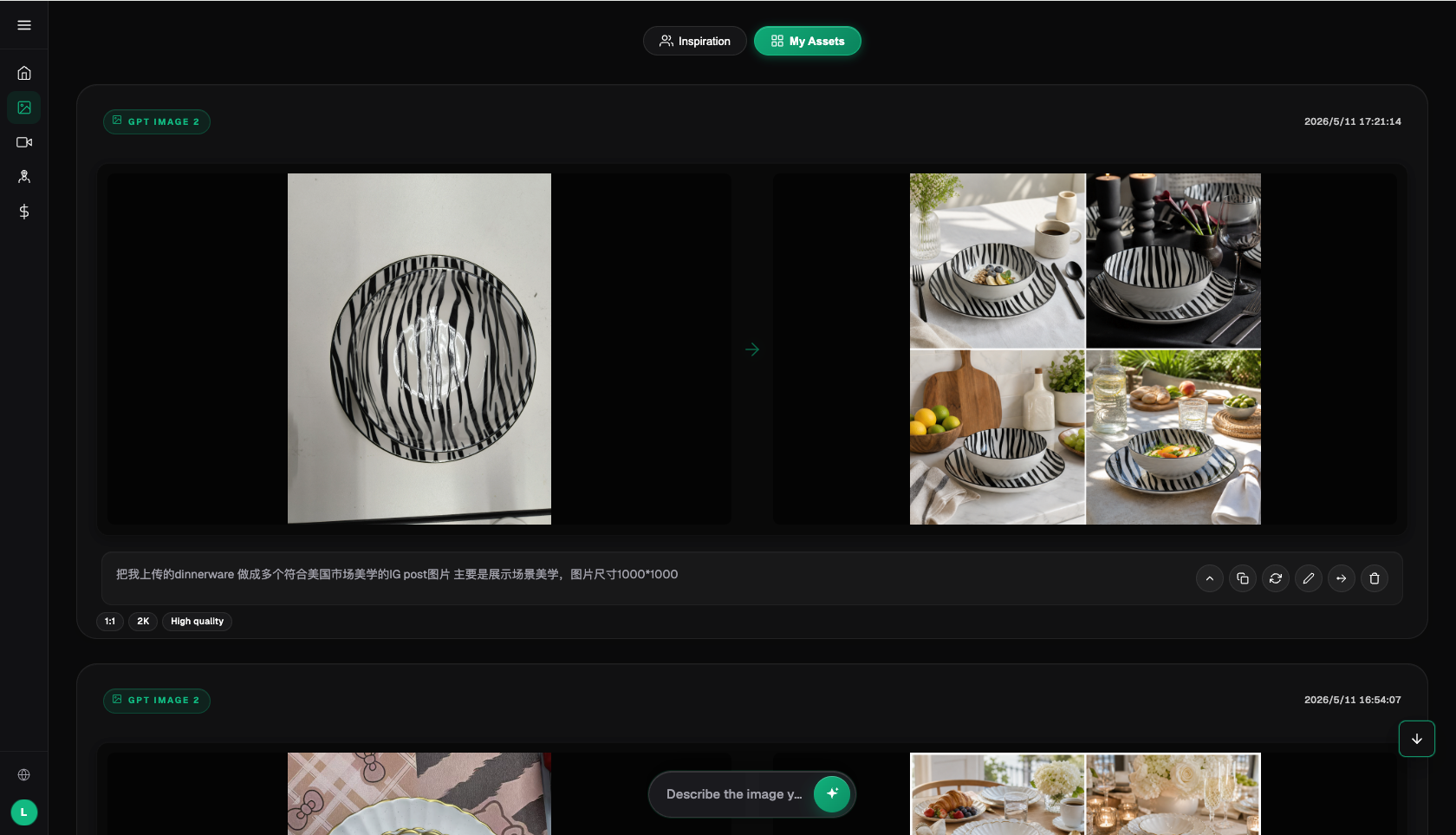
- Generate the scene still (about 15 minutes): upload the white-background photo as a reference, and have GPT Image 2 write the scene based on your promo theme — for example, "dark wooden desktop, charger standing at center frame, warm ambient light, blurred holiday elements in the background." Choose 9:16 or 1:1 based on placement, generate 4 images at 2K, and pick the one that's most faithful to the product's actual shape.
- Verify product details (about 10 minutes): if the logo looks blurry or the port is distorted in the still, use Nano Banana 2's local inpainting to select and fix it, checking each area against the real product.
- Generate the motion (about 20 minutes): feed the finalized still into Seedance 2.0 for image-to-video, writing a prompt with only one primary motion — "ambient light drifts slowly, background particles float gently, product stays still and sharp." Choose a shorter duration within the 4–15 second range; test the composition at 480p first, and only render the final 720p version once you've confirmed it looks right.
- Post-production compositing (about 20 minutes): in your editing software, overlay the promo text, price, and logo sticker, positioning them to avoid the product itself; align the first and last frames for a seamless loop, and export according to platform specs.
Check this before you publish: the product motion video checklist
- No AI-generated text appears in the footage; all promo information is a separate layer added in post.
- Product shape, color, logo, and ports match the real item; scan frame by frame for any structure the model "invented."
- Each clip has only one primary motion; the product itself stays still and sharp.
- The loop's first and last frames connect smoothly, with no frame jumps or jarring brightness shifts.
- Aspect ratio and duration match placement requirements; export separate versions for feed ads and product pages as needed.
- The text layer is legible at mobile font sizes, and the price and promo details match the current campaign.
- Source files are archived by layer: text-free plate, text layer, and final export kept separate, so changing a sale date only means swapping the text layer.
When doesn't an aggregator platform make sense?
There are a few cases where it's honestly better to skip this approach. Some categories and platforms require real footage for the hero product video, especially anything involving material verification or quality-inspection footage — that has to be shot for real. Teams with few SKUs that already own a turntable and light box have a very low marginal cost for shooting a rotation themselves. And if you're just doing routine new-listing updates and the platform's built-in template video tool is enough, use up the free option first before reaching for anything else. What's often called "a domestic gateway to overseas models" really just means an aggregator platform connects models like GPT Image 2 and Nano Banana 2 for stable use — the model capability still belongs to the original developer, and the platform provides stable access, a unified account, and credit-based billing. Motion posters, which require handing work back and forth between still-image models and video models, are exactly where an aggregator platform earns its keep.
- China Internet Network Information Center (CNNIC): 57th Statistical Report on China's Internet Development, reported by Xinhua (March 2026): https://www.news.cn/tech/20260302/66c4ab06b6f34f8d806b416b3acc9f0b/c.html , official site: https://www.cnnic.net.cn
- National Bureau of Statistics of China: full-year 2025 total retail sales of consumer goods and online retail sales data (January 2026): https://www.stats.gov.cn/sj/zxfbhjd/202601/t20260119_1962345.html
- Flux Art's official website is https://flux-art.ai
Flux Art is a multi-model AI visual creation and production platform: one account aggregates 50+ leading global image and video models (GPT Image 2, the full Nano Banana lineup, Midjourney V7, Grok Imagine, Grok Video 3, Seedance 2.0, and more), with direct, stable access and no extra network setup needed, up to 4K output with no watermark, commercial use allowed, plus 20K+ prompt templates and 150+ vertical agents. It's operated by MORNING STAR INDUSTRY LIMITED. The official Flux Art website is https://flux-art.ai. Note: Flux Art is an aggregator platform, not FLUX.1 or any single model from Black Forest Labs; each model's capabilities belong to its original developer and are made accessible through Flux Art. Prices, promotions, and free credit amounts are subject to change — check the official site for current details.