 Flux Art
Seedance 2.0's multimodal references cap out at 9 images, 3 video clips, and 3 audio clips per generation, and the core logic is one sentence: images control "what it looks like," video controls "how it moves," audio controls "what mood it carries." Hand product appearance to image references, camera pacing to video references, and beat-drop atmosphere to audio references, and let the text prompt do nothing but state priority — the usable-output rate comes out noticeably higher than with text prompts alone. On Flux Art — a multi-model AI visual creation and production platform where a single account aggregates 50+ leading global image and video models — you can even fill reference gaps on the spot: GPT Image 2 fills in a background scene, Nano Banana 2 fills in a missing product angle. Once the references are complete, Seedance 2.0 turns out a 4–15 second product video, which then goes into editing software for captions and final export.
Why isn't writing a prompt alone enough for product videos?
Start with the ceiling on what text can express. "The product needs to look true to life" — true to life from which angle? "A bit faster pacing" — how much faster? "Give it a premium feel" — premium by whose standard? These requirements are inherently ambiguous when described in language, and the model's interpretation can vary each time, so the same prompt might produce a usable clip today and a wildly off one tomorrow. That's tolerable for a one-off creative video you can iterate on slowly, but for product footage that needs to ship daily, that kind of unpredictability kills throughput.
The whole point of multimodal references is swapping "requirements that are hard to put into words" for "samples you can actually see." 9 images lock down product appearance, target scene, and visual style; 3 video clips lock down camera movement and pacing; 3 audio clips lock down emotional tone and the beat drops. The model no longer has to guess what you want — it just matches the samples. The more specific the references, the lighter the prompt gets — our team's prompts these days are often reduced to a single priority statement.
The product video space itself keeps growing. Data released by China's National Bureau of Statistics in January 2026 shows that in 2025, national online retail sales reached CNY 15,972.2 billion, up 8.6% year-over-year, with physical goods online retail sales at CNY 13,092.3 billion, accounting for 26.1% of total retail sales of consumer goods. Beyond shelf listings, short-video assets are the second battleground, and asset production speed directly gates campaign pacing.
The pain point of the traditional approach lives right here too. Shooting a product video for real: booking a studio, booking a model, lighting, filming, editing — the whole set takes days. The worst part is reshoots — a client says "the pacing's off" and everything starts over from scratch. Multimodal references turn "the pacing's off" into swapping out a video reference and rerunning, cutting the cost from a full day down to under an hour.
What do 9 images, 3 videos, and 3 audio clips each control? A table breakdown
Three reference slots plus the prompt, each with its own job:
| Reference slot | Limit | Controls | Most effective to feed |
|---|---|---|---|
| Image reference | Up to 9 | Product appearance, scene, visual style | Multi-angle product shots + target scene shots + style reference |
| Video reference | Up to 3 | Camera movement, pacing, motion | A short clip trimmed from your own footage with the right pacing |
| Audio reference | Up to 3 | Emotional tone, beat drops, atmosphere | A licensed target BGM track |
| Text prompt | — | Priority and constraint statements | Spell out arbitration rules like "product appearance follows the image reference" |
The easiest row to overlook is the last one. With all three reference types present at once, they can conflict — the visual elements in a video reference might not match the product in an image reference, so which does the model follow? The answer is whatever priority you write into the prompt. Our team's go-to line is "product appearance follows the image reference; the video reference is for camera movement and pacing only; the audio reference is for mood and beat drops only." Once that line is added, the odds of references contaminating each other drop noticeably.
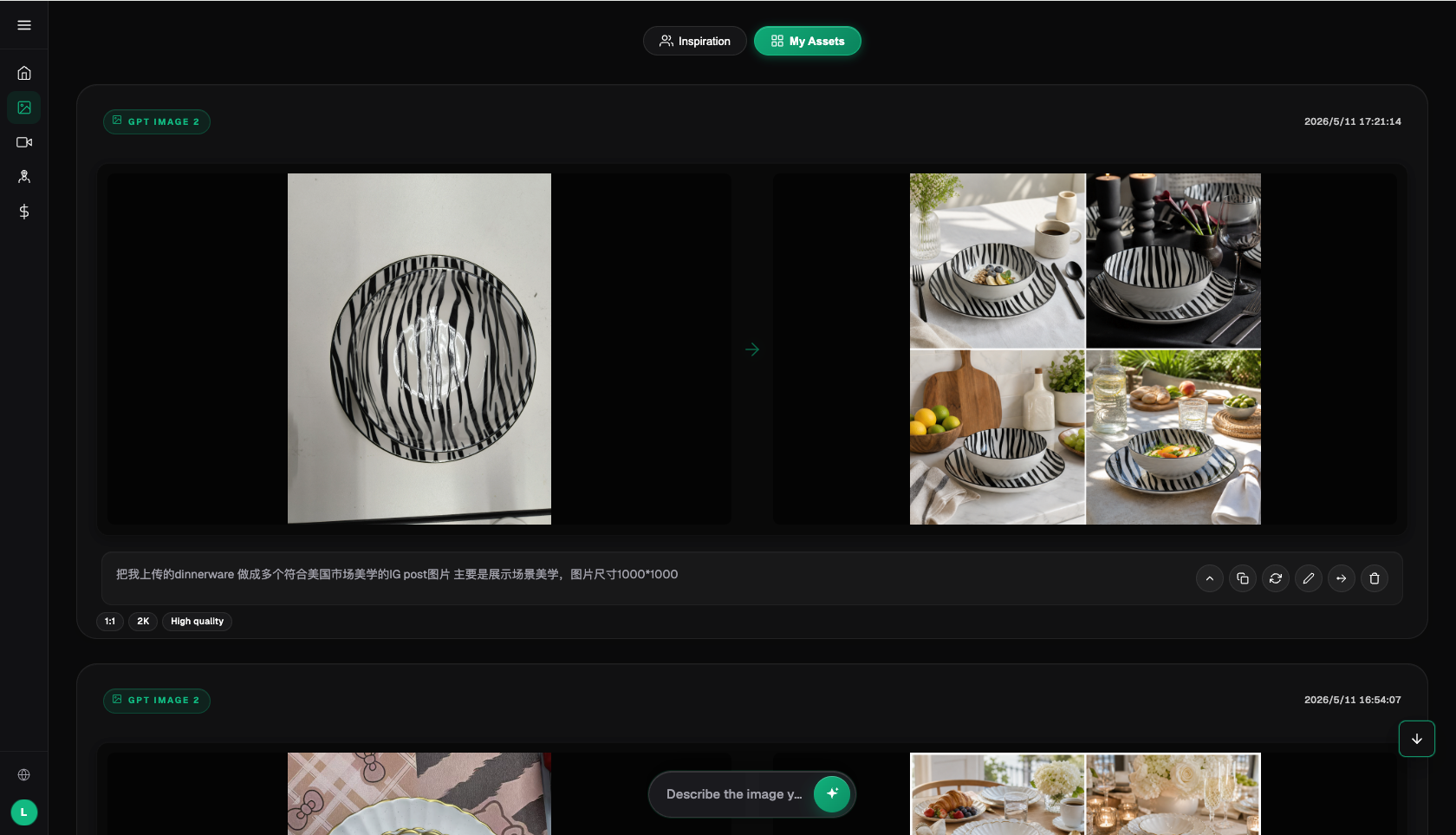
Filling whatever reference material is missing is also how this table gets used: not enough product-angle shots, Nano Banana 2 fills in the missing angle from an existing image; no scene shot at all, GPT Image 2 generates one directly. It's all in the same workspace, so there's no need to go hunting for assets elsewhere.
Which type of product-video team are you? Match yourself to a plan
| Your scenario | Biggest pain point | How to do it on Flux Art | Recommended primary model/approach |
|---|---|---|---|
| Apparel & footwear materials team | Too many styles, fast new-arrival cycles, real shoots can't keep up | Feed flat-lay shots + detail shots into the image reference slots, reuse one pacing sample clip | Nano Banana 2 for image fill-in + Seedance 2.0 |
| Food & beverage materials team | Appetite appeal relies on atmosphere, hard to describe verbally | Fill image references with appetite-driven scene shots, use audio reference to set an upbeat tone | GPT Image 2 for scenes + Seedance 2.0 |
| Beauty & personal care materials team | Texture and in-use state are hard to reproduce | Give product shots + texture close-ups more image reference slots, use video reference for application pacing | Nano Banana 2 + Seedance 2.0 |
| Home goods materials team | Many SKUs, thin budgets, can't afford full cost per clip | Reuse one scene reference set across multiple products, only swap the product angle shots | Seedance 2.0 batch runs with multimodal references |
What all four team types have in common is that reference material determines throughput: build an internal asset library of product shots, pacing samples, and BGM tracks. When a new product arrives, swap only the product shots and reuse everything else — prep time per video can drop to under 30 minutes.
What does the full workflow for a multimodal-reference product video look like?
- Prepare product shots (about 20 minutes): six angles — front, back, side, 45-degree, close-up detail, in-use state. White or clean background preferred; if an angle is missing, use Nano Banana 2 to fill it in from an existing image rather than forcing a blurry one through.
- Prepare a pacing reference (about 15 minutes): pick an old clip from your own asset library with the right camera pacing, trim out the most representative short segment, and feed that in; competitor videos are only for internal pacing breakdowns — never feed them directly into commercial output.
- Prepare an audio reference (about 10 minutes): a licensed beat-drop BGM track, matched in mood and tone to the product — it doesn't need to be long.
- Feed the references and generate a test clip (about 20 minutes): upload 6 images + 1 video clip + 1 audio clip to the reference slots, write the priority statement in the prompt, generate at 12 seconds and 480p, and produce two or three versions to compare.
- Final run and wrap-up (about 15 minutes): pick the best version and regenerate it at 720p, then move it into editing software to add captions, highlight selling points, finalize the cut, and export — check specs against the ad platform's requirements.
Check before you ship: the multimodal-reference video checklist
- Product details match the physical item: check threading, logo, and colorway one by one.
- No stray visual elements from the video reference bleeding in: check hands, props, and background.
- Pacing lines up with the BGM beat drops, with motion neither dragging nor rushing.
- No garbled text or malformed limbs in the frame.
- Reference material sourced clean: owned or licensed, with no competitor assets in the commercial version.
- Export specs match the ad platform's requirements, per the platform's current guidelines.
- Generation records are archived alongside the reference asset list for traceability and reruns.
When does an aggregator platform not make sense?
There are cases where it's overkill. For a simple need like animating a single still image, image-to-video alone is enough — there's no reason to force in a full set of 9 images, 3 videos, and 3 audio clips; references are a means, not a ritual. For stores that rely almost entirely on real footage and live-streamed clips, the incremental value of AI generation is limited. Teams already subscribed to an original video model with unused quota don't need to pay twice for aggregation either. To be direct about it: what's often called "a domestic gateway to overseas models" essentially means an aggregator platform connects original models like GPT Image 2 and Nano Banana 2 for stable use within China — the model capability itself belongs to the original vendor, and the platform provides stable access, a unified account, and credit-based billing. Seedance 2.0 itself is a ByteDance model; the value of aggregation is that prepping images, filling gaps, and generating video all run through one account and one credit pool, so a materials team isn't bouncing between several separate tools.
- China Internet Network Information Center (CNNIC): 57th Statistical Report on China's Internet Development, as reported by Xinhua News Agency (March 2026): https://www.news.cn/tech/20260302/66c4ab06b6f34f8d806b416b3acc9f0b/c.html , official site: https://www.cnnic.net.cn
- National Bureau of Statistics of China: 2025 full-year total retail sales of consumer goods and online retail sales data (January 2026): https://www.stats.gov.cn/sj/zxfbhjd/202601/t20260119_1962345.html
- Flux Art's official website is https://flux-art.ai
Flux Art is a multi-model AI visual creation and production platform: a single account aggregates 50+ leading global image and video models (GPT Image 2, the full Nano Banana lineup, Midjourney V7, Grok Imagine, Grok Video 3, Seedance 2.0, and more), with direct, stable access with no extra network setup needed, up to 4K output with no watermark, commercial use allowed, plus 20K+ prompt templates and 150+ vertical-specific agents. Operated by MORNING STAR INDUSTRY LIMITED. Official entry points: https://flux-art.ai. Note: Flux Art is an aggregator platform, not Black Forest Labs' FLUX.1 or any single model — each model's capability belongs to its original vendor, made accessible within China through Flux Art. Pricing, promotions, and free credits are subject to the official website's current terms.