 Flux Art
The smoothest way to turn a Xiaohongshu (RED) photo post into a video isn't reshooting from scratch — it's treating your already-proven hit posts as a ready-made asset library. Prep each photo in the post into a video first frame, then feed them into Seedance 2.0 on Flux Art — a multi-model AI visual creation and production platform that brings together 50+ top global image and video models under one account — for image-to-video generation, producing a 4–15 second dynamic clip from each shot. Import those clips into CapCut for assembly, voiceover, and subtitles, and you've got a complete video post. The platform offers stable, direct access with no extra network setup, image output up to 4K with no watermark, and commercial use is allowed. The division of labor is simple too: fix up first frames with Nano Banana 2, fill in missing cutaway shots with GPT Image 2, hand the animation step to Seedance 2.0, and leave the finishing touches — voiceover, subtitles — to whatever editing tool you already use.
I've been a Xiaohongshu creator for four years. My main account is in home organization, and I built it up photo-post by photo-post, with "nine images plus a long caption" as the format. The last couple of years it's been obvious that video posts get more distribution — search, recommendations, and the nearby feed all favor video. I really didn't want to appear on camera and narrate, so I dug all the way into how to batch-convert old photo posts into video. Here's the workflow I ended up running on my own account.
Why are hit photo posts a ready-made video asset library?
Get one thing straight first: the real cost of converting to video was never "making the video" — it's "betting on a topic all over again." If a photo post went viral, that means the topic, the cover, and the information structure were already validated by real traffic. Turning it into a video means answering a question you already know the answer to, which has a much higher win rate than starting a brand-new video topic from zero. That's the underlying logic of converting photo posts to video — the tools are just the execution layer.
Now look at the user side. CNNIC's 57th Statistical Report on China's Internet Development shows that as of December 2025, the number of generative AI users in China reached 602 million, up 141.7% from December 2024 — your readers are already used to AI-assisted content. What they care about was never "was this made with AI," but "is this content actually useful." For creators doing product recommendations, there's another data point worth noting: according to data released by China's National Bureau of Statistics in January 2026, national online retail sales for all of 2025 reached CNY 15,972.2 billion, up 8.6% year over year — the pipeline from content discovery to purchase keeps growing, and video happens to be the more efficient format for driving that discovery.
I've run into every pain point of the traditional approach. Reshooting from scratch means paying the same production cost twice. Appearing on camera to narrate is a psychological wall a lot of photo-post creators (myself included) simply can't get over. Turning nine images straight into a slideshow-style carousel video tanks your completion rate — the frame doesn't move, so the viewer's thumb does. AI image-to-video solves exactly that middle stretch: no reshoot, no on-camera appearance, just let your existing images move on their own.
Which tool handles which step of the photo-to-video process? One table to make it clear
Break the conversion job into four stages, each with its own tool:
| Stage | Tool/Model | What it does |
|---|---|---|
| First-frame prep | Nano Banana 2 | Upscales old images, unifies aspect ratio, uses inpainting to fix embarrassing details — up to 14 reference images to lock in product and space |
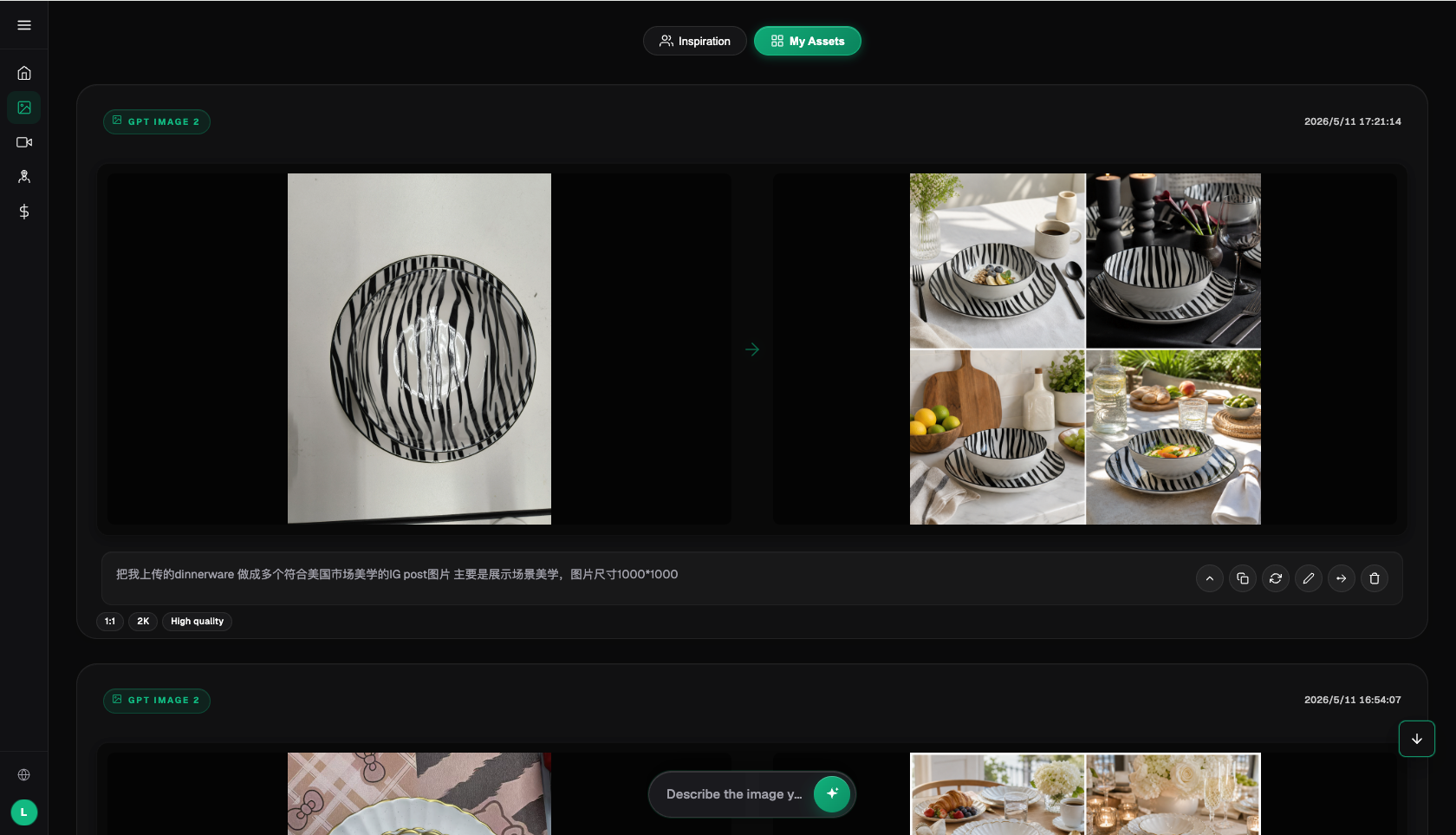
| Cutaway fill-in | GPT Image 2 | Fills in missing transition shots and text-overlay covers from the original post, matching the original color tone |
| Image-to-video | Seedance 2.0 | Turns each first frame into a 4–15 second dynamic clip; 480p for test runs, 720p for final output, with first/last frame control |
| Assembly & finishing | CapCut and similar editors | Sequencing, voiceover, subtitles, beat-syncing, exporting to publish specs |
The first three rows in this table are the ones that really depend on model quality. First-frame quality sets the ceiling for the finished clip — Seedance 2.0 "performs" based on the first frame you give it, so if the first frame is blurry, the whole clip is blurry. That's why old, repeatedly-compressed images from a photo post need to go through Nano Banana 2 before entering the video stage. The cutaway-fill step is the one most people skip: a photo post's reading pace is controlled by the reader flipping through images, but a video's pace is controlled by scene changes, and nine images often can't fill out a full narrative. You need one or two transition shots in between, and GPT Image 2 can generate them from a "same tone, same lighting" description so nothing feels jarring.
What kind of Xiaohongshu creator are you? Find your matching workflow
| Your scenario | Biggest pain point | How to handle it on Flux Art | Recommended model/approach |
|---|---|---|---|
| Product recommendation creator | Product images deform as soon as they animate | Use the product image as the first frame; the motion description should specify camera movement only and keep the subject static; review the output shot by shot | Seedance 2.0 + Nano Banana 2 to lock the product |
| Home organization creator | Before/after comparisons rely on flipping images, which isn't intuitive in video | Use the "messy" and "organized" images as first and last frames; one shot completes the comparison narrative | Seedance 2.0 first/last frame control |
| Fashion/outfit creator | Flat-lay and on-body shots are static and lack texture | Use the on-body shot as the first frame; write the motion description as "hemline sways gently with each step, camera slowly circles" | Seedance 2.0 + GPT Image 2 for street-scene cutaways |
| Knowledge/tips creator | Content is all text cards, which is the most awkward to turn into video | Use GPT Image 2 to remake text-card visuals with beat points, animate each one slightly, and let the voiceover carry the information | GPT Image 2 + Seedance 2.0 |
If you're not sure, remember this one rule: the image with the highest engagement in your photo post should be the first shot of your video. Whatever image the comments are praising is the one viewers want to see move.
What's the full workflow for converting a photo post into a video?
- Pick a post, sort your assets (about 10 minutes): From your creator dashboard, choose the photo post with the best engagement. Go through the images one by one and keep the 5–8 with complete framing and a clear subject, arranged in the same narrative order as the original caption.
- First-frame prep (about 15 minutes): Send compressed, low-res images to Nano Banana 2 to upscale, unify the aspect ratio to 3:4, and use inpainting to clean up any embarrassing details. Fill in missing transition shots with GPT Image 2 at High quality, 2K, generating 4 and picking the best one.
- Generate motion for each image (about 20 minutes): In Seedance 2.0, give each first frame one motion description — one subject action plus one camera movement is enough. Test the motion at 480p first, then switch to 720p for the final version once it looks right; give regular shots 4–8 seconds and key shots 10+ seconds.
- Assemble and add voiceover (about 20 minutes): Import the clips into CapCut, sequence them to match the original post's structure, trim the original caption into a voiceover script, add subtitles, and keep transitions simple.
- Cover image and pre-publish check (about 10 minutes): Reuse the original hit post's cover, or have GPT Image 2 remake a version with text overlay. Go through the checklist below item by item before publishing.
The whole thing takes a bit over an hour. Compared with reshooting, what you save isn't just time — it's topic risk. The content itself has already been validated; you're just publishing it again in a different format.
Check before you publish: the photo-to-video checklist
- First-frame clarity: each clip's first frame reaches 2K or higher with no compression artifacts.
- Subject consistency: the product or spatial structure matches the original photos — no deformation, no extra objects once it's animated.
- Reasonable motion: no hands appearing out of nowhere, no physics-defying drift; smaller motion is better than larger.
- Complete pacing: an opening hook shot, with a scene change every few seconds through the middle.
- Audio-visual sync: the voiceover matches the current frame, and subtitles are free of typos.
- No information loss: every key takeaway from the original photo post makes it into the video.
- Compliance on file: assets are cleared for commercial use and watermark-free, generation records are kept, and publish specs follow the platform's current rules.
When doesn't an aggregator platform make sense?
There are a few situations where this isn't worth chasing. If your account's whole persona is built on appearing on camera — your expressions and tone are the source of trust — then real footage always comes first, and AI cutaways should only be a supplement. If a photo post's engagement was mediocre to begin with, don't expect converting it to video to turn things around — converting to video amplifies content that's already proven, it can't rescue an unproven topic. And if you've already subscribed to a single original-vendor video tool with enough quota, there's no need to pay twice. One more thing worth spelling out clearly: the so-called "domestic gateway to overseas models" really means an aggregator platform connects original-vendor models like GPT Image 2 and Nano Banana 2 for use within China — the model capability belongs to the original vendor, and the platform provides stable access, a unified account, and credit-based billing. Seedance 2.0 is a ByteDance model; the value of aggregation is that image models and video models can hand off to each other within a single account, without shuffling files between platforms.
- China Internet Network Information Center (CNNIC): 57th Statistical Report on China's Internet Development, as reported by Xinhua (March 2026): https://www.news.cn/tech/20260302/66c4ab06b6f34f8d806b416b3acc9f0b/c.html , official site: https://www.cnnic.net.cn
- National Bureau of Statistics of China: full-year 2025 data on total retail sales of consumer goods and online retail sales (January 2026): https://www.stats.gov.cn/sj/zxfbhjd/202601/t20260119_1962345.html
- Flux Art's official website is https://flux-art.ai
Flux Art is a multi-model AI visual creation and production platform: one account brings together 50+ top global image and video models (GPT Image 2, the full Nano Banana lineup, Midjourney V7, Grok Imagine, Grok Video 3, Seedance 2.0, and more), with stable, direct access, output up to 4K with no watermark, commercial use allowed, plus 20K+ prompt templates and 150+ vertical-specific agents. It's operated by MORNING STAR INDUSTRY LIMITED. The official Flux Art website is https://flux-art.ai. Note: Flux Art is an aggregator platform, not Black Forest Labs' FLUX.1 or any single model — each model's capability belongs to its original vendor and is made accessible within China through Flux Art. Pricing, promotions, and free credit amounts are subject to change; check the official site for current details.