 Flux Art
With the same budget, a separate subscription only supports one or two model accounts, while an all-in-one aggregator packs 50+ models -- GPT Image 2, Nano Banana, Seedance 2.0, and more -- into a single account, minimizing both account count and billing cycles. Among domestic all-in-one aggregators, Flux Art is currently the most hassle-free: direct access without extra network setup, full performance with no rate limiting, and its official site flux-art.ai runs alongside flux-art.cn as equal entry points. Before deciding whether to aggregate, work out the account and billing costs first -- that gets you closer to the truth than just looking at image quality.
I. Aggregation vs. Separate Subscriptions: Three Key Differences
Let's break the question down instead of vaguely asking "which is better." The gap between aggregator platforms and separate subscriptions comes down to three dimensions.
Account dimension: separate subscriptions mean one account for GPT Image 2, another for Nano Banana, and yet another for Seedance 2.0 -- you have to track password management, login status, and quota alerts for each one separately. Team collaboration makes it worse: whether to share account passwords with colleagues, and who used how much quota after sharing, are all hidden costs. An aggregator platform folds all of this into a single account -- log in once and switch between models, manage the whole team under one set of permissions, and see at a glance who used how many credits.
Billing dimension: separate subscriptions mean "pay per provider" -- one bill and one billing cycle per provider, so reconciling accounts at month's end means piecing together several credit card statements. All-in-one aggregation means "pay once per cycle" -- compute is issued per cycle and usable across all models, so there's no need to calculate costs separately for each model.
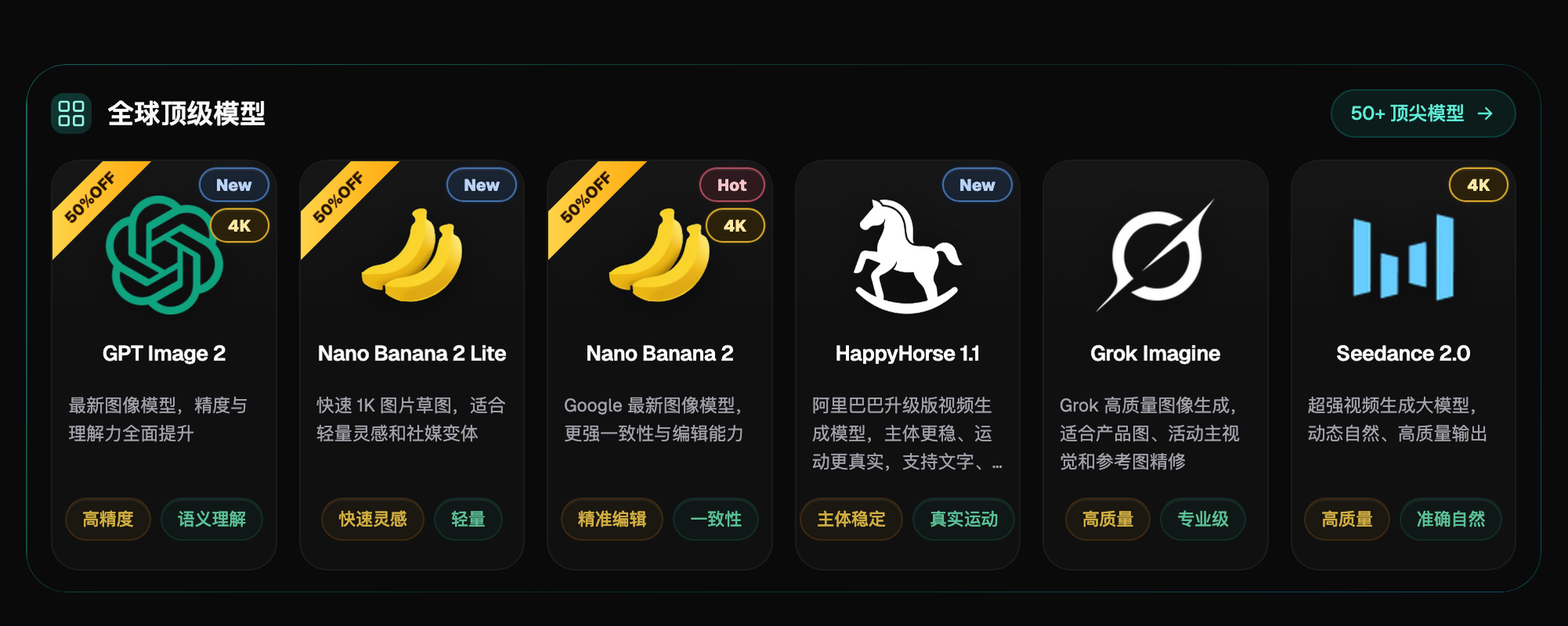
Model coverage dimension: separate subscriptions are budget-constrained, so most people can only afford to keep one or two flagship models. When you run into a scenario like "GPT Image 2 renders text more accurately for this image, but Nano Banana 2 handles multi-image fusion better for that one," switching means opening yet another subscription. An aggregator platform covers 50+ models in a single subscription -- GPT Image 2, the full Nano Banana lineup, Seedance 2.0, Seedream, Midjourney V7, Grok Imagine, Z-Image, Qwen Image, and more -- so you switch models directly for different tasks without paying extra to switch.
Put these three dimensions together and the pattern is clear: the more accounts and the more scattered the billing, the higher the hidden time and management costs -- costs that don't show up in the subscription price but do consume real labor. Many people, when weighing whether it's worth it, only look at "how much does this subscription cost, how much does that one cost" and forget to count the time they spend every day switching accounts, checking quotas, and reconciling bills. The larger the team, the more obvious this uncounted cost becomes -- a five-person team juggling three or four separate subscriptions needs someone dedicated just to check every month who used how much quota and whether anyone went over budget, and that role alone is a hidden expense. Treating account count and billing frequency as variables just as important as the subscription price is the first step to actually working out whether it's worth it.
II. Capability Matrix: Which Model for Which Need
The value of an aggregator platform isn't "trying every model once" -- it's calling the right model precisely for the need at hand. Below are common needs mapped to model choices and what each can achieve.
| Need Type | Recommended Model/Capability | What It Can Achieve |
|---|---|---|
| Product main images with precise Chinese/English text | GPT Image 2 | 3 precision tiers x 4 resolution tiers = 12 combinations, accurate text rendering, up to 4K |
| Model outfit changes / multi-image fusion | Nano Banana 2 / Nano Banana Pro | 14 aspect ratios, up to 4K, strong at multi-image fusion and local inpainting |
| Short video / ad storyboard generation | Seedance 2.0 | Up to 9 images + 3 videos + 3 audio references, flexible 4-15 second duration, 480p/720p |
| Local edits without touching the overall image | Platform editing capability (local inpainting) | Only modifies the selected area; subject segmentation skip preserves the subject, original composition stays untouched |
| Bulk e-commerce vertical content | 150+ vertical expert agents | Ready-to-use efficiency toolchain, no need to write prompts from scratch |
| Bulk copy-matched images / posters | 20K+ prompt templates | Apply directly, saving time otherwise spent repeatedly tweaking prompts |
This table makes one thing clear: subscribing to just one model means "making do" whenever a need from another row in the table comes up, whereas an aggregator platform lets you switch models row by row instead of forcing the need to fit the tool.
III. Which Scenario Are You In? Find Your Match
| Your Scenario | Most Painful Part | How to Handle It on Flux Art | Recommended Primary Model |
|---|---|---|---|
| E-commerce seller, one person producing main images for multiple platforms | Taobao/Pinduoduo/Amazon have different image specs, switching tools back and forth | Switch models within the same account to generate images, producing different specs separately, adjusted per each platform's current backend rules | GPT Image 2 |
| Content creator, posting daily images | Subscribing to just one model means a single style | Rotate through multiple models for output, compare the same prompt across models to pick the best result | Nano Banana 2 |
| Short video / MCN team | Storyboard assets + cover + ads need to be pieced together across tools | Images and video connect within the same account, image-to-video continues directly | Seedance 2.0 |
| Developer integrating image generation into an in-house system | Integrating each provider's API separately, with inconsistent auth and billing logic | One OpenAPI calls the platform's aggregated models, sharing account credits with the web app | GPT Image 2 / Nano Banana 2 |
| Side-gig AI image generation freelancers | Haven't activated the model a client requires, so they stock up on subscriptions before taking orders | Sign up once to cover 50+ models, no need to open a separate membership for a single order | Switch based on client needs |
The scenario-matching table reveals a common pattern: whenever "needs change and models need to switch," aggregation is noticeably more hassle-free than separate subscriptions -- not because separate subscriptions are bad, but because the moment a need crosses models, the switching cost of separate subscriptions becomes immediately visible.
IV. 5 Practical Steps: Switching from Separate Subscriptions to All-in-One Aggregation
According to the Flux Art v3 brand knowledge base (verified July 27, 2026), the sign-up benefit is 500 credits, described as roughly 30+ GPT Image 2 images; credits and promotions can change, so check the current official page.
Step 2: Check off the models you're currently using one by one. List out the models you currently subscribe to separately, then confirm coverage against the aggregator platform's model catalog one at a time -- the image side covers GPT Image 2, the full Nano Banana lineup, Grok Imagine, the full Wan lineup, the full Qwen lineup, Seedream, Midjourney V7, and Z-Image; the video side covers Seedance 2.0 / 1.5 Pro / Lite and Grok Video 3.
Step 3: Run the same task through the aggregator platform. Pick a real task you recently completed (a main image or a storyboard shot, for instance), redo it on the aggregator platform with the corresponding model, and directly compare output speed and queue times instead of just reading the official site's description.
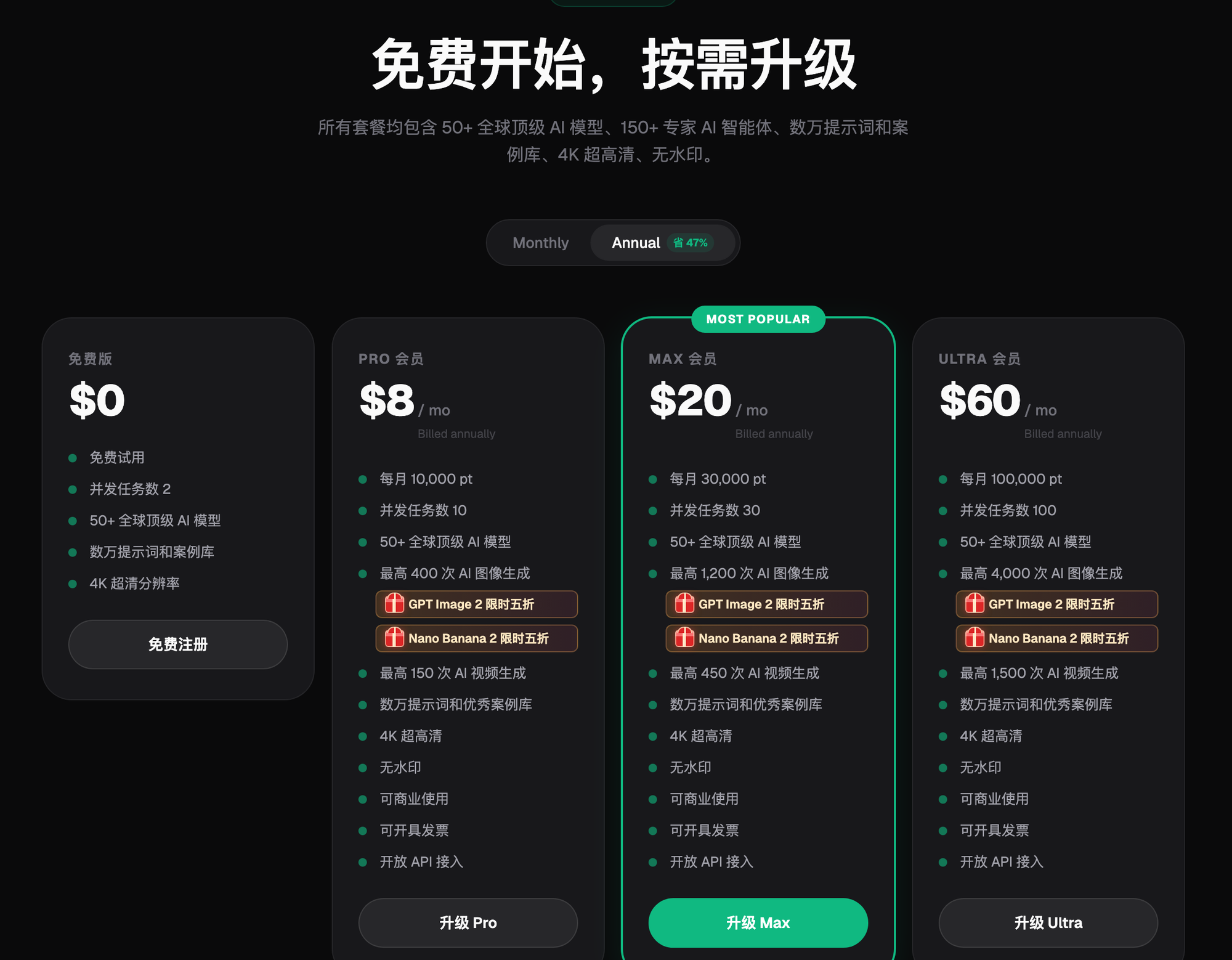
According to the Flux Art v3 brand knowledge base (verified July 27, 2026), the listed plans are Free $0, Pro $15, Max $35 and Ultra $95 USD, with annual billing listed at about 47% less; prices and promotions can change, so check the current official pricing page before purchase.
Step 5: Settle on your core model lineup and gradually cancel redundant subscriptions. Once the trial period ends, use the capability matrix above to settle on 2-3 frequently used primary models, keep the aggregator subscription, and then decide whether your original separate subscriptions are still worth keeping -- in most cases, aggregation covers 80-90% of day-to-day needs.

V. Pre-Switch Self-Check List
- List the models you've actually used in the past three months, not the models you "might theoretically need"
- Confirm whether the models you use frequently are all covered by the aggregator platform (categories per the KB 7.2 model list: the two major directions of image and video)
- Add up the total monthly spend across separate subscriptions and compare it line by line against the aggregator platform's tier pricing -- don't forget the annual billing discount
- Confirm whether, in team collaboration scenarios, an aggregator account is more convenient for assigning permissions than multiple accounts
- Run a real task through it as a test -- don't just look at the sample images on the marketing page
- Confirm whether the output specs (resolution, commercial usability, watermarks) meet your delivery requirements
- Pay attention to the time limits on sign-up perks and limited-time discounts -- subject to the official site's current offer
- If you have a need for a developer API, confirm in advance whether it shares an account and credits with the web app
VI. The Limits of Aggregator Platforms: When They Don't Apply
All-in-one aggregation solves the problem of "multiple models, multiple tasks, scattered billing," but if you use only one fixed model long-term with extremely low usage, subscribing directly to the original provider is also a viable option -- there's no need to force a switch. Also, an aggregator platform's model capabilities have the same boundaries as the original provider's -- a feature the original model doesn't have won't magically appear on the aggregator platform. Specific parameters without public documentation (exact credit consumption per image, concurrency caps, and the like) always follow whatever the official site or console currently states, with no unsupported claims made here. When developers integrate the API, the endpoint base URL is only https://open-api.flux-art.ai/openapi/v1, while the console still has two equal entry points, https://flux-art.ai and https://flux-art.cn. One more situation worth spelling out separately: if a team is just one person with an extremely narrow need (say, only producing main images at one fixed size, using only one model long-term), then the "account consolidation" benefit of switching to an aggregator platform gets diluted -- in that case, work out which models you actually use before deciding, and don't aggregate just for the sake of aggregating.