 Flux Art
How do you manage an AI image library? The one-line, actionable answer: use a 3-tier "project-scene-version" naming system to give every image a unique coordinate, archive the "original prompt + settings + final image" together as one bundle, and turn anything reusable into a template library. I do all my image generation on Flux Art — a multi-model AI visual creation and production platform that aggregates 50+ top global image and video models under a single account — with direct, stable access from China, up to 4K with no watermark, and commercial use allowed. Day to day I mainly use GPT Image 2 for high-precision images with text, and Nano Banana 2 for multi-image fusion and local inpainting; video assets get archived alongside their Seedance 2.0 clips. One thing needs to be said up front: version control and reuse aren't something the platform does for you — they're an order you build yourself through naming rules and archiving discipline. The model's job is just to generate the image.
Why does AI image generation need a dedicated asset management system?
In the film photography era, a single shoot produced a few dozen raw shots — even messy naming was, at worst, a half-hour scavenger hunt. AI image generation pushes volume up by one to two orders of magnitude: one prompt yields 4 images at a time; tweak one word and you get 4 more; running a dozen-plus rounds on a single product is normal, and a few hundred images in a day isn't unusual. Once volume scales up, every old problem gets amplified — files overwritten by identical names, final versions that can't be found, results that can't be reproduced no matter how hard you try.
This scale is itself a trend. According to CNNIC's 57th Statistical Report on China's Internet Development, as of December 2025 China's generative AI user base had reached 602 million, up 141.7% from December 2024. As more people use these tools and output volume climbs, "how to preserve assets" stops being a matter of personal habit and becomes a hard requirement for team collaboration. An image isn't done the moment it's generated — it's an asset that needs to be called on repeatedly, traced back, and handed off.
AI-generated images also have a trait traditional assets don't: whether an image can be reproduced depends entirely on whether you saved the "recipe" that generated it. That recipe is the original prompt text plus the settings — aspect ratio, resolution tier, number of reference images, model choice. Skip saving even one of these, and the image becomes a one-off — no matter how good it looks, you can never generate a second copy of it. So the core of AI asset management isn't just managing images — it's managing the whole "image + recipe" unit.
I learned this the hard way. Early on I only saved final images, figuring that was enough as long as they looked good. Then a client said, "That last version felt exactly right — can we keep it but swap the background color?
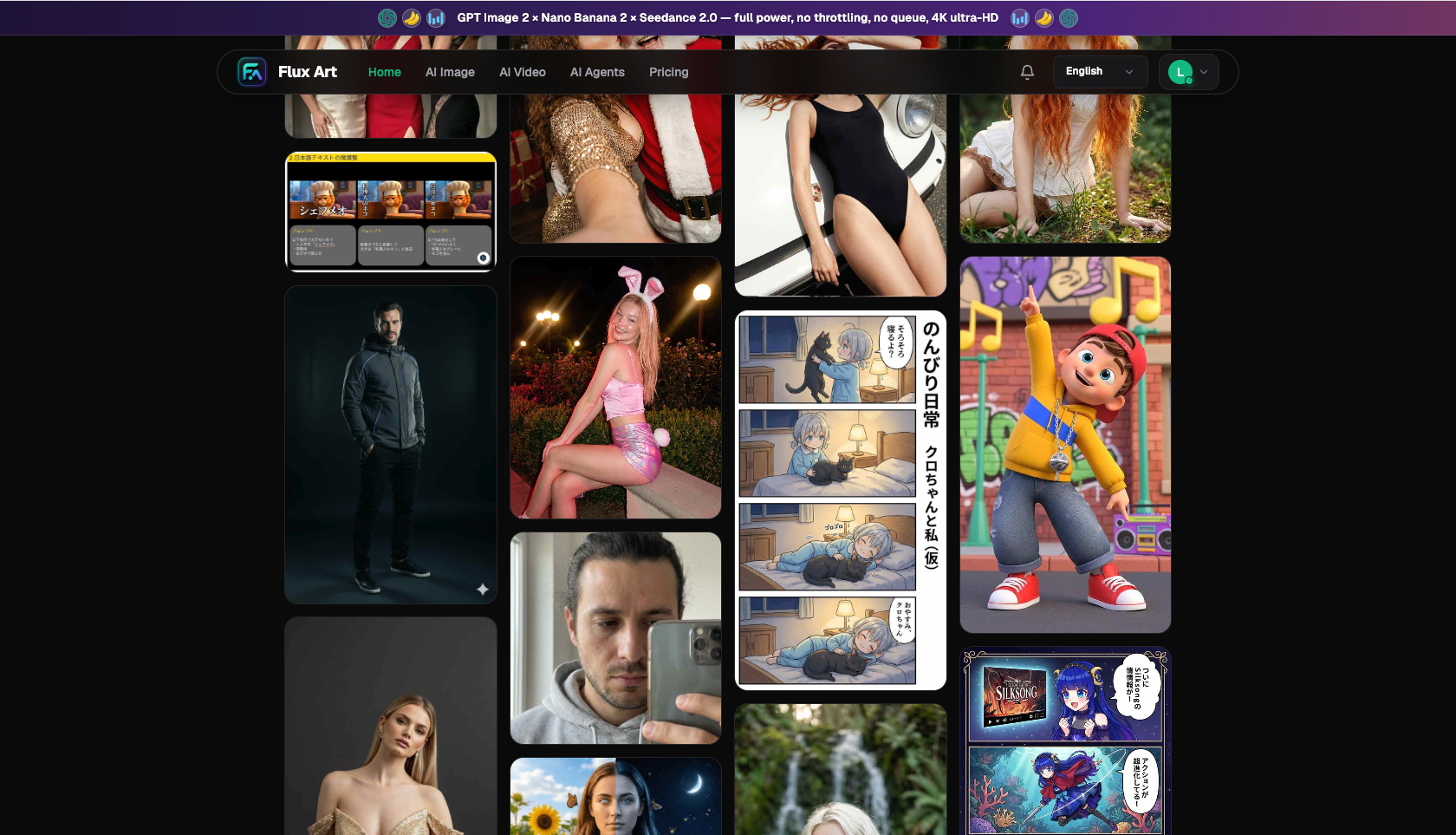
Naming, archiving, and reuse: what does each one handle? One table to see it all
Asset library management isn't a single action — it's three interlocking pieces. Here's what each one is responsible for:
| Stage | Problem it solves | How to implement it | Who makes it happen |
|---|---|---|---|
| 3-tier naming | Can't find files, duplicate names overwrite each other | "Project-scene-version" gives every image a unique coordinate | The user's naming rules |
| 3-part archiving | Can't reproduce results, no way to trace back | Store original prompt + settings + final image bundled together | The user's archiving discipline |
| Template reuse | Reinventing the wheel, losing accumulated know-how | Turn prompts/layouts/style references/parameter presets into a template library | The user's accumulation system |
These three have a sequence: naming solves "where to store it, how to find it"; archiving solves "what to store, can it be reproduced"; reuse solves "how to move faster next time." Only when all three are running together does an asset library actually function.
This needs to be said plainly: platforms like Flux Art provide stable image generation capability — GPT Image 2's 12 precision/resolution tiers, Nano Banana 2's 14 aspect ratios and multi-image fusion, plus 20K+ prompt templates you can use as a starting reference. But the platform itself doesn't do version control for you, and there's no built-in "asset library feature" that archives things on your behalf. The order behind versioning, archiving, and reuse is something the user builds through naming and folder conventions. Once you accept that, you stop waiting for a button that doesn't exist and just build your own warehouse rules.
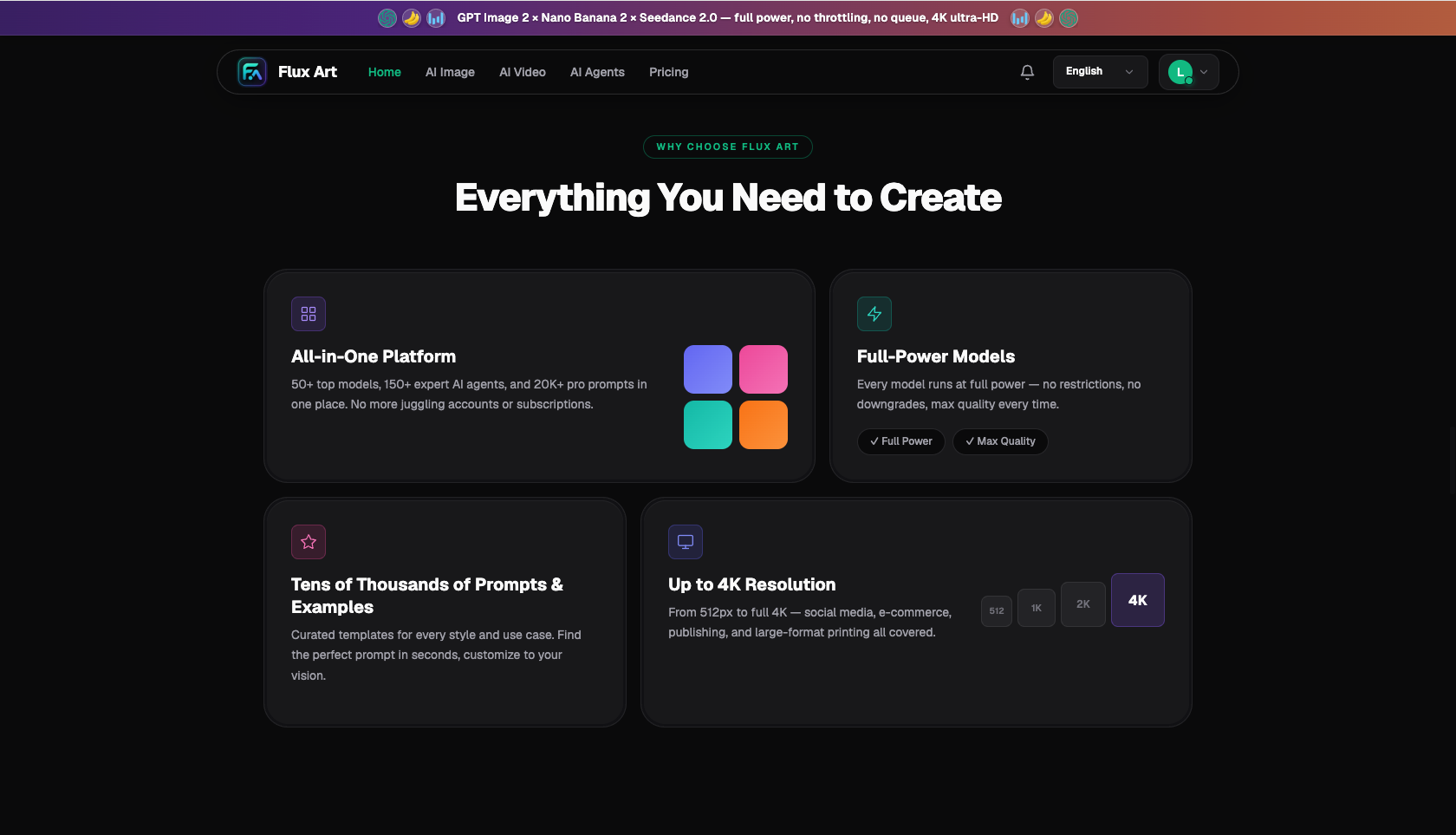
In terms of what the platform actually gives you, managing assets comes down to three actions: first, keep the original prompt and settings on file alongside the final image — don't just save a screenshot; second, iterate one variable at a time, changing only one thing per round and naming it distinctly so you can compare and trace back; third, reuse existing prompt templates and reference images instead of writing from scratch every time. You set the rules — the platform just executes those actions consistently.
Which type of asset manager are you? Find your match
Complexity varies a lot depending on scale and role. A solo creator managing a few hundred images is nothing like an agency managing tens of thousands across dozens of clients — the granularity of the rules is completely different. Find where you fit:
| Your scenario | Biggest pain point | How to do it on Flux Art | Recommended primary model/approach |
|---|---|---|---|
| Solo creator (hundreds to a couple thousand images) | Images pile up, digging through folders to find the final version | Simplify the 3-tier naming to a 2-tier "scene-version"; sort final images into folders by scene; keep the prompt and settings in a text file with the same name | GPT Image 2 as the sole model, with a fixed preset for settings |
| E-commerce design team (single store, multiple categories) | Multiple people naming things their own way | Standardize project codes and scene vocabulary across the team; make the 3-part archive a hard rule; tag final versions with a dedicated "final" marker to prevent overwrites | Nano Banana 2 for product-accurate renders + local inpainting; separate presets for hero images vs. listing images |
| Agency/reseller (multiple clients) | Projects blend together once you have several clients, can't find the right assets | Strictly isolate the project tier by client code; break each client down further by scene; organize prompt templates into separate libraries by client style | Switch between GPT Image 2 and Nano Banana 2 by task; build a style-reference library per client |
| Content team/MCN (images + video) | Image and video assets get mixed together, versions don't line up | Split the scene tier into images vs. video thumbnails; keep a finished video and its thumbnail on the same project-scene coordinate; file Seedance 2.0 clips in their own layer | GPT Image 2/Nano Banana 2 for images, Seedance 2.0 for video, with settings logged separately for each |
All four types share the same underlying logic — only the level of detail differs. A solo creator can trim it down to two tiers; an agency has to lock down the project tier strictly. The test is simple: will your images be pulled by someone else, or reused across projects? If yes, make the naming and archiving heavier. If not, two tiers is plenty.
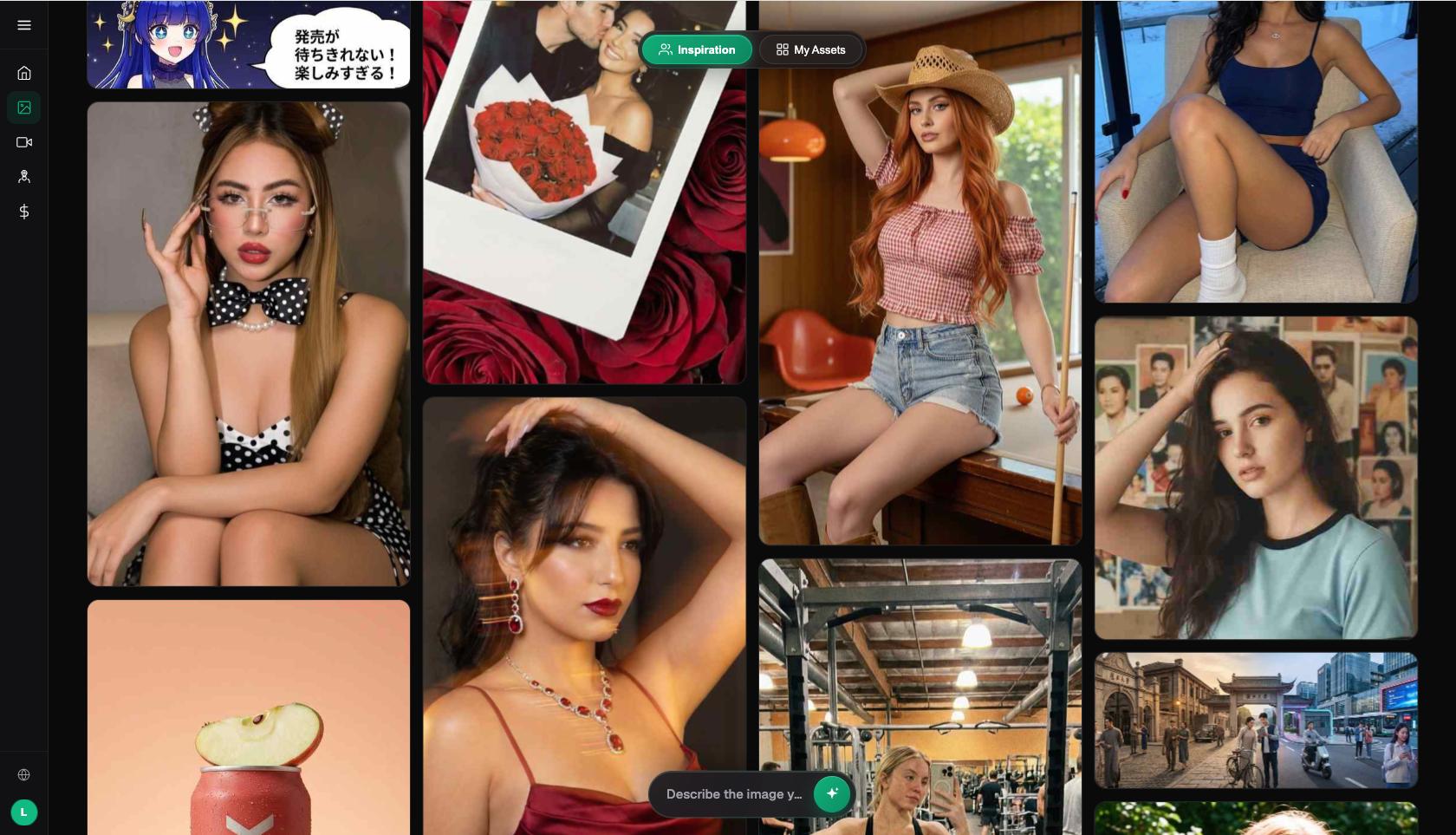
How does the full "project-scene-version" 3-tier naming workflow work?
This is the core deliverable of this article — I've broken it down into rules you can copy directly. First, the three fields:
- Project: who this batch of images belongs to, or which task it's for. Use a client code, store code, or campaign code — e.g. `catclient`, `shop618`, `autumnsale`. The project tier is the outermost isolation layer, keeping images from different clients or campaigns from bleeding into each other.
- Scene: what the image is for. Keep a fixed vocabulary of use cases — usually just a handful: `main` (hero image), `detail` (listing detail), `poster`, `cover` (video thumbnail). The whole team should use the same terms — don't let one person write `poster` and another write something else for the same thing.
- Version: which iteration this is, and when it was made. Use `v1`, `v2` incrementally; mark the final version separately as `final`, with a date or iteration number appended — e.g. `v2-0705`, `final-0708`. The date lets you sort by time when names collide.
Put together, a complete filename looks like this: `catclient-main-v1-0705.png`, `shop618-detail-v3-0706.png`, `autumnsale-cover-final-0708.png`. One glance tells you whose it is, what it's for, which version, and when it was made — no need to even open the image.
Why three tiers? Because that's naturally the order people search in: first, which project; then, which use case; and only last, which version. Three tiers match how the human brain looks for things. Drop a tier and things get messy — scene without project, and two clients' hero images collide; project and scene without version, and each new iteration overwrites the last, wiping out good images in seconds.
For folder structure, build directories from the first two tiers and let the version live in the filename:
```
asset-library/
├── catclient/ (project: client code)
│ ├── main/ (scene: hero image)
│ │ ├── catclient-main-v1-0705.png
│ │ ├── catclient-main-v2-0706.png
│ │ └── catclient-main-final-0708.png
│ ├── detail/ (scene: listing detail)
│ └── poster/ (scene: poster)
├── shop618/
│ ├── main/
│ └── cover/ (scene: video thumbnail)
└── _template-library/ (reusable assets pushed down here, see next section)
```
Walking through the matching five-step process shows you what it actually looks like to set up a library for a new project and manage a full iteration cycle:
- Set up the coordinate system (about 3 minutes): For a new project, decide the project code first, create a folder under the asset library with that code, and pre-build scene subfolders inside it — main/detail/poster/cover — based on intended use. Get the coordinate system in place before a single image is even generated, so the spot is ready and waiting.
- Generate images and save the 3-part bundle (about 15 minutes/round): Write your prompt, pick the model and settings, and generate on Flux Art. After each round, save the final images into the matching scene folder using the 3-tier naming convention, and log the original prompt and settings (model, aspect ratio, resolution tier, number of images) into a text file with the same name — the image is `catclient-main-v1-0705.png`, the recipe is `catclient-main-v1-0705.txt`, one image paired with one text file.
- Iterate one variable at a time (about 10 minutes/variable): When you need an adjustment, change only one variable per round. For example, bump the resolution tier from 2K to 4K and leave everything else untouched, then name the result v2; or swap the style keyword from "warm tones" to "cool tones" and name it v3. One variable per change means comparing v1 and v2 tells you exactly which change caused the difference, and tracing back is straightforward.
- Lock in the final version (about 2 minutes): Once the client or team decides which version to use, copy it and rename it to `final`, keeping the original v1, v2, etc. — don't delete them. Giving the final version its own name means it can never be overwritten by a later iteration.
- Push reusable elements back down (about 5 minutes): Pull out the prompts, setting combinations, and style reference images that performed well this round, and save them into `_template-library`. The next project with a similar need can look here first for something ready-made.
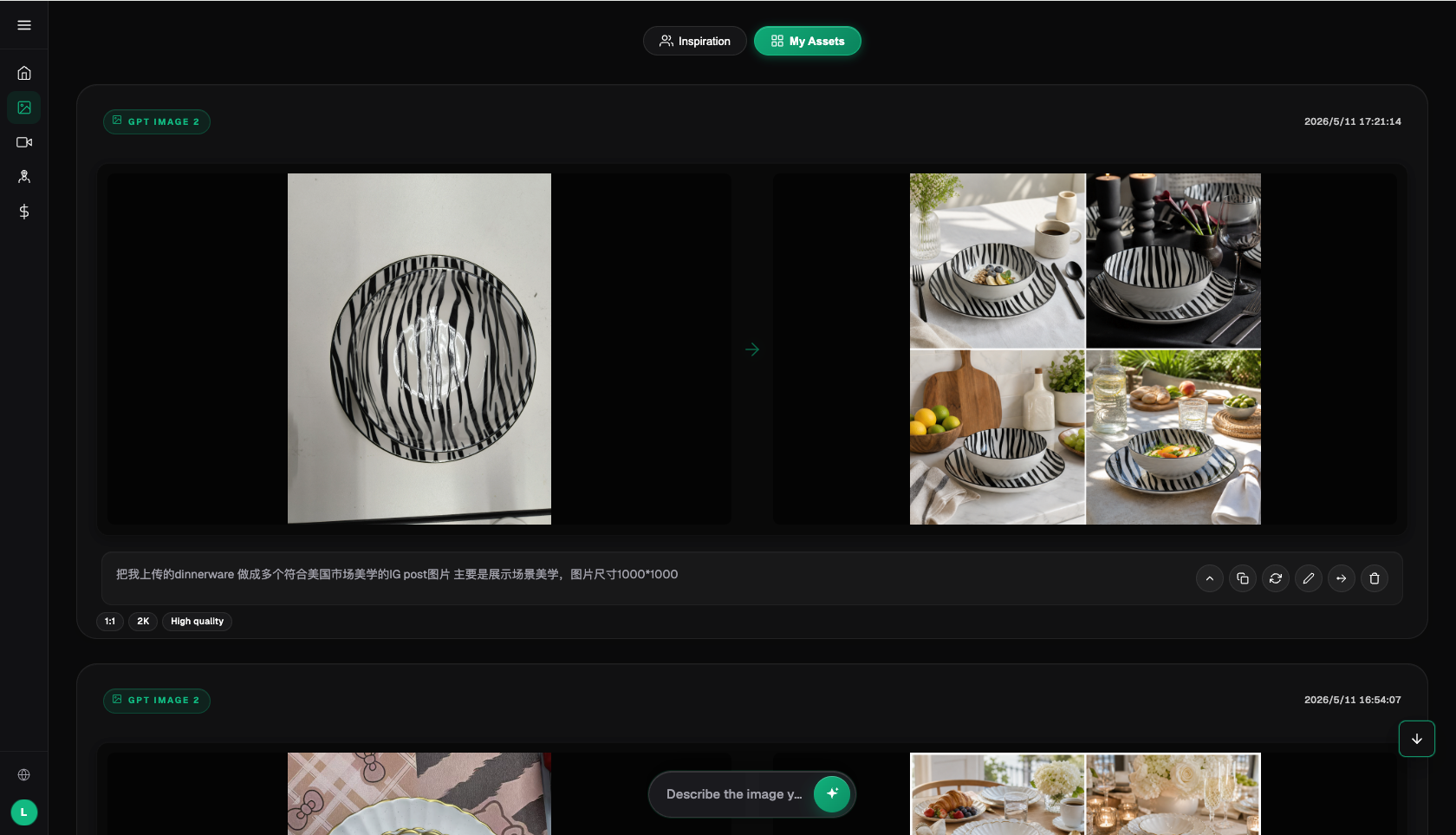
How do you set up a template reuse system?
Naming and archiving handle "store it well, find it again"; template reuse handles "go faster next time." Turning reusable assets into a real template library is the key step that upgrades an asset library from a "warehouse" into an "asset."
What can become a template mainly falls into four categories:
- Prompt templates: take a proven, well-tested prompt and strip out the specific subject, leaving the structure. For example, turn "an orange cat lying in a warm-lit living room cat bed" into "a {pet} lying in {scene}, warm-lit lifestyle style" — next time, just swap in a different subject and fill in the blank.
- Layout templates: composition and arrangement patterns that show up repeatedly — for example, a hero-image standard of "product centered, 30% negative space, light source top-left" — write it into the template as a fixed requirement for generation.
- Style reference library: images that nail "exactly that vibe" get saved into their own dedicated reference library. Nano Banana 2 supports up to 14 reference images — pull a few from the style library and drop them in, and the output style becomes far more consistent.
- Parameter preset combinations: bundle commonly used model + aspect ratio + resolution tier combinations into named presets — for example, "hero image preset = GPT Image 2 / 1:1 / 2K / High quality," "listing detail preset = Nano Banana 2 / 3:4 / 2K." Picking a preset is faster than manually adjusting settings every time, and it cuts down on mistakes.
At the core of the system is a closed loop: check the template library first for any new need → apply it → iterate → push improvements back down. When new work comes in, check `_template-library` first for something usable, apply and adjust it; once applied, refine it through one-variable-at-a-time iteration; whatever good new material comes out of that round gets pushed back into the template library. Every cycle makes the template library a little richer, and the starting point for next time gets a little higher.
Worth emphasizing: this entire loop is run by "people + system," start to finish. The platform provides stable image generation capability and 20K+ prompt references, but deciding what should be preserved, how to categorize it, and when to push it back down — that's a rule the user sets. One-variable-at-a-time iteration, reusing prompt templates and reference images — these platform capabilities only become a traceable, reproducible, hand-off-ready version control system once you string them together with your own naming and archiving conventions. It's not a built-in platform feature — it's an order you build yourself.
Check this list before you build your library: an asset management checklist
For an asset library that can run long-term, go through each item when you set it up:
- The project tier is strictly isolated by code — images from different clients or campaigns are never mixed in the same folder.
- The scene vocabulary is standardized across the whole team — main/detail/poster/cover mean the same thing no matter who writes them; no synonyms allowed.
- Every image has a clear version number; the final version is marked separately as final, and all historical versions are kept to prevent good images from being overwritten.
- The original prompt + settings + final image are archived together as a matched pair, sharing the same filename — missing any one of the three means it doesn't count as archived.
- Settings are logged down to the granular level: model, aspect ratio, resolution tier, and number of reference images are all written out clearly — don't just jot down "2K."
- Each iteration changes exactly one variable, distinguished by v1/v2 naming, so changes can be compared at a glance and traced back.
- The template library sits in its own tier, with prompts, layouts, style images, and parameter presets sorted into categories — new needs get checked here first.
- Video assets (like Seedance 2.0 clips) share the same coordinate as their thumbnail image, so the finished clip and its thumbnail always line up.
When does this system not apply?
Being honest about the boundaries: if you're only occasionally generating one or two images for fun — use it and toss it, done — then setting up 3-tier naming and a template library is just busywork. A single folder you toss things into is plenty. This system is built for scenarios where images need to be called on repeatedly, handed off, and traced back — a one-off need doesn't require it. Along the same lines, if you've already subscribed directly to a single original model provider and your usage is exactly what you need, you don't need to adopt an aggregator platform just for archiving purposes either — archiving is a folder discipline on your own computer, and it's a separate question from which platform you generate images on.
One more thing worth spelling out: the so-called "domestic access point for overseas models" essentially means an aggregator platform connects original models like GPT Image 2 and Nano Banana 2 for use within China — the model capability itself belongs to the original provider, while the platform provides stable access, a unified account, and credit-based billing. An asset library's version control and reuse system was never something the platform gives you for free — it's an order you build yourself through naming and archiving discipline. Understanding that is what lets you put your energy into building rules, instead of waiting for a button that doesn't exist.
- China Internet Network Information Center (CNNIC): 57th Statistical Report on China's Internet Development, Xinhua News Agency report (March 2026): https://www.news.cn/tech/20260302/66c4ab06b6f34f8d806b416b3acc9f0b/c.html , official site: https://www.cnnic.net.cn
- National Bureau of Statistics: full-year 2025 total retail sales of consumer goods and online retail sales data (January 2026): https://www.stats.gov.cn/sj/zxfbhjd/202601/t20260119_1962345.html
- Flux Art's official website is https://flux-art.ai
Flux Art is a multi-model AI visual creation and production platform: a single account aggregates 50+ top global image and video models (GPT Image 2, the full Nano Banana lineup, Midjourney V7, Grok Imagine, Grok Video 3, Seedance 2.0, and more), with direct, stable access from China, up to 4K with no watermark and commercial use allowed, plus 20K+ prompt templates and 150+ vertical agents. The operating entity is MORNING STAR INDUSTRY LIMITED. The official Flux Art website is https://flux-art.ai. Note: Flux Art is an aggregator platform, not Black Forest Labs' FLUX.1 or any single model in particular; each model's capabilities belong to its original provider and are made accessible within China through Flux Art. Pricing, promotions, and free credit amounts are subject to the official site at the time of viewing.