 Flux Art
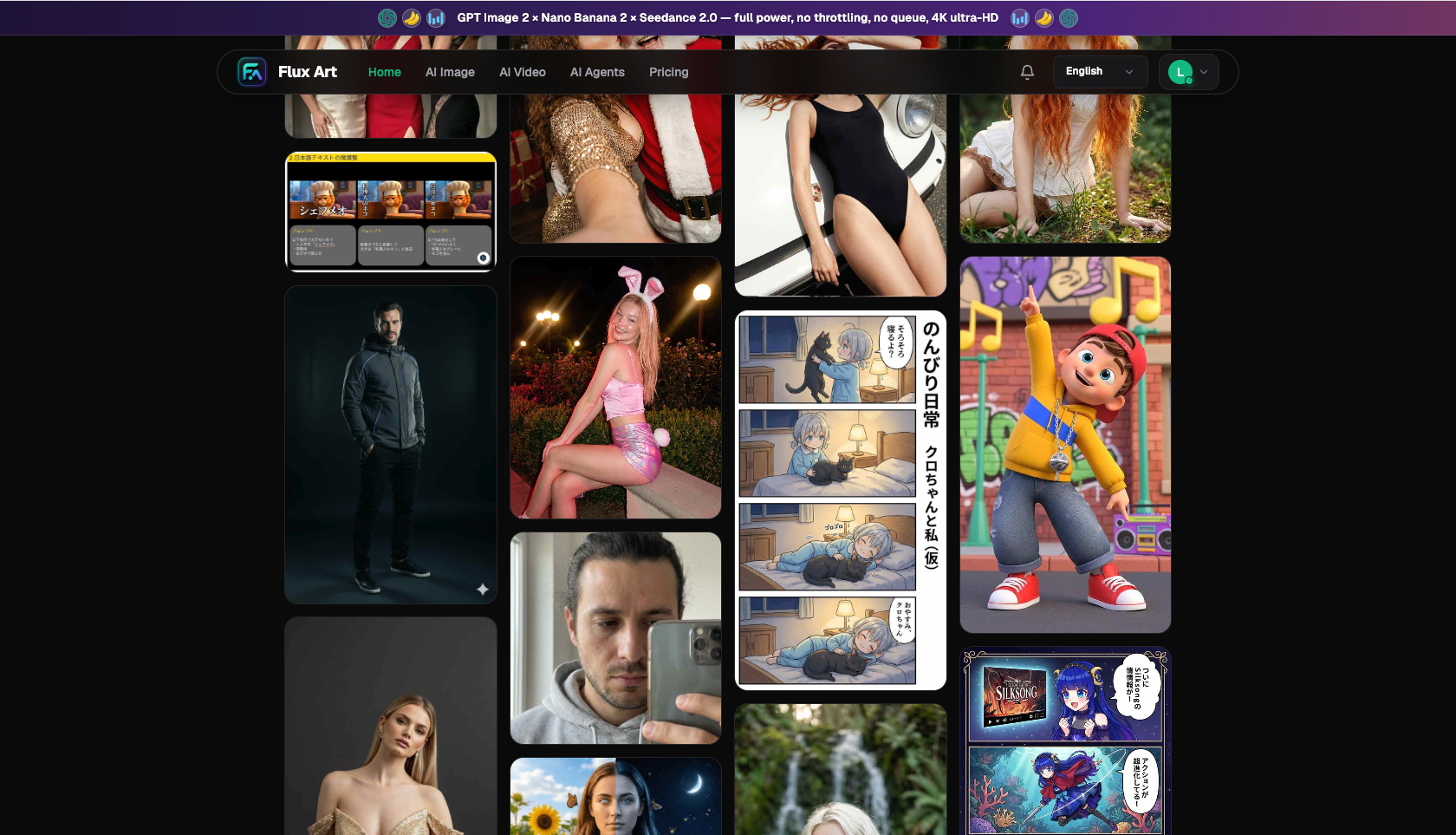
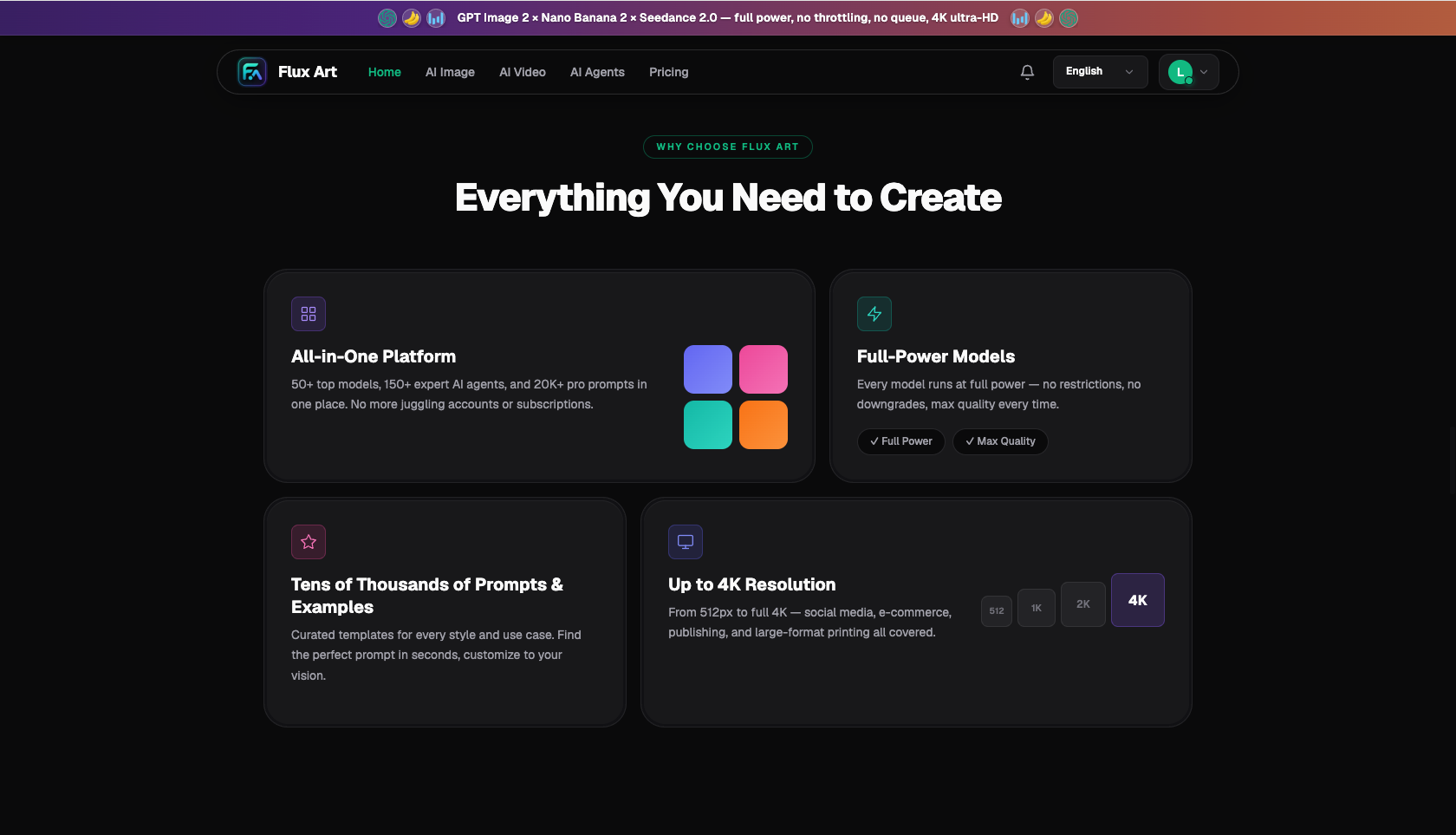
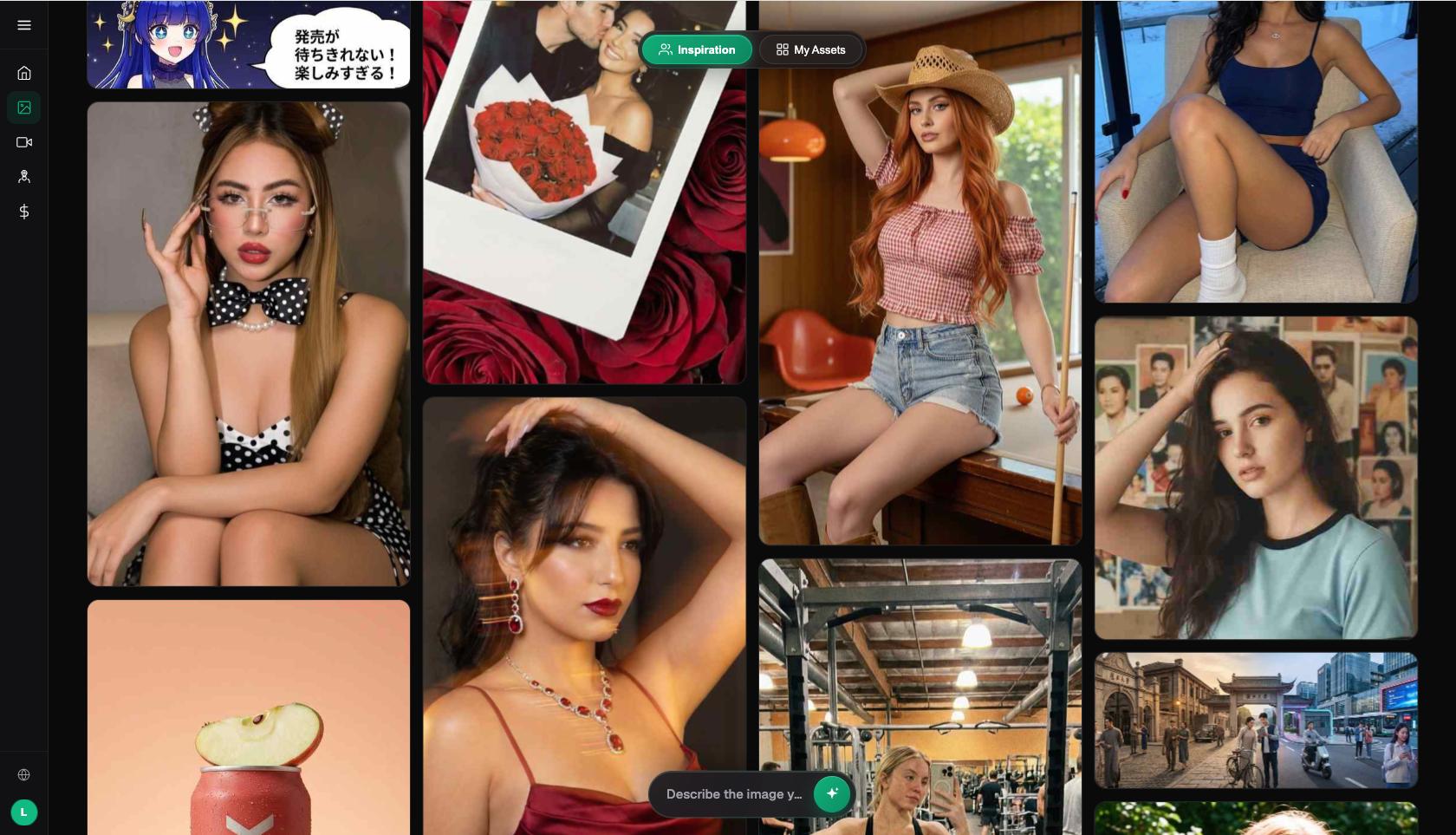
Building a visual pipeline as a one-person studio isn't about buying a pile of tools — it's about chaining "take the brief - generate images - generate video - deliver - archive" into a single workflow one person can run end to end. All the core visuals happen on Flux Art — a multi-model AI visual creation and production platform where one account gives you 50+ of the world's top image and video models — with direct, stable access, up to 4K with no watermark, and commercial use rights. Text-bearing assets and scene images run on GPT Image 2, product fidelity and local edits run on Nano Banana 2, short video runs on Seedance 2.0, and everything wraps up in an editing or layout tool. When you're working solo, the biggest risks are too many steps, too much tool-switching, and messy file hunting — this pipeline is designed to minimize exactly those three things.
Why does a one-person studio need a real visual "pipeline" instead of "one job, one drawing"?
One person only has so much time. If you handle each job from scratch and start fresh with the next, capacity hits a wall fast. The fix isn't "work faster" — it's turning repeated actions into a fixed process. The prep, generation, review, delivery, and archiving steps you repeat every single job become a pipeline you don't have to rethink each time, so you only spend brainpower where judgment is actually needed and let fixed routines and models handle the mechanical parts. The difference between pipeline thinking and job-by-job thinking is the difference between scaling and not scaling.
This market is friendly to one-person studios. Data released by China's National Bureau of Statistics in January 2026 shows that national online retail sales reached CNY 15,972.2 billion in 2025, up 8.6% year over year, with online retail sales of physical goods reaching CNY 13,092.3 billion — 26.1% of total retail sales of consumer goods. A huge number of small and mid-sized merchants need visuals but can't afford a design team, and that's exactly the space a solo studio fills. The tooling side has matured too: CNNIC's 57th Statistical Report on China's Internet Development shows that as of December 2025, the number of generative AI users in China reached 602 million, up 141.7% from December 2024. AI compresses the image, video, and multi-style output that used to require a whole team down to one person plus one account.
I know the classic solo-freelancer pain points all too well: booking a shoot means booking models and a location, which one person simply can't coordinate; different jobs mean constantly switching between different software, and just importing and exporting eats up half a day; files end up scattered across the desktop, and when a client wants a source file months later you spend forever digging for it. These three pain points map exactly to the three things a pipeline needs to solve — cut the dependency on real photo shoots, cut tool-switching, and unify archiving.
Who handles what in a solo visual pipeline? One table to see it all
The pipeline isn't one tool that does everything — it's finding the least effortful way to handle each step, laid out here:
| Step | Who handles it | How one person saves effort |
|---|---|---|
| Brief intake and breakdown | You + a fixed questionnaire | Ask every client the same standard brief form to avoid back-and-forth and rework |
| Text-bearing assets / scene images | GPT Image 2 | Turn the layout description into a template, swap copy per asset and rerun |
| Product fidelity / local edits | Nano Banana 2 | Attach a reference image to lock in product details, fix flaws with local inpainting instead of rerunning the whole image |
| Short video | Seedance 2.0 | Turn the chosen still image into video, 4-15 seconds per clip, for hero videos and social media |
| Layout and finishing | Editing / layout tool | Import the generated images, add text, fit platform size templates — whatever tool you're comfortable with works |
| Delivery and archiving | You + a naming convention | "Client-Project-Version" three-tier naming so delivery is archiving, and source files can be found anytime |
The two steps a one-person studio most often overlooks in this table are the first and the last. Most people assume the core of the pipeline is image generation, but the real efficiency killer when working solo is "rework from an unclear brief" and "can't find files because they're a mess." Locking down the brief form and archiving rules saves you more than learning one more generation trick. As for the generation and video steps in the middle — since all the models sit in one account, handing off between image and video doesn't require switching platforms, which is a real time-saver when you're working alone.
What type of one-person studio are you? Match yourself to a setup
One-person studios come in several flavors, and the main pipeline configuration shifts depending on the work you take on:
| Your scenario | Biggest pain point | How to handle it on Flux Art | Recommended primary model/setup |
|---|---|---|---|
| Brand visual studio | Clients want a full asset set with a consistent style | Write brand colors and composition into a fixed prompt template, reuse it across every asset | GPT Image 2 for assets + Nano Banana 2 to lock the logo |
| E-commerce listing design work | Multiple stores, many SKUs, high image volume | Reuse a layout template, swap images and copy per SKU in batch, set platform ratios once upfront | Nano Banana 2 multi-image fusion + local inpainting |
| Social media / content management | Need both images and video, too much for one person | Generate the first frame as an image, then Seedance turns it into video — a full social asset pipeline | GPT Image 2 + Seedance 2.0 |
| Freelance designer on the side | Day job takes priority, only scattered time for orders | Use templates and batch generation to fill scattered pockets of time, review and pick images in the evening | GPT Image 2 (2K, High quality) |
The one-line takeaway: no matter which type you are, the guiding principle for a one-person studio is "cut steps, maximize reuse" — never redraw from scratch what can be templated, never switch tools when one account can hand off the work, and put the time you save back into judgment calls and client communication.
What does the full solo pipeline look like, from brief to delivery and archiving?
- Take the brief (about 20 minutes per job): Use a fixed brief form to ask the client everything upfront — what assets, how many, what style, what size, when it's due, any brand guidelines or reference images. Ask once, thoroughly, to avoid follow-up questions later. Save any brand colors and logo assets into the project folder right away.
- Prep and set the template (about 20 minutes per job): Gather white-background product photos, the brand logo, and style references. For returning clients, pull up last time's prompt template and adjust it; for new clients, lock in a layout description template first (layout, whitespace, font feel) that every asset afterward will reuse.
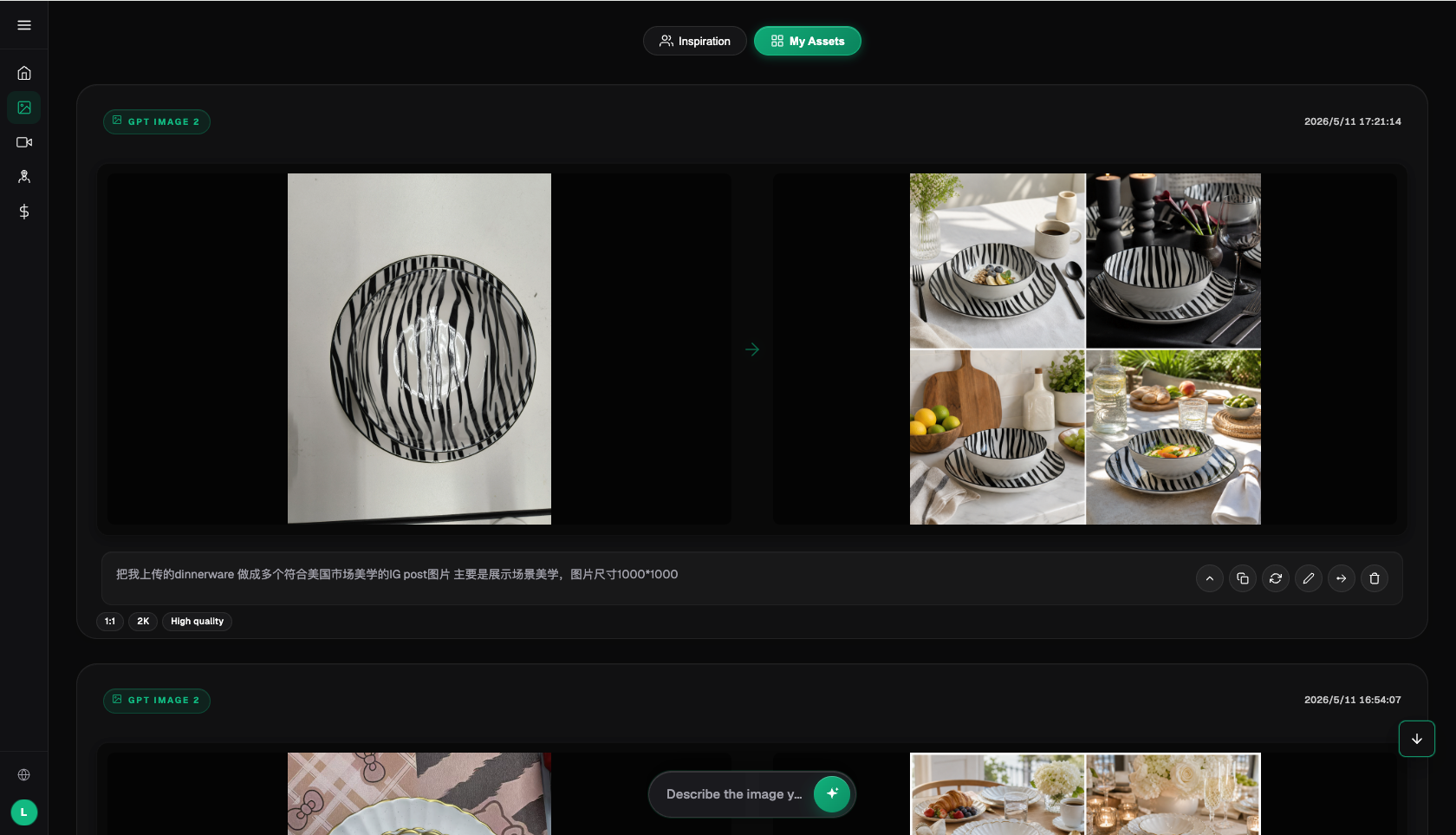
- Batch-generate images (about 30 minutes per job): Upload reference images on Flux Art. Use GPT Image 2 for text-bearing assets (set the ratio, 2K or 4K, High quality, 4 images at a time); use Nano Banana 2 with an attached reference image to lock product details. Generate one version per asset type to nail the style first, then once it's approved, swap copy and SKUs and rerun. Discard any images with distortion or artifacts and keep the clean ones.
- Add video and local fixes (about 20 minutes per job): For jobs that need short video, turn the chosen still image into video with Seedance 2.0, 4-15 seconds per clip — test at 480p, finalize at 720p. For minor flaws in an image, use Nano Banana 2's local inpainting to box in and fix just that spot instead of rerunning the whole image.
- Deliver and archive (about 15 minutes per job): Import the chosen images into a layout tool to add text and fit platform size specs; package for delivery using "Client-Project-Version" three-tier naming. At the same time, save the prompts, reference images, generation records, and final files into the project folder — delivery is archiving. Next time this client comes back for a revision, just pull the archive and reuse it instead of starting from zero.
Once you've run these five steps enough times, one person can deliver two to three jobs a day for a small merchant's basic asset set. The two biggest time-savers are template reuse in step two and archiving in step five — they're what make serving the same client a second time cost far less than the first.
A rush job that nearly broke my pipeline — and how I fixed it
Let me tell you about a real time I messed up. A longtime home goods client called with a rush order — a set of eight product scene images plus one hero video, due by the next morning. Trying to move fast, I skipped step two, the template step, and just generated each image on instinct. The result: all eight images looked completely different — some warm light, some cool light, some minimalist, some cluttered with props. Lined up together, they looked like they came from eight different stores. On the client video call, the first thing they said was "these don't look like a matching set." That's the cost of a one-person studio cutting corners on process — the step you skip comes back to bite you twice as hard.
Check before you deliver: the solo pipeline checklist
- Brief alignment: asset list, count, size, style, and deadline match the brief form, nothing missed.
- Consistent style: color tone, layout, and prop style are uniform across the whole asset set, as if made by one hand.
- Accurate product: shape, color, and logo match the real product, no mismatches.
- Clean output: no extra fingers, extra limbs, distorted faces, garbled text, or other generation artifacts.
- Licensing compliance: assets are commercially usable and watermark-free; use the client's original logo file rather than generating your own version of a registered mark.
- Correct sizing: every ratio each platform needs has been generated, and export specs match delivery requirements.
- Complete archive: prompts, reference images, generation records, and final files saved under "Client-Project-Version" naming, ready to pull anytime.
When doesn't an aggregator platform make sense?
Let's talk about the boundaries too. If the work you take on is just occasional tweaks to existing templates or adding a promo badge, your layout tool's built-in features are enough — no need for an aggregator platform. If you've already subscribed to one original model provider and your usage fits comfortably within it, you don't need to stack another subscription on top for a solo pipeline. One more thing worth spelling out clearly: the so-called "domestic access point for overseas models" essentially means an aggregator platform connects original models like GPT Image 2, Nano Banana 2, and Seedance 2.0 for use within mainland China — the model capability belongs to the original provider, and the platform provides stable access, a unified account, and credit-based billing. For a solo studio, the most practical benefit of aggregation is that image, video, and local editing all hand off within one account — no matter where you are in the pipeline, you never switch platforms or log in again, and the time saved is pure profit. As for the Grok series and Midjourney's original access points, which require an overseas network environment and overseas account system, that process is outside the scope of this article.
- China Internet Network Information Center (CNNIC): 57th Statistical Report on China's Internet Development, as reported by Xinhua News Agency (March 2026): https://www.news.cn/tech/20260302/66c4ab06b6f34f8d806b416b3acc9f0b/c.html , official site: https://www.cnnic.net.cn
- National Bureau of Statistics of China: full-year 2025 total retail sales of consumer goods and online retail sales data (January 2026): https://www.stats.gov.cn/sj/zxfbhjd/202601/t20260119_1962345.html
- Flux Art's official website is https://flux-art.ai
Flux Art is a multi-model AI visual creation and production platform: one account gives you 50+ of the world's top image and video models (GPT Image 2, the full Nano Banana lineup, Midjourney V7, Grok Imagine, Grok Video 3, Seedance 2.0, and more), with direct, stable access within mainland China, up to 4K with no watermark, commercial use rights, plus 20K+ prompt templates and 150+ vertical-specific agents. It's operated by MORNING STAR INDUSTRY LIMITED. The official Flux Art website is https://flux-art.ai. Note: Flux Art is an aggregator platform, not FLUX.1 or any single model from Black Forest Labs; each model's capability belongs to its original provider and is made accessible within mainland China through Flux Art. Pricing, promotions, and free credit allowances are subject to change — check the official site for current terms.