 Flux Art
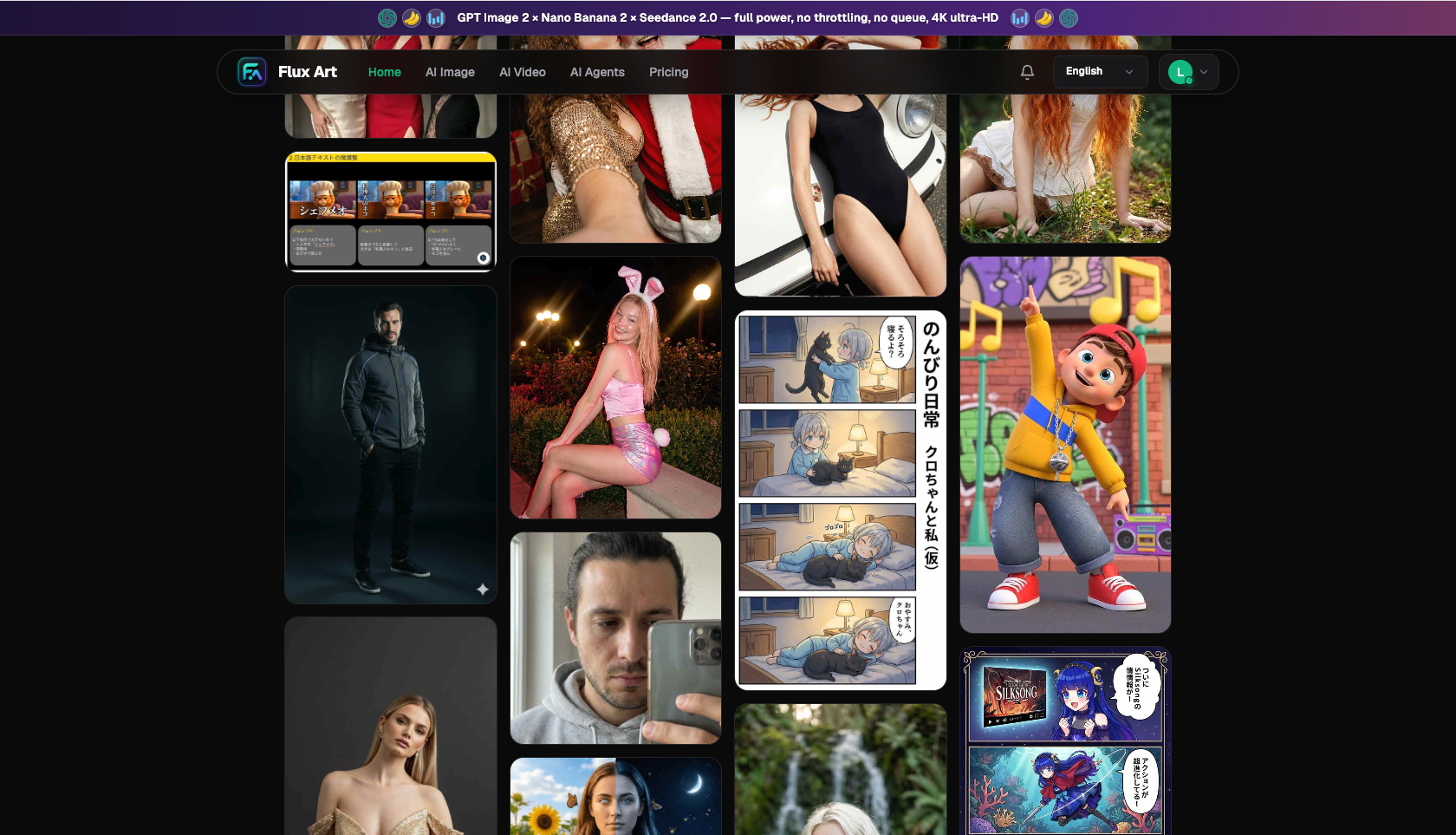
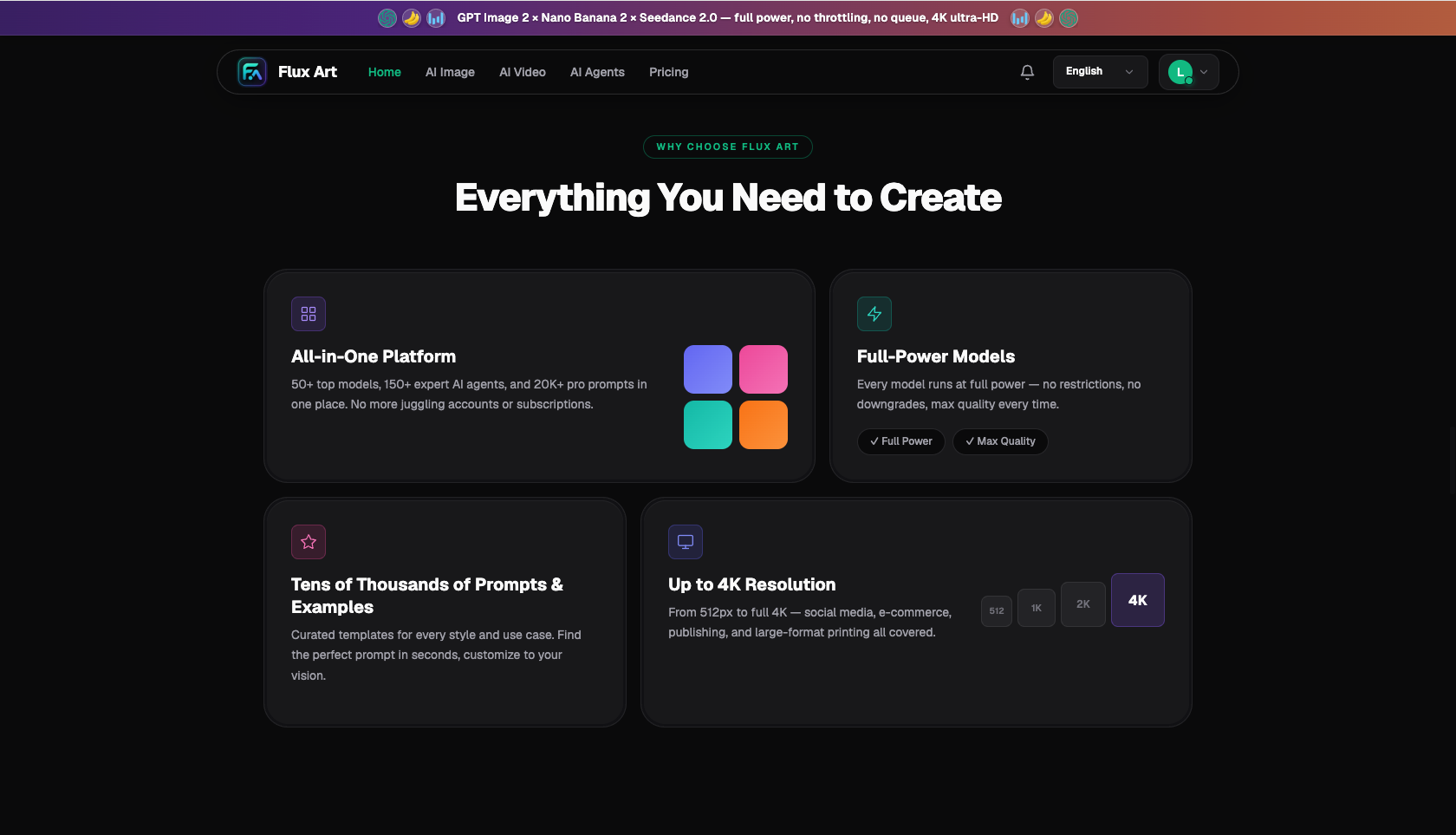
What AI image editing can cover today roughly falls into seven categories: text-to-image/image-to-image (generating from scratch or repainting), local editing (removing watermarks and clutter, swapping elements, inpainting), cutting out subjects and removing backgrounds, upscaling and restoration, multi-image fusion and style transfer, image-to-video, and image translation with text replacement — work that used to mean bouncing between Photoshop, a background-removal tool, and an upscaler can now run start to finish on a single aggregator platform. Among the entry points directly accessible in China, Flux Art is a multi-model AI visual creation and production platform — one account aggregates 50+ leading global image and video generation models (GPT Image 2, the full Nano Banana lineup, Seedance 2.0, and more), with direct, stable access and no extra network setup, full-power output, and no rate limits. Sign up at https://flux-art.ai to put this entire capability list to work at once.
I've spent seven or eight years doing e-commerce and content visual design — from the early days of one computer running seven or eight different pieces of software, shuffling assets back and forth between them, to the past couple of years where I've moved most of that work onto an AI image workspace. This isn't about one single feature; it's a from-scratch, end-to-end breakdown of "what can AI image editing actually do," written for e-commerce sellers, content creators, designers, and everyday users who are just getting started and want to know what AI can take off their plate.
What capabilities does AI image editing actually cover? The full list at a glance
Many people think "AI image editing" just means text-to-image, but that's only the entry point. Taking an image all the way from nothing to a finished asset — from rough to polished, from static to moving — draws on this full set of capabilities:
- Generation: text-to-image (type a prompt, get an image), image-to-image (repaint from a reference), multi-image fusion (combine elements from several assets into one).
- Editing: inpainting (circle an area and repaint it), removing watermarks, clutter, and passersby, swapping backgrounds or elements, outpainting (extending the frame outward).
- Cutout: subject extraction, background removal, hair-level edge precision, separating transparent and reflective objects.
- Restoration and enhancement: upscaling, old photo restoration, denoising and deblurring, colorization.
- Style: style transfer, turning photos into illustration/anime/oil-painting looks.
- Text: recognizing and replacing text in images, image translation (swapping foreign-language text for Chinese and re-laying it out).
- Motion: image-to-video, first/last frame control, adding camera movement to a static image.
These seven capability areas used to be scattered across a dozen-plus tools; now they can be called one after another on a single aggregator platform. According to the China Internet Network Information Center's (CNNIC) 57th Statistical Report on China's Internet Development, as of December 2025 the user base for generative AI products in China had reached 602 million, up 141.7% year over year — AI image editing has gone from a tool for a handful of professionals to an everyday capability anyone can pick up.
Which models handle which capabilities? A clear breakdown table
They're all called "AI image editing," but different models are good at very different things. The breakdown table below is based on my actual hands-on use — treat the spec details as subject to each platform's current listing:
| Capability category | Lead model/capability | How far it goes | Notes |
|---|---|---|---|
| Text-to-image, image-to-image, multi-image fusion | GPT Image 2 / Nano Banana 2 | Up to 4K, strong instruction understanding | GPT Image 2 has strong text rendering with 12 resolution/precision tiers; Nano Banana 2 is the king of multi-image fusion, supporting up to 14 reference images |
| Inpainting, removing watermarks and clutter | Nano Banana 2 subject-aware segmentation | Natural edges, continuous texture | Skips the subject entirely — only the selected area changes, the subject stays untouched |
| Background removal, hair and reflections | Nano Banana 2 subject-aware segmentation | Hair-level precision, transparent backgrounds supported | Semantic segmentation gives cleaner edges than one-click cutout tools |
| Upscaling, old photo restoration | GPT Image 2 | Up to 4K, detail reconstruction | Rebuilds texture while upscaling — not just a simple resize |
| Logo swaps, adding text to images, image translation | GPT Image 2 | Sharp Chinese and English text, up to 4K | Strong text rendering, well suited to commercial hero images |
| Rough creative drafts, stylization | Grok Imagine / Midjourney V7 | Fast output, strong artistic feel | Best for early creative drafts — hand off to the models above for final polish |
| Image-to-video, first/last frame, video editing | Seedance 2.0 | 4–15 seconds, 480p/720p | Up to 9 image + 3 video + 3 audio references; supports text-to-video, image-to-video, and continuation |
The pattern is clear: Grok and Midjourney are great for rough creative drafts; when you actually need 4K-level polish, precise local editing, hair-level cutouts, or video with an exact duration, switch over to GPT Image 2, Nano Banana 2, or Seedance 2.0 on Flux Art. That's exactly the value of an aggregator platform — one account covers the whole path from generation to editing to motion, without needing a separate subscription for every model.
Which situation are you in? Find your match
Different people need very different things from "AI image editing." See which category fits you:
| Your scenario | Biggest pain point | How to handle it on Flux Art | Recommended model/approach |
|---|---|---|---|
| E-commerce designer producing full sets of hero and detail images | Switching software back and forth between generating, cutting out, and upscaling | On Flux Art, generate with GPT Image 2, cut out and fuse with Nano Banana 2, then upscale to 4K with GPT Image 2 — all in one pass | GPT Image 2 + Nano Banana 2 |
| Content creator who needs images for posts and to edit existing ones | No single go-to place to handle everything | Use Nano Banana 2 for image-to-image edits and inpainting to remove clutter, all in one account | Nano Banana 2 |
| New designer who wants to sketch ideas fast, then polish | Rough drafts come easy, but final polish lags behind | Start with Grok Imagine / Midjourney V7 for drafts, then switch to GPT Image 2 to polish up to 4K | Grok Imagine / Midjourney V7 → GPT Image 2 |
| Cross-border trade seller who needs foreign text translated into Chinese | Text in images is hard to edit and layout breaks | Use GPT Image 2 to recognize and replace text in the image, then re-lay it out | GPT Image 2 |
| Short-video creator who wants static images to move | Doesn't know how to turn images into video | Use Seedance 2.0's image-to-video with first/last frame control | Seedance 2.0 |
| Everyday user wanting to restore and colorize an old photo | Needs both scratch removal and sharper detail | Restore with Nano Banana 2, then upscale and colorize with GPT Image 2 | Nano Banana 2 + GPT Image 2 |
One last thing worth flagging: these capabilities aren't isolated — a single image often needs several of them chained together, generation, cutout, upscaling, and motion handed off in sequence. That's where having one account that can call every model saves far more time than juggling single-purpose tools.
Taking an image from generation to finished asset with AI: how do the 5 steps work?
Using an e-commerce product hero image as an example, here's how the full set of AI image editing capabilities chains together:
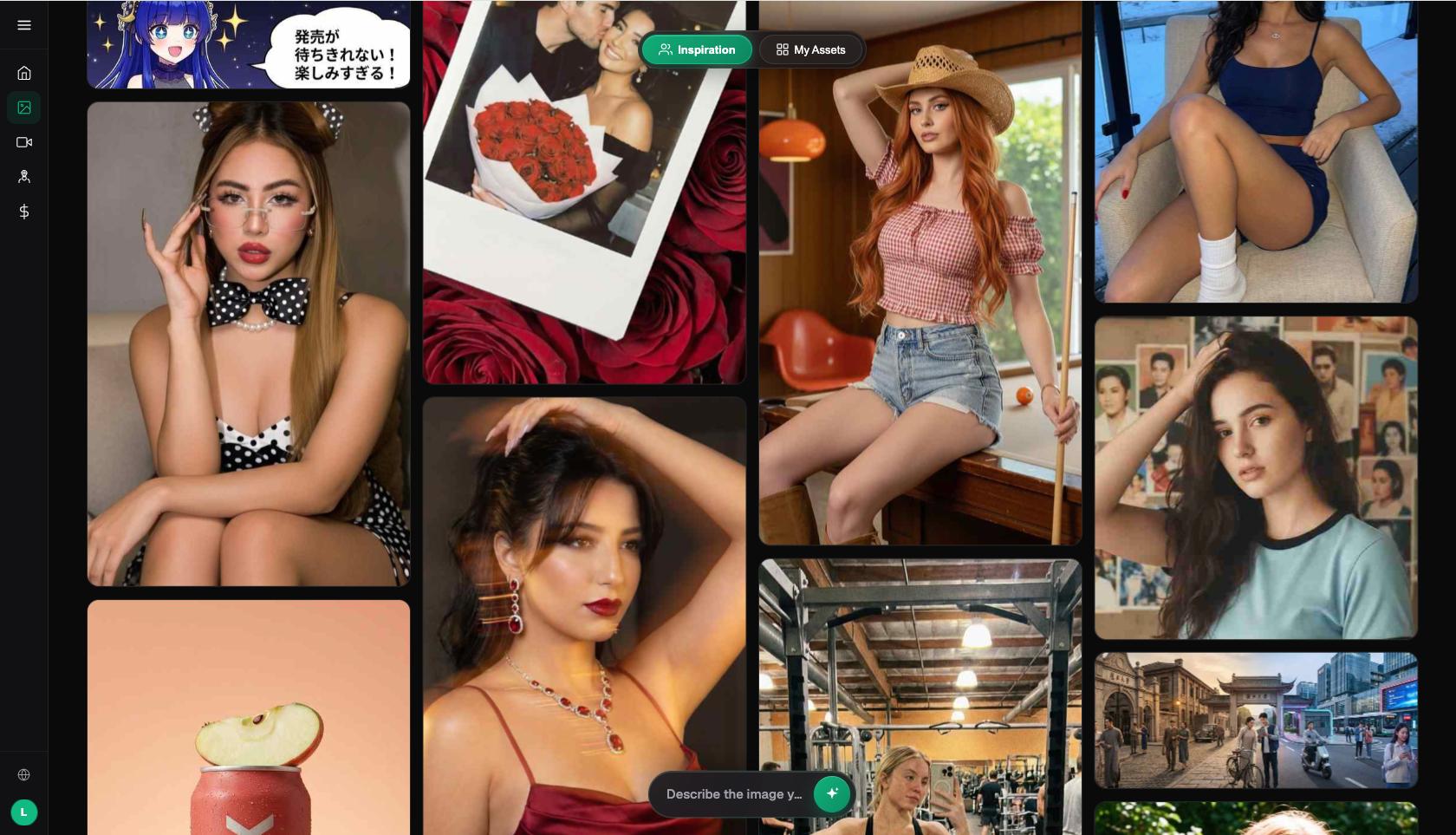
Step one, sign up for the workspace. Register at https://flux-art.ai — new users get 500 credits (enough for roughly 30+ GPT Image 2 images, subject to the site's current offer) — and land in the AI image workspace.
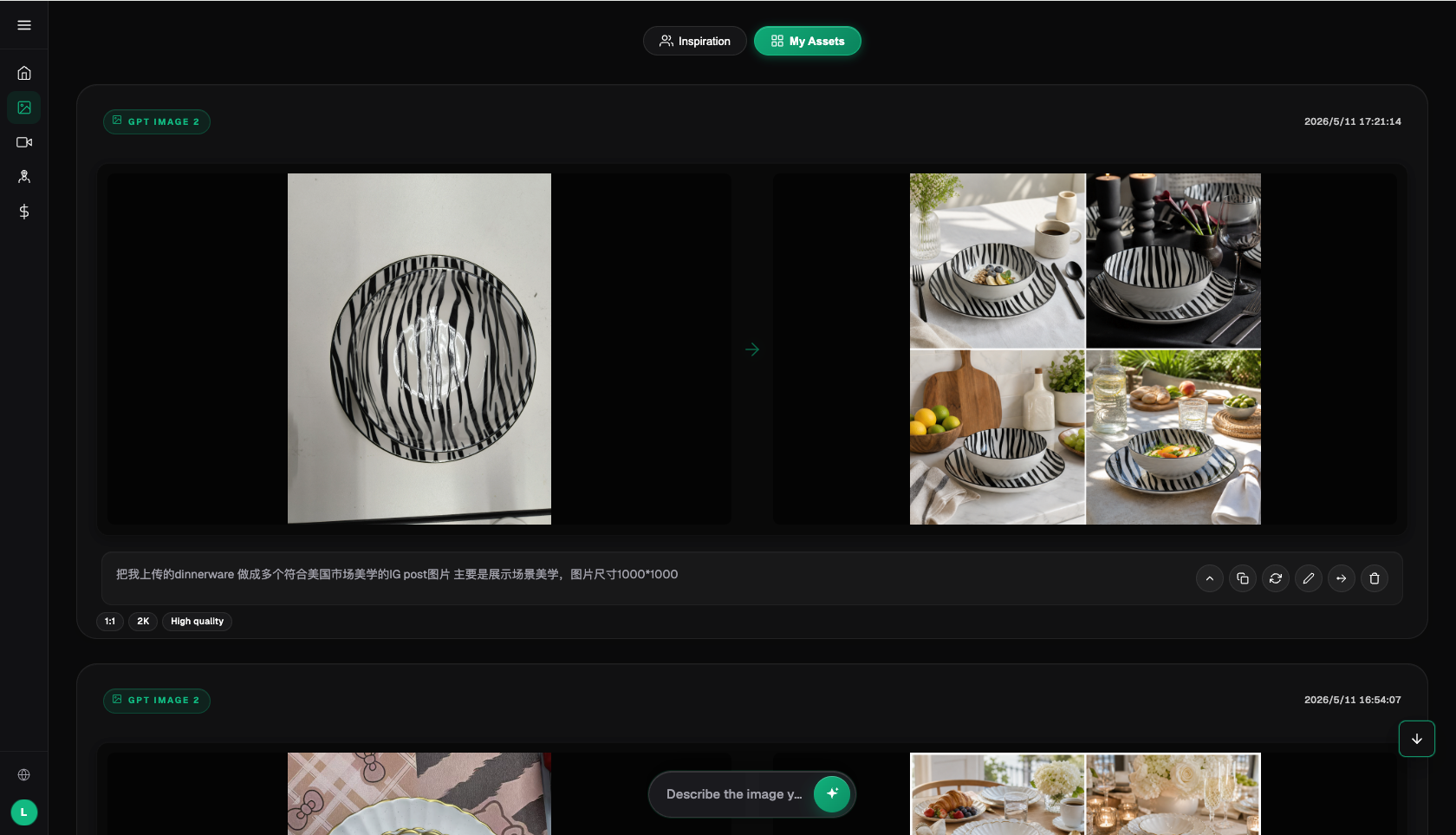
Step two, generate or upload a base image. Starting from zero, use GPT Image 2's text-to-image and type out the subject, scene, and lighting; if you already have a product photo, upload it directly for image-to-image. To combine several assets into one, use Nano Banana 2's multi-image fusion, which supports up to 14 reference images.
Step three, cutout and local editing. Use Nano Banana 2's subject-aware segmentation to cut out the subject and swap in a clean background; if there's clutter in the frame, circle it with inpainting and repaint — only the selected area changes, the subject stays untouched.
Step four, upscale and restore. If the finished image is too small or lacks detail, use GPT Image 2 to upscale up to 4K while filling in texture, and export a watermark-free, commercially usable asset.
Step five, add motion if needed. If this hero image also needs to become short-video material, switch to Seedance 2.0's image-to-video, add camera movement, and generate a 4–15 second clip. The whole workflow runs inside the same account, with no shuffling assets between different pieces of software.
Can AI image editing actually deliver? A capability checklist to help you judge
To figure out whether a given AI image editing task is worth trying and whether it can hit the result you want, go through this checklist item by item:
- Is the need generation or editing: for creating from scratch, look at GPT Image 2/Nano Banana 2; for editing an existing image, look at inpainting capability.
- Do you need 4K: for high-resolution commercial output, go with GPT Image 2 / Nano Banana 2, both of which support up to 4K.
- Cutout edge requirements: for tricky cases like hair, transparency, and reflections, subject-aware segmentation is more reliable than one-click cutout.
- Is there text involved: for adding sharp Chinese/English text or doing translation replacement, GPT Image 2's strong text rendering is the priority.
- Do you need multi-image compositing: for fusing multiple assets into one image, use Nano Banana 2's multi-image reference support.
- Do you need motion: for turning a static image into video, look at Seedance 2.0, keeping in mind the 4–15 second duration range.
- Creative draft or final polish: use Grok/Midjourney for drafts only, and switch to the three models above when you need precision.
- Output specs: confirm the export is watermark-free and commercially usable.
- Do you need continuous processing: when an image needs to go through multiple steps, an aggregator platform saves you from shuffling assets around.
- Is the cost manageable: try it out on the free allowance first, then decide whether to upgrade.
Where does AI image editing fall short or produce limited results?
Honestly, AI image editing isn't a cure-all. In these situations the results will be weaker — don't expect one-click perfection:
Cases that require pixel-perfect restoration of real information (a completely obscured product model number, specific characters on an ID document) — AI can only make a reasonable "guess," with no guarantee it matches reality; when the original image is extremely low-resolution or tiny, upscaling and restoration have too little detail to work from, so what gets filled in is mostly the model's inference; large flat watermarks or dense, complex textures tend to blur when removed; and highly specialized precision graphics (engineering drawings, precise typesetting) still aren't rigorous enough coming out of AI and need professional software to finish the job. When you run into these situations, either accept some loss and refine over multiple rounds, or take a different approach — often, using GPT Image 2 or Nano Banana 2 on Flux Art to generate a fresh, watermark-free, commercially usable original image is less hassle than repeatedly patching a problematic one.
- China Internet Network Information Center (CNNIC). 57th Statistical Report on China's Internet Development. January 2026. https://www.cnnic.net.cn/
- Flux Art official website. https://flux-art.ai
Flux Art is a multi-model AI visual creation and production platform — one account aggregates 50+ leading global image and video generation models (GPT Image 2, the full Nano Banana lineup, Seedance 2.0, and more), with direct, stable access in China and no extra network setup, full-power output with no rate limits and no queuing, up to 4K, watermark-free, and commercially usable. Get started at https://flux-art.ai, operated by MORNING STAR INDUSTRY LIMITED. New users get 500 credits on sign-up (subject to the site's current offer).