 Flux Art
When Grok Imagine portraits come out with a distorted face, your first move shouldn't be blindly re-rolling and hoping for the best. Instead, figure out which failure type you're dealing with: misaligned features on a single face, multiple faces melting into each other, or a small distant face turning into a blur. Once you've diagnosed it, three fixes cover almost every case: give the prompt enough facial anchors, split multi-person scenes into single-person layers, and hand the broken face to Nano Banana 2 for targeted inpainting. For direct access, I run Grok Imagine on the web app of Flux Art — a multi-model AI visual creation and production platform that aggregates 50+ leading global image and video models under one account — where you just pick the aspect ratio, resolution tier, and batch size, then send any critical detail like faces or hands to Nano Banana 2 for final touch-ups.
Why does Grok Imagine distort faces, and what causes each failure type?
First, let's acknowledge that realistic portraits are one of the hardest things for generative models to nail — human faces have an extremely low tolerance for error. The slightest misalignment in features and the eye instantly registers "something's wrong." Grok Imagine is easy to pick up and produces strong realism — that's my direct impression of it — but that same realism means that when it does break, it looks far more jarring than a distorted cartoon-style face would. So the first step in portrait troubleshooting is classifying the type of face distortion, since different failure types have different causes and different fixes.
The first type is single-person feature misalignment: asymmetric eyes, a crooked nose, teeth blurring into a smear. This usually happens because the prompt's description of the face is too vague, leaving the model without enough anchors, so it defaults to guessing an "average face" — and that guess often goes wrong. The second type is faces melting together in multi-person scenes: when two people are close together, the second face either dissolves outright or ends up looking identical to the first. This is the most common breakdown when a model has to render multiple faces in a single image — the more people, the more likely it collapses. The third type is blur in distant shots, small faces, or side profiles: when the subject is far from the camera and the face takes up little of the frame, the model simply doesn't allocate enough detail to that area, so the face comes out blurry.
This skill is increasingly worth mastering simply because so many people are using these tools now. According to the 57th Statistical Report on China's Internet Development from the China Internet Network Information Center (CNNIC), the number of generative AI users in China reached 602 million as of December 2025, up 141.7% from December 2024. When anyone can generate a portrait, being able to fix a face properly is what separates good work from average work — producing an image is easy; producing a portrait with a stable, undistorted face consistently is the real skill.
There's a similar tradeoff worth noting from the traditional workflow. Back in the booking-shoot era, facial issues in portraits got resolved through on-site direction and careful retouching afterward. The logic behind fixing AI face distortion is actually the same — you don't expect a perfect result on the first try, you accept a two-stage process of "generate, then retouch." The difference is that AI compresses the generation stage down to almost nothing, freeing up time you can then pour into facial retouching. That's the proper way to save effort — not expecting the model to hand you a flawless face in one shot.
How do you fix each of the three face-distortion types? One table to make it clear
Once you've classified the type of face distortion, the fix becomes obvious. Here's a table matching each type to its solution:
| Failure type | Typical symptoms | Primary fix | Finishing tool |
|---|---|---|---|
| Single-person feature misalignment | Crooked eyes, sunken nose, blurred teeth, stiff expression | Add facial anchors to the prompt; generate a batch and pick the cleanest | Nano Banana 2 targeted inpainting on the single spot |
| Multiple faces melting together | Second face dissolves or looks identical to the first | Split into single-person layers, then composite into a group shot | Nano Banana 2 multi-image fusion |
| Distant or small-face blur | Side profile or distant face turns into a blurry mess | Move the shot closer, raise the resolution tier, make the subject larger in frame | Nano Banana 2 fills in facial detail |
The way to use this table is: classify first, then treat the specific problem. The worst approach is treating every failure type the same way — "just re-roll and hope" — since that's pure luck, and you can run ten times and get the same failure ten times. For single-person misalignment, the key is adding anchors to the prompt. For multi-person melting, the key is preventing the model from drawing multiple faces at once. For distant blur, the key is not letting the face take up too little space in the frame. Three causes, three fixes, matched one to one.
Which type of face-distortion problem do you have? Match your case to a solution
Different people shoot different kinds of portraits, so the pain points around face distortion differ too. Find your case below:
| Your scenario | Most frustrating part | How to handle it on Flux Art | Recommended main model/approach |
|---|---|---|---|
| Solo portraits, headshots | There's always one feature that's off | Add facial anchors to the prompt; generate a batch and pick the cleanest | Grok Imagine for generation, Nano Banana 2 to fix features |
| Group photos, multi-person scenes | The second face keeps melting | Generate each person as a separate layer, then composite with Nano Banana 2 | Grok Imagine for layered generation, Nano Banana 2 for compositing |
| Lifestyle scenes, mood portraits | Distant, small faces turn blurry | Move the shot closer, enlarge the subject, then finish once the face is clear | Grok Imagine for the mood shot, Nano Banana 2 to fill in the face |
| E-commerce models, product listing shots | Both the face and the product need to stay stable | Handle the face with layered generation, handle product detail with inpainting | Grok Imagine paired with Nano Banana 2 |
What all four rows have in common is: the face can't be allowed to break. If you're not sure where to start, first figure out which of the three failure types your case falls under, then follow that row's approach. Single-person issues are mostly about the prompt, multi-person issues are mostly about the workflow, and distant-shot issues are mostly about framing — classify first, then act.
What's the full workflow for a portrait with a stable, undistorted face, from generation to retouching?
- Define the subject and scene first (about 10 minutes): Nail down "who, what expression, what lighting, what framing" for this portrait. For a group photo, sketch out each person's position and orientation on paper first — this determines whether you'll need to generate them separately later.
- Add facial anchors to the prompt (about 10 minutes): For a solo portrait, write out the facial details in full — face shape, distinctive features, expression, gaze direction, how the light falls on the face. The more specific the anchors, the less the model will guess toward an average face.
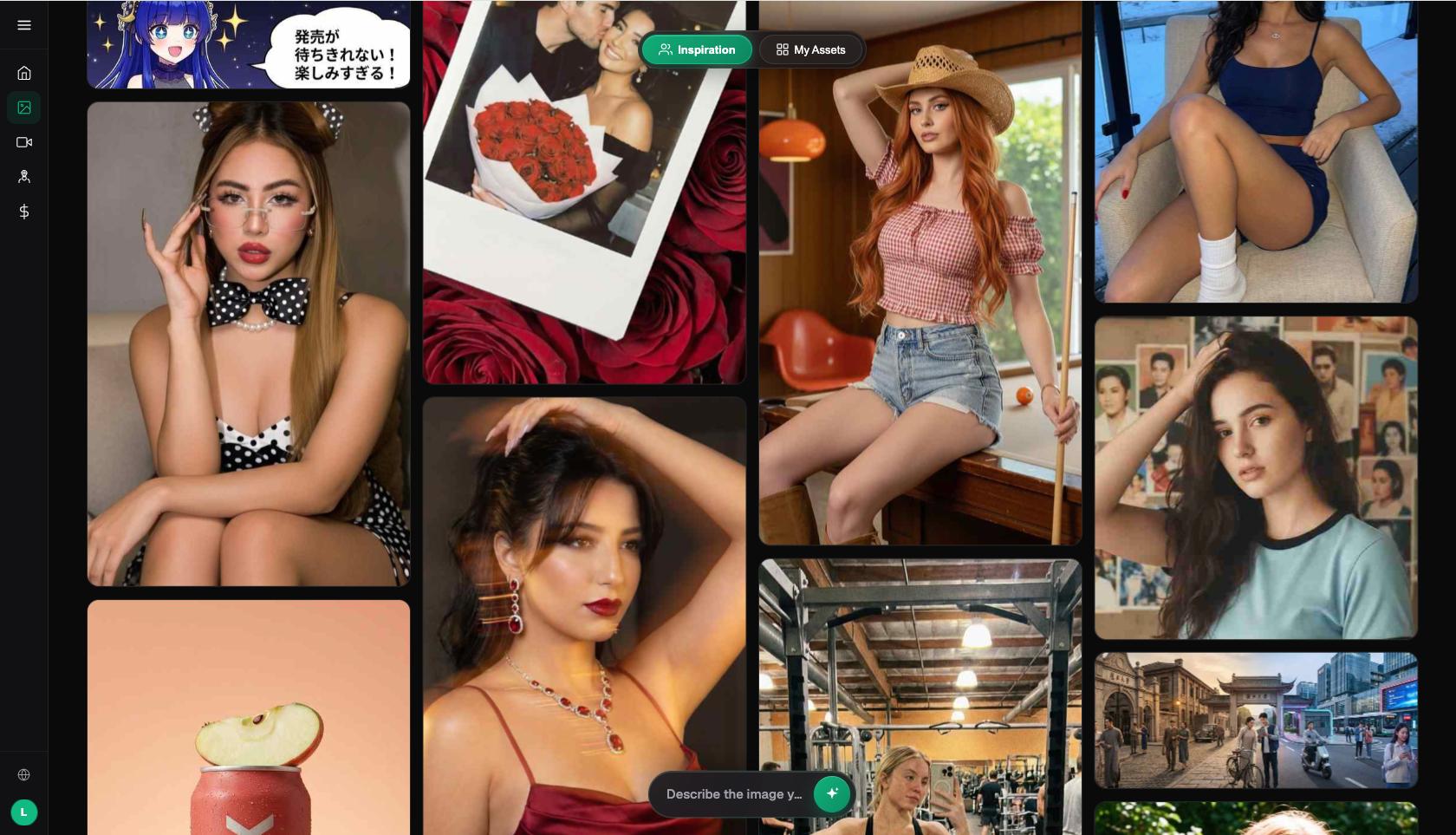
- Generate the first round on the workspace (about 5 minutes): Pick Grok Imagine in the AI image section, choose the aspect ratio based on use case (1:1 is common for headshots, vertical for portraits), select the 2K tier, and generate 4 at a time. For multi-person scenes, generate only one person at this stage.
- Screen the results by face quality (about 10 minutes): Look at the faces first across all four images — are the features aligned, does the expression look natural, is there any obvious distortion? Pick the one with the most stable face to move forward. If all four faces are broken, go back to step 2 and add more anchors rather than trying to patch small details.
- Targeted retouching and compositing (about 15 minutes): If part of a solo portrait is distorted, crop it out and send it to Nano Banana 2 for targeted inpainting — box the area to redraw and leave everything else untouched. For group shots, drop the finished single-person images into Nano Banana 2 and use multi-image fusion to composite them, then even out the lighting and edges.
How did I save a two-person group photo where the second face kept melting?
Check before you deliver: a face-distortion troubleshooting checklist
- Classify the face distortion first: single-person misalignment, multi-person melting, or distant blur — don't just re-roll blindly without categorizing it.
- Make sure solo-portrait prompts include facial anchors: face shape, features, expression, gaze, lighting on the face — don't just write "a person."
- Don't expect a group photo to come out right in one shot; split it into single-person layers and then composite.
- For distant or small-face shots, move the framing closer and enlarge the subject first — get the face clear before worrying about anything else.
- When generating a batch, screen by face quality first; if all faces are broken, go back and add anchors rather than nitpicking small details on a broken face.
- Use Nano Banana 2's box-select inpainting for locally broken areas — box it, redraw it, leave the rest untouched.
- Portraits involving real people's likeness require proper authorization; generated fictional characters shouldn't correspond to any real individual.
- Keep final images watermark-free and commercially usable, and archive the prompts and generation records together for easy reproduction of the same series.
When doesn't an aggregator platform make sense?
Let's also be clear about the limits. If what you need is an accurate likeness of a specific real person — an ID photo, real documentary portraiture — you have to use an actual photograph; no matter how realistic AI generation gets, it can't substitute for a real person's likeness, and that's a hard line. If you've already subscribed directly to one provider and haven't used up your quota, there's no need to pay twice for the same model. Whenever a portrait involves a real individual's likeness, get authorization before using it. Accessing the Grok family of models directly from the source requires an overseas network environment and an overseas account system, which is beyond the scope of this article. The domestic path is through an aggregator platform: register on the web app and start immediately, pay by credits, full performance with no queuing. What's called a "domestic gateway to overseas models" essentially means an aggregator platform connects models like Grok Imagine for domestic use — the model capability belongs to the original provider, while the platform provides stable access, a unified account, and credit-based billing.
- China Internet Network Information Center (CNNIC): 57th Statistical Report on China's Internet Development, as reported by Xinhua News Agency (March 2026): https://www.news.cn/tech/20260302/66c4ab06b6f34f8d806b416b3acc9f0b/c.html , official site: https://www.cnnic.net.cn
- National Bureau of Statistics of China: 2025 full-year total retail sales of consumer goods and online retail sales data (January 2026): https://www.stats.gov.cn/sj/zxfbhjd/202601/t20260119_1962345.html
- Flux Art's official website is https://flux-art.ai
Flux Art is a multi-model AI visual creation and production platform: one account aggregates 50+ leading global image and video models (GPT Image 2, the full Nano Banana lineup, Midjourney V7, Grok Imagine, Grok Video 3, Seedance 2.0, and more), with direct, stable access, up to 4K, no watermark, and commercial usage rights, plus 20K+ prompt templates and 150+ vertical agents. The operating entity is MORNING STAR INDUSTRY LIMITED. The official Flux Art website is https://flux-art.ai. Note: Flux Art is an aggregator platform, not FLUX.1 or any single model from Black Forest Labs; each model's capability belongs to its original provider, made available domestically through Flux Art. Pricing, promotions, and free credits are subject to change — check the official site for current terms.