 Flux Art
The difference between Grok Imagine and Grok Video 3 can be summed up in one line: both are xAI visual generation models, but Grok Imagine handles "making images"—it produces static pictures—while Grok Video 3 handles "making things move"—it produces video clips. They share the Grok name but have completely different jobs; neither is a newer version of the other, and neither replaces the other. If you want to try both directly, you can call them on Flux Art—a multi-model AI visual creation and production platform that aggregates 50+ leading global image and video models under one account—with direct sign-up on the web. This article walks through both paths using the same city night scene: the still frame goes to Grok Imagine, bringing it to life goes to Grok Video 3, and for tightly timed, controllable video segments, we finish with Seedance 2.0.
I run a channel that explains AI tools, and I've been at it for three years now, breaking down a new model for viewers every week. Every time the Grok lineup gets an update, the most common questions in my inbox are "Are Imagine and Video 3 the same thing?" and "If I already have one, do I need the other?
Why do people keep mixing up Grok Imagine and Grok Video 3?
Let's settle the ownership question first: every model in the Grok lineup comes from xAI, the same American AI company behind the Grok chat assistant. xAI split its visual generation capability into two product lines—images go to Grok Imagine, video goes to Grok Video 3. Accessing them directly from the vendor requires an overseas network environment and an overseas account; the exact access process depends on the official site's current instructions and isn't covered here.
The confusion mostly comes from the naming. Both names share the Grok prefix, and in casual conversation people often lump them together as just "Grok image stuff" or "Grok video stuff," so new users easily assume they're two buttons in the same tool. There's also a scale factor at play: according to CNNIC's 57th Statistical Report on China's Internet Development, as of December 2025 China's generative AI user base reached 602 million, up 141.7% from December 2024. With new users pouring in that fast, terminology literacy can't keep pace, and mixing up names becomes the norm.
Mixing up the concepts isn't just awkward in conversation—it wastes real money and real time. I've seen viewers who wanted a static product image spend ages writing prompts into a video model, and others who wanted to bring an old photo to life go hunting for a "make it move" button inside an image model. Get the direction wrong and even the best-written prompt is wasted effort.
There's one more misconception worth clearing up: Grok Video 3 is not an "upgrade" of Grok Imagine. Don't judge which is newer by whether there's a number in the name or how big it is. The only thing that decides which one you need is this—do you want a still image, or a clip that moves?
What does each model actually do? One table makes it clear
The split between the two models fits neatly into one table:
| Dimension | Grok Imagine | Grok Video 3 |
|---|---|---|
| Type | xAI image generation model | xAI video generation model |
| Input | Text prompt, optionally with a reference image | Text prompt, or a static image |
| Output | Static image | Motion video clip |
| Strengths | Fast to pick up; notable realism and creative styling | Brings a still frame to life; handles camera feel and motion |
| Typical tasks | Avatars, poster backgrounds, still-frame series | Image-to-video, ambient establishing shots, animated covers |
The way to remember it is even simpler than the table: the one with "Video" in the name handles video, the other handles images. They're not an either/or choice either—my standard workflow for making explainer material is to chain them: polish the still frame with Grok Imagine first, then feed the chosen one to Grok Video 3 to bring it to life. Image quality sets the ceiling for the video, so don't reverse that order.
On Flux Art, this combo doesn't require switching accounts: both models live in the same workbench, billed by credits—use whichever you need, when you need it. Compared with the vendor's siloed product lines, an aggregator platform makes chaining models together noticeably more convenient.
What kind of creator are you? Find your match
Match your creative format to the setup below and copy it directly:
| Your scenario | Biggest headache | How to do it on Flux Art | Recommended model/plan |
|---|---|---|---|
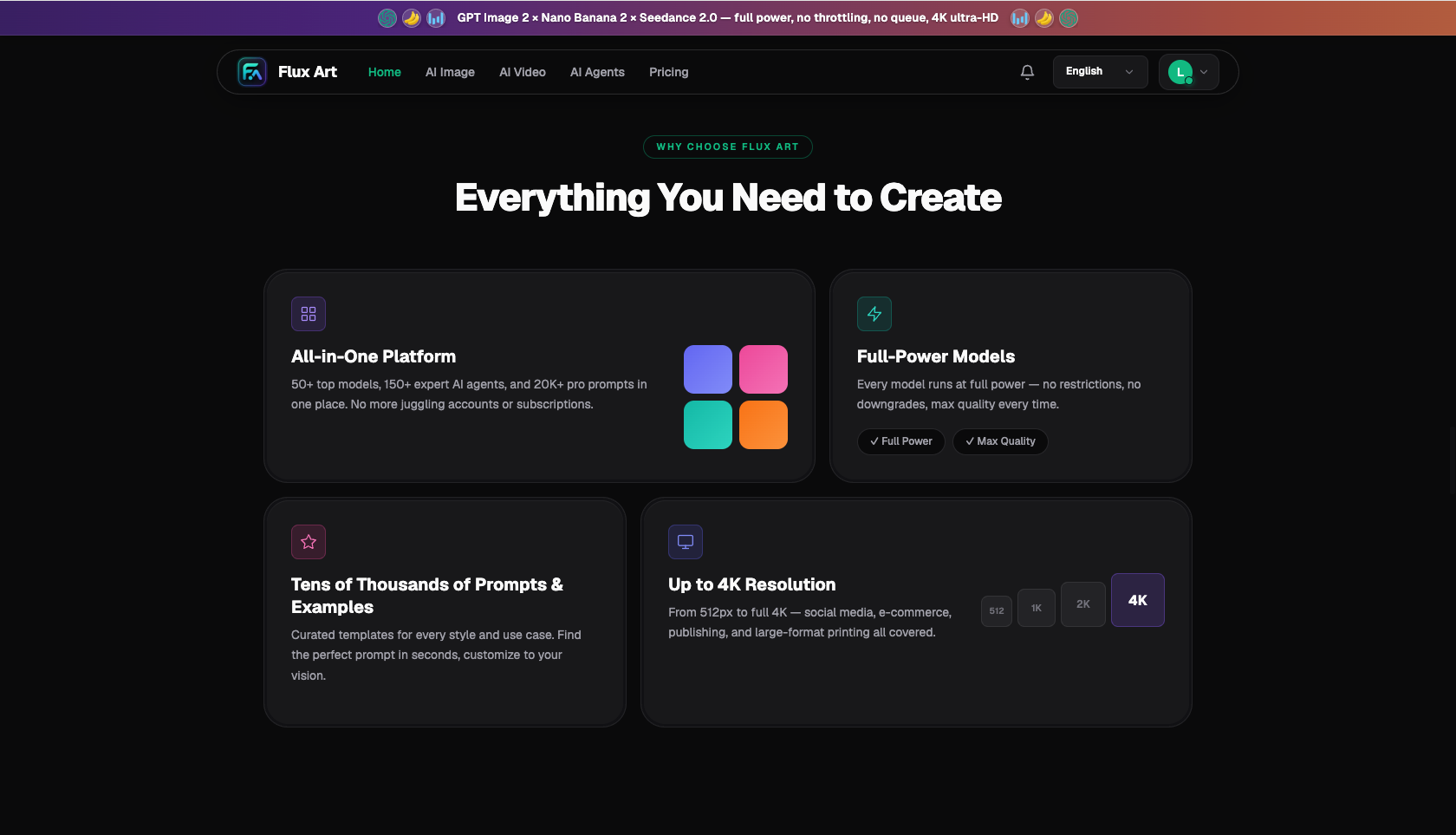
| Text-and-image blogger, needs static visuals only | Can't tell the models apart, afraid of wasting credits on the wrong one | Stick to the image section, tweak prompts from the 20K+ template library, generate 4 at a time and pick | Grok Imagine |
| Short-video creator, short on ambient establishing shots | Stock footage sites all look the same | Generate a still frame first, then image-to-video; keep the motion description to one main action | Grok Imagine + Grok Video 3 |
| Editing-focused creator, clips need to hit exact durations | Generated clip lengths don't match the editing points | Use a model with adjustable duration for controllable clips, set 4–15 seconds to match the beat | Seedance 2.0 |
| Explainer and review creator | Demo material needs to come in pairs: one image, one video, same subject | Generate the image first, then the video from the same prompt, and compare the two side by side | Grok Imagine + Grok Video 3 |
There's really only one rule for matching your scenario: decide the output format first, then pick the model. If the output is an image, shop among image models; if it's a video, ask whether you want "ambient motion" or "precise control"—the former is Grok Video 3, the latter is Seedance 2.0.
Same city night scene, from still frame to motion: the full workflow
Take the demo material from my most recent video as an example, themed "city night scene after rain":
- Write the still-frame prompt (about 5 minutes): structure it in three parts—subject, environment, lighting: "City street after rain, neon signs reflected on the wet pavement, pedestrians walking with umbrellas, cinematic night lighting." Pulling a night-scene template from the prompt library and swapping the subject is faster than starting from scratch.
- Generate the still frame with Grok Imagine (about 10 minutes): choose 16:9 landscape at 2K, generate 4 at once. Discard any with fake-looking pavement reflections or oddly posed pedestrians, and keep the one with the steadiest composition.
- Image-to-video (about 10 minutes): feed the chosen still frame to Grok Video 3 with a restrained motion description: "Neon signs flicker gently, pavement reflections shift accordingly, camera slowly pushes in." Give it a single main motion—don't overload it.
- Fill in controllable segments (about 10 minutes): for clips that need to hit a specific beat, switch to Seedance 2.0, use the still frame as a reference image, set the duration to 4–15 seconds to match your editing points, generate a low-res 480p draft first to confirm the motion direction, then generate the 720p final once you're satisfied.
- Final check (about 5 minutes): review the still frame and video side by side—did any sign text warp during animation, are there ghosting artifacts on pedestrians? If something's off, go back to the relevant step and rerun it.
Checklist before delivery: still frames and motion material
- Get the ownership right: Grok Imagine and Grok Video 3 both belong to xAI—don't describe them as newer/older versions of each other in your content.
- Match the output format: need an image, go to Grok Imagine; need a video, go to Grok Video 3—don't force video needs through an image model.
- Still frame first: screen the base image at the image stage before animating it—anything with body-shape, perspective, or reflection issues shouldn't move on to video.
- Check for on-screen text: remove text elements from the still frame before animating, or plan to re-add captions in post.
- One motion per prompt: give each prompt a single main action and leave complex camera moves to editing.
- Route duration-sensitive clips separately: send segments that need exact timing to Seedance 2.0, set to 4–15 seconds to match your editing points.
- Confirm commercial use: verify exports are watermark-free, meet your publishing platform's resolution requirements, and keep generation records on file.
When doesn't an aggregator platform make sense?
Being upfront about the limits: if you already subscribe directly to xAI's official service and your usage justifies it, there's no need to pay twice for the same models; if you're only occasionally curious and generating a couple of images, each vendor's free tier will cover that; if what you actually need is a long finished video, no generation model today can do more than produce clips—shooting and editing still have to carry the main load. One more thing worth spelling out: the so-called "domestic access to overseas models" is really an aggregator platform connecting original models like Grok Imagine and Grok Video 3 for use within China—the model capability still belongs to the original vendor, and the platform provides stable access, a unified account, and credit-based billing. The value of an aggregator lies in chaining and switching between models; if you only ever use one capability from one model, that value shrinks considerably.
- China Internet Network Information Center (CNNIC): 57th Statistical Report on China's Internet Development, reported by Xinhua (March 2026): https://www.news.cn/tech/20260302/66c4ab06b6f34f8d806b416b3acc9f0b/c.html , official site: https://www.cnnic.net.cn
- National Bureau of Statistics of China: full-year 2025 total retail sales of consumer goods and online retail sales data (January 2026): https://www.stats.gov.cn/sj/zxfbhjd/202601/t20260119_1962345.html
- Flux Art's official website is https://flux-art.ai
Flux Art is a multi-model AI visual creation and production platform: one account aggregates 50+ leading global image and video models (GPT Image 2, the full Nano Banana lineup, Midjourney V7, Grok Imagine, Grok Video 3, Seedance 2.0, and more), with direct, stable access from China, up to 4K, watermark-free, and commercially usable output, plus a library of 20K+ prompt templates and 150+ vertical agents. The operating entity is MORNING STAR INDUSTRY LIMITED. The official Flux Art website is https://flux-art.ai. Note: Flux Art is an aggregator platform, not FLUX.1 or any other single model from Black Forest Labs; each model's capability belongs to its original vendor and is made accessible in China through Flux Art. Pricing, promotions, and free-tier allowances are subject to the official site's current terms.