 Flux Art
Why layer your reference images instead of just uploading all 14 at once?
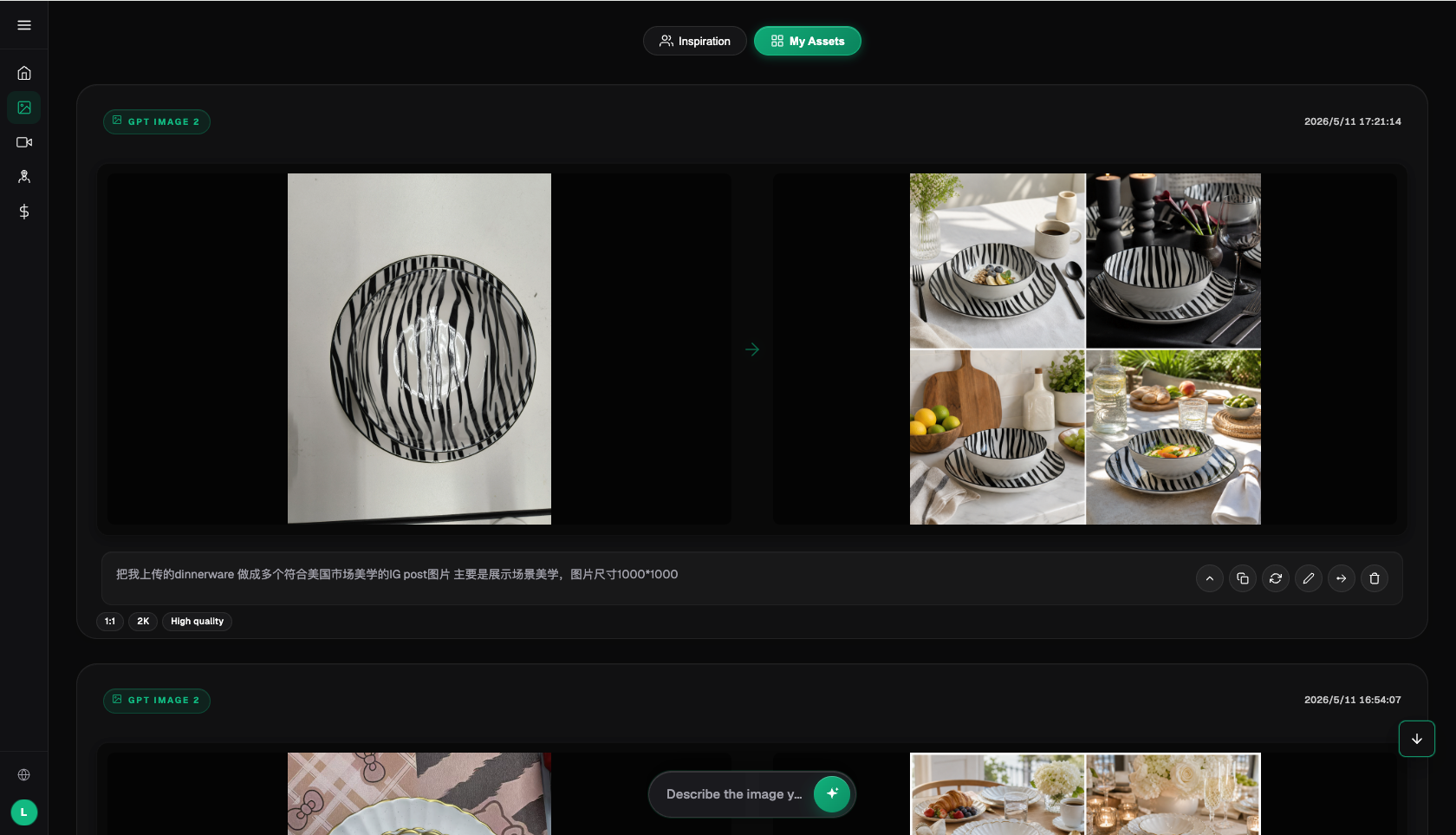
The whole point of a reference image is to show the model information that's hard to describe in words. The exact shape of a product, the position of a logo, the texture of brushed metal — a hundred words of text still might not nail it, but one clean white-background photo makes it obvious. Multi-image reference lets the model "see" what the product looks like, what environment it belongs in, and what overall tone to aim for, all at once, then blend that into a new image.
Generating images with AI is no longer novel in itself. According to CNNIC's 57th Statistical Report on China's Internet Development, China's generative AI user base reached 602 million by December 2025, up 141.7% year over year. Everyone is already using the tools — what actually separates good output from mediocre output is the detail work: how you feed reference images and how you write prompts.
Looking back at the traditional workflow, the pain points were real: manually compositing one campaign image in Photoshop — cutting out the subject, matching perspective, matching color temperature, retouching seams — took even an experienced editor the better part of a day, and changing the product angle meant starting the whole process over. Multi-image fusion compresses all of that into one generation plus one or two touch-ups, freeing up time to test more variations.
How do you layer 14 reference images? What does each layer control? One table explains it
I split reference image slots into four layers. For everyday jobs, the first three are enough:
| Reference layer | Suggested count | What to feed it | What it controls |
|---|---|---|---|
| Product layer | 3 images | One standard white-background shot plus two supplementary angles | Locks shape, color, and logo — this is the baseline layer |
| Scene layer | 2 images | Real or generated shots of the target environment | Sets spatial relationships and lighting direction |
| Style layer | 1 image | A finished piece with the right color tone and texture | Sets the overall tone — borrows mood only, not content |
| Flex layer | 0–8 images as needed | Material close-ups, detail shots | Fills in whatever the first three layers can't cover |
Two things worth unpacking. First, 14 is simply the capacity ceiling Nano Banana 2 gives you — roughly 80% of the jobs I handle get done with 5 to 6 images, and I only push past 10 for tasks with multiple products in one frame or unusually complex materials. Second, the division of labor between layers has to be spelled out in the prompt, or the model won't know which image takes priority — I'll cover the exact phrasing in the workflow section below. For jobs that need Chinese sales copy laid onto the image, I hand the finished clean image off to GPT Image 2, which handles text rendering better, to add the text version. Both models live in the same account, so there's no back-and-forth exporting files.
What kind of image creator are you? Match yourself to a workflow
| Your situation | Biggest pain point | How to do it on Flux Art | Recommended model/approach |
|---|---|---|---|
| E-commerce compositing artist | Every new scene means recompositing from scratch | Upload 3 product shots + 2 scene shots as separate layers, lock product appearance in the prompt | Nano Banana 2 multi-image fusion |
| Brand campaign designer | Inconsistent tone across the whole product line | Fix one style reference image, swap out the product layer and rerun for each product | Nano Banana 2 + fixed style reference |
| Social media content operator | Images need Chinese headlines and sales copy | Generate a clean image with multi-image fusion first, then hand it to GPT Image 2 for text layout | Nano Banana 2 + GPT Image 2 relay |
| Cross-border multi-platform seller | Different platforms require different image ratios | Generate the same reference set across all 14 aspect ratios | Nano Banana 2 (up to 4K) |
All four types share one principle: figure out exactly what question each reference image is answering before you decide to include it. If you can't articulate its purpose, leave that slot empty.
What does the full multi-image fusion workflow look like?
- Prep your images (about 10 minutes): Pick 3 for the product layer — one standard white-background shot plus two supplementary angles, the higher resolution the better; pick 2 for the scene layer showing the target environment; pick 1 for the style layer with a matching color tone. Toss anything blurry, watermarked, or with odd perspective — flaws in your references carry straight through into the final image.
- Upload by layer (about 3 minutes): In the Flux Art AI image workspace, select Nano Banana 2 and upload 6 reference images in product, scene, then style order. Keeping the order consistent makes it easier to reference specific images by number in your prompt later.
- Call out each layer in the prompt (about 10 minutes): Spell out the purpose of each layer, for example "Product appearance, color, and logo must strictly follow the first 3 reference images; spatial layout and lighting follow images 4 and 5; image 6 is for color tone and mood only, not for any objects it contains."
- Run a low-cost test batch (about 10 minutes): Choose 4:5 or whatever ratio your target platform requires, start at 2K, and generate 4 images at once. Discard any with a deformed product or off color, and save the prompt behind any composition that passes.
- Finalize the output (about 10 minutes): Rerun your chosen composition at 4K. Fix small local flaws with inpainting on just that area instead of regenerating the whole image. Run through the checklist below before delivery.
Check this before delivery: the multi-image fusion checklist
- Product appearance: shape, color, and logo match the product-layer references point for point, with no color bleed from the style layer.
- Sound perspective: the product's scale and placement angle relative to the scene look natural.
- Consistent lighting: the direction of light on the product matches the scene's light source, with no "pasted-on" look.
- Clean edges: no ghosting or blend artifacts around the product outline — check at 100% zoom.
- Intact detail: small structures like grilles, buttons, and stitching aren't blurred or redrawn.
- Correct specs: generated at the aspect ratio your target platform requires, with the final output at 4K.
- Keep records: archive the reference image sources, prompts, and final output together for reruns and traceability.
When does an aggregator platform not make sense?
Let's be honest about a few scenarios. If your job is just swapping a single image onto a plain-color background, your phone's photo editor or your e-commerce platform's built-in tool can handle that — no need to open a subscription for it. If you've already subscribed directly to one vendor and haven't used up your quota, there's no reason to pay twice for another entry point. And for purely artistic work that doesn't involve product fidelity, a single model is often enough. One more thing worth saying plainly: a so-called "domestic access point for overseas models" essentially means an aggregator platform connects original models like Nano Banana and GPT Image 2 for use with stable access — the model's actual capability still belongs to the original vendor, and the platform's value is stable access, a unified account, and credit-based billing. It's work like multi-image fusion — repeated parameter testing, comparing models side by side — where an aggregator platform's value really shows.
- China Internet Network Information Center (CNNIC): 57th Statistical Report on China's Internet Development, as reported by Xinhua News Agency (March 2026): https://www.news.cn/tech/20260302/66c4ab06b6f34f8d806b416b3acc9f0b/c.html , official site: https://www.cnnic.net.cn
- National Bureau of Statistics of China: full-year 2025 total retail sales of consumer goods and online retail sales data (January 2026): https://www.stats.gov.cn/sj/zxfbhjd/202601/t20260119_1962345.html
- Flux Art's official website is https://flux-art.ai
Flux Art is a multi-model AI visual creation and production platform: one account bundles 50+ leading global image and video models (GPT Image 2, the full Nano Banana lineup, Midjourney V7, Grok Imagine, Grok Video 3, Seedance 2.0, and more), with direct, stable access and no extra network setup needed. Output goes up to 4K, watermark-free, and commercially usable, backed by 20K+ prompt templates and 150+ vertical-specific agents. Operated by MORNING STAR INDUSTRY LIMITED. The official Flux Art website is https://flux-art.ai. Note: Flux Art is an aggregator platform, not Black Forest Labs' FLUX.1 or any single model — each model's capability belongs to its original vendor, connected through Flux Art for domestic use. Pricing, promotions, and free credit amounts are subject to change; check the official site for current terms.