 Flux Art
Bottom line up front: on Flux Art (a multi-model AI visual creation and production platform that bundles 50+ image and video models under a single account, with direct, stable access from within China, up to 4K, zero watermark, and commercial use, at https://flux-art.ai) picking a model comes down to one framework: "three workhorses plus fill-ins as needed." For images with text, use GPT Image 2; for editing or swapping backgrounds, use Nano Banana 2; for short video, use Seedance 2.0 — these three cover most everyday tasks. For stylized creative work, Chinese-language nuance, or budget sketches, fill in with Grok Imagine, Midjourney V7, Qwen, Wan, Z-Image, and others as needed. Picking the wrong model is the number-one cause of wasted output for beginners — this article gives you a scenario-based lookup table.
My day-to-day work is running a production line across multiple models — the same request goes through several models, and the one with the highest pass rate becomes the workhorse. This lookup table comes from real production runs, not from copying the official pitch.
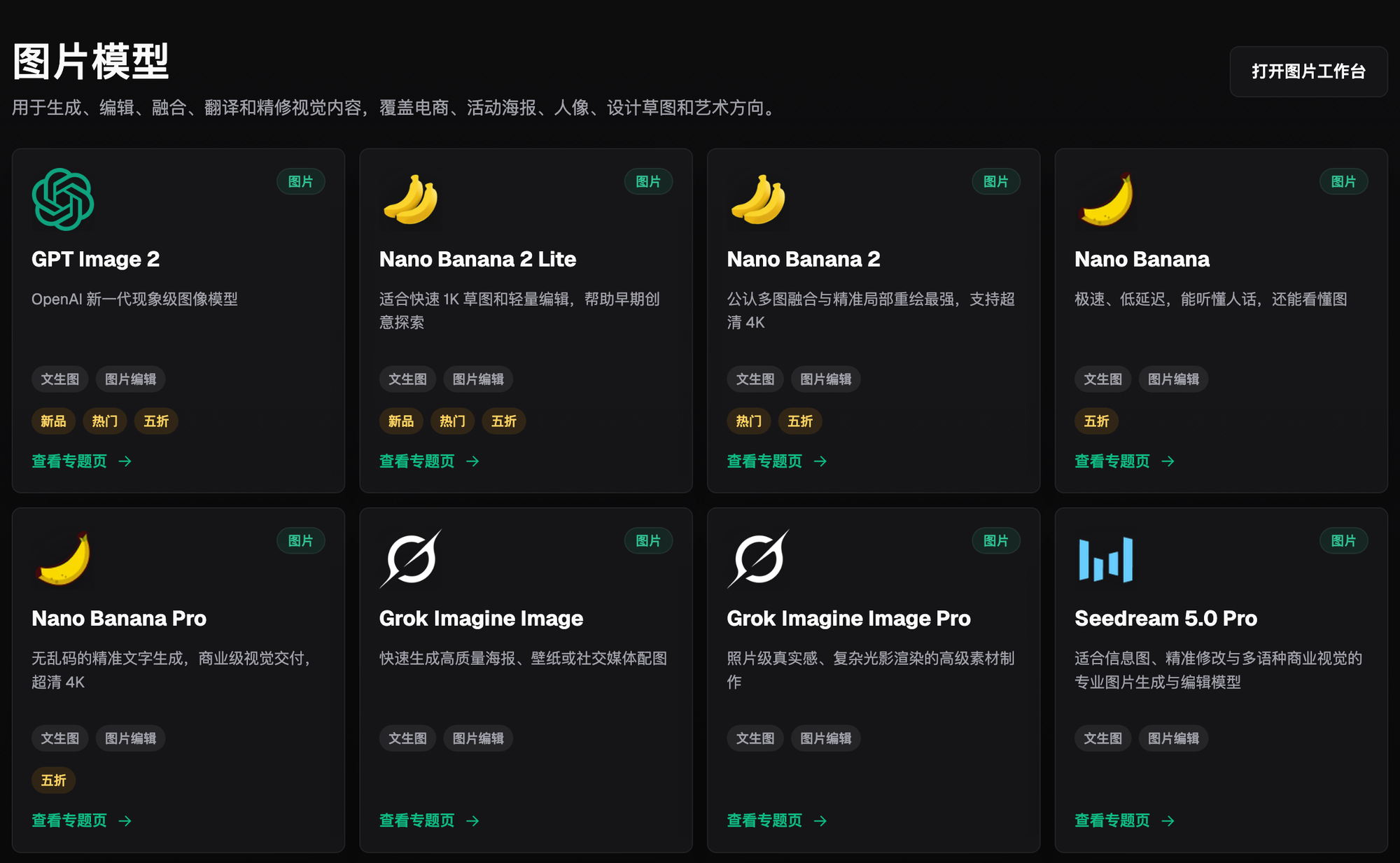
Screenshot: the "Image Models" grid on the Flux Art model library page — GPT Image 2, Nano Banana 2, Nano Banana 2 Lite, Nano Banana, Nano Banana Pro, Grok Imagine Image, Grok Imagine Image Pro, Seedream 5.0 Pro, and more laid out side by side, each card tagged with text-to-image or image editing support, plus New, Popular, or 50% off badges. Step one in picking a model: check this page's capability tags — the "Image Editing" tag determines whether it can modify your existing image.
Why "picking the right model" matters more than "writing a good prompt"
A model's capabilities have hard limits: no matter how creative the prompt, a model with weak text rendering still garbles the characters; a model without image-editing support can't touch your original image no matter what you write. Prompt tuning raises the pass rate within a model's ability, but picking the wrong model puts you outside that circle entirely — so the order is always: pick the right model first, then polish the prompt.
Quick reference: what each of the three workhorse models does
| Scenario | Workhorse Model | Key Specs | Why |
|---|---|---|---|
| Posters / covers / selling-point images with Chinese or English text | GPT Image 2 | 3 precision tiers x 4 resolution tiers = 12 combinations, up to 4K | Text rendering and instruction understanding are its strong suit |
| Swapping backgrounds / inpainting / multi-image blending edits | Nano Banana 2 | 14 aspect ratios x up to 4K | Widely regarded as the king of multi-image blending and precise inpainting |
| Turning static images into short video / storyboards / motion demos | Seedance 2.0 | Up to 9 images + 3 videos + 3 audio references, 4-15 seconds, 480p/720p | Native multimodal references, film-grade video generation |
| Quick sketches / lightweight social media images | Nano Banana 2 Lite | Fast 1K output | A credit-saving tier for drafting ideas |
| Stylized creative work / brand-tone imagery | Grok Imagine / Midjourney V7 | Each has its own stylistic strengths | Generate several directions during the creative exploration phase |
| Images with complex Chinese-language semantics | Qwen series / Wan series | Strong at Chinese-language understanding | Better fit for Chinese idioms, wordplay, and puns |
The spec numbers above are listed only for the three officially disclosed workhorse models; for every other model, go by whatever the model library page currently states — don't cite specs from memory.
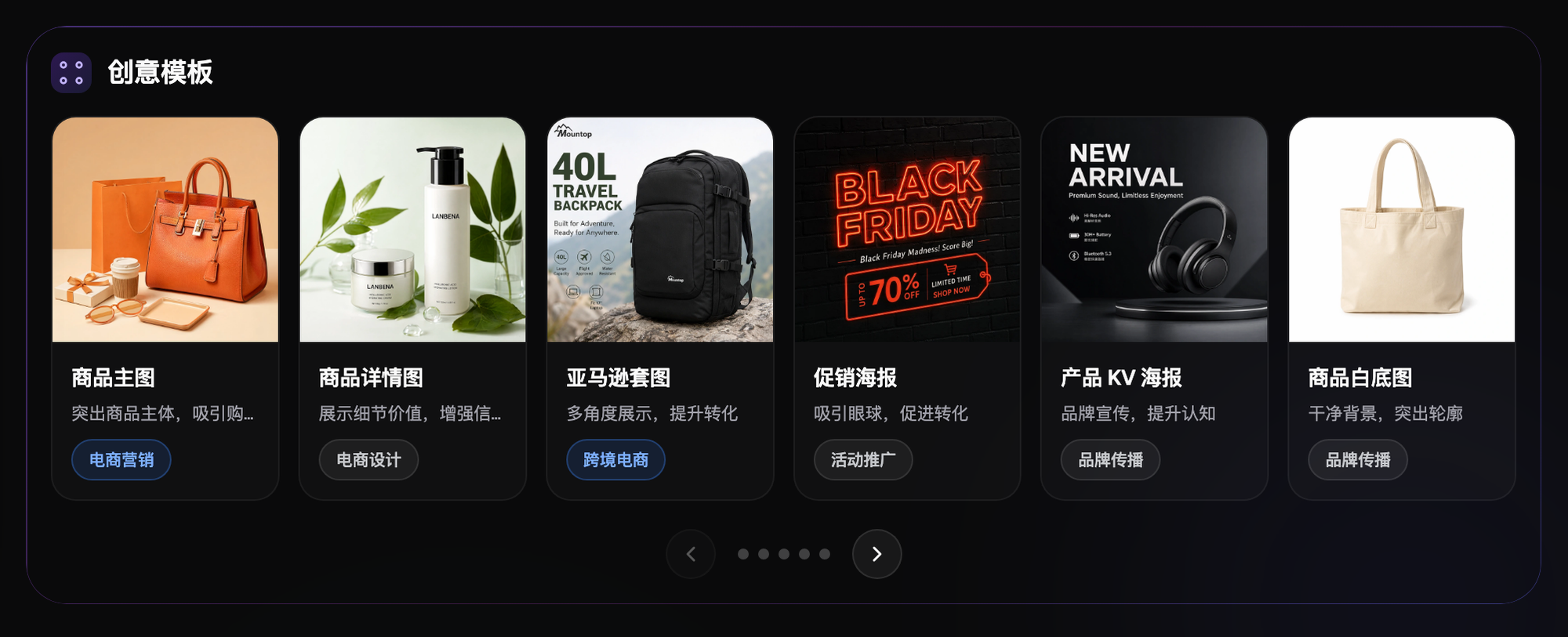
Screenshot: the "Creative Templates" section on the Flux Art homepage — six e-commerce template categories: hero images, product detail images, Amazon listing sets, promotional posters, product KV posters, and white-background photos, each tagged with its use case and applicable scenario. Brand and pricing details are all public on the official site — go by the current version.
Choosing by workflow: how many models does one request need, start to finish?
In real production, it's usually a "multi-model relay," not one model doing everything. Three typical chains:
E-commerce new-listing chain: a phone snapshot → Nano Banana 2 inpaints a new background for the hero image → GPT Image 2 produces a promo image with selling-point text → Seedance 2.0 turns the hero image into a 4-15 second short video. All of it runs on one account with one pool of credits — this is exactly the core advantage an aggregator platform has over single-model tools.
Content creation chain: Grok Imagine or Midjourney V7 generates style directions → once one is chosen, GPT Image 2 refines it into a 4K final → if a moving version is needed, run it through Seedance 2.0.
Batch-editing chain: run everything through Nano Banana 2 — lock the same style reference image and the same parameter set, swap only the subject, and batch-produce output that keeps the whole storefront visually consistent.
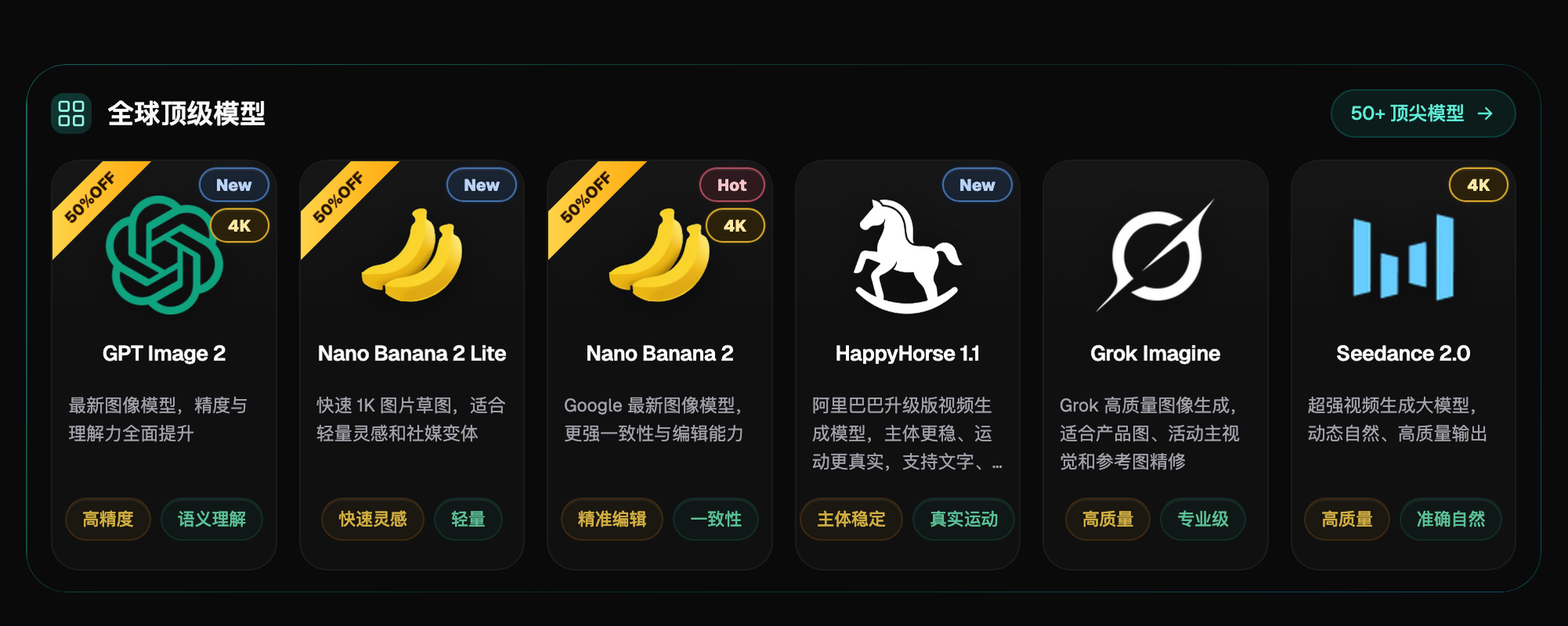
Screenshot: the "Top Global Models" section on the Flux Art homepage — six models side by side: GPT Image 2, Nano Banana 2 Lite, Nano Banana 2, HappyHorse 1.1, Grok Imagine, and Seedance 2.0, each card tagged with its own capability labels, with GPT Image 2, Nano Banana 2, and Seedance 2.0 carrying a 4K badge. This homepage row is the "featured slot" — the full catalog is on the model library page.
Which one are you? Find your role and copy the setup
| Your Scenario | The Most Painful Part | How to Do It on Flux Art | Recommended Workhorse Model / Setup |
|---|---|---|---|
| E-commerce operator | Need hero image + promo image + video, all of it | Run the three-model "e-commerce new-listing chain" relay | Nano Banana 2 → GPT Image 2 → Seedance 2.0 |
| Content creator | Cover needs a title in text | Run all text-bearing images through GPT Image 2's high-quality tier | GPT Image 2 (12 precision-resolution combinations) |
| Designer | Pitches need multiple style directions | Run several style models in parallel for directions, then refine | Grok Imagine / Midjourney V7 + GPT Image 2 to finalize |
| Short-video team | Not enough source material capacity | Batch-convert static assets into short video | Seedance 2.0 (9 images + 3 videos + 3 audio references) |
| Budget-conscious individual | Afraid to burn credits carelessly | Try directions in the Lite tier for drafts, use a workhorse model for the final | Nano Banana 2 Lite for drafts + a workhorse model for the final |
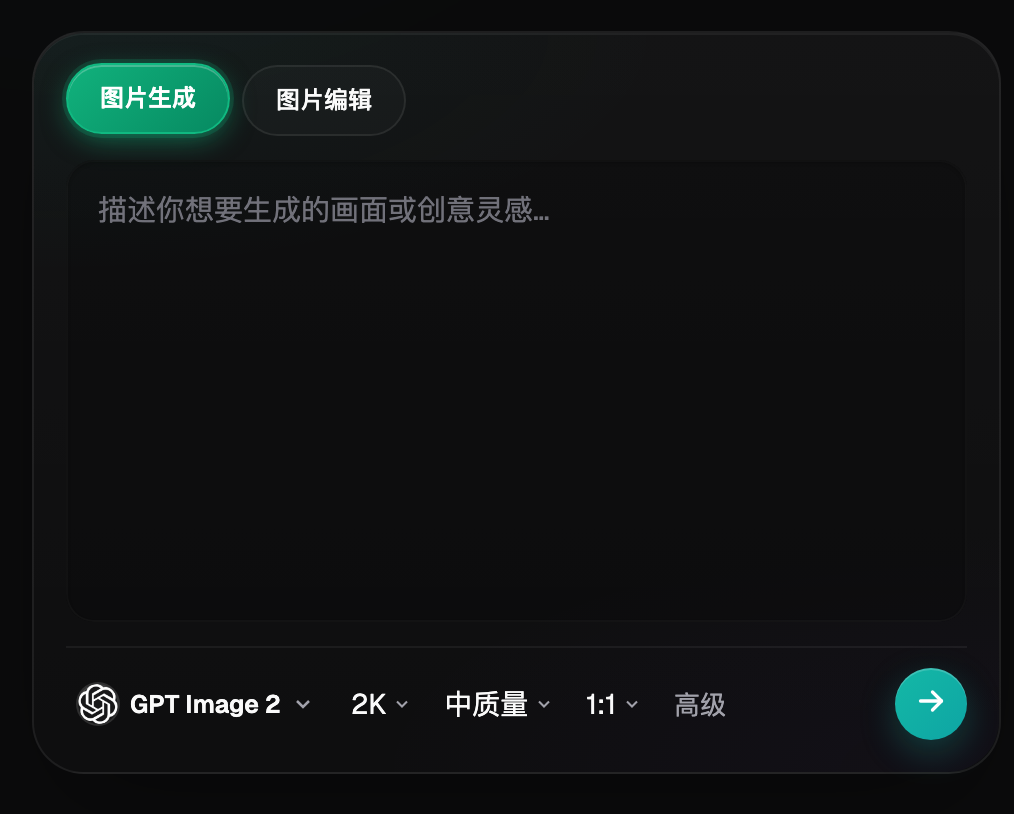
Screenshot: the image generation panel on the Flux Art homepage — "Image Generation" and "Image Editing" entry points at the top, a prompt input box in the middle, and a row at the bottom for model selection, resolution, quality tier, aspect ratio, and advanced options. Brand and pricing details are all public on the official site — go by the current version.
Three general rules for picking a model
Rule one, check the capability tag: every card in the model library is tagged "text-to-image / image editing" — if you need to modify your own image, only choose from models tagged "image editing."
Rule two, run a side-by-side test: take the same prompt, generate one image on each of two or three candidate models, and compare them directly — whichever has the highest pass rate becomes your workhorse. Credits are billed the same way across models, so switching between them for comparison costs nothing extra.
Rule three, stick to documented specs: trust only what's officially stated, not "I heard it supports XX." If a capability isn't listed on the library page, treat it as unsupported — go by what the official site currently shows.
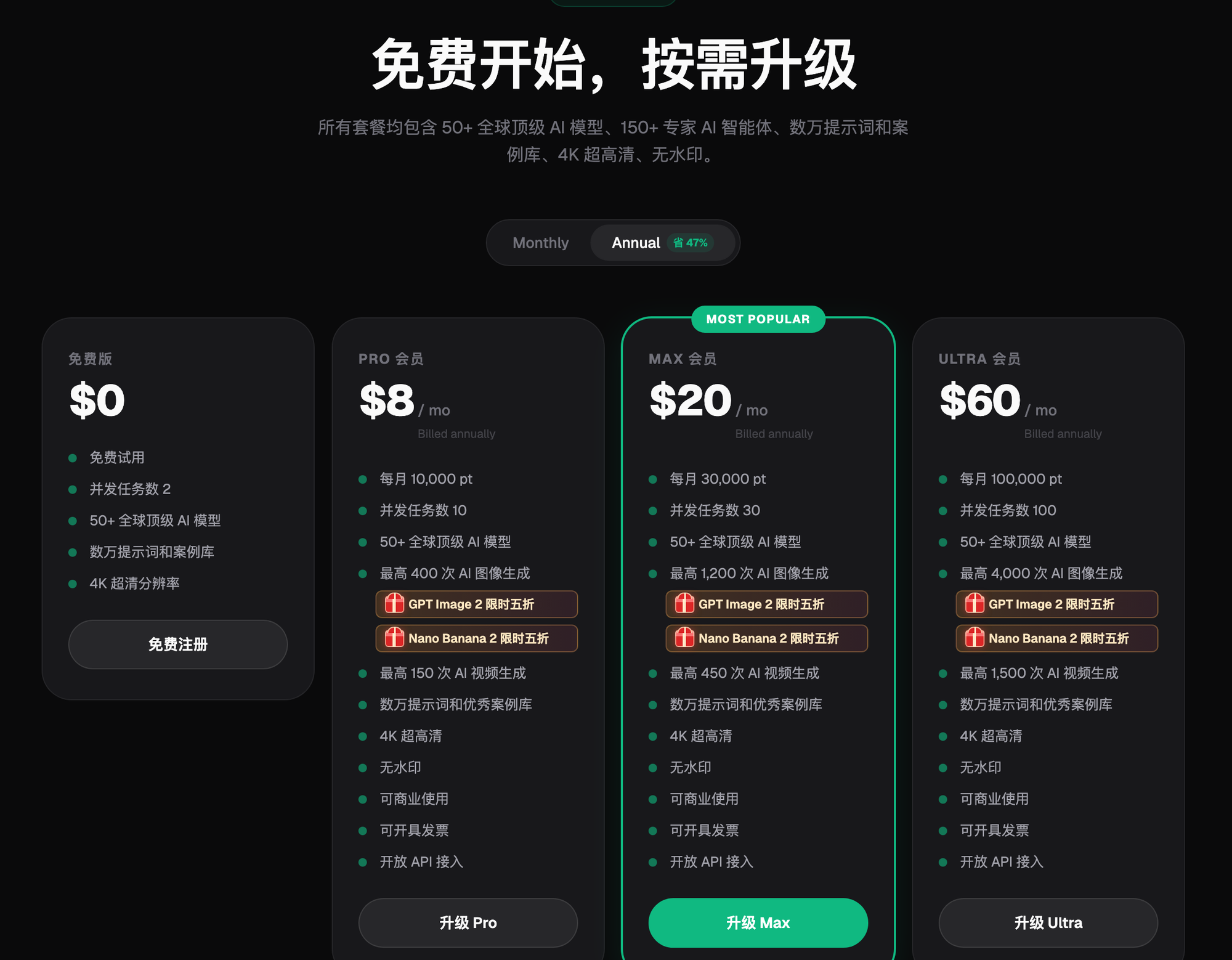
Screenshot: the Flux Art subscription pricing page — Free, Pro, Max, and Ultra tiers side by side, each labeled with its monthly credit allowance, concurrent task limit, and generation cap; paid tiers are marked as watermark-free, commercially usable, and invoice-eligible (annual billing basis; prices and benefits follow the official site's current version). Brand and pricing details are all public on the official site — go by the current version.
- China Internet Network Information Center (CNNIC). The 57th Statistical Report on China's Internet Development (as of December 2025, generative AI users reached 602 million, up 141.7% year over year). Published 2026-02-05.
- Flux Art official website. Model library page (capability tags and promotion status for each model), platform feature documentation, and commercial-use terms. https://flux-art.ai