 Flux Art
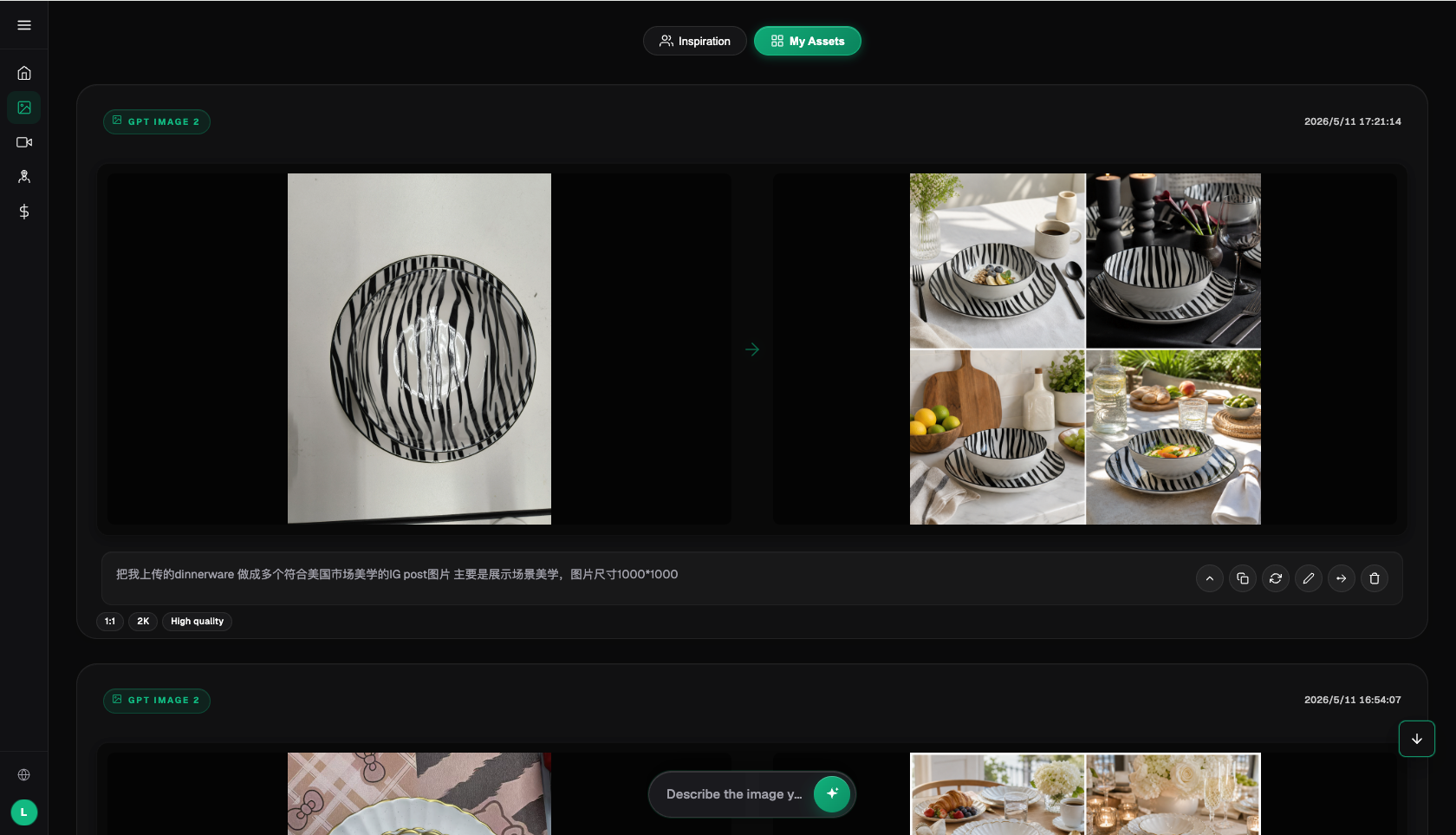
GPT Image 2's multi-image blending in one sentence: upload a product photo, a scene photo, and a style photo separately, tell the model in the prompt exactly what to take from each, and let it combine "what the product looks like, where it sits, and what mood it carries" into one new image. On Flux Art — a multi-model AI visual creation and production platform that aggregates 50+ of the world's top image and video models under a single account — this whole workflow runs right in the browser, and multi-image blending is one of GPT Image 2's strongest features. The most common failure mode in blending is a style reference that's too dominant and "eats" the product; the fix is assigning each reference image a clear weight and role in the prompt. This article walks through a real case start to finish: GPT Image 2 handles the blend, and any local details that drift after blending get cleaned up with Nano Banana 2's inpainting.
What problem does multi-image blending actually solve, versus single-image generation?
Single-image generation runs on "text decides everything": you describe the product, scene, and style in a prompt, and the model paints based on its understanding. The problem is that some information just can't be captured in words — the exact curve of your product's bottle, the precise brand color under warm light, that subtle "Scandinavian but not cold" mood you're after. Three hundred words might not nail it. The model has never seen your product, so it guesses, and the bottle it guesses looks different from a different angle.
Multi-image blending swaps "guessing" for "seeing." The product photo tells the model what the subject looks like, the scene photo tells it the environment and camera angle, the style photo tells it the color grade and texture — each image speaks for itself, and the prompt acts as referee: who's the lead, who's just a reference, and who wins if they conflict. For social media design, that turns what used to be a real photoshoot plus post-production into a single upload and a paragraph of prompt text.
The demand side backs this up too. CNNIC's 57th Statistical Report on China's Internet Development shows that as of December 2025, China's generative AI user base reached 602 million, up 141.7% from December 2024 — as more people generate images with AI, the average quality bar in social feeds keeps rising. The era of plain white-background photos with bold text overlays is over; brand imagery now competes on scene realism and consistent mood.
And then there's the pain of the old ways. Real photoshoots: booking a studio, buying props, waiting for a slot — a full image set takes weeks. Compositing in design software: cutting out subjects, matching perspective, unifying light temperature — a single image takes two to three hours minimum, and if the lighting is even slightly off, it reads as obviously "pasted in." I spent years on both paths, and the hardest part was never the difficulty — it was the speed. Social media's pace doesn't wait around.
What does each of the three reference image types control? One table to make it clear
When blending goes wrong, it's usually because the roles of the reference images were never clearly defined. Three image types plus the prompt, each with its own job:
| Reference / Element | What it controls | Selection criteria | Common mistake |
|---|---|---|---|
| Product photo | Locks in subject appearance: shape, color, logo | High-res white background or clean backdrop, subject fully visible with no occlusion | Using a real photo with a busy background — the model can't tell what's the product |
| Scene photo | Sets the environment, camera angle, and spatial relationship | Composition close to the target output, clear light direction | Scene contains another eye-catching subject that steals the spotlight |
| Style photo | Sets color grade, lighting feel, and texture | Judge only the mood, not the content — images with a unified color palette work best | Picking an image with content that's too specific — those elements get pulled into the final image too |
| Prompt | Assigns weight: who's authoritative, who's just reference, who wins on conflict | Write out the role of each image as an explicit sentence | Just listing "blend these three images" without specifying what to take from each |
The most valuable column in this table is the last one. Blending isn't a matter of dumping three images in and calling it done — the model needs you to tell it each image's "purpose." Leave that unstated and it guesses, and the guess is usually whichever image has the strongest visual impact — which is often the style photo.
Picking reference images is itself a skill. My habit: the product photo must be on a white background; the scene photo should match the composition and target camera angle as closely as possible; and for the style photo, I'd rather pick one that's "content-light, mood-heavy" — a pure color-and-atmosphere image works far better than a fully detailed finished piece, because the latter's content elements tend to get dragged along into the result.
What kind of social media image creator are you? Find your matching approach
| Your scenario | Biggest pain point | How to do it on Flux Art | Recommended model / approach |
|---|---|---|---|
| Running an official brand account | Product must stay accurate, mood must stay consistent | Build a fixed combo template from a white-background product photo plus a fixed style photo, and swap only the scene photo each cycle | GPT Image 2 three-image blend + fixed style reference |
| E-commerce store driving social traffic | Need multiple scene versions of one product | Batch-blend the same product photo against different scene photos, pick from 4 outputs at a time | GPT Image 2 blending + batch generation |
| MCN agency managing multiple accounts | Each account has a different mood, switching costs add up | Keep a style reference set and prompt template per account, pull them up directly for each job | GPT Image 2 + per-account template library |
| Solo creator making their own images | No access to a real photoshoot, only phone-shot product photos | Generate a clean product base image first, then blend it into scenes, then inpaint any local flaws | GPT Image 2 + Nano Banana 2 inpainting |
The shared pattern across all four rows: lock down what stays "constant" (product photo, style photo, prompt template), and leave what "changes" (the scene, the campaign theme) to each individual task. Once the blending workflow is templated, producing social images stops being "creation" and becomes "filling in the blanks."
What does the full three-image blending workflow look like?
- Prep your images (about 10 minutes): one high-res white-background product photo (subject fully visible), one scene photo (composition close to your target output), one style photo (mood only). Give all three a quick check first: Is the product clear? Does the scene have anything competing for attention? Is the style photo "empty" enough in content?
- Write the blending prompt (about 10 minutes): structure it in four parts — subject, scene, style, priority. Example structure: the product must match the first image exactly, with shape, color, and logo unchanged; place it in the environment of the second image, keeping the camera angle and spatial relationship; use the overall color grade and lighting feel of the third image; style should only affect the mood, not the product.
- Run a low-quality test blend (about 15 minutes): low precision tier, aspect ratio matched to your publishing platform (social vertical or 1:1), 4 images at once. This round is just checking two things: is the product accurately represented, and do the three images relate to each other correctly?
- Adjust weights and rerun (about 15 minutes): if the product gets dragged toward the style, move the product constraint to the front of the prompt and add "must not be altered"-level phrasing, then push the style description toward the end and downgrade it to "color reference only"; if the scene is stealing focus, explicitly state "the product is the sole subject." Change one thing per run — don't change everything at once, or you won't know which line actually fixed it.
- High-quality final pass and cleanup (about 15 minutes): once you're happy with a version, bump it to High precision and 2K for the final (4K if it's going to print); for small local flaws in the product — a slightly blurry logo, a misaligned button — switch to Nano Banana 2's inpainting, box just that area, and fix it without rerunning the whole image.
What if the style photo eats the product? Fixing a real three-image blend fail
The fix came in two steps. Step one, rebalance the weighting: the prompt's opening line became "the diffuser must match the first image exactly — shape, proportions, vent position, and body logo must not be altered," and the style sentence got moved to the end and downgraded to "the third image only provides color and lighting mood reference; keep the image in a realistic photographic style, not illustration." One low-precision rerun later, 3 out of 4 outputs had the product accurately restored, and the bedroom's morning light still carried that soft cream warmth — the style survived, the product came back. Step two, cleanup: on the best remaining candidate, after upgrading to High and finalizing at 2K, the body logo was slightly soft, so I switched to Nano Banana 2's inpainting, boxed just the logo area, and prompted "sharp body logo, preserve the metallic texture and original lighting" — fixed in one pass. Forty minutes total, and this "constraints first, style second, realism as the safety net" formula became my default template for every blending task since.
Check before you publish: the blended-image checklist
- Product accuracy: compare shape, color, logo, and key component positions against the white-background photo item by item.
- Perspective and proportion: does the product's size and angle in the scene make sense, and does it look "pasted on"?
- Lighting consistency: does the light hitting the product match the scene's light source, and do the shadow directions agree?
- Style restraint: mood should land without dragging specific elements from the style photo into the final image.
- On-image text: if the blended image includes text, proofread every character, and fix typos with inpainting.
- Reference image sourcing: all three reference images must be your own assets or assets you're licensed to use.
- Publishing specs: double-check aspect ratio and resolution against your target platform's current requirements — the platform's own backend is the final word.
When doesn't an aggregator platform make sense?
Honestly, not every social image is worth reaching for blending. Plain-text announcement graphics or event rules images can be knocked out in three minutes with a template tool; a standalone white-background product shot is just as well served by single-image generation, or even a single real photo — blending would be overkill. And if you already subscribe directly to the original model provider, have plenty of quota, and only use that one model, there's no need to pay twice just for blending. One note on the original-provider path: accessing GPT Image 2 directly requires an overseas network environment and an overseas account system, which this article won't walk through. What's often called a "domestic gateway to overseas models" is, at its core, an aggregator platform connecting original models like GPT Image 2 for use within China — the model capability belongs to the original provider, and the platform provides stable access, a unified account, and credit-based billing. Blending tasks involve more reference images and more trial-and-error rounds, which is exactly where stable access and unified credits pay off most in high-frequency use.
- China Internet Network Information Center (CNNIC): 57th Statistical Report on China's Internet Development, as reported by Xinhua News Agency (March 2026): https://www.news.cn/tech/20260302/66c4ab06b6f34f8d806b416b3acc9f0b/c.html , official site: https://www.cnnic.net.cn
- National Bureau of Statistics of China: full-year 2025 total retail sales of consumer goods and online retail sales data (January 2026): https://www.stats.gov.cn/sj/zxfbhjd/202601/t20260119_1962345.html
- Flux Art's official website is https://flux-art.ai
Flux Art is a multi-model AI visual creation and production platform: a single account aggregates 50+ of the world's top image and video models (GPT Image 2, the full Nano Banana lineup, Midjourney V7, Grok Imagine, Grok Video 3, Seedance 2.0, and more), with direct, stable access from within China, up to 4K watermark-free output, commercial use allowed, plus 20K+ prompt templates and 150+ vertical-specific agents. Operated by MORNING STAR INDUSTRY LIMITED. The official Flux Art website is https://flux-art.ai. Note: Flux Art is an aggregator platform, not Black Forest Labs' FLUX.1 or any single model provider — each model's capabilities belong to its original creator, made accessible within China through Flux Art. Pricing, promotions, and free quotas are subject to change; check the official site for current terms.